Market Analysis
What We’ll Cover Today
Understanding your market
Analyzing your competitors
Defining target markets
Pricing strategies
Positioning
What We’ll Cover Today
Understanding your market
Analyzing your competitors
Defining target markets
Pricing strategies
Positioning
Questions to ask
 Is your market growing or shrinking?
 Is there room for one more company?
 Will you be bringing something different to
the market?
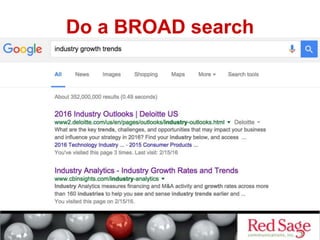
Do a BROAD search
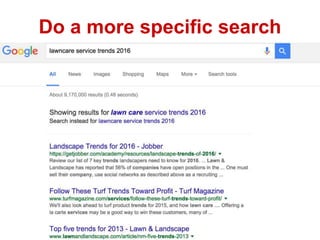
Do a more specific search
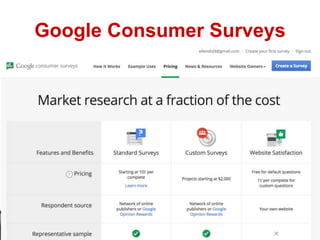
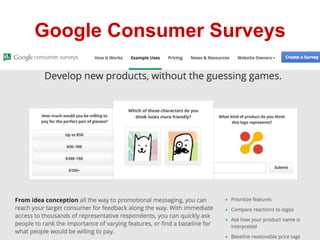
Google Consumer Surveys
What are industry blogs
talking about?
Conduct primary research
Interview potential customers, vendors, association leaders, related businesses
Use your own knowledge of
your industry
Trends?
Pricing?
Competitors?
New technology?
2006 – How I did it then
 Personal knowledge of industry,
competitors and pricing
 I knew website sales would continue
to grow in industry
 I knew I had an innovative product
 I didn’t aim too high
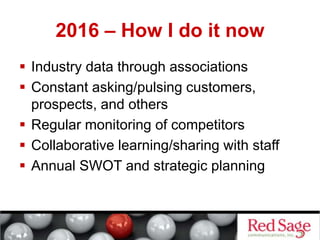
2016 – How I do it now
 Industry data through associations
 Constant asking/pulsing customers,
prospects, and others
 Regular monitoring of competitors
 Collaborative learning/sharing with staff
 Annual SWOT and strategic planning
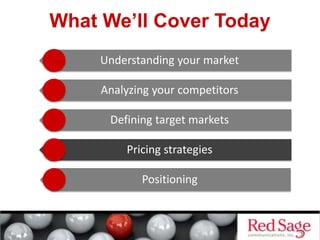
What We’ll Cover Today
Understanding your market
Analyzing your competitors
Defining target markets
Pricing strategies
Positioning
Spy on your competitors:
What do they say about themselves?
How are you different?
Where can you research them?
Websites
Google
Press Releases
Social Media
Networking Events
Ask mutual contacts
The more you understand
your competitors,
the more effectively you can
position your company!
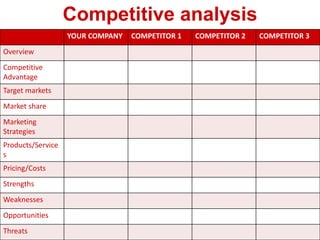
Competitive analysis
YOUR COMPANY COMPETITOR 1 COMPETITOR 2 COMPETITOR 3
Overview
Competitive
Advantage
Target markets
Market share
Marketing
Strategies
Products/Service
s
Pricing/Costs
Strengths
Weaknesses
Opportunities
Threats
What We’ll Cover Today
Understanding your market
Analyzing your competitors
Defining target markets
Pricing strategies
Positioning
Who buys from you?
Do they all look alike?
Or are they all a bit different?
The more you understand
your different target markets,
the better you can structure
your products, services and
marketing efforts.
Target market examples
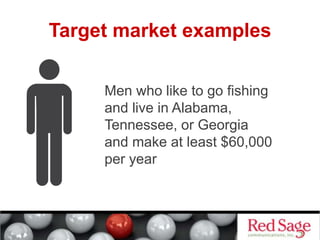
Men who like to go fishing
and live in Alabama,
Tennessee, or Georgia
and make at least $60,000
per year
Target market examples
Women between the ages
of 25 and 65 who live
within 30 miles of Decatur,
Alabama
Target market examples
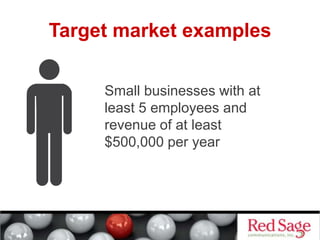
Small businesses with at
least 5 employees and
revenue of at least
$500,000 per year
Target market examples
The HR Directors at major
industries in Decatur such
as BP and 3M
Target market examples
Government Contractors
in Huntsville
Understand the value and potential
of each of your Target Markets.
Which are the easiest to sell to?
Which are the most profitable?
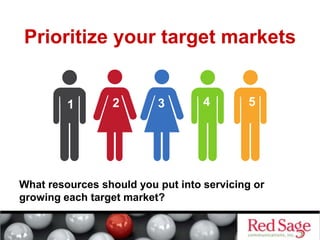
Prioritize your target markets
1 2 3 4 5
What resources should you put into servicing or
growing each target market?
Establishing target markets
is the most efficient way
to maximize your
sales and marketing.
Should your services be packaged or marketed a bit
differently for different markets?
Define your services &
message for each market
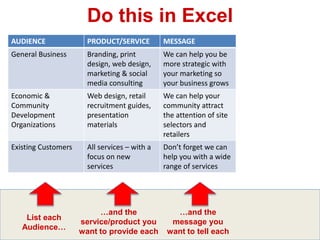
AUDIENCE PRODUCT/SERVICE MESSAGE
General Business Branding, print
design, web design,
marketing & social
media consulting
We can help you be
more strategic with
your marketing so
your business grows
Economic &
Community
Development
Organizations
Web design, retail
recruitment guides,
presentation
materials
We can help your
community attract
the attention of site
selectors and
retailers
Existing Customers All services – with a
focus on new
services
Don’t forget we can
help you with a wide
range of services
List each
Audience…
…and the
service/product you
want to provide each
…and the
message you
want to tell each
Do this in Excel
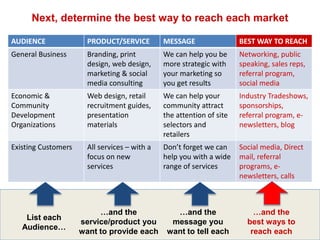
AUDIENCE PRODUCT/SERVICE MESSAGE BEST WAY TO REACH
General Business Branding, print
design, web design,
marketing & social
media consulting
We can help you be
more strategic with
your marketing so
you get results
Networking, public
speaking, sales reps,
referral program,
social media
Economic &
Community
Development
Organizations
Web design, retail
recruitment guides,
presentation
materials
We can help your
community attract
the attention of site
selectors and
retailers
Industry Tradeshows,
sponsorships,
referral program, e-
newsletters, blog
Existing Customers All services – with a
focus on new
services
Don’t forget we can
help you with a wide
range of services
Social media, Direct
mail, referral
programs, e-
newsletters, calls
List each
Audience…
…and the
service/product you
want to provide each
…and the
message you
want to tell each
…and the
best ways to
reach each
Next, determine the best way to reach each market
Research your options
 Are there industry associations that allow
networking, tradeshows or advertising?
 What local events do women go to and
what local groups do they belong to?
 What magazines or newspapers do my
customers read?
 What websites do my customers visit?
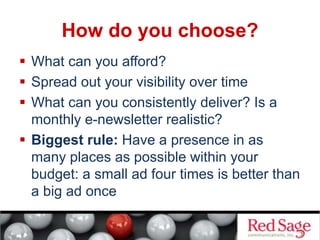
How do you choose?
 What can you afford?
 Spread out your visibility over time
 What can you consistently deliver? Is a
monthly e-newsletter realistic?
 Biggest rule: Have a presence in as
many places as possible within your
budget: a small ad four times is better than
a big ad once
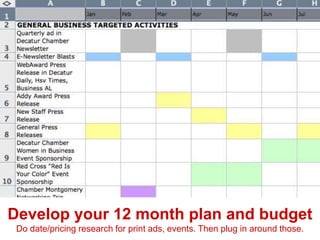
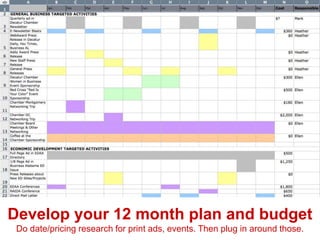
Develop your 12 month plan and budget
Do date/pricing research for print ads, events. Then plug in around those.
Develop your 12 month plan and budget
Do date/pricing research for print ads, events. Then plug in around those.
Build in Structure and
Accountability with Monthly
Marketing Meetings
 What happened last month? Did it yield results?
Should we do anything different?
 What is coming up? What do we need to
prepare?
 Anything anyone is seeing in the industry as an
opportunity or threat?
 Any customer feedback on products or services?
How I identified my
target markets
- then and now -
What We’ll Cover Today
Understanding your market
Analyzing your competitors
Defining target markets
Pricing strategies
Positioning
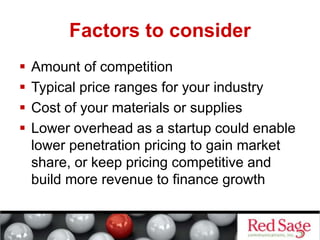
Factors to consider
 Amount of competition
 Typical price ranges for your industry
 Cost of your materials or supplies
 Lower overhead as a startup could enable
lower penetration pricing to gain market
share, or keep pricing competitive and
build more revenue to finance growth
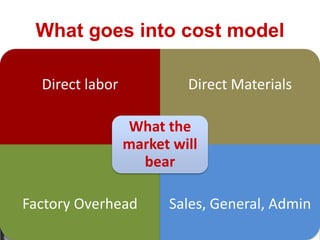
What goes into cost model
Direct labor Direct Materials
Factory Overhead Sales, General, Admin
What the
market will
bear
2006 – How I did it then
 I knew most industry pricing
 I belonged to an industry that provided
annual pricing surveys by market size and
size of agency
 I knew what the market would bear
 I used standard pricing out the gate for
design, penetration pricing for web.
2016 – How I do it now
All of the above plus
 Direct analysis of all rates and pricing
based on current data
 Adjustments based on internal analysis of
profitability by service and industry + what
the market will bear
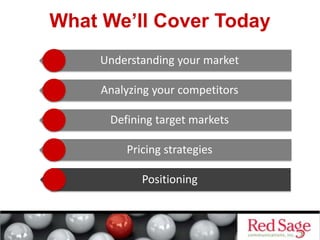
What We’ll Cover Today
Understanding your market
Analyzing your competitors
Defining target markets
Pricing strategies
Positioning
How can you differentiate to stand
out in your markets?
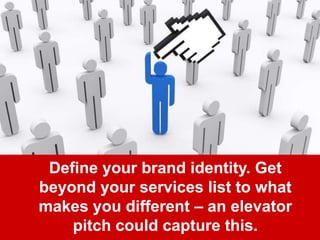
Define your brand identity. Get
beyond your services list to what
makes you different – an elevator
pitch could capture this.
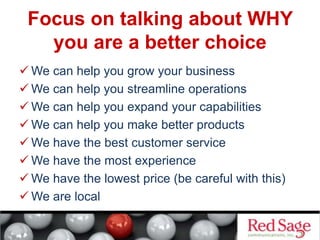
Focus on talking about WHY
you are a better choice
 We can help you grow your business
 We can help you streamline operations
 We can help you expand your capabilities
 We can help you make better products
 We have the best customer service
 We have the most experience
 We have the lowest price (be careful with this)
 We are local
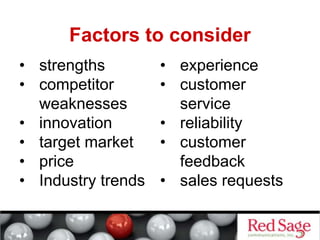
Factors to consider
• strengths
• competitor
weaknesses
• innovation
• target market
• price
• Industry trends
• experience
• customer
service
• reliability
• customer
feedback
• sales requests
How I did it
2006 - 2009/10 - 2016
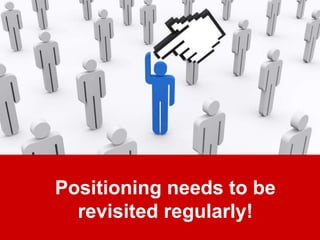
Positioning needs to be
revisited regularly!
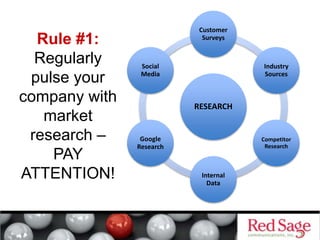
Rule #1:
Regularly
pulse your
company with
market
research –
PAY
ATTENTION!
RESEARCH
Customer
Surveys
Industry
Sources
Competitor
Research
Internal
Data
Google
Research
Social
Media
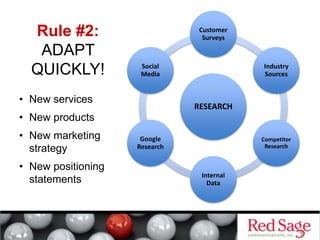
Rule #2:
ADAPT
QUICKLY!
RESEARCH
Customer
Surveys
Industry
Sources
Competitor
Research
Internal
Data
Google
Research
Social
Media
• New services
• New products
• New marketing
strategy
• New positioning
statements
Bottom Line:
You don’t have to be perfect.
You just have to be better
than your competitors.
Download this presentation at
www.slideshare.net/ellendid4
Please connect with me!
www.RedSageOnline.com
twitter.com/ellendidier
twitter.com/RedSageAL
facebook.com/redsage linkedin.com/in/ellendidie
r

Market Analysis for Entrepreneurs

  • 1.
  • 2.
    What We’ll CoverToday Understanding your market Analyzing your competitors Defining target markets Pricing strategies Positioning
  • 3.
    What We’ll CoverToday Understanding your market Analyzing your competitors Defining target markets Pricing strategies Positioning
  • 4.
    Questions to ask Is your market growing or shrinking?  Is there room for one more company?  Will you be bringing something different to the market?
  • 5.
    Do a BROADsearch
  • 7.
    Do a morespecific search
  • 8.
  • 9.
  • 10.
    What are industryblogs talking about?
  • 11.
    Conduct primary research Interviewpotential customers, vendors, association leaders, related businesses
  • 12.
    Use your ownknowledge of your industry Trends? Pricing? Competitors? New technology?
  • 13.
    2006 – HowI did it then  Personal knowledge of industry, competitors and pricing  I knew website sales would continue to grow in industry  I knew I had an innovative product  I didn’t aim too high
  • 14.
    2016 – HowI do it now  Industry data through associations  Constant asking/pulsing customers, prospects, and others  Regular monitoring of competitors  Collaborative learning/sharing with staff  Annual SWOT and strategic planning
  • 15.
    What We’ll CoverToday Understanding your market Analyzing your competitors Defining target markets Pricing strategies Positioning
  • 16.
    Spy on yourcompetitors: What do they say about themselves? How are you different?
  • 17.
    Where can youresearch them? Websites Google Press Releases Social Media Networking Events Ask mutual contacts
  • 18.
    The more youunderstand your competitors, the more effectively you can position your company!
  • 19.
    Competitive analysis YOUR COMPANYCOMPETITOR 1 COMPETITOR 2 COMPETITOR 3 Overview Competitive Advantage Target markets Market share Marketing Strategies Products/Service s Pricing/Costs Strengths Weaknesses Opportunities Threats
  • 20.
    What We’ll CoverToday Understanding your market Analyzing your competitors Defining target markets Pricing strategies Positioning
  • 21.
    Who buys fromyou? Do they all look alike?
  • 22.
    Or are theyall a bit different?
  • 23.
    The more youunderstand your different target markets, the better you can structure your products, services and marketing efforts.
  • 24.
    Target market examples Menwho like to go fishing and live in Alabama, Tennessee, or Georgia and make at least $60,000 per year
  • 25.
    Target market examples Womenbetween the ages of 25 and 65 who live within 30 miles of Decatur, Alabama
  • 26.
    Target market examples Smallbusinesses with at least 5 employees and revenue of at least $500,000 per year
  • 27.
    Target market examples TheHR Directors at major industries in Decatur such as BP and 3M
  • 28.
    Target market examples GovernmentContractors in Huntsville
  • 29.
    Understand the valueand potential of each of your Target Markets. Which are the easiest to sell to? Which are the most profitable?
  • 30.
    Prioritize your targetmarkets 1 2 3 4 5 What resources should you put into servicing or growing each target market?
  • 31.
    Establishing target markets isthe most efficient way to maximize your sales and marketing.
  • 32.
    Should your servicesbe packaged or marketed a bit differently for different markets? Define your services & message for each market
  • 33.
    AUDIENCE PRODUCT/SERVICE MESSAGE GeneralBusiness Branding, print design, web design, marketing & social media consulting We can help you be more strategic with your marketing so your business grows Economic & Community Development Organizations Web design, retail recruitment guides, presentation materials We can help your community attract the attention of site selectors and retailers Existing Customers All services – with a focus on new services Don’t forget we can help you with a wide range of services List each Audience… …and the service/product you want to provide each …and the message you want to tell each Do this in Excel
  • 34.
    AUDIENCE PRODUCT/SERVICE MESSAGEBEST WAY TO REACH General Business Branding, print design, web design, marketing & social media consulting We can help you be more strategic with your marketing so you get results Networking, public speaking, sales reps, referral program, social media Economic & Community Development Organizations Web design, retail recruitment guides, presentation materials We can help your community attract the attention of site selectors and retailers Industry Tradeshows, sponsorships, referral program, e- newsletters, blog Existing Customers All services – with a focus on new services Don’t forget we can help you with a wide range of services Social media, Direct mail, referral programs, e- newsletters, calls List each Audience… …and the service/product you want to provide each …and the message you want to tell each …and the best ways to reach each Next, determine the best way to reach each market
  • 35.
    Research your options Are there industry associations that allow networking, tradeshows or advertising?  What local events do women go to and what local groups do they belong to?  What magazines or newspapers do my customers read?  What websites do my customers visit?
  • 36.
    How do youchoose?  What can you afford?  Spread out your visibility over time  What can you consistently deliver? Is a monthly e-newsletter realistic?  Biggest rule: Have a presence in as many places as possible within your budget: a small ad four times is better than a big ad once
  • 37.
    Develop your 12month plan and budget Do date/pricing research for print ads, events. Then plug in around those.
  • 38.
    Develop your 12month plan and budget Do date/pricing research for print ads, events. Then plug in around those.
  • 39.
    Build in Structureand Accountability with Monthly Marketing Meetings  What happened last month? Did it yield results? Should we do anything different?  What is coming up? What do we need to prepare?  Anything anyone is seeing in the industry as an opportunity or threat?  Any customer feedback on products or services?
  • 40.
    How I identifiedmy target markets - then and now -
  • 41.
    What We’ll CoverToday Understanding your market Analyzing your competitors Defining target markets Pricing strategies Positioning
  • 42.
    Factors to consider Amount of competition  Typical price ranges for your industry  Cost of your materials or supplies  Lower overhead as a startup could enable lower penetration pricing to gain market share, or keep pricing competitive and build more revenue to finance growth
  • 43.
    What goes intocost model Direct labor Direct Materials Factory Overhead Sales, General, Admin What the market will bear
  • 44.
    2006 – HowI did it then  I knew most industry pricing  I belonged to an industry that provided annual pricing surveys by market size and size of agency  I knew what the market would bear  I used standard pricing out the gate for design, penetration pricing for web.
  • 45.
    2016 – HowI do it now All of the above plus  Direct analysis of all rates and pricing based on current data  Adjustments based on internal analysis of profitability by service and industry + what the market will bear
  • 46.
    What We’ll CoverToday Understanding your market Analyzing your competitors Defining target markets Pricing strategies Positioning
  • 47.
    How can youdifferentiate to stand out in your markets?
  • 48.
    Define your brandidentity. Get beyond your services list to what makes you different – an elevator pitch could capture this.
  • 49.
    Focus on talkingabout WHY you are a better choice  We can help you grow your business  We can help you streamline operations  We can help you expand your capabilities  We can help you make better products  We have the best customer service  We have the most experience  We have the lowest price (be careful with this)  We are local
  • 50.
    Factors to consider •strengths • competitor weaknesses • innovation • target market • price • Industry trends • experience • customer service • reliability • customer feedback • sales requests
  • 51.
    How I didit 2006 - 2009/10 - 2016
  • 52.
    Positioning needs tobe revisited regularly!
  • 53.
    Rule #1: Regularly pulse your companywith market research – PAY ATTENTION! RESEARCH Customer Surveys Industry Sources Competitor Research Internal Data Google Research Social Media
  • 54.
  • 55.
    Bottom Line: You don’thave to be perfect. You just have to be better than your competitors.
  • 57.
    Download this presentationat www.slideshare.net/ellendid4 Please connect with me! www.RedSageOnline.com twitter.com/ellendidier twitter.com/RedSageAL facebook.com/redsage linkedin.com/in/ellendidie r