RURAL-MARKETING CHAPTER 1
A silent revolution is sweeping the Indian country side. It has compelled marketing whiz kids to go rural. The marketing battle has shifted from cities to villages. “Go rural” seems to be the latest slogan. Adi Godrej says“The rural consumer is discerning and the rural markets are vibrant. At the current rate of growth it will soon outstrip the urban market. The rural market is no longer sleeping we are”  The real India lies in the villages. All smart marketers Indian as well as MNCs have revered this gospel. Companies like Hindustan lever, Godrej, Colgate Palmolive, Parle Foods, Nirma works,  Philips, have made in roads into the countryside. Rural reach is on the rise and it is fast becoming the most important route to growth.   RURAL MARKETING INTRODUCTION
Quite often rural mktg is defined in a narrower sense to include only  mktg of agricultural  produce.   Let us see how in phased manner, it’s definition & scope has been widened.According to National Commission “Rural Marketing is a process which starts with a decision to produce a saleable farm commodity and it involves all the aspects of market structure or system, both functional and institutional based on technical and economic considerations and includes pre and post harvest operations, assembling, grading, storage, transportation and distribution”.“Rural marketing can be defined as a function that manages all activities involved in assessing , stimulating and converting the purchasing power of rural consumers, into an effective demand for specific products and services and moving these products and services to the people in rural areas to create satisfaction and a better standard of living and thereby achieving organizational goals”.Definition of rural marketing
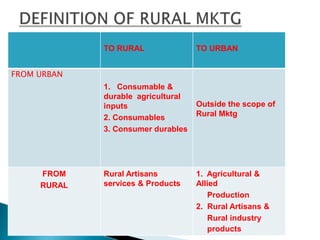
Rural marketing involves the process of developing, pricing, promoting ,distributing rural specific product and a service leading to exchange between rural and urban market which satisfies consumer demand and also achieves organizational objectivesIt is a two-way marketing process wherein the transactions can be:1. Urban to Rural: It involves the selling of products and services by urban marketers in rural areas. These include: Pesticides, FMCG Products, Consumer durables, etc.2. Rural to Urban: Here, a rural producer (involved in agriculture) sells his produce in urban market. This may not be direct. There generally are middlemen, agencies, government co-operatives, etc who sell fruits, vegetables, grains, pulses and others.3. Rural to rural: These include selling of agricultural tools, cattle, carts and others to another village in its proximity.
Large, Diverse and Scattered Market: Rural market in India is large, andscattered into a number of regions. There may be less number of shopsavailable to market products.Major Income of Rural consumers is from Agriculture: Rural Prosperityis tied with agriculture prosperity. In the event of a crop failure, theincome of the rural masses is directly affected.Standard of Living and rising disposable income of the rural customers:It is known that majority of the rural population lives below poverty lineand has low literacy rate, low per capital income, societal backwardness,low savings, etc. But the new tax structure, good monsoon, governmentregulation on pricing has created disposable incomes. Today the ruralcustomer spends money to get value and is aware of the happening around him. · Traditional Outlook: Villages develop slowly and have traditionaloutlook. Change is a continuous process but most rural people accept change gradually. This is gradually changing due to literacy especially in the youth who have begun to change the outlook in the villages.Features of Indian Rural Markets:
Rising literacy levels: It is documented that approximately 45% of ruralIndians are literate. Hence awareness has increases and the farmers are well-informed about the world around them. They are also educating themselves on the new technology around them and aspiring for a betterlifestyle.Diverse Socioeconomic background: Due to dispersion of geographicalareas and uneven land fertility, rural people have disparatesocioeconomic background, which ultimately affects the rural market.Infrastructure Facilities: The infrastructure facilities like cemented roads, warehouses, communication system, and financial facilities areinadequate in rural areas. Hence physical distribution is a challenge tomarketers who have found innovative ways to market their products.
The term rural marketing which was earlier used us an umbrella term to refer to all commercial transactions of rural people acquired a separate meaning of great significance in 1990s. The evolution is explained belowPhase #1 :: ( Before mid 60’s )                       Rural mktg referred  to mktg                        of rural product in rural &                        urban areas & agricultural                        inputs in  rural mkts. It was considered synonymous to “Agricultural mktg”Scope of rural marketing
Green revolution ushered in scientific farming practices and transferred many poor villages into prosperous busy centers. As a result, the demand for agricultural inputs went up. Better irrigation facilities, soil testing, use of high yield varieties of seeds, fertilizers, pesticides, and employment of machinery like power tillers matches, harvesters, threshers, etc changed the rural scenario. In this context marketing of agricultural inputs assumed significance. During this period the marketing of rural products received considerable attention in the general marketing framework. Village industries flourished and products like handicrafts, handlooms, textiles, soaps, safety matches, crackers etc, hit urban market on large scale.  Phase 2
During  the  two  earlier  phases ,  mktg  of    house hold  consumables  &  durables   to    the rural mkts was  not  considered. In this third phase, it  assumed prime importance. India's industrial sector had gained importance and it contributed to the growth of GNP. A new service sector emerged signifying the metamorphosis of agricultural sector into industrial society. Due to the development programs of central and state governments and socially responsible business groups like Tata's, Birla's, Gonekas and others the rural areas witnessed all round socio economic progress. The economic reforms further accelerated this market. Steadily the rural market has grown for household consumables and durables.Phase 3 after mid 1990
DEFINITION OF RURAL MKTG
Rural marketing can be seen as a function which manages all those activities involved in assessing, stimulating and converting the purchasing power into and effective demand for specific products and services, and moving them to the people in rural area to create satisfaction and a standard of living to them and thereby achieves the goals of the organization. Rural marketing
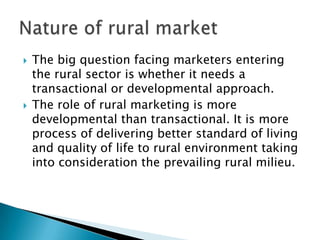
The big question facing marketers entering the rural sector is whether it needs a transactional or developmental approach.The role of rural marketing is more developmental than transactional. It is more process of delivering better standard of living and quality of life to rural environment taking into consideration the prevailing rural milieu. Nature of rural market
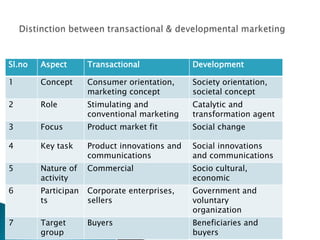
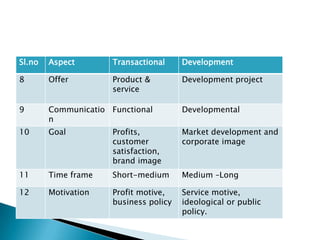
Distinction between transactional & developmental marketing
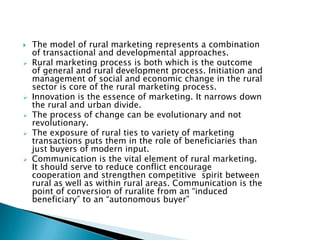
The model of rural marketing represents a combination of transactional and developmental approaches.Rural marketing process is both which is the outcome of general and rural development process. Initiation and management of social and economic change in the rural sector is core of the rural marketing process.
Innovation is the essence of marketing. It narrows down the rural and urban divide.
The process of change can be evolutionary and not revolutionary.
The exposure of rural ties to variety of marketing transactions puts them in the role of beneficiaries than just buyers of modern input.
Communication is the vital element of rural marketing. It should serve to reduce conflict encourage cooperation and strengthen competitive  spirit between rural as well as within rural areas. Communication is the point of conversion of ruralite from an “induced beneficiary” to an “autonomous buyer”   The rural market can be classified in way to similar to urban market.Consumer Market:Constituents : Individuals and householdsProducts: Consumables Food products, toiletries, cosmetics, Textiles and Garments. Foot Wear, etc.Durables : Watches, Bicycles Radio, TV, Kitchen appliances, Furniture, Sewing machine, wheelers etc.    Taxonomy of rural market
Constituents :agricultural and allied activities, poultry farming, fishing animal husbandry cottage health center school co-operatives etc.Products : consumable seeds, fertilizer, pesticides, animal feed. Fishnets, medicines, petrol diesel etc.Durables : Tillers, tractors, pump sets, generators, harvesters, boats etc. Industrial market
Constituents : individuals, households, offices and production firms.Services market: repairs, transport. Banking, credit insurance, healthcare, education, and communication, power etc.Services market
Large Population (approx. 72%)Increasing prosperityImproving literacy levelsGrowth in consumptionChanging Life StyleImproved Life CycleMkt growth rates > than urban counter partRural mktg is no more expensive &Remoteness is no longer a problemHelp from Tele - Communication technology to reach rural customersAttractiveness of rural market
Rural markets hitherto found unattractive have become the new targets to corporate enterprises mainly for two reasons:Urban markets have become congested with too many competitors. The markets have reached saturation point. Rural markets have become the main street with potential for consumption of variety of products and services. For many products rural market provides a promise owing to lag in adaptation. It makes market entry easy.Attractiveness of rural market
Large Population (approx. 72%)Increasing prosperityImproving literacy levelsGrowth in consumptionChanging Life StyleImproved Life CycleMkt growth rates > than urban counter partRural mktg is no more expensive &Remoteness is no longer a problemHelp from Tele - Communication technology to reach rural customersRural Mkt offers high Business Potential
· Large, Diverse and Scattered Market: Rural market in India is large, and scattered into a number of regions. There may be less number of shops available to market products.· Major Income of Rural consumers is from Agriculture: Rural Prosperity is tied with agriculture prosperity. In the event of a crop failure, the income of the rural masses is directly affected.Changes in rural market
 Standard of Living and rising disposable income of the rural customers It is known that majority of the rural population lives below poverty line and has low literacy rate, low per capital income, societal backwardness, low savings, etc. But the new tax structure, good monsoon, government regulation on pricing has created disposable incomes. Today the rural customer spends money to get value and is aware of the happening around him. Traditional Outlook: Villages develop slowly and have a traditional outlook. Change is a continuous process but most rural people accept change gradually. This is gradually changing due to literacy especially in the youth who have begun to change the outlook in the villages Changes in rural market
Rising literacy levels: It is documented that approximately 45% of rural Indians are literate. Hence awareness has increases and the farmers are well-informed about the world around them. They are also educating themselves on the new technology around them and aspiring for a better   lifestyle. Diverse Socioeconomic background: Due to dispersion of geographical areas and uneven land fertility, rural people have disparate socioeconomic background, which ultimately affects the rural market.Changes in rural market
Infrastructure Facilities: The infrastructure facilities like cemented roads, warehouses, communication system, and financial facilities are inadequate in rural areas. Hence physical distribution is a challenge to marketers who have found innovative ways to market their products.As part of planned economic development, the government is making continuous efforts towards rural development. In this age of liberalization, privatization and globalization, rural market offers a big attraction to the marketers to explore markets that are untapped.Changes in rural market
PopulationOccupation PatternIncome GenerationLocation of rural populationExpenditure PatternLiteracy LevelLand DistributionLand Use PatternIrrigationDvpt ProgrammesInfrastructure Facilities- Rural Electrification                                    - Rural Communication :i)   Road Network                                                                         ii)  Rail Network                                                                        iii)  Cinema Houses                                                                            iv)  Television                                                                         v)  Postal Systemrural market environment
Though Indian rural mkt offer vast untapped potential, it is not so easy to operate because of variety of problems.Rural Mktg is  TIME COMSUMING & requires CONSIDERABLE INVESTMENTS in terms of EFFORTS in evolving appropriate mktg strategies to tackle these problems.Problems of rural market
A. Underdeveloped people & Underdeveloped market.B. Low Literacy Levels C. Lack of Proper Physical Communication   Facilities.D. Media for Rural Communication.E. Many Languages & dialects.F. Vastness & Uneven Spread.G. Low per capita incomes.H. Logistics, Storage , Handling & Transport.I.  Product Positioning.J  Hierarchy of MarketsK. Seasonal DemandProblems of rural market
To solve the problems of rural markets in India, the following suggestions can be used by marketers:1. Regarding the problems of physical distribution, the marketer may have a joint network of stockiest/ clearing-cum-forwarding (C&F) agents at strategic location for facilitation of physical distribution for its products in the rural market. The main advantage of this scheme is that the costs of physical distribution can be shared by the companies and stockiest. The combination of different modes of transport based on availability of tracks will be beneficial to the companies. Some of the leading companies use delivery vans in rural areas for resolving the distribution problems in rural market. The delivery van takes the products to the retail shops in every corner of the rural market and it enables the company to establish direct sales contact with majority of the rural consumers which helps in sales promotion Solutions to problems of rural markets:
2. The rural market is composed of a number of retail sales outlets along with fair price shops under the public distribution system. It is suggested that the government should encourage private shopkeepers and cooperative stores to come forward and establish their business in rural areas instead of the weekly market known as weekly bazaar. Fertilizer companies have opened their outlets for proper distribution of fertilizer among the farmers. Similarly, the companies dealing in consumer goods can apply this model. The company may also appoint a number of retailers in and around the feeder towns and attach them to the stockiest who distributes the goods to the retailers as per the potential of the market. This system has the benefit of penetrating into the interior areas of the rural markets.
3. To solve the problems of sales force management, it is suggested that the company takes due care in the recruitment and selection of sales people because the traits they require are different from urban and suburban sales persons. For the rural markets, only those sales people should be preferred for selection who is willing to work in rural areas. They must be aware of the local language and must have the patience to deal with rural customers and can discharge the duties of a bare-footed salesman. Administration of such a large and scattered sales force, supervising and supporting them in sales calls, guiding them, attending to their official and personal problems, and motivating them for better results should be an exacting task for the sales manager. Thus, the people operating in rural areas should invariably be from the rural background and should have a missionary zeal to serve the rural masses.
4. With reference to marketing communication in rural areas, the company should use organized media-mix like TV, Radio, cinema and POP(point of purchase) advertising. Television is gaining popularity in the rural areas but due to poor supply of electricity, radio is performing significantly better. Since, the rural people need demonstration, short-feature films with disguised advertisement messages, direct advertisement films and documentaries that combine knowledge and advertisements will perform better rural marketing communication. Here the companies may also use audiovisual publicity vans, which may sell the products with promotion campaign. To attract the rural consumers, companies can organize village fairs, dance and drama shows, group meetings to convince the rural consumers about the products and services.
The rural market in India is quite fascinating and challenging in spite of all the difficulties existing. The potential is enormous. Even though, these markets have weaknesses they also have tremendous opportunities which should be availed by the marketers. It is well known that “Markets are created and not born”. The market so created should be tapped effectively. An ideal example is that of LIC. The Life Insurance Corporation of India generates life insurance business by appointing the insurance agent from the village itself so that he can easily convince his near and dear ones. LIC started a scheme called Gram Vikas where the Sarpanch is given a target to sell a minimum of 10 policy plans and the commission so earned is spent on the development of their respective villages. The marketers have to come up with innovative ideas through which the villagers also get involved in getting business from their respective villages. The Indian rural market is quite fascinating and challenging. It provides tremendous opportunities which beckon a marketer to explore.          Conclusion
Consumer is the basic foundation of every business. What consumer see, thinks, prefers and buys is of great importance to marketers to fine tune their marketing offers and achieve high level of consumer acceptance and Satisfaction.Chapter 2  The rural consumer
The rural consumers are classified into the following groups based on their economic status:The Affluent Group: They are cash rich farmers and a very few innumber. They have affordability but not form a demand base large enough for marketing firms to depend on. Wheat farmers in Punjab and rice merchants of Andhra Pradesh fall in this group.The Middle Class: This is one of the largest segments for manufactured goods and is fast expanding. Farmers cultivating sugar cane in UP and Karnataka fall in this category. The Poor: This constitutes a huge segment. Purchasing power is less, but strength is more. They receive the grants from government and reap the benefits of many such schemes and may move towards the middle class. The farmers of Bihar and Orissa fall under this category.Classification of rural consumer
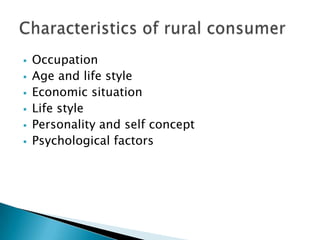
Occupation
Age and life style
Economic situation
Life style
Personality and self concept
Psychological factors Characteristics of rural consumer
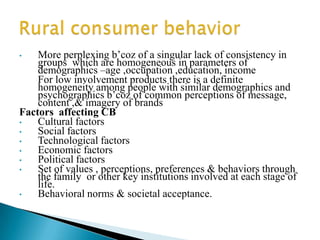
More perplexing b’coz of a singular lack of consistency in groups  which are homogeneous in parameters of demographics –age ,occupation ,education, income        For low involvement products there is a definite homogeneity among people with similar demographics and psychographics b’coz of common perceptions of message, content ,& imagery of brands Factors  affecting CBCultural factors
Social factors
Technological factors
Economic factors
Political factors
Set of values , perceptions, preferences & behaviors through the family  or other key institutions involved at each stage of life.

Chapter1

  • 1.
  • 2.
    A silent revolutionis sweeping the Indian country side. It has compelled marketing whiz kids to go rural. The marketing battle has shifted from cities to villages. “Go rural” seems to be the latest slogan. Adi Godrej says“The rural consumer is discerning and the rural markets are vibrant. At the current rate of growth it will soon outstrip the urban market. The rural market is no longer sleeping we are” The real India lies in the villages. All smart marketers Indian as well as MNCs have revered this gospel. Companies like Hindustan lever, Godrej, Colgate Palmolive, Parle Foods, Nirma works, Philips, have made in roads into the countryside. Rural reach is on the rise and it is fast becoming the most important route to growth. RURAL MARKETING INTRODUCTION
  • 3.
    Quite often ruralmktg is defined in a narrower sense to include only mktg of agricultural produce. Let us see how in phased manner, it’s definition & scope has been widened.According to National Commission “Rural Marketing is a process which starts with a decision to produce a saleable farm commodity and it involves all the aspects of market structure or system, both functional and institutional based on technical and economic considerations and includes pre and post harvest operations, assembling, grading, storage, transportation and distribution”.“Rural marketing can be defined as a function that manages all activities involved in assessing , stimulating and converting the purchasing power of rural consumers, into an effective demand for specific products and services and moving these products and services to the people in rural areas to create satisfaction and a better standard of living and thereby achieving organizational goals”.Definition of rural marketing
  • 4.
    Rural marketing involvesthe process of developing, pricing, promoting ,distributing rural specific product and a service leading to exchange between rural and urban market which satisfies consumer demand and also achieves organizational objectivesIt is a two-way marketing process wherein the transactions can be:1. Urban to Rural: It involves the selling of products and services by urban marketers in rural areas. These include: Pesticides, FMCG Products, Consumer durables, etc.2. Rural to Urban: Here, a rural producer (involved in agriculture) sells his produce in urban market. This may not be direct. There generally are middlemen, agencies, government co-operatives, etc who sell fruits, vegetables, grains, pulses and others.3. Rural to rural: These include selling of agricultural tools, cattle, carts and others to another village in its proximity.
  • 5.
    Large, Diverse andScattered Market: Rural market in India is large, andscattered into a number of regions. There may be less number of shopsavailable to market products.Major Income of Rural consumers is from Agriculture: Rural Prosperityis tied with agriculture prosperity. In the event of a crop failure, theincome of the rural masses is directly affected.Standard of Living and rising disposable income of the rural customers:It is known that majority of the rural population lives below poverty lineand has low literacy rate, low per capital income, societal backwardness,low savings, etc. But the new tax structure, good monsoon, governmentregulation on pricing has created disposable incomes. Today the ruralcustomer spends money to get value and is aware of the happening around him. · Traditional Outlook: Villages develop slowly and have traditionaloutlook. Change is a continuous process but most rural people accept change gradually. This is gradually changing due to literacy especially in the youth who have begun to change the outlook in the villages.Features of Indian Rural Markets:
  • 6.
    Rising literacy levels:It is documented that approximately 45% of ruralIndians are literate. Hence awareness has increases and the farmers are well-informed about the world around them. They are also educating themselves on the new technology around them and aspiring for a betterlifestyle.Diverse Socioeconomic background: Due to dispersion of geographicalareas and uneven land fertility, rural people have disparatesocioeconomic background, which ultimately affects the rural market.Infrastructure Facilities: The infrastructure facilities like cemented roads, warehouses, communication system, and financial facilities areinadequate in rural areas. Hence physical distribution is a challenge tomarketers who have found innovative ways to market their products.
  • 7.
    The term ruralmarketing which was earlier used us an umbrella term to refer to all commercial transactions of rural people acquired a separate meaning of great significance in 1990s. The evolution is explained belowPhase #1 :: ( Before mid 60’s ) Rural mktg referred to mktg of rural product in rural & urban areas & agricultural inputs in rural mkts. It was considered synonymous to “Agricultural mktg”Scope of rural marketing
  • 8.
    Green revolution usheredin scientific farming practices and transferred many poor villages into prosperous busy centers. As a result, the demand for agricultural inputs went up. Better irrigation facilities, soil testing, use of high yield varieties of seeds, fertilizers, pesticides, and employment of machinery like power tillers matches, harvesters, threshers, etc changed the rural scenario. In this context marketing of agricultural inputs assumed significance. During this period the marketing of rural products received considerable attention in the general marketing framework. Village industries flourished and products like handicrafts, handlooms, textiles, soaps, safety matches, crackers etc, hit urban market on large scale. Phase 2
  • 9.
    During the two earlier phases , mktg of house hold consumables & durables to the rural mkts was not considered. In this third phase, it assumed prime importance. India's industrial sector had gained importance and it contributed to the growth of GNP. A new service sector emerged signifying the metamorphosis of agricultural sector into industrial society. Due to the development programs of central and state governments and socially responsible business groups like Tata's, Birla's, Gonekas and others the rural areas witnessed all round socio economic progress. The economic reforms further accelerated this market. Steadily the rural market has grown for household consumables and durables.Phase 3 after mid 1990
  • 10.
  • 11.
    Rural marketing canbe seen as a function which manages all those activities involved in assessing, stimulating and converting the purchasing power into and effective demand for specific products and services, and moving them to the people in rural area to create satisfaction and a standard of living to them and thereby achieves the goals of the organization. Rural marketing
  • 12.
    The big questionfacing marketers entering the rural sector is whether it needs a transactional or developmental approach.The role of rural marketing is more developmental than transactional. It is more process of delivering better standard of living and quality of life to rural environment taking into consideration the prevailing rural milieu. Nature of rural market
  • 13.
    Distinction between transactional& developmental marketing
  • 15.
    The model ofrural marketing represents a combination of transactional and developmental approaches.Rural marketing process is both which is the outcome of general and rural development process. Initiation and management of social and economic change in the rural sector is core of the rural marketing process.
  • 16.
    Innovation is theessence of marketing. It narrows down the rural and urban divide.
  • 17.
    The process ofchange can be evolutionary and not revolutionary.
  • 18.
    The exposure ofrural ties to variety of marketing transactions puts them in the role of beneficiaries than just buyers of modern input.
  • 19.
    Communication is thevital element of rural marketing. It should serve to reduce conflict encourage cooperation and strengthen competitive spirit between rural as well as within rural areas. Communication is the point of conversion of ruralite from an “induced beneficiary” to an “autonomous buyer” The rural market can be classified in way to similar to urban market.Consumer Market:Constituents : Individuals and householdsProducts: Consumables Food products, toiletries, cosmetics, Textiles and Garments. Foot Wear, etc.Durables : Watches, Bicycles Radio, TV, Kitchen appliances, Furniture, Sewing machine, wheelers etc. Taxonomy of rural market
  • 20.
    Constituents :agricultural andallied activities, poultry farming, fishing animal husbandry cottage health center school co-operatives etc.Products : consumable seeds, fertilizer, pesticides, animal feed. Fishnets, medicines, petrol diesel etc.Durables : Tillers, tractors, pump sets, generators, harvesters, boats etc. Industrial market
  • 21.
    Constituents : individuals,households, offices and production firms.Services market: repairs, transport. Banking, credit insurance, healthcare, education, and communication, power etc.Services market
  • 22.
    Large Population (approx.72%)Increasing prosperityImproving literacy levelsGrowth in consumptionChanging Life StyleImproved Life CycleMkt growth rates > than urban counter partRural mktg is no more expensive &Remoteness is no longer a problemHelp from Tele - Communication technology to reach rural customersAttractiveness of rural market
  • 23.
    Rural markets hithertofound unattractive have become the new targets to corporate enterprises mainly for two reasons:Urban markets have become congested with too many competitors. The markets have reached saturation point. Rural markets have become the main street with potential for consumption of variety of products and services. For many products rural market provides a promise owing to lag in adaptation. It makes market entry easy.Attractiveness of rural market
  • 24.
    Large Population (approx.72%)Increasing prosperityImproving literacy levelsGrowth in consumptionChanging Life StyleImproved Life CycleMkt growth rates > than urban counter partRural mktg is no more expensive &Remoteness is no longer a problemHelp from Tele - Communication technology to reach rural customersRural Mkt offers high Business Potential
  • 25.
    · Large, Diverseand Scattered Market: Rural market in India is large, and scattered into a number of regions. There may be less number of shops available to market products.· Major Income of Rural consumers is from Agriculture: Rural Prosperity is tied with agriculture prosperity. In the event of a crop failure, the income of the rural masses is directly affected.Changes in rural market
  • 26.
    Standard ofLiving and rising disposable income of the rural customers It is known that majority of the rural population lives below poverty line and has low literacy rate, low per capital income, societal backwardness, low savings, etc. But the new tax structure, good monsoon, government regulation on pricing has created disposable incomes. Today the rural customer spends money to get value and is aware of the happening around him. Traditional Outlook: Villages develop slowly and have a traditional outlook. Change is a continuous process but most rural people accept change gradually. This is gradually changing due to literacy especially in the youth who have begun to change the outlook in the villages Changes in rural market
  • 27.
    Rising literacy levels:It is documented that approximately 45% of rural Indians are literate. Hence awareness has increases and the farmers are well-informed about the world around them. They are also educating themselves on the new technology around them and aspiring for a better lifestyle. Diverse Socioeconomic background: Due to dispersion of geographical areas and uneven land fertility, rural people have disparate socioeconomic background, which ultimately affects the rural market.Changes in rural market
  • 28.
    Infrastructure Facilities: Theinfrastructure facilities like cemented roads, warehouses, communication system, and financial facilities are inadequate in rural areas. Hence physical distribution is a challenge to marketers who have found innovative ways to market their products.As part of planned economic development, the government is making continuous efforts towards rural development. In this age of liberalization, privatization and globalization, rural market offers a big attraction to the marketers to explore markets that are untapped.Changes in rural market
  • 29.
    PopulationOccupation PatternIncome GenerationLocationof rural populationExpenditure PatternLiteracy LevelLand DistributionLand Use PatternIrrigationDvpt ProgrammesInfrastructure Facilities- Rural Electrification - Rural Communication :i) Road Network ii) Rail Network iii) Cinema Houses iv) Television v) Postal Systemrural market environment
  • 30.
    Though Indian ruralmkt offer vast untapped potential, it is not so easy to operate because of variety of problems.Rural Mktg is TIME COMSUMING & requires CONSIDERABLE INVESTMENTS in terms of EFFORTS in evolving appropriate mktg strategies to tackle these problems.Problems of rural market
  • 31.
    A. Underdeveloped people& Underdeveloped market.B. Low Literacy Levels C. Lack of Proper Physical Communication Facilities.D. Media for Rural Communication.E. Many Languages & dialects.F. Vastness & Uneven Spread.G. Low per capita incomes.H. Logistics, Storage , Handling & Transport.I. Product Positioning.J Hierarchy of MarketsK. Seasonal DemandProblems of rural market
  • 32.
    To solve theproblems of rural markets in India, the following suggestions can be used by marketers:1. Regarding the problems of physical distribution, the marketer may have a joint network of stockiest/ clearing-cum-forwarding (C&F) agents at strategic location for facilitation of physical distribution for its products in the rural market. The main advantage of this scheme is that the costs of physical distribution can be shared by the companies and stockiest. The combination of different modes of transport based on availability of tracks will be beneficial to the companies. Some of the leading companies use delivery vans in rural areas for resolving the distribution problems in rural market. The delivery van takes the products to the retail shops in every corner of the rural market and it enables the company to establish direct sales contact with majority of the rural consumers which helps in sales promotion Solutions to problems of rural markets:
  • 33.
    2. The ruralmarket is composed of a number of retail sales outlets along with fair price shops under the public distribution system. It is suggested that the government should encourage private shopkeepers and cooperative stores to come forward and establish their business in rural areas instead of the weekly market known as weekly bazaar. Fertilizer companies have opened their outlets for proper distribution of fertilizer among the farmers. Similarly, the companies dealing in consumer goods can apply this model. The company may also appoint a number of retailers in and around the feeder towns and attach them to the stockiest who distributes the goods to the retailers as per the potential of the market. This system has the benefit of penetrating into the interior areas of the rural markets.
  • 34.
    3. To solvethe problems of sales force management, it is suggested that the company takes due care in the recruitment and selection of sales people because the traits they require are different from urban and suburban sales persons. For the rural markets, only those sales people should be preferred for selection who is willing to work in rural areas. They must be aware of the local language and must have the patience to deal with rural customers and can discharge the duties of a bare-footed salesman. Administration of such a large and scattered sales force, supervising and supporting them in sales calls, guiding them, attending to their official and personal problems, and motivating them for better results should be an exacting task for the sales manager. Thus, the people operating in rural areas should invariably be from the rural background and should have a missionary zeal to serve the rural masses.
  • 35.
    4. With referenceto marketing communication in rural areas, the company should use organized media-mix like TV, Radio, cinema and POP(point of purchase) advertising. Television is gaining popularity in the rural areas but due to poor supply of electricity, radio is performing significantly better. Since, the rural people need demonstration, short-feature films with disguised advertisement messages, direct advertisement films and documentaries that combine knowledge and advertisements will perform better rural marketing communication. Here the companies may also use audiovisual publicity vans, which may sell the products with promotion campaign. To attract the rural consumers, companies can organize village fairs, dance and drama shows, group meetings to convince the rural consumers about the products and services.
  • 36.
    The rural marketin India is quite fascinating and challenging in spite of all the difficulties existing. The potential is enormous. Even though, these markets have weaknesses they also have tremendous opportunities which should be availed by the marketers. It is well known that “Markets are created and not born”. The market so created should be tapped effectively. An ideal example is that of LIC. The Life Insurance Corporation of India generates life insurance business by appointing the insurance agent from the village itself so that he can easily convince his near and dear ones. LIC started a scheme called Gram Vikas where the Sarpanch is given a target to sell a minimum of 10 policy plans and the commission so earned is spent on the development of their respective villages. The marketers have to come up with innovative ideas through which the villagers also get involved in getting business from their respective villages. The Indian rural market is quite fascinating and challenging. It provides tremendous opportunities which beckon a marketer to explore. Conclusion
  • 37.
    Consumer is thebasic foundation of every business. What consumer see, thinks, prefers and buys is of great importance to marketers to fine tune their marketing offers and achieve high level of consumer acceptance and Satisfaction.Chapter 2 The rural consumer
  • 38.
    The rural consumersare classified into the following groups based on their economic status:The Affluent Group: They are cash rich farmers and a very few innumber. They have affordability but not form a demand base large enough for marketing firms to depend on. Wheat farmers in Punjab and rice merchants of Andhra Pradesh fall in this group.The Middle Class: This is one of the largest segments for manufactured goods and is fast expanding. Farmers cultivating sugar cane in UP and Karnataka fall in this category. The Poor: This constitutes a huge segment. Purchasing power is less, but strength is more. They receive the grants from government and reap the benefits of many such schemes and may move towards the middle class. The farmers of Bihar and Orissa fall under this category.Classification of rural consumer
  • 39.
  • 40.
  • 41.
  • 42.
  • 43.
  • 44.
  • 45.
    More perplexing b’cozof a singular lack of consistency in groups which are homogeneous in parameters of demographics –age ,occupation ,education, income For low involvement products there is a definite homogeneity among people with similar demographics and psychographics b’coz of common perceptions of message, content ,& imagery of brands Factors affecting CBCultural factors
  • 46.
  • 47.
  • 48.
  • 49.
  • 50.
    Set of values, perceptions, preferences & behaviors through the family or other key institutions involved at each stage of life.