By-APURV KUMAR
MAURYA
Wage and Salary Administration is the group of
activities involved in the development,
implementation and maintenance of a pay
System.
 Denotes the process of managing a company’s
compensation program.
WAGE :
Wage is termed as a compensation that is given on the
basis of the amount of work done and the hours spent in
doing that.
Wages are variable and do vary with day to day functioning
of an individual.
Wages are given to labours who are engaged in
manufacturing processes and get the compensation on a
daily basis.
SALARY :
The term salary is the agreed upon amount of
money between the employer and the employee
that is extended at regular intervals on the basis
of an individual’s performance.
Salary is generally a fixed amount of package
calculated on an annual basis.
Salaried persons are generally said to be doing
“white collar office jobs” which implies that an
individual is well educated, skilled and is
employed with some firm and holds a good
position in the society.
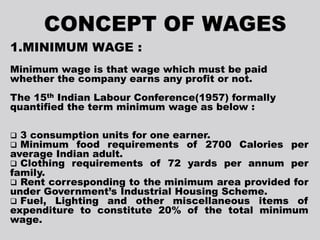
1.MINIMUM WAGE :
Minimum wage is that wage which must be paid
whether the company earns any profit or not.
The 15th Indian Labour Conference(1957) formally
quantified the term minimum wage as below :
 3 consumption units for one earner.
 Minimum food requirements of 2700 Calories per
average Indian adult.
 Clothing requirements of 72 yards per annum per
family.
 Rent corresponding to the minimum area provided for
under Government’s Industrial Housing Scheme.
 Fuel, Lighting and other miscellaneous items of
expenditure to constitute 20% of the total minimum
wage.
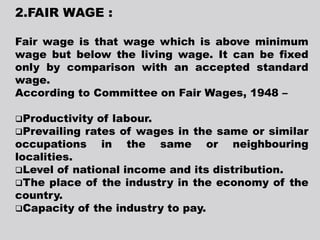
2.FAIR WAGE :
Fair wage is that wage which is above minimum
wage but below the living wage. It can be fixed
only by comparison with an accepted standard
wage.
According to Committee on Fair Wages, 1948 –
Productivity of labour.
Prevailing rates of wages in the same or similar
occupations in the same or neighbouring
localities.
Level of national income and its distribution.
The place of the industry in the economy of the
country.
Capacity of the industry to pay.
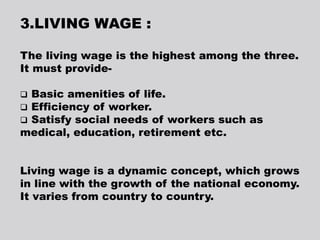
3.LIVING WAGE :
The living wage is the highest among the three.
It must provide-
 Basic amenities of life.
 Efficiency of worker.
 Satisfy social needs of workers such as
medical, education, retirement etc.
Living wage is a dynamic concept, which grows
in line with the growth of the national economy.
It varies from country to country.
WAGE DIFFERENTIALS
Wage differential means differences in wages.
Wages differ in different employments,
industries and localities and also between
persons in the same employment or grade.
 Occupational Differences
 Inter-firm Differentials
 Inter Area or Regional Differences
 Inter-personal wage Differences
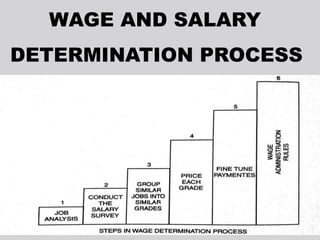
WAGE AND SALARY
DETERMINATION PROCESS
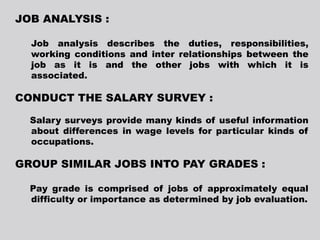
JOB ANALYSIS :
Job analysis describes the duties, responsibilities,
working conditions and inter relationships between the
job as it is and the other jobs with which it is
associated.
CONDUCT THE SALARY SURVEY :
Salary surveys provide many kinds of useful information
about differences in wage levels for particular kinds of
occupations.
GROUP SIMILAR JOBS INTO PAY GRADES :
Pay grade is comprised of jobs of approximately equal
difficulty or importance as determined by job evaluation.
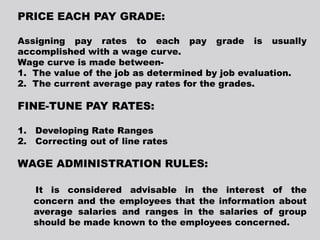
PRICE EACH PAY GRADE:
Assigning pay rates to each pay grade is usually
accomplished with a wage curve.
Wage curve is made between-
1. The value of the job as determined by job evaluation.
2. The current average pay rates for the grades.
FINE-TUNE PAY RATES:
1. Developing Rate Ranges
2. Correcting out of line rates
WAGE ADMINISTRATION RULES:
It is considered advisable in the interest of the
concern and the employees that the information about
average salaries and ranges in the salaries of group
should be made known to the employees concerned.

Wages and sallery administration

  • 1.
  • 2.
    Wage and SalaryAdministration is the group of activities involved in the development, implementation and maintenance of a pay System.  Denotes the process of managing a company’s compensation program.
  • 3.
    WAGE : Wage istermed as a compensation that is given on the basis of the amount of work done and the hours spent in doing that. Wages are variable and do vary with day to day functioning of an individual. Wages are given to labours who are engaged in manufacturing processes and get the compensation on a daily basis.
  • 4.
    SALARY : The termsalary is the agreed upon amount of money between the employer and the employee that is extended at regular intervals on the basis of an individual’s performance. Salary is generally a fixed amount of package calculated on an annual basis. Salaried persons are generally said to be doing “white collar office jobs” which implies that an individual is well educated, skilled and is employed with some firm and holds a good position in the society.
  • 5.
    1.MINIMUM WAGE : Minimumwage is that wage which must be paid whether the company earns any profit or not. The 15th Indian Labour Conference(1957) formally quantified the term minimum wage as below :  3 consumption units for one earner.  Minimum food requirements of 2700 Calories per average Indian adult.  Clothing requirements of 72 yards per annum per family.  Rent corresponding to the minimum area provided for under Government’s Industrial Housing Scheme.  Fuel, Lighting and other miscellaneous items of expenditure to constitute 20% of the total minimum wage.
  • 6.
    2.FAIR WAGE : Fairwage is that wage which is above minimum wage but below the living wage. It can be fixed only by comparison with an accepted standard wage. According to Committee on Fair Wages, 1948 – Productivity of labour. Prevailing rates of wages in the same or similar occupations in the same or neighbouring localities. Level of national income and its distribution. The place of the industry in the economy of the country. Capacity of the industry to pay.
  • 7.
    3.LIVING WAGE : Theliving wage is the highest among the three. It must provide-  Basic amenities of life.  Efficiency of worker.  Satisfy social needs of workers such as medical, education, retirement etc. Living wage is a dynamic concept, which grows in line with the growth of the national economy. It varies from country to country.
  • 8.
    WAGE DIFFERENTIALS Wage differentialmeans differences in wages. Wages differ in different employments, industries and localities and also between persons in the same employment or grade.  Occupational Differences  Inter-firm Differentials  Inter Area or Regional Differences  Inter-personal wage Differences
  • 9.
  • 10.
    JOB ANALYSIS : Jobanalysis describes the duties, responsibilities, working conditions and inter relationships between the job as it is and the other jobs with which it is associated. CONDUCT THE SALARY SURVEY : Salary surveys provide many kinds of useful information about differences in wage levels for particular kinds of occupations. GROUP SIMILAR JOBS INTO PAY GRADES : Pay grade is comprised of jobs of approximately equal difficulty or importance as determined by job evaluation.
  • 11.
    PRICE EACH PAYGRADE: Assigning pay rates to each pay grade is usually accomplished with a wage curve. Wage curve is made between- 1. The value of the job as determined by job evaluation. 2. The current average pay rates for the grades. FINE-TUNE PAY RATES: 1. Developing Rate Ranges 2. Correcting out of line rates WAGE ADMINISTRATION RULES: It is considered advisable in the interest of the concern and the employees that the information about average salaries and ranges in the salaries of group should be made known to the employees concerned.