Principles of Marketing
Lecture # 4
Marketing Environment
 Marketing environment has been defined as:"the
totality of physical and social factors that are taken
directly into consideration in the decision-making
behavior of individuals in the organization.“
The business environment is a Marketing term and
refers to factors and forces that affect a firm's ability to
build and maintain successful customer relationships
Levels or types of Marketing
environment
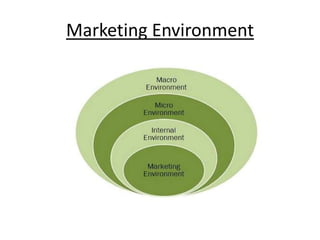
There are two basic levels of the environment:
• Internal environment
• External environment
Marketing Environment
Micro and Macro Environment
Levels or types of Marketing
environment
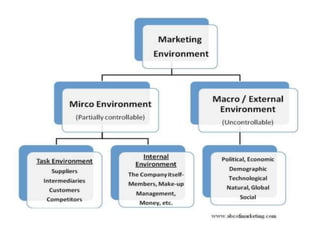
• Internal environment – the internal elements
of the organization used to create,
communicate and deliver market offerings.
• Micro environment – small forces external the
company that affect its ability to serve its
customers.
• Macro environment – larger societal forces
that affect the survival of the organization.
Internal Environment
• The internal environment "consists of those relevant
physical and social factors within the boundaries of the
organization or specific decision unit that are taken
directly into consideration in the decision-making
behavior of individuals in that system".
• This includes all departments such as management,
finance, research and development, purchasing,
Business operations and accounting.
• Each of these departments influences marketing
decisions.
Internal Environment
• For example,
– Research and development have input as to the
features a product can perform.
– Accounting approves the financial side of marketing
plans and budget in customer dissatisfaction.
– Marketing managers must watch supply availability
and other trends dealing with suppliers to ensure that
product will be delivered to customers in the time
frame required in order to maintain a strong customer
relationship.
External Environment
• The external environment "consists of those
relevant physical and social factors outside the
boundaries of the organization or specific
decision unit that are taken directly into
consideration.“
• The external environment can be further
broken into micro and macro environments.
Micro-environment
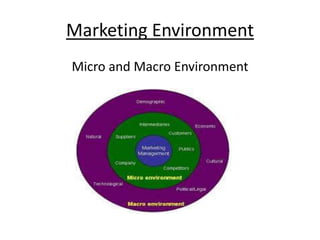
• The micro-environment consists of
customers, partners, and
competitors.
• The most important aspect of micro-
environment is the customer
market.
Micro-environment
• There are different types of customer markets,
which includes:
– consumer markets,
– business markets,
– government markets,
– Globalization international markets, and
– reseller markets.
Micro-environment
• Consumer Market:
The consumer market is made up of individuals who buy
goods and services for their own personal use or use in
their household.
• Business Market:
– Business markets include those who buy goods and
services for use in producing their own products to sell.
– This is different from the reseller market which includes
businesses that purchase goods to resell for earning
profit.
– These are the same companies mentioned as market
intermediaries.
Micro-environment
• Government Market:
– The government market consists of government
agencies that buy goods to produce public
services or
– transfer goods to others who need them.
• International market:
• International markets include buyers in other countries
Macro-environment
• The macro-environment refers to all forces that are
part of the larger society and affect the micro-
environment.
• It includes concepts such as demography, economy,
natural forces, technology, politics, and culture.
• The purpose of analyzing the macro marketing
environment is to understand the environment better
and to adapt to the social environment and change
through the marketing effort of the enterprise to
achieve the goal of the enterprise marketing.
• Factors affecting organization in Macro
environment are known as PEST, that is:
–Political,
–Economical,
–Social and
– Technological
PEST Analysis
• The Four environmental factors of the PEST
analysis are the following:
– Political Factors
– Economical Factors
– Social Factors
– Technological Factors
Political Factors
• The company/organization needs to consider the
political environment when creating business
strategies.
• The entire political environment includes looking
at government policies and the risk and instability
of current political factors.
• Political risks can include an unexpected loss of
ownership due to government takeover
(nationalization), or changes in labor laws which
might increase the cost of the
company's workforce.
Political Factors
• However often business can anticipate issues
by performing a political risk analysis.
• The political instability can influence the
business and the duration of time that
business/ organization is profitable.
Political Factors
• Taxation Policy
• Trade regulations
• governmental stability
• unemployment Policy
• Political stability
Economic Factors
• The economic factors of the business
environment are all the variables that impact
how the consumer spends their money and
the power of that purchase
Economic Factors
• Interest rate
• Inflation rate
• Earning power
• Growth in spending power
• Rate of people in a pensionable age
Social Factors
(Socio-cultural)
• The socio-cultural environment looks at
the demographic characteristics of the current
business environment.
• It looks at the values, customs and norms of
the environment of which a company or
organization is placed
Social Factors
(Socio-cultural)
• Values, beliefs
• Language
• Religion
• Education
• Literacy
Technological factors
• The technological environment is becoming a
lot more important in the modern day
business environment.
• New technology produces new opportunities
for companies and organizations to create, sell
and promote a product.
• Technology is rapidly growing and forever
changing.
Technological factors
• Internet
• E-commerce
• Social Media
• Electronic Media
• Research and Development
Any Question???
Questions
• What is Marketing environment?
• What are the types of Marketing environment?
• Define and explain Internal Environment.
• Define and explain External Environment.
• What is Micro and Macro Environment?
• What is Macro Environment?
• Explain the factors of Macro environment in
detail.
• Define and explain PEST analysis in detail.

Marketing Environment.pptx

  • 1.
    Principles of Marketing Lecture# 4 Marketing Environment
  • 2.
    Marketing Environment  Marketingenvironment has been defined as:"the totality of physical and social factors that are taken directly into consideration in the decision-making behavior of individuals in the organization.“ The business environment is a Marketing term and refers to factors and forces that affect a firm's ability to build and maintain successful customer relationships
  • 3.
    Levels or typesof Marketing environment There are two basic levels of the environment: • Internal environment • External environment
  • 5.
  • 6.
  • 7.
    Levels or typesof Marketing environment • Internal environment – the internal elements of the organization used to create, communicate and deliver market offerings. • Micro environment – small forces external the company that affect its ability to serve its customers. • Macro environment – larger societal forces that affect the survival of the organization.
  • 8.
    Internal Environment • Theinternal environment "consists of those relevant physical and social factors within the boundaries of the organization or specific decision unit that are taken directly into consideration in the decision-making behavior of individuals in that system". • This includes all departments such as management, finance, research and development, purchasing, Business operations and accounting. • Each of these departments influences marketing decisions.
  • 9.
    Internal Environment • Forexample, – Research and development have input as to the features a product can perform. – Accounting approves the financial side of marketing plans and budget in customer dissatisfaction. – Marketing managers must watch supply availability and other trends dealing with suppliers to ensure that product will be delivered to customers in the time frame required in order to maintain a strong customer relationship.
  • 10.
    External Environment • Theexternal environment "consists of those relevant physical and social factors outside the boundaries of the organization or specific decision unit that are taken directly into consideration.“ • The external environment can be further broken into micro and macro environments.
  • 11.
    Micro-environment • The micro-environmentconsists of customers, partners, and competitors. • The most important aspect of micro- environment is the customer market.
  • 12.
    Micro-environment • There aredifferent types of customer markets, which includes: – consumer markets, – business markets, – government markets, – Globalization international markets, and – reseller markets.
  • 13.
    Micro-environment • Consumer Market: Theconsumer market is made up of individuals who buy goods and services for their own personal use or use in their household. • Business Market: – Business markets include those who buy goods and services for use in producing their own products to sell. – This is different from the reseller market which includes businesses that purchase goods to resell for earning profit. – These are the same companies mentioned as market intermediaries.
  • 14.
    Micro-environment • Government Market: –The government market consists of government agencies that buy goods to produce public services or – transfer goods to others who need them. • International market: • International markets include buyers in other countries
  • 15.
    Macro-environment • The macro-environmentrefers to all forces that are part of the larger society and affect the micro- environment. • It includes concepts such as demography, economy, natural forces, technology, politics, and culture. • The purpose of analyzing the macro marketing environment is to understand the environment better and to adapt to the social environment and change through the marketing effort of the enterprise to achieve the goal of the enterprise marketing.
  • 16.
    • Factors affectingorganization in Macro environment are known as PEST, that is: –Political, –Economical, –Social and – Technological
  • 17.
    PEST Analysis • TheFour environmental factors of the PEST analysis are the following: – Political Factors – Economical Factors – Social Factors – Technological Factors
  • 18.
    Political Factors • Thecompany/organization needs to consider the political environment when creating business strategies. • The entire political environment includes looking at government policies and the risk and instability of current political factors. • Political risks can include an unexpected loss of ownership due to government takeover (nationalization), or changes in labor laws which might increase the cost of the company's workforce.
  • 19.
    Political Factors • Howeveroften business can anticipate issues by performing a political risk analysis. • The political instability can influence the business and the duration of time that business/ organization is profitable.
  • 20.
    Political Factors • TaxationPolicy • Trade regulations • governmental stability • unemployment Policy • Political stability
  • 21.
    Economic Factors • Theeconomic factors of the business environment are all the variables that impact how the consumer spends their money and the power of that purchase
  • 22.
    Economic Factors • Interestrate • Inflation rate • Earning power • Growth in spending power • Rate of people in a pensionable age
  • 23.
    Social Factors (Socio-cultural) • Thesocio-cultural environment looks at the demographic characteristics of the current business environment. • It looks at the values, customs and norms of the environment of which a company or organization is placed
  • 24.
    Social Factors (Socio-cultural) • Values,beliefs • Language • Religion • Education • Literacy
  • 25.
    Technological factors • Thetechnological environment is becoming a lot more important in the modern day business environment. • New technology produces new opportunities for companies and organizations to create, sell and promote a product. • Technology is rapidly growing and forever changing.
  • 26.
    Technological factors • Internet •E-commerce • Social Media • Electronic Media • Research and Development
  • 27.
  • 28.
    Questions • What isMarketing environment? • What are the types of Marketing environment? • Define and explain Internal Environment. • Define and explain External Environment. • What is Micro and Macro Environment? • What is Macro Environment? • Explain the factors of Macro environment in detail. • Define and explain PEST analysis in detail.