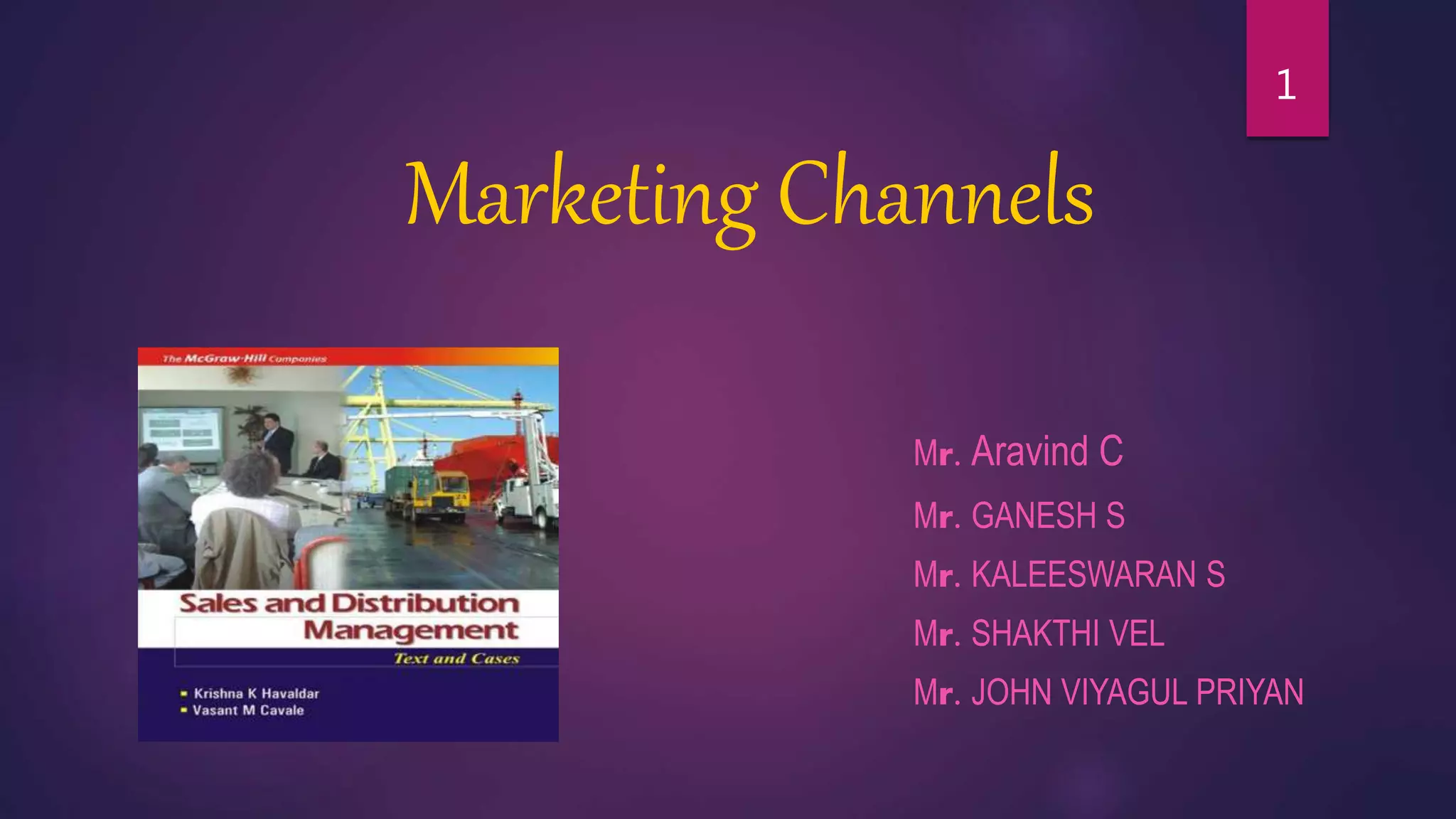

Marketing Channels
Mr. Aravind C
Mr. GANESH S
Mr. KALEESWARAN S
Mr. SHAKTHI VEL
Mr. JOHN VIYAGUL PRIYAN
1
DEFINITION
Marketing channels are defined as internal ( own salesforce) or external (all
kinds of channel partners) contractual organisations that management
operates to achieve its distribution objectives ( reaching the product or service
to the consumers/ end-users/ customers).
2
Channel Functions
Information gathering
Consumer motivation
Bargaining with suppliers
Placing orders
Financing
Inventory management
Risk bearing
3
CHANNEL FORMATS
Is decided by who ‘drives’ the channel system:
 Producer driven
 Seller driven
 Service driven
 Others
4
Producer Driven
This is the effort of the manufacturer & tries to reach the product to his consumers.
Examples:
 Company owned retail outlets – petrol, Bata, Reliance mobiles
 Licensed outlets – KMMF
 Consignment selling agents
 Franchisees
 Brokers
5
Seller Driven
Use of existing channels to reach the largest number of end users
 Existing wholesalers and retailers -paanwalas
 Modern retail formats
 Specialty stores – Shoppers’ Stop
 Discount stores – Subhiksha
 Pheriwalas
6
Service Driven
These are the people who facilitate the distribution
 Transporters and freight forwarders
 Providers of warehouse space
 C&F agents
 3P Logistics service providers
 Couriers
7
OTHER FORMATS
 Multi-level marketing systems – Amway, Modicare, Tupperware.
 Co-operative societies
 Telephone kiosks
 TV home shopping
 The internet
 Exhibitions, fairs and trade shows
 Data base marketing
8
Channel Levels
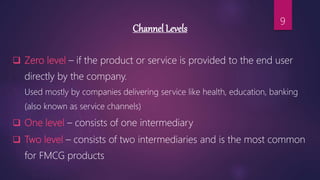
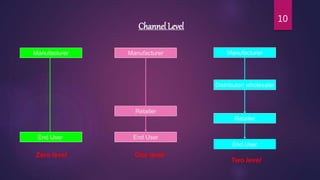
 Zero level – if the product or service is provided to the end user
directly by the company.
Used mostly by companies delivering service like health, education, banking
(also known as service channels)
 One level – consists of one intermediary
 Two level – consists of two intermediaries and is the most common
for FMCG products
9
Channel Level
End User
Manufacturer
Zero level
Manufacturer
Retailer
End User
Manufacturer
Distributor/ wholesaler
Retailer
End User
One level
Two level
10
Service Channel
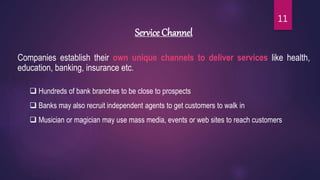
Companies establish their own unique channels to deliver services like health,
education, banking, insurance etc.
 Hundreds of bank branches to be close to prospects
 Banks may also recruit independent agents to get customers to walk in
 Musician or magician may use mass media, events or web sites to reach customers
11
Channel Flows
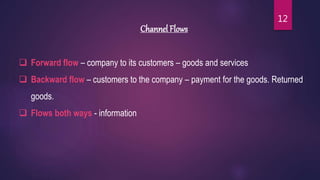
 Forward flow – company to its customers – goods and services
 Backward flow – customers to the company – payment for the goods. Returned
goods.
 Flows both ways - information
12
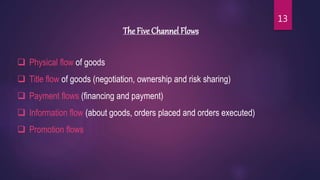
The Five Channel Flows
 Physical flow of goods
 Title flow of goods (negotiation, ownership and risk sharing)
 Payment flows (financing and payment)
 Information flow (about goods, orders placed and orders executed)
 Promotion flows
13
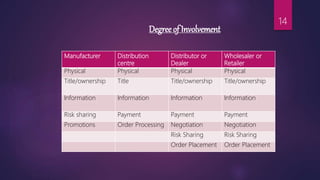
Degree of Involvement
Manufacturer Distribution
centre
Distributor or
Dealer
Wholesaler or
Retailer
Physical Physical Physical Physical
Title/ownership Title Title/ownership Title/ownership
Information Information Information Information
Risk sharing Payment Payment Payment
Promotions Order Processing Negotiation Negotiation
Risk Sharing Risk Sharing
Order Placement Order Placement
14
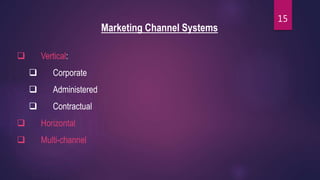
Marketing Channel Systems
 Vertical:
 Corporate
 Administered
 Contractual
 Horizontal
 Multi-channel
15
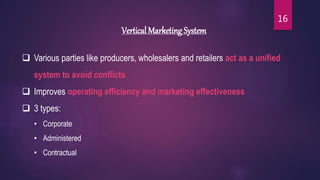
Vertical Marketing System
 Various parties like producers, wholesalers and retailers act as a unified
system to avoid conflicts
 Improves operating efficiency and marketing effectiveness
 3 types:
• Corporate
• Administered
• Contractual
16
Corporate VMS
 Combines successive stages of production and distribution under single ownership
 Examples:
• Bata, Bombay Dyeing, Raymond
• Sears, Goodyear
• Suppliers of food items could be also their own supplying firms - like Nilgiris
17
Administered VMS
 Co-ordinates distribution activities
 Gains market power by dominating a channel
 Usually true of dominant brands like GE, Kodak, Pepsi, Gillette, Coke and HLL in
certain locations
• Command high level of co-operation in shelf space, displays, pricing policies
and promotion strategies
18
Contractual VMS
 Independent producers, wholesalers and retailers operate on a contract
 Could take the forms of:
• Wholesaler sponsored voluntary chains
• Retailer co-operatives
• Manufacturer sponsored retail or wholesale franchise
• Franchise organizations
• Service firm sponsored retail franchise
19
Horizontal Marketing systems
 Two or more unrelated companies join together to pool resources and exploit an emerging
market opportunity
• In-store banking in hotels, big stores
• Retail outlets in petrol bunks
• Coffee Day outlets in airports
20
MULTI-CHANNEL MARKETING CHANNELS
 Company uses different channels to reach / same or different market segments
• Most FMCG companies have separate networks for retail market and institutions
• Pharma companies may use different channels to reach doctors, chemists and hospitals
21
Used in situations where:
• Same product but different market segments
• Unrelated products in same market – detergents and ice creams (HUL)
• Size of buyers varies
• Geographic concentration of potential consumers varies
• Reach is difficult- ladakh or north eastern states.
22
THANK YOU
23

Marketing channels

  • 1.
    Marketing Channels Mr. AravindC Mr. GANESH S Mr. KALEESWARAN S Mr. SHAKTHI VEL Mr. JOHN VIYAGUL PRIYAN 1
  • 2.
    DEFINITION Marketing channels aredefined as internal ( own salesforce) or external (all kinds of channel partners) contractual organisations that management operates to achieve its distribution objectives ( reaching the product or service to the consumers/ end-users/ customers). 2
  • 3.
    Channel Functions Information gathering Consumermotivation Bargaining with suppliers Placing orders Financing Inventory management Risk bearing 3
  • 4.
    CHANNEL FORMATS Is decidedby who ‘drives’ the channel system:  Producer driven  Seller driven  Service driven  Others 4
  • 5.
    Producer Driven This isthe effort of the manufacturer & tries to reach the product to his consumers. Examples:  Company owned retail outlets – petrol, Bata, Reliance mobiles  Licensed outlets – KMMF  Consignment selling agents  Franchisees  Brokers 5
  • 6.
    Seller Driven Use ofexisting channels to reach the largest number of end users  Existing wholesalers and retailers -paanwalas  Modern retail formats  Specialty stores – Shoppers’ Stop  Discount stores – Subhiksha  Pheriwalas 6
  • 7.
    Service Driven These arethe people who facilitate the distribution  Transporters and freight forwarders  Providers of warehouse space  C&F agents  3P Logistics service providers  Couriers 7
  • 8.
    OTHER FORMATS  Multi-levelmarketing systems – Amway, Modicare, Tupperware.  Co-operative societies  Telephone kiosks  TV home shopping  The internet  Exhibitions, fairs and trade shows  Data base marketing 8
  • 9.
    Channel Levels  Zerolevel – if the product or service is provided to the end user directly by the company. Used mostly by companies delivering service like health, education, banking (also known as service channels)  One level – consists of one intermediary  Two level – consists of two intermediaries and is the most common for FMCG products 9
  • 10.
    Channel Level End User Manufacturer Zerolevel Manufacturer Retailer End User Manufacturer Distributor/ wholesaler Retailer End User One level Two level 10
  • 11.
    Service Channel Companies establishtheir own unique channels to deliver services like health, education, banking, insurance etc.  Hundreds of bank branches to be close to prospects  Banks may also recruit independent agents to get customers to walk in  Musician or magician may use mass media, events or web sites to reach customers 11
  • 12.
    Channel Flows  Forwardflow – company to its customers – goods and services  Backward flow – customers to the company – payment for the goods. Returned goods.  Flows both ways - information 12
  • 13.
    The Five ChannelFlows  Physical flow of goods  Title flow of goods (negotiation, ownership and risk sharing)  Payment flows (financing and payment)  Information flow (about goods, orders placed and orders executed)  Promotion flows 13
  • 14.
    Degree of Involvement ManufacturerDistribution centre Distributor or Dealer Wholesaler or Retailer Physical Physical Physical Physical Title/ownership Title Title/ownership Title/ownership Information Information Information Information Risk sharing Payment Payment Payment Promotions Order Processing Negotiation Negotiation Risk Sharing Risk Sharing Order Placement Order Placement 14
  • 15.
    Marketing Channel Systems Vertical:  Corporate  Administered  Contractual  Horizontal  Multi-channel 15
  • 16.
    Vertical Marketing System Various parties like producers, wholesalers and retailers act as a unified system to avoid conflicts  Improves operating efficiency and marketing effectiveness  3 types: • Corporate • Administered • Contractual 16
  • 17.
    Corporate VMS  Combinessuccessive stages of production and distribution under single ownership  Examples: • Bata, Bombay Dyeing, Raymond • Sears, Goodyear • Suppliers of food items could be also their own supplying firms - like Nilgiris 17
  • 18.
    Administered VMS  Co-ordinatesdistribution activities  Gains market power by dominating a channel  Usually true of dominant brands like GE, Kodak, Pepsi, Gillette, Coke and HLL in certain locations • Command high level of co-operation in shelf space, displays, pricing policies and promotion strategies 18
  • 19.
    Contractual VMS  Independentproducers, wholesalers and retailers operate on a contract  Could take the forms of: • Wholesaler sponsored voluntary chains • Retailer co-operatives • Manufacturer sponsored retail or wholesale franchise • Franchise organizations • Service firm sponsored retail franchise 19
  • 20.
    Horizontal Marketing systems Two or more unrelated companies join together to pool resources and exploit an emerging market opportunity • In-store banking in hotels, big stores • Retail outlets in petrol bunks • Coffee Day outlets in airports 20
  • 21.
    MULTI-CHANNEL MARKETING CHANNELS Company uses different channels to reach / same or different market segments • Most FMCG companies have separate networks for retail market and institutions • Pharma companies may use different channels to reach doctors, chemists and hospitals 21
  • 22.
    Used in situationswhere: • Same product but different market segments • Unrelated products in same market – detergents and ice creams (HUL) • Size of buyers varies • Geographic concentration of potential consumers varies • Reach is difficult- ladakh or north eastern states. 22
  • 23.