What is a
Distribution
strategy
?
Distribution strategy
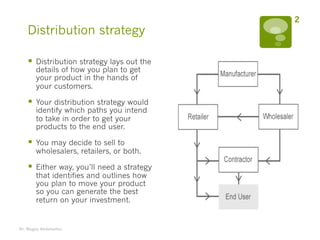
§ Distribution strategy lays out the
details of how you plan to get
your product in the hands of
your customers.
§ Your distribution strategy would
identify which paths you intend
to take in order to get your
products to the end user.
§ You may decide to sell to
wholesalers, retailers, or both.
§ Either way, you’ll need a strategy
that identifies and outlines how
you plan to move your product
so you can generate the best
return on your investment.
Dr. Magdy Abdelsattar
2
Strategy Formulating Steps
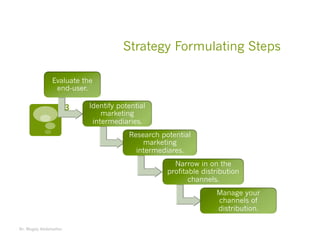
Evaluate the
end-user.
Identify potential
marketing
intermediaries.
Research potential
marketing
intermediares.
Narrow in on the
profitable distribution
channels.
Manage your
channels of
distribution.
Dr. Magdy Abdelsattar
3
Step 1: Evaluate the end-user.
§ Does the end user need personalized service? If so,
who is the best person to provide that service to them?
§ Is the end user more likely to purchase this product
online or at a physical store?
§ How much will you need to educate the end user on
your product? Who is in the best position to help you
educate the end user?
Dr. Magdy Abdelsattar
4
Step 2: Identify potential marketing intermediaries
§ There are only two ways for you to sell product to the end user:
§ Directly – you can sell directly to the end user through a sales force.
§ Indirectly – or you can sell indirectly to the end user through marketing
intermediaries.
§ You can typically group potential marketing intermediaries into a couple
different categories:
§ Agents and Brokers – Agents and brokers are marketing intermediaries
that act, essentially, like an outsourced sales force. The main difference
here is that agents and brokers don’t typically buy the product from
you. Instead, they sell it for you and make a fee or commission.
§ Wholesalers and Distributors – Wholesalers and distributors are
marketing intermediaries who purchase product in bulk from the
manufacturer and store it until they can sell it to retailers or contractors
at a profit.
§ Retailers – Retailers typically purchase products from
wholesalers/distributors and resell it to contractors and end users.
§ Value Added Resellers – And lastly, value added resellers such as
contractors typically purchase products, bundle them within their
service, and sell it to the end user.
Dr. Magdy Abdelsattar
5
Step 3: Research potential marketing intermediares
§ The point here is to make sure that you really get to
know them…more than just what’s written on paper.
§ Here are a few questions that you may want to
consider asking:
§ What are some ways that you think we may be able
to partner?
§ What are some of your weaknesses that we could
potentially address?
§ What are some of your strengths that we may be
able to take advantage of?
§ Who would you sell to and at what markup?
Dr. Magdy Abdelsattar
6
Step 4: Narrow in on the profitable distribution channels.
§ We now need to find which types of distribution channels are available and
then narrow in on the most profitable distribution channels.
§ In most cases, it’s common to have multiple channels of distribution that you
manage. Different channels of distribution may have different sets of
marketing intermediaries who help you move your product.
§ Distribution can typically be grouped into three primary categories:
§ Intensive distribution – intensive distribution means there are a lot of
intermediaries. An example of intensive distribution may be snack foods;
one product may be stocked in many stores and may have many different
channels of distribution.
§ Selective distribution – selective distribution means there are a few
intermediaries. An example of selective distribution might be a particular
type of fruit that is only sold within a certain geographical area.
§ Exclusive distribution – exclusive distribution means only a few
intermediaries and those intermediaries have to carry only their products.
An example of exclusive distribution might be high end fashion products
that are only sold in very specific stores.
Dr. Magdy Abdelsattar
7
Step 5: Manage your channels of distribution
§ Manage your channels of distribution to make sure that
you are maximizing your return on investment.
§ Make sure that you track the progress of each
distribution channel against the goals that you laid out
in the previous steps.
§ If a distribution channel starts to under perform, meet
with your distribution partners and figure out where the
leak is in your distribution model.
§ More importantly, determine how you can get things
back on track and optimize each channel of distribution.
Dr. Magdy Abdelsattar
8

Distribution strategy

  • 1.
  • 2.
    Distribution strategy § Distributionstrategy lays out the details of how you plan to get your product in the hands of your customers. § Your distribution strategy would identify which paths you intend to take in order to get your products to the end user. § You may decide to sell to wholesalers, retailers, or both. § Either way, you’ll need a strategy that identifies and outlines how you plan to move your product so you can generate the best return on your investment. Dr. Magdy Abdelsattar 2
  • 3.
    Strategy Formulating Steps Evaluatethe end-user. Identify potential marketing intermediaries. Research potential marketing intermediares. Narrow in on the profitable distribution channels. Manage your channels of distribution. Dr. Magdy Abdelsattar 3
  • 4.
    Step 1: Evaluatethe end-user. § Does the end user need personalized service? If so, who is the best person to provide that service to them? § Is the end user more likely to purchase this product online or at a physical store? § How much will you need to educate the end user on your product? Who is in the best position to help you educate the end user? Dr. Magdy Abdelsattar 4
  • 5.
    Step 2: Identifypotential marketing intermediaries § There are only two ways for you to sell product to the end user: § Directly – you can sell directly to the end user through a sales force. § Indirectly – or you can sell indirectly to the end user through marketing intermediaries. § You can typically group potential marketing intermediaries into a couple different categories: § Agents and Brokers – Agents and brokers are marketing intermediaries that act, essentially, like an outsourced sales force. The main difference here is that agents and brokers don’t typically buy the product from you. Instead, they sell it for you and make a fee or commission. § Wholesalers and Distributors – Wholesalers and distributors are marketing intermediaries who purchase product in bulk from the manufacturer and store it until they can sell it to retailers or contractors at a profit. § Retailers – Retailers typically purchase products from wholesalers/distributors and resell it to contractors and end users. § Value Added Resellers – And lastly, value added resellers such as contractors typically purchase products, bundle them within their service, and sell it to the end user. Dr. Magdy Abdelsattar 5
  • 6.
    Step 3: Researchpotential marketing intermediares § The point here is to make sure that you really get to know them…more than just what’s written on paper. § Here are a few questions that you may want to consider asking: § What are some ways that you think we may be able to partner? § What are some of your weaknesses that we could potentially address? § What are some of your strengths that we may be able to take advantage of? § Who would you sell to and at what markup? Dr. Magdy Abdelsattar 6
  • 7.
    Step 4: Narrowin on the profitable distribution channels. § We now need to find which types of distribution channels are available and then narrow in on the most profitable distribution channels. § In most cases, it’s common to have multiple channels of distribution that you manage. Different channels of distribution may have different sets of marketing intermediaries who help you move your product. § Distribution can typically be grouped into three primary categories: § Intensive distribution – intensive distribution means there are a lot of intermediaries. An example of intensive distribution may be snack foods; one product may be stocked in many stores and may have many different channels of distribution. § Selective distribution – selective distribution means there are a few intermediaries. An example of selective distribution might be a particular type of fruit that is only sold within a certain geographical area. § Exclusive distribution – exclusive distribution means only a few intermediaries and those intermediaries have to carry only their products. An example of exclusive distribution might be high end fashion products that are only sold in very specific stores. Dr. Magdy Abdelsattar 7
  • 8.
    Step 5: Manageyour channels of distribution § Manage your channels of distribution to make sure that you are maximizing your return on investment. § Make sure that you track the progress of each distribution channel against the goals that you laid out in the previous steps. § If a distribution channel starts to under perform, meet with your distribution partners and figure out where the leak is in your distribution model. § More importantly, determine how you can get things back on track and optimize each channel of distribution. Dr. Magdy Abdelsattar 8