:
Aishwarya goyal
International Marketing
Unit 1
 Definition, scope, importance and challenges of international marketing,
International trade theories, Reasons for going international, economic
analysis of multinational trade, International Market Segmentation and
Positioning; Screening and Selection of Markets; International Market
Entry Strategies: Exporting, licensing, Contract Manufacturing, Joint
Venture M & A, Setting-up of Wholly Owned Subsidiaries Aboard,
Strategic Alliances.
Unit 2
 International Marketing Environment: Political, Legal,
Environmental, Socio Cultural and Technological environment,
Country Risk Analysis, International Economic Environment:
IMF, WTO, International Monetary System, International Trade
Barriers: Tariff and Non Tariff
Regional Blocks: European Union, NAFTA, SAARC, ASEAN,
MERCOSUR, International Marketing Research, Selection of
export markets.
Unit 3
 Direction & composition of Indian exports, Indian
export and import policy export promotion
organizations, export, incentives, Producing for exports,
export quality control; export finance, shipment and
procedures thereof, Export documents
Unit 4
 Processing of an export order, organization and structure of export and import houses.
International product policy: Product standardization & adaptation, international, product
mix, International product life cycle, new product development, exports packaging,
International pricing policy: Factors influencing selection of pricing policies, international
pricing strategies, International distribution policy: Factors influencing selection of
international distribution channels, types of international distribution channels, role of
internet in international distribution International communication policy: communication
strategies in international marketing, international promotion mix.
 Relevant case studies related to the topics should be discussed.
Books for reference
International marketing by francis cherunilam (Himalaya
Publication)
International marketing strategy and theory
By sak onkvisit and john j. shaw
1. International business Vs international marketing
2. Domestic marketing Vs international marketing
3. Importance/Advantages of international marketing
4. International Orientation (EPRG Framework)
5. Stages of Internationalization
6. Reasons for Entering International markets
7. Factors that reinforces to take interest in International Marketing
in Modern Times
8. Scope of international marketing/ market entry strategies
International Business:- International business means carrying of business
activities beyond national boundaries. These activities include normally the
transactions of economic resources such as goods, capital and services
comprising of technology, skilled labor, transportation etc. They also
include international production. The production may embrace either
production of physical goods or providing services like banking, finance,
insurance, construction, trading etc.
International Marketing:- International marketing is an important aspect of
international business. international marketing is the performance of
business activities designed to plan. price, promote and direct the flow of a
company's goods and services to consumers.
Domestic Marketing
Marketing focuses on the satisfaction of customer needs, wants
and requirements.
There is normally a focus upon profitability, but marketing
focuses on profitability through customer satisfaction.
DEFINITION OF INTERNATIONAL
MARKETING
International marketing is the application of marketing
orientation and marketing capabilities to international
business.
International marketing is the performance of business
activities designed to plan, price, promote and direct the
flow of company’s goods and services to consumers in more
than one nation for profit.
DEFINITION OF INTERNATIONAL
MARKETING
International Marketing can be defined as exchange of goods and
services between different national markets involving buyers and
sellers.
According to the American Marketing Association:
“International Marketing is the multi-national process of planning and
executing the conception, prices, promotion and distribution of ideal
goods and services to create exchanges that satisfy the individual and
organizational objectives.”
Comparing Domestic and International
Marketing
Similarity:
- Both carry out transactions that meet the needs of individuals and
organizations
Differences:
- International markets have greater growth potential
-Some tasks associated with international marketing not included or less
intense than in domestic marketing (e.g., cultural research, political
factors, exchange rates, trade laws, long distance distribution.)
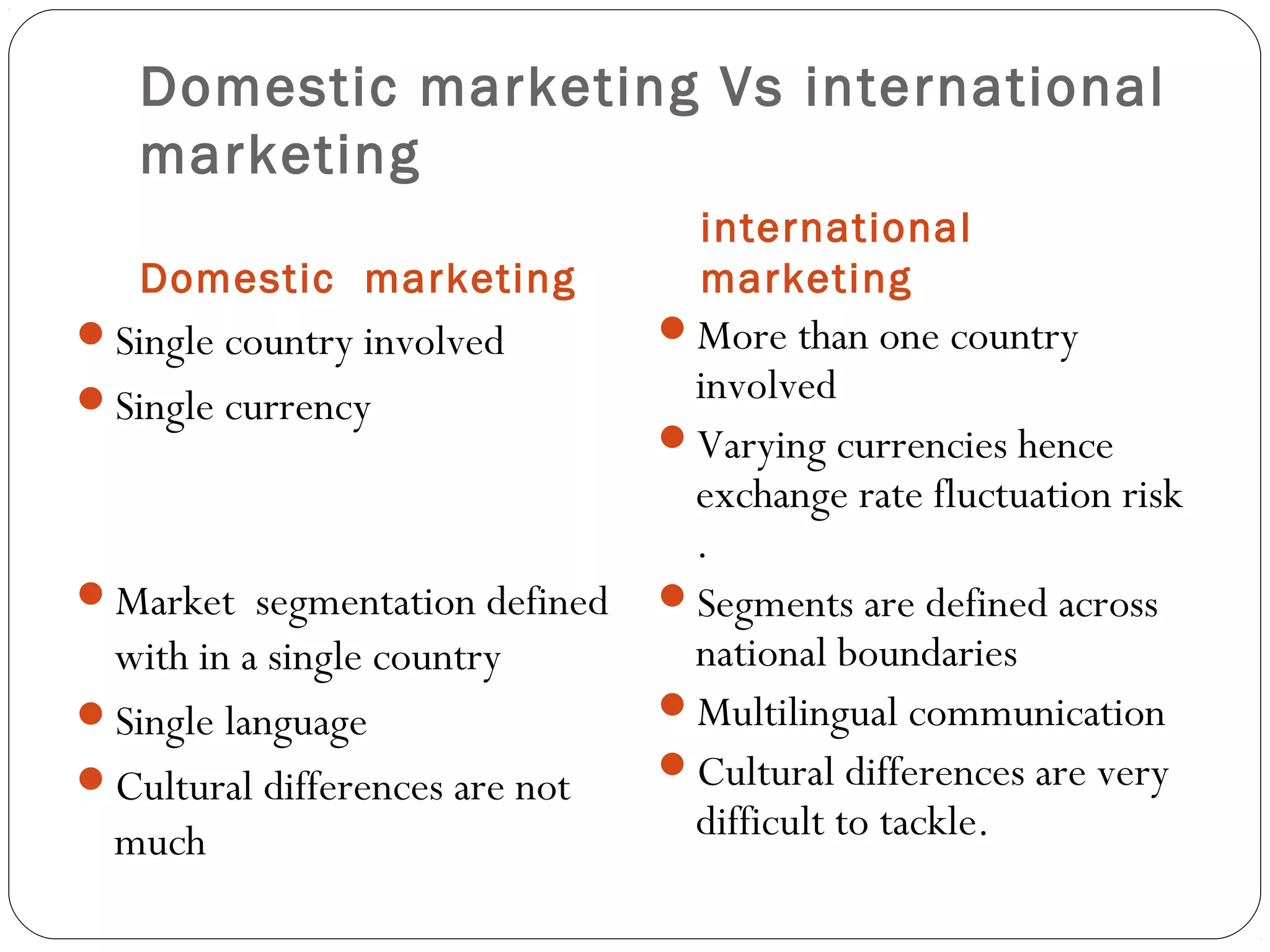
Domestic marketing Vs international
marketing
Domestic marketing
international
marketing
Single country involved
Single currency
Market segmentation defined
with in a single country
Single language
Cultural differences are not
much
More than one country
involved
Varying currencies hence
exchange rate fluctuation risk
.
Segments are defined across
national boundaries
Multilingual communication
Cultural differences are very
difficult to tackle.
Domestic marketing Vs international
marketing
Domestic marketing
international
marketing
Competition is easy to observe
and assess.
Processing and documentation is
easy and simple.
Control on intermediary and
distribution channel
Research data is easily assessed
and available in single language.
Competition is quite
unpredictable and difficult to
measure and analyze.
Documentation is quite diverse
and complicated.
Distribution left on
intermediaries.
Research data is difficult to
obtain, interpret and often
expensive.
Domestic marketing Vs international
marketing
Domestic marketing
international
marketing
Business regulations and
legal laws are clearly
understood.
Less political risk
Business regulations and
legal laws are not clearly
understood.
More political risk.
Importance/Advantages of international
marketing
Higher profitability
Market expansion
Brand reputation
Global Networking
survival
Better standard of living
The Importance of International
Marketing
For US-based companies, 75% of sales potential is outside
the US.
About 90% of Coca-Cola’s operating income is generated
outside the US.
For Japanese companies, 85% of potential is outside Japan.
For German and EU companies, 94% of potential is outside
Germany.
International Orientation
(EPRG Framework)
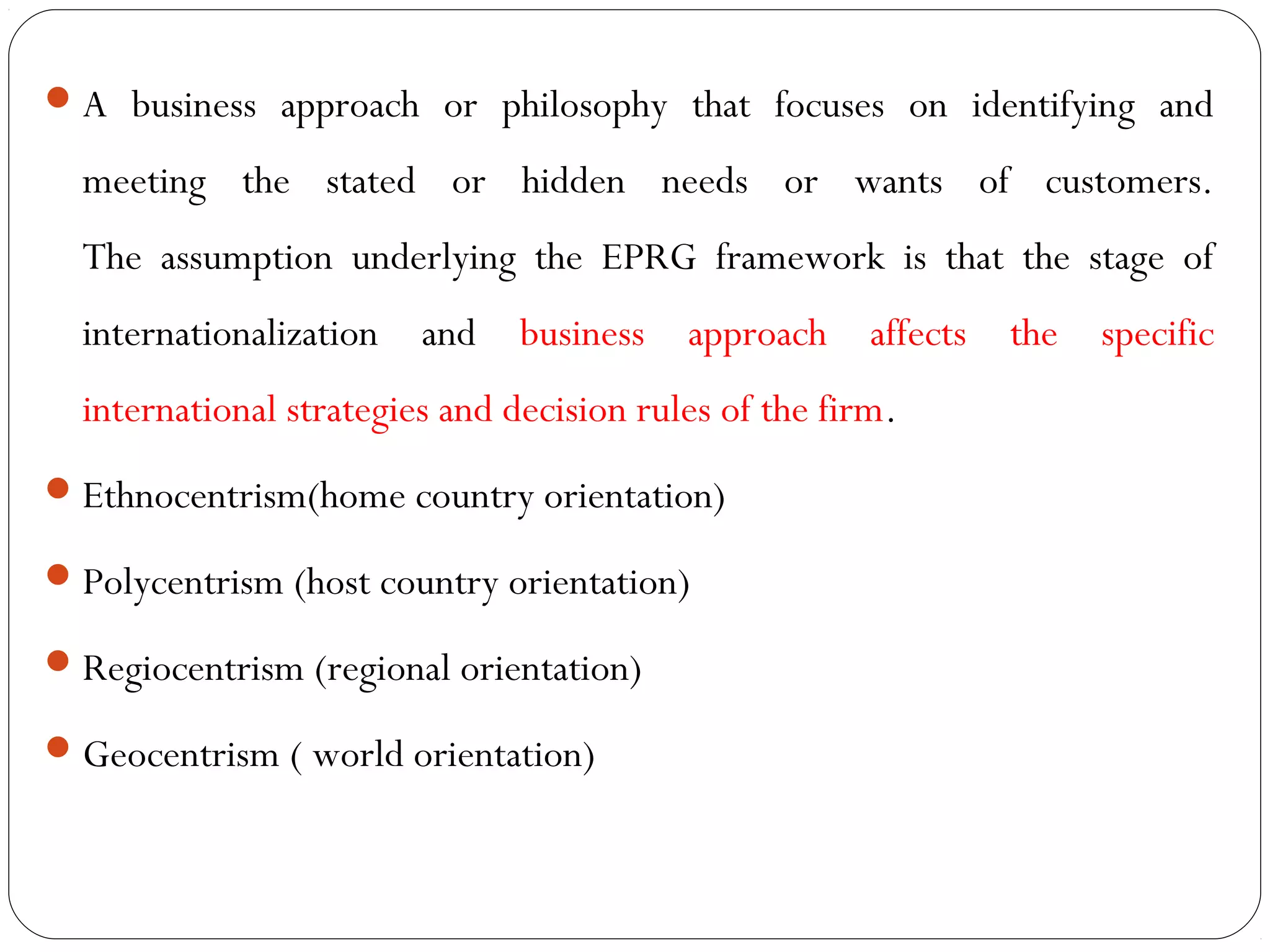
A business approach or philosophy that focuses on identifying and
meeting the stated or hidden needs or wants of customers.
The assumption underlying the EPRG framework is that the stage of
internationalization and business approach affects the specific
international strategies and decision rules of the firm.
Ethnocentrism(home country orientation)
Polycentrism (host country orientation)
Regiocentrism (regional orientation)
Geocentrism ( world orientation)
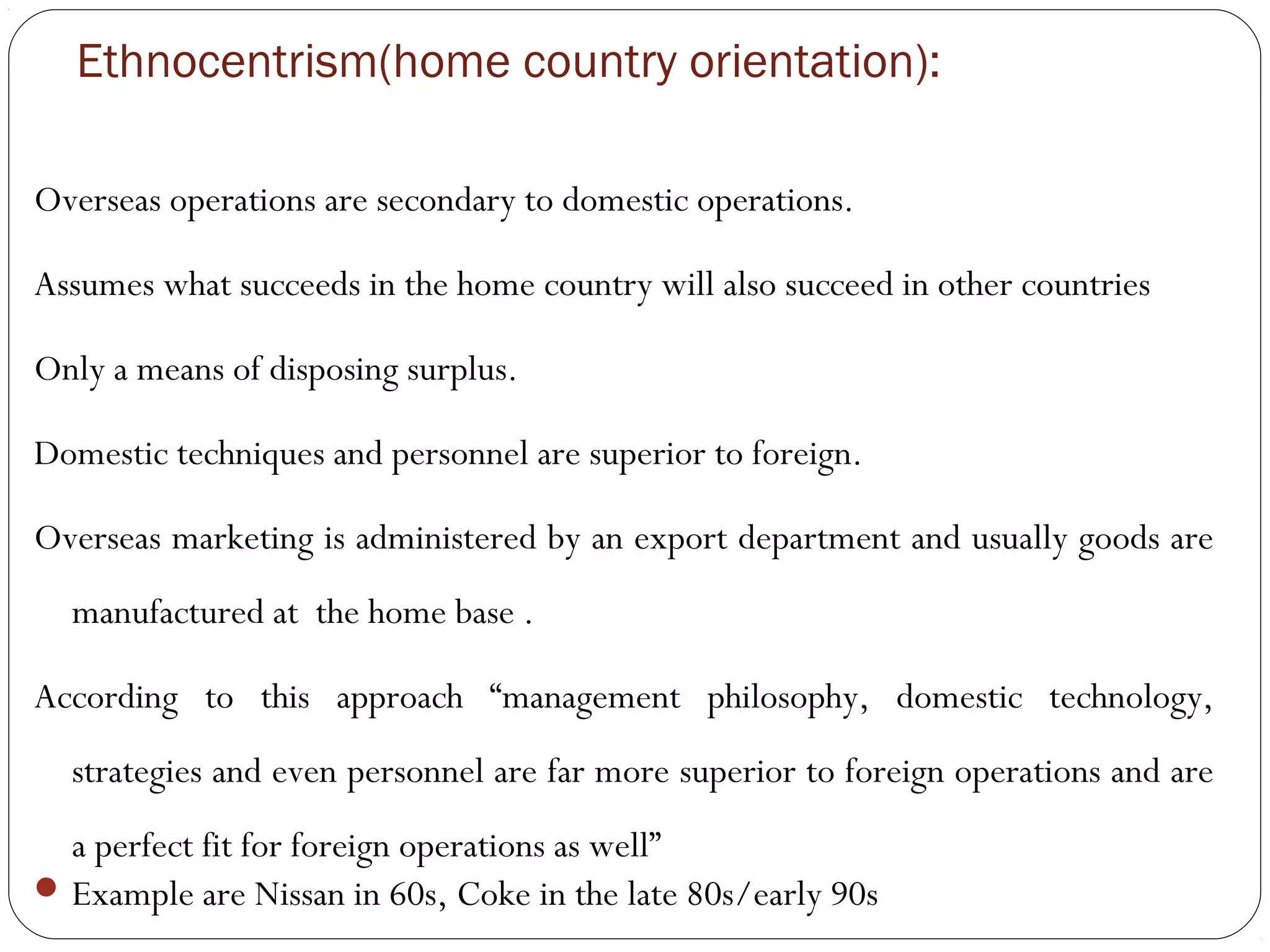
Ethnocentrism(home country orientation):
Overseas operations are secondary to domestic operations.
Assumes what succeeds in the home country will also succeed in other countries
Only a means of disposing surplus.
Domestic techniques and personnel are superior to foreign.
Overseas marketing is administered by an export department and usually goods are
manufactured at the home base .
According to this approach “management philosophy, domestic technology,
strategies and even personnel are far more superior to foreign operations and are
a perfect fit for foreign operations as well”
Example are Nissan in 60s, Coke in the late 80s/early 90s
Polycentrism (host country orientation):
Put emphasis on differences between markets which is caused by variation
such as culture, customs, laws and politics.
This approach is based on the assumption that each market is unique in terms
of its market environment such as political, cultural, legal, economic,
consumer behavior and market structure.
Highly localized / adapted approach to marketing
In this approach emphasis is on local laws, customs and culture and great care
is taken to understand the local ways of doing business.
Polycentrism (host country orientation):
The product features are tailored to the local domestic
environment, taking into account different food preferences,
religious customs and other characteristics that define the
locality. Companies choose to follow this strategy because
their products will be better received by local customers,
rather than seen as something unusual that is produced by a
foreign company.
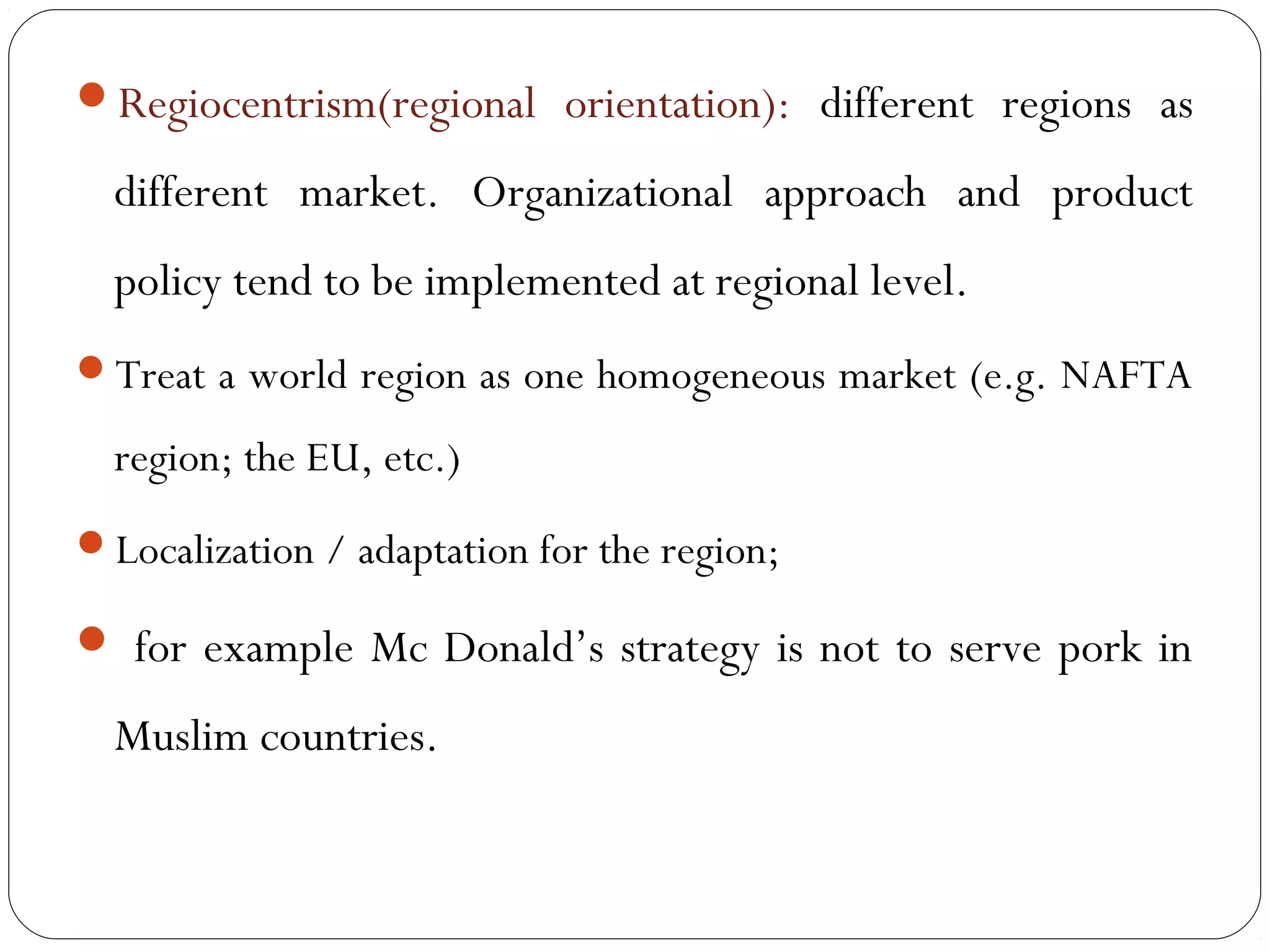
Regiocentrism(regional orientation): different regions as
different market. Organizational approach and product
policy tend to be implemented at regional level.
Treat a world region as one homogeneous market (e.g. NAFTA
region; the EU, etc.)
Localization / adaptation for the region;
 for example Mc Donald’s strategy is not to serve pork in
Muslim countries.
Geocentrism( world orientation):
Entire world is single market and developed standardized
marketing mix projecting a uniform image of the company and its
products for the global market.
World view – focused on standardizing programs but will
adapt if indicated by research
Global / transnational company
E.g. Toyota, palmolive, philips, electrolux
Geo-centrism( world orientation):
A very well-known cola soft drink is one example of a
transnational product. This company's beverage recipe is
kept secret and has not changed in many years. The product
is sold in over 200 countries worldwide, and this beverage
company retains exactly the same beverage formulation in
each country. The bottle’s label may reflect the local
language, but the logo and contents remain the same.
Management Orientations
Ethnocentric:
Home country is
Superior, sees
Similarities in foreign
Countries
Regiocentric:
Sees similarities and
differences in a world
Region; is ethnocentric or
polycentric in its view of
the rest of the world
Geocentric:
World view, sees
Similarities and
Differences in home
And host countries
Polycentric:
Each host country Is
Unique, sees differences
In foreign countries
Stages of Internationalization
1. Domestic Marketing: Companies manufacturing products and selling
those within the country itself. So, no international phenomenon at all.
2. Foreign Marketing: It refers to domestic marketing within the foreign
country. Approach of marketer in this stage is said to be ‘ethnocentric’
because although he is selling goods to foreign countries, product
development is totally based upon the taste of local customer. So, focus is still
on domestic market
3. International Marketing: Now, company starts selling products to various
countries and the approach is ‘Polycentric’ i.e. making different products for
different countries.
4. Multinational Marketing : Now, in this stage, the number of countries
in which the company is doing business gets bigger than that in earlier
stage. And so, instead of producing different goods for different countries,
company tries to identify different regions for which it can deliver same
product. So, same product for countries lying in one region but different
from product offered in countries of another region.
e.g. a company may decide to offer same product to India, Sri lanka and
Pakistan if it thinks the taste of people of these countries is same but at the
same time offering different product for American countries.
This approach is called ‘Regiocentric approach’.
5. Global Marketing: This is the final stage of evolution. In this stage
company really operates in a very large number of countries and for
the purpose of achieving cost efficiencies
it analyses the requirement and taste of customers of all the countries
and come out with a single product which can satisfy the needs of all.
This approach is called ‘Geocentric approach’.
Reasons for Entering International
markets
1. Growth-
 When the domestic market potential saturates.
 Firm enter international markets to explore opportunities their.
 Companies having small home market like-Singapore, Hongkong,
Japan.
Nissan, Sony, Toyota, Canon etc.
2. Profitability-
 Price differentials and enhanced profits in international
markets.
 Exemption from indirect taxes and duties, several incentives by
government for export oriented production, marketing support
schemes contribute to enhance the profitability of firms.
Example- Apple earn 390 million U.S dollar net profit
from foreign land and 310 m U.S dollar from domestic
land.
3. Achieving Economics of Scale-
 Large scale production capabilities in international markets.
 Large scale production, reduction in unit production cost.
Example- world market is 4 times larger than U.S market
4. Risk spread-
 Overseas markets provide an opportunity to reduce their
dependence on one market and spread the market risks.
 It reduces dependence on one market only.
5. Uniqueness of product or service-
 The products with unique attributes in order to meet
competition in the overseas markets and enjoy enormous
opportunities in international markets.
Handicraft, Software development etc.
6. Quality-
 Quality and cost are the two important determinants of demand & these
can better achieved in global firm.
7. World Economic Trends-
 Fast growth of developing economies has created new marketing
opportunities and has provided a major incentive for companies to expand
globally. Liberalization, privatization and globalization movement is
opening up closed markets and has provided opportunities and threats.
8. Leverage –
 Leverage is an advantage that a company enjoys that conducts business
in more than one country.
Example –Skills exchange, scale economics, resource utilization
etc.
Factors that reinforces to take interest in
International Marketing in Modern Times
 Income growth of the consumers
 Lower trade barriers
 Desire for new products, around the world
Search for new markets/new avenues/new segments
Demand for new styled goods/ services– innovative goods.
Integration of telecommunication facilities/communication
Faster means of travel, transport, technology.
SCOPE OF INTERNATIONAL MARKETING
Exports and Imports: international trading
Joint Ventures: A joint venture comes into existence when a foreign
investor acquires interest in a local company and vice versa or when
overseas and local firms jointly form a new firm.
Wholly owned manufacturing: A company with long term
interest in a foreign market may establish fully owned
manufacturing facilities. Manufacturing abroad provides the
firm with total control over quality and production.
18 of the world top manufacturing companies have set up their
manufacturing and R&D facilities in china.
For example, Nokia mobile phones are manufactured in India
(along with other global locations) for exports worldwide.
Contract manufacturing: When a firm enters into a contract with other
firm in foreign country to manufacture and assembles the products and
retains product marketing with itself, it is known as contract
manufacturing.
Asian countries being the prime focus for big pharmaceutical companies
looking to outsource. This is primarily due to the advantage of low
production costs in Asia in comparison to other regions.
Management contracting
Management contracting : the supplier brings a package of skills
that will provide an integrated service to the client without
incurring the risk and benefit of ownership.
 A management contract is an agreement between the
management company (operator) and a property owner
(investor), whereby the operator assumes complete
responsibility for managing the asset. For this service, the
operator is paid a fee based on a prescribed formula.
Strategic alliances: A firm is able to improve the long term competitive
advantage by forming a strategic alliance with its competitors.
Strategic alliances are partnerships in which two or more companies work
together to achieve objectives that are mutually beneficial.
Companies may share resources, information, capabilities and risks to
achieve this.
strategic alliance is to obtain the advantage of another company's
innovations without having to invest in new research and development.
Apple has partnered with Sony, Motorola, Phillips, and AT&T .
ICICI Bank, India’s largest private sector bank and Vodafone India,
one of India’s largest telecom service providers, announced a strategic
alliance to launch a unique mobile money transfer and
payment service called ‘m-pesa’. ‘m-pesa’ is the trademark of
Vodafone. 
Counter trade: Counter trade is a form of international trade in which
export and import transactions are directly interlinked i.e. import of
goods are paid by export of goods. It is therefore a form of barter
between countries.
North-Eastern China, sharing the borders with Russia, North Korea
and Mongolia. The Chinese are doing barter trade since the days of
the Japanese occupation of Korea and Mongolia. China sells coal in
exchange for Russian crude oil.
countries who have problems with hard cash. Barter Trading is also
one of the most reliable way of doing business in CUBA .
MARKETING ENTRY
STRATEGIES
Contractual entry modes
Licensing
Franchising
Management contracts
Contract manufacturing
Turnkey operations
Export entry modes
Direct exporting
Indirect exporting
Entry through investment
Joint venture
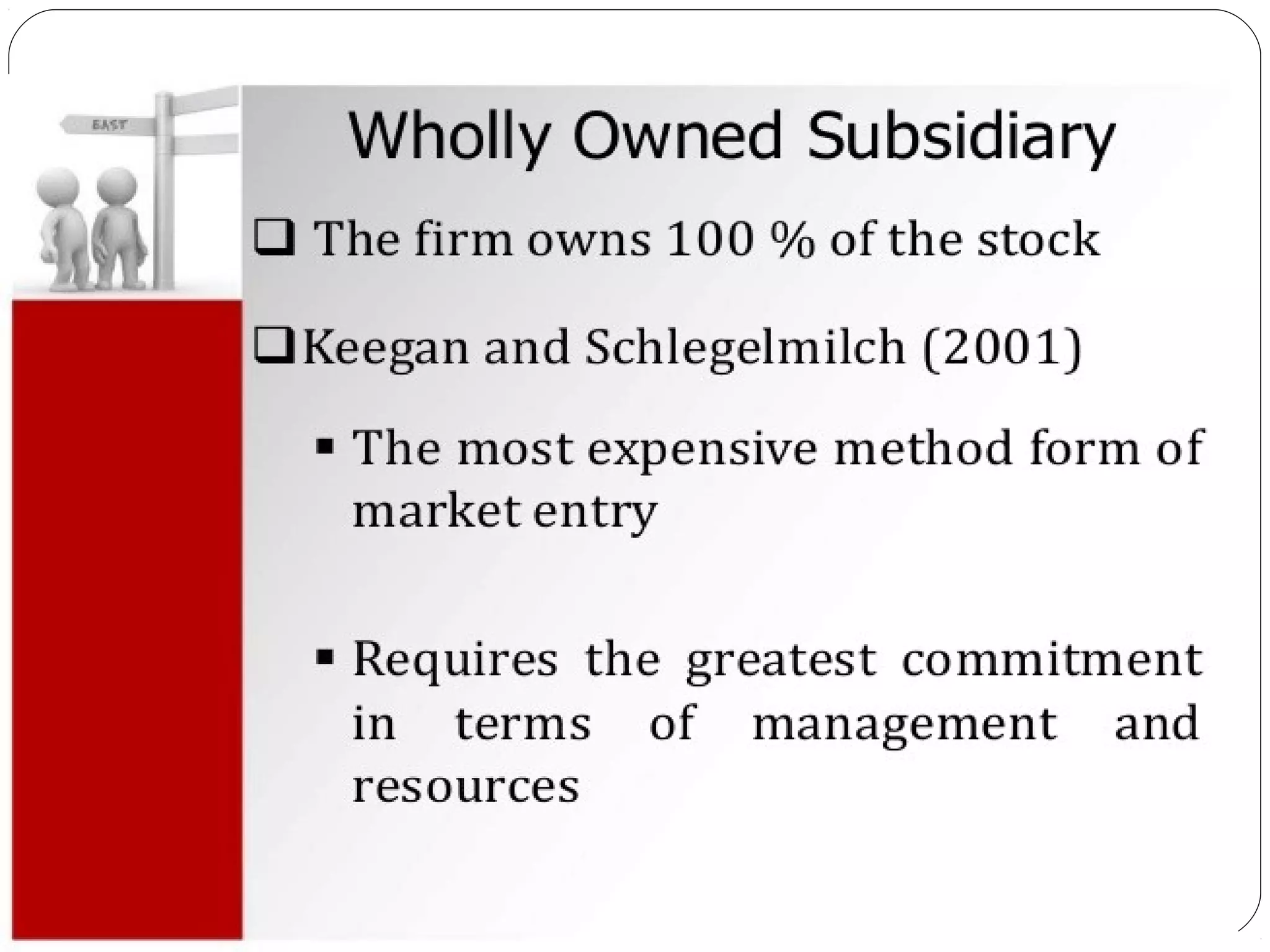
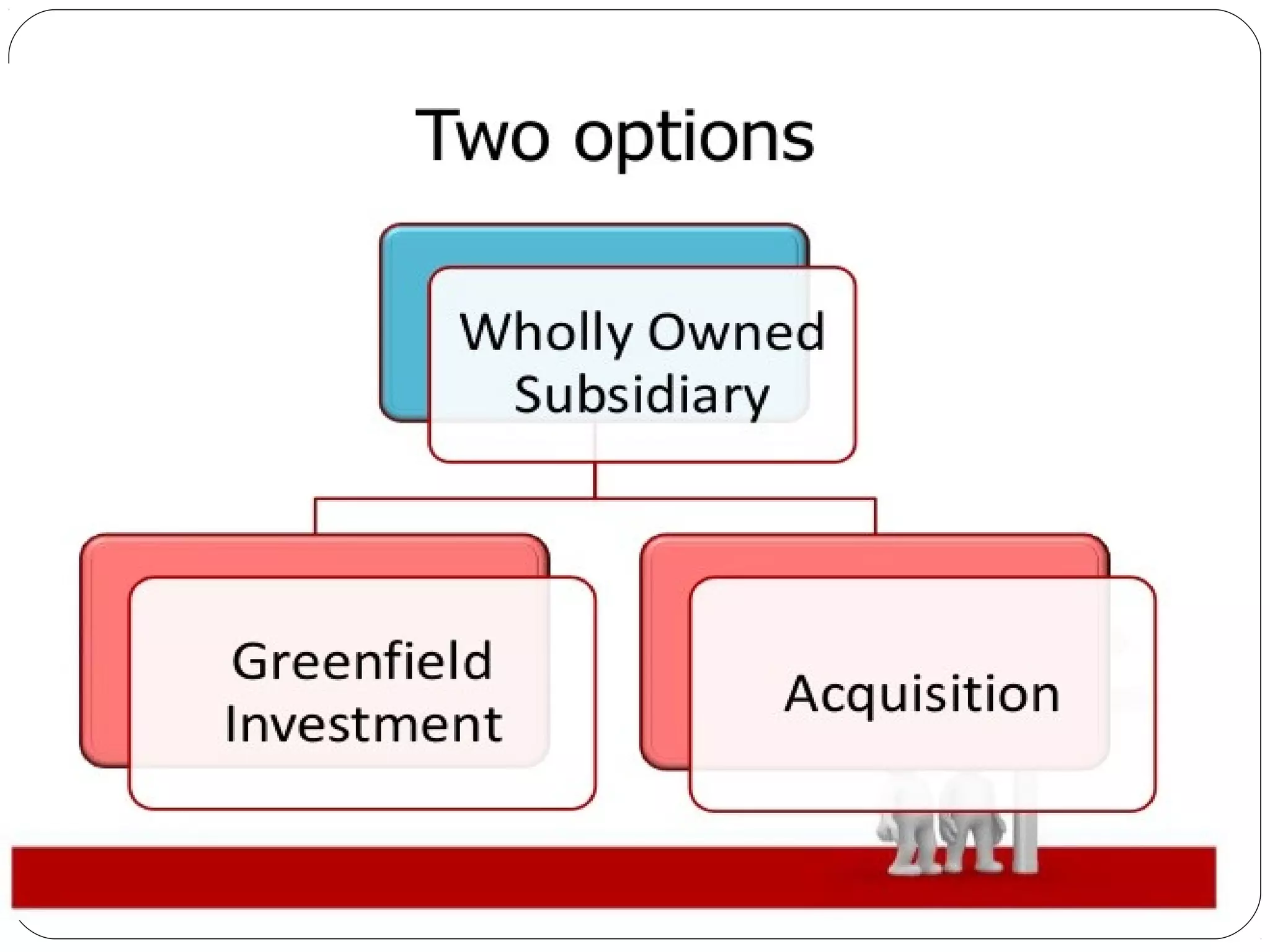
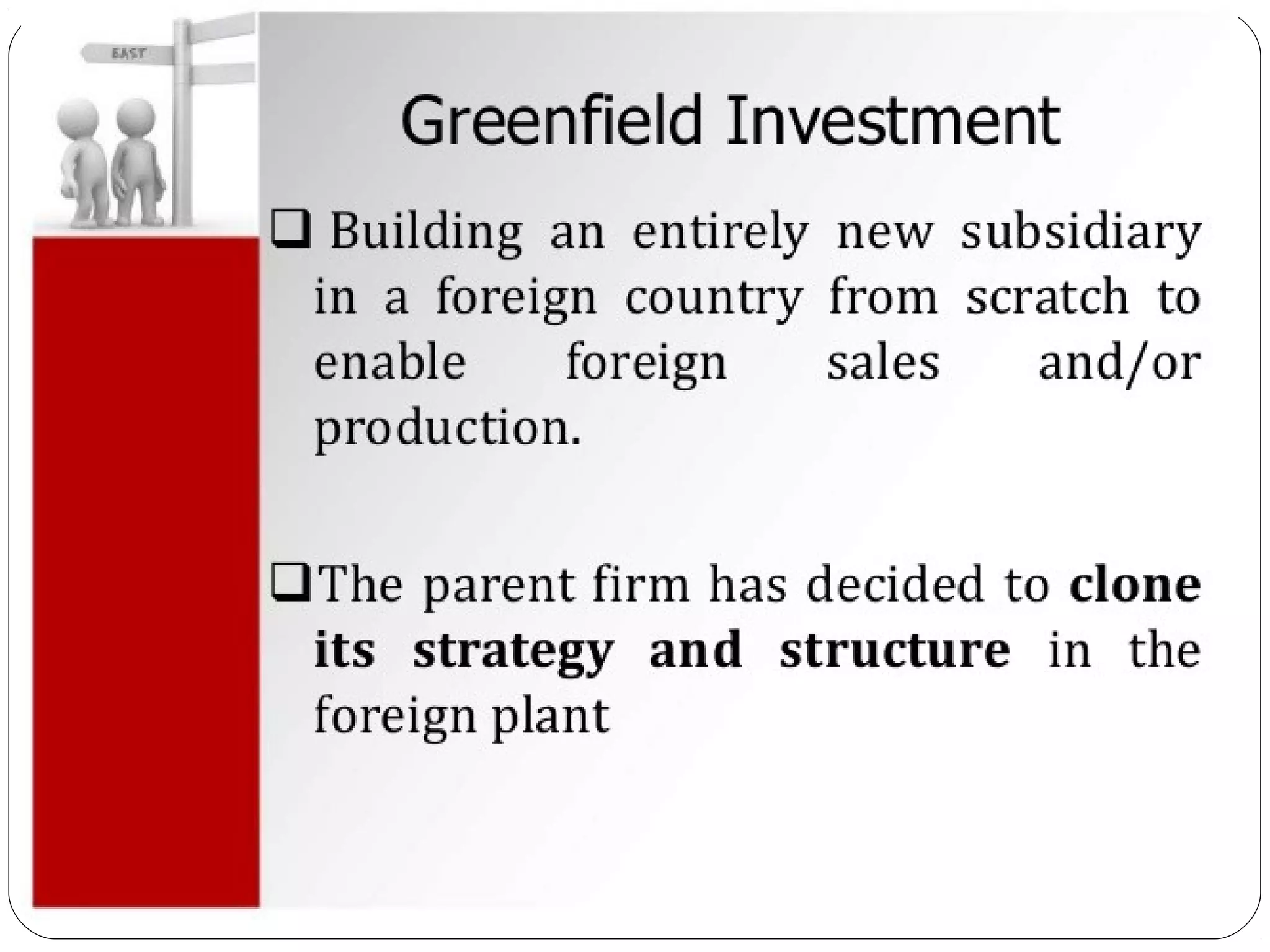
Wholly owned subsidiaries
Licensing and Franchising
Licensing is an international entry mode involving the
granting of permission by the licenser to the licensee to use
intellectual property rights, such as trademarks, patents, or
technology, under defined conditions.
 For example Coca Cola and Pepsi are doing their business in
India through licensing.
Under a licensing agreement, the multinational firm grants rights on its
intangible property to a foreign company for a specified period of time.
The licenser is normally paid a royalty on each unit produced and sold.
Although the multinational firm usually has no ownership interests, it
often provides ongoing support and advice.
Most companies consider this market-entry option of licensing to be a
low-risk option because there’s typically no up-front investment.
Franchising
 under a franchising agreement, the multinational firm grants rights on its intangible
property, like technology or a brand name, to a foreign company for a specified period
of time and receives a royalty in return. The difference is that the franchiser provides a
bundle of services and products to the franchisee.
 For example, McDonald’s expands overseas through franchises. Each franchise pays
McDonald’s a franchisee fee and a percentage of its sales and is required to purchase
certain products from the franchiser. In return, the franchisee gets access to all of
McDonald’s products, systems, services, and management expertise.
 Another example are KFC, Pizza hut.
 Franchising is very common in service industry and licensing is common in
manufacturing industries.
Advantages of licensing
Avoidance of import restriction and transportation cost
Less risky because no investment
Low cost entry mode
Disadvantages of licensing
Confidentiality becomes open
Lack of control on quality
Management contract
In this arrangement a company agrees to manage an independent enterprise
in a foreign target market for a fee over the committed period.
A management contract is an arrangement under which
operational control of an enterprise is guided by contract in a separate
enterprise which performs the necessary managerial functions in
return for a fee.
Management contracts involve not just selling a method of doing
things (as with franchising or licensing) but involve actually doing
them.
A management contract can involve a wide range of functions, such as
technical operation of a production facility, management of personnel,
accounting, marketing services and training.
These contracts are frequently used by firms that provide specialized
services like management, technical knowledge, engineering, IT etc. in a
foreign location for a specified time period and fee.
Management contracts are often formed where there is a lack of local skills
to run a project.
Contract manufacturing
In this international firms negotiates with a foreign company
to manufacture a product for subsequent sale by the former.
To get the product manufactured according to their own
specifications the firm transfers technology and other inputs
to the contract manufacturer.
Advantages: It saves the time to setup manufacturing
capability in a new country. It is very helpful in situation
where the firm has little or no knowledge about the legal
system and formalities of the new country.
Disadvantage: The firm is at a risk of losing some profits
of manufacturing to the local manufacturer. Also, such a
system provides lesser control to the firm compared to
manufacturing in the country.
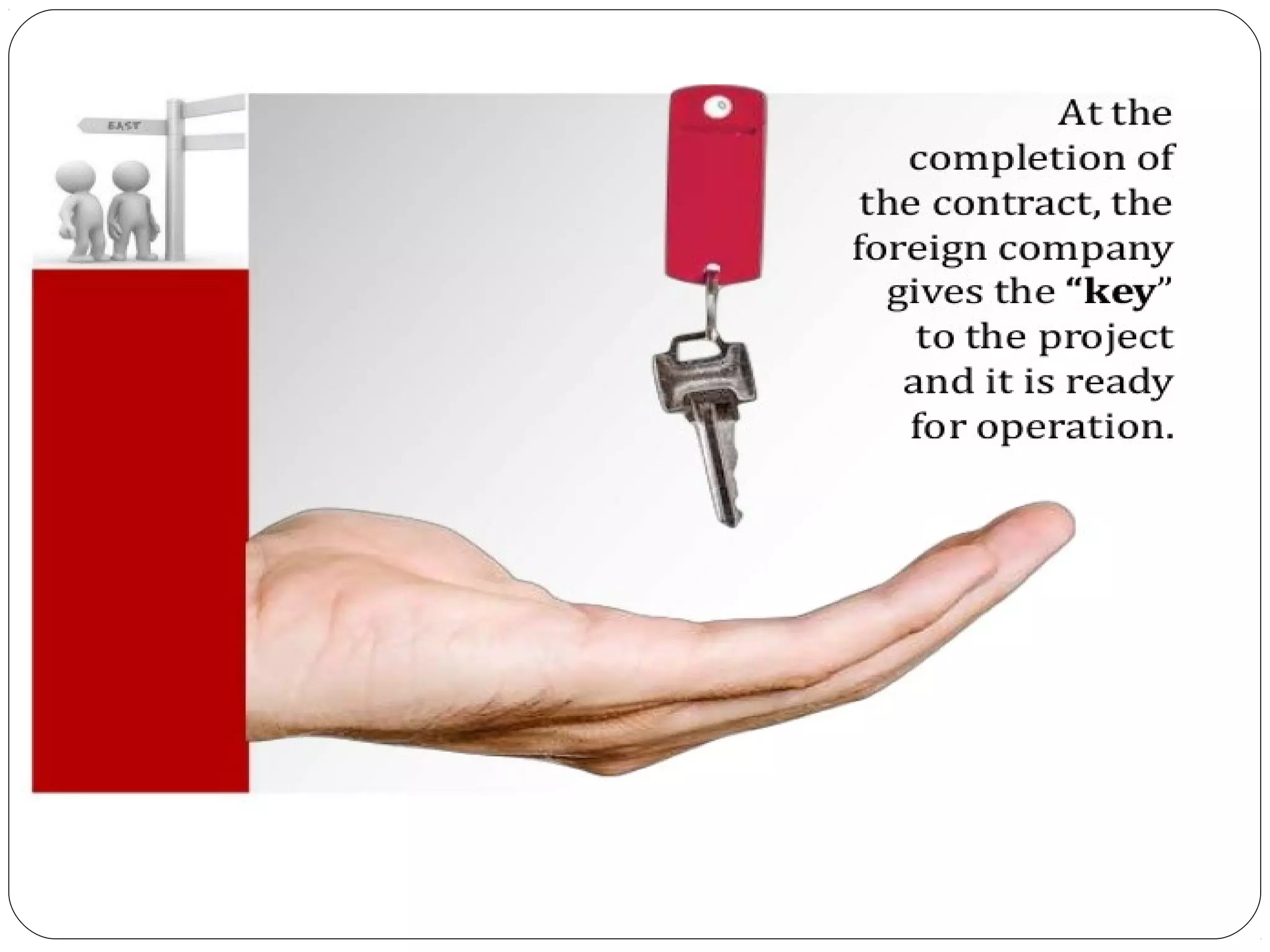
Turnkey operations
In this system the international operator provides a total package of
services ( engineering, construction, financing, training and
management) until the project reaches the final stage when it can be
handed over to its owner.
These are special kind of contracts where a firm construct a facility
start operations, train local personnel and then transfer the facility
to the foreign owner.
These contracts are usually for large infrastructure projects such as
dams, railways airports etc.
Export Entry Modes
Direct Exporting
Indirect Exporting
TWO TYPES OF EXPORTING
Direct Export: Producer sell directly to the
importer.
Indirect Export: A firm in the domestic country do
the exporting for the manufacturer or sale through
export agent.
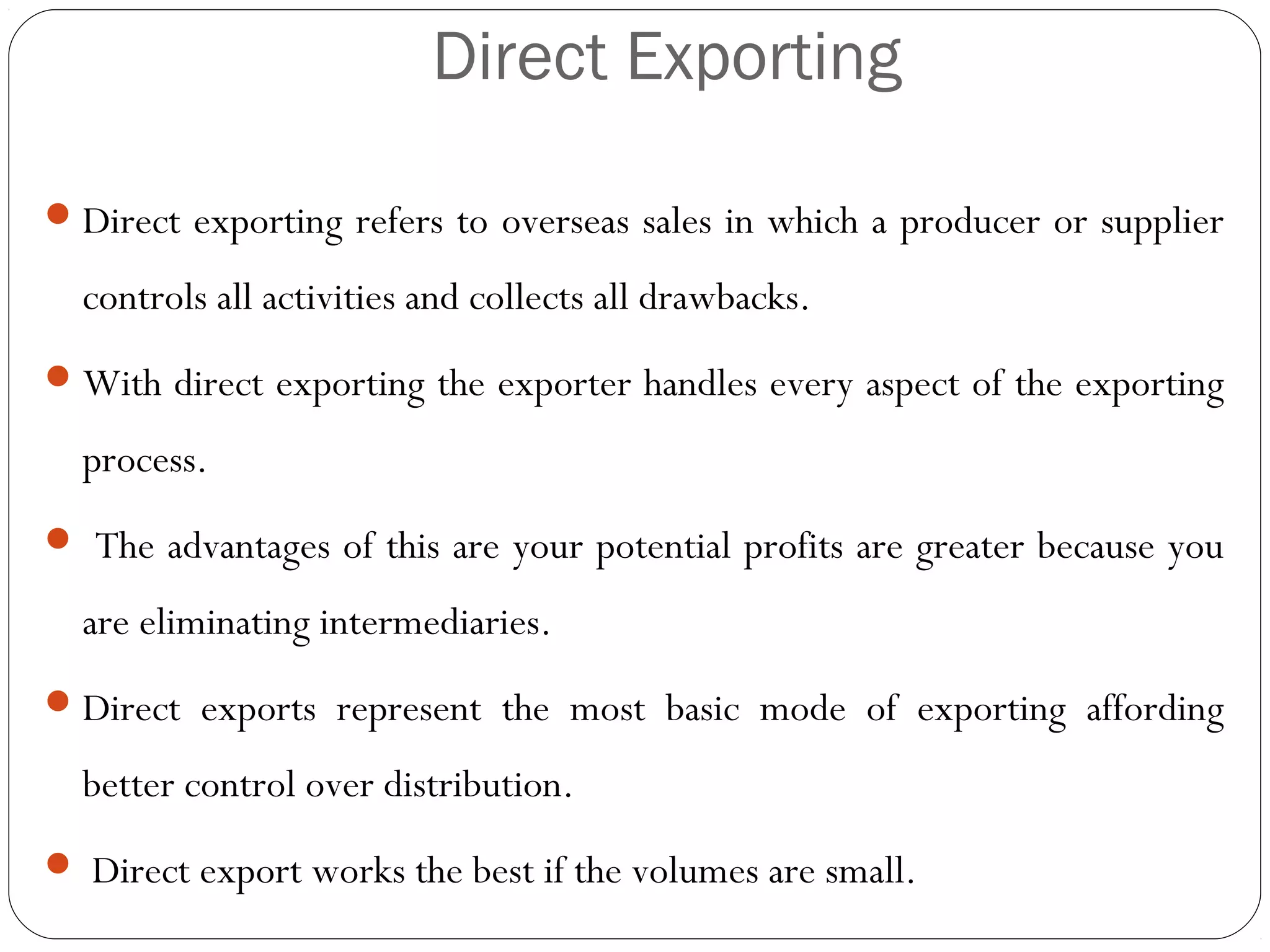
Direct Exporting
Direct exporting refers to overseas sales in which a producer or supplier
controls all activities and collects all drawbacks.
With direct exporting the exporter handles every aspect of the exporting
process.
 The advantages of this are your potential profits are greater because you
are eliminating intermediaries.
Direct exports represent the most basic mode of exporting affording
better control over distribution.
 Direct export works the best if the volumes are small.
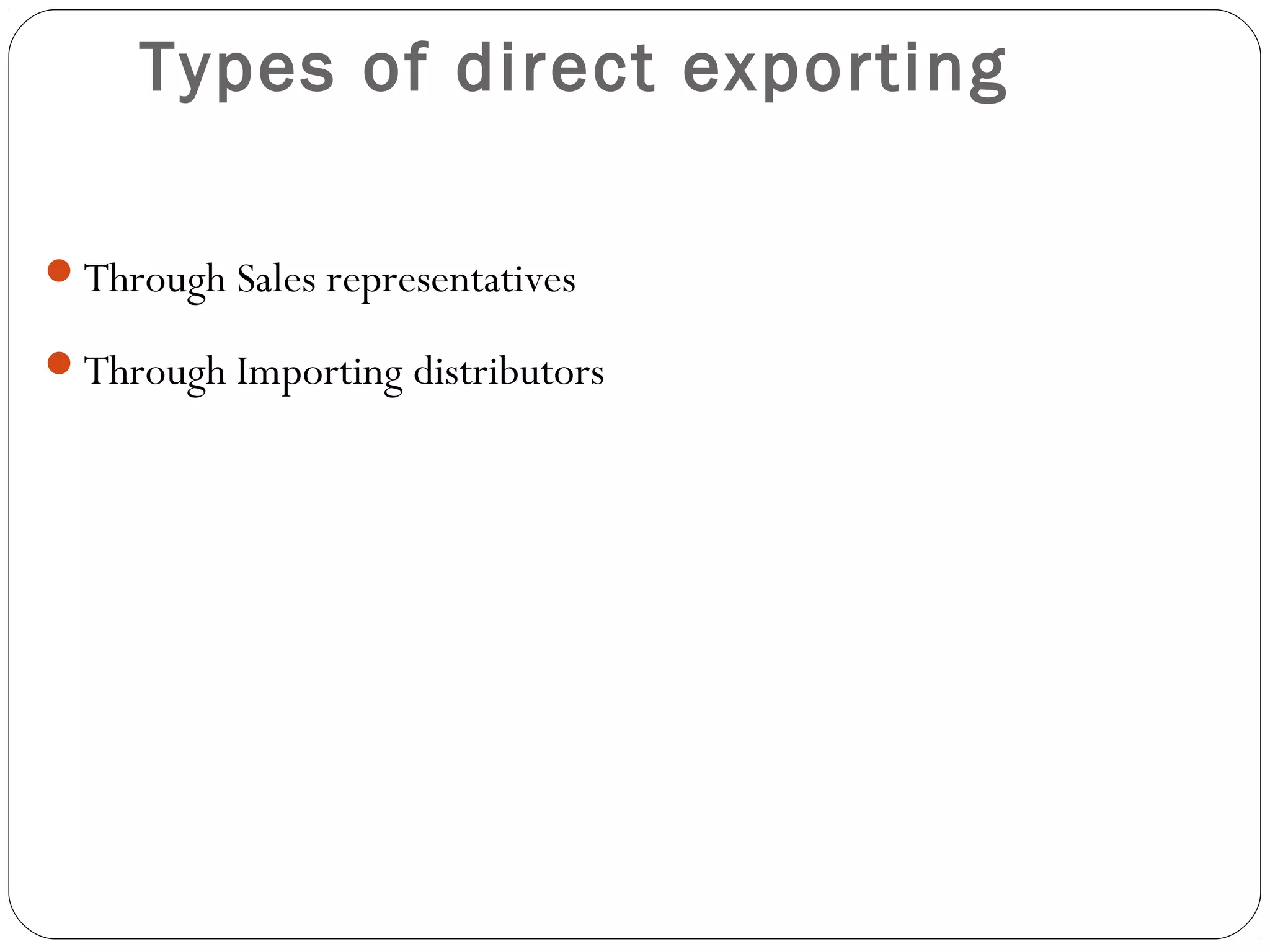
Types of direct exporting
Through Sales representatives
Through Importing distributors
Advantages of direct exporting:
 + Control over selection of foreign markets and choice of foreign representative
companies;
+ Good information feedback from target market;
+ Better protection of trademarks, patents, goodwill, and other intangible property;
+ Potentially greater sales than with indirect exporting.
Disadvantages of direct exporting:
 - Higher start-up costs and higher risks as opposed to indirect exporting;
- Greater information requirements;
- Longer time-to-market as opposed to indirect exporting.
Indirect Exporting
Indirect export is the process of exporting through domestically
based export intermediaries.
Indirect methods of exporting requires less marketing investment,
but, as the exporter has no control over its products in the foreign
market, the company lose substantial control over the marketing
process.
Exports that are not handled directly by the manufacturer or
producer but through an export agent
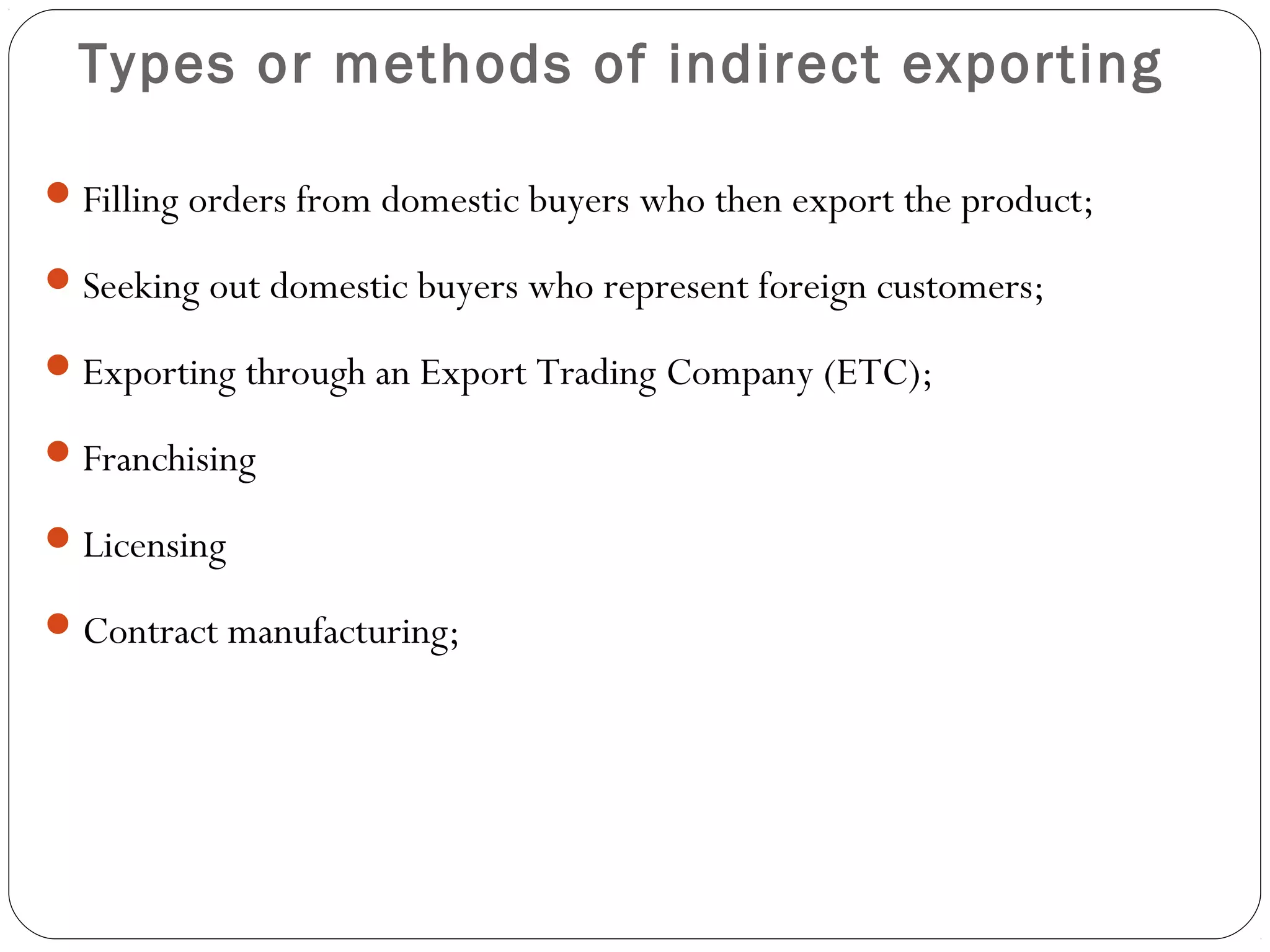
Types or methods of indirect exporting
Filling orders from domestic buyers who then export the product;
Seeking out domestic buyers who represent foreign customers;
Exporting through an Export Trading Company (ETC);
Franchising
Licensing
Contract manufacturing;
Entry Through Investment
Wholly owned manufacturing:
A company with long term interest in a foreign market may
establish fully owned manufacturing facilities. Factors like
trade barriers, cost differences, government policies etc.
encourage the setting up of production facilities in foreign
markets. Manufacturing abroad provides the firm with total
control over quality and production.
Joint Venture
Joint venture is a contractual arrangement between two or more parties
who agree to come together to undertake a business project.
All the parties contribute capital and share profits and losses in a decided
ratio.
Joint Venture is temporary in nature because they are executed for a
definite period of time to accomplish a specific purpose. The contract
automatically dissolves after the expiry of the decided time period.
Popular example for the successful international joint venture is Sony
Ericsson. The joint venture of this company was established on October
2001, it is the joint venture between Japanese Sony Corporation and the
Swedish telecom communications company Ericsson to make mobile
phones and smart phones.
Bajaj Allianz Life Insurance Co., Ltd. , it is the joint venture between the
Indian Motorcycle company Bajaj and German Insurance Giant Allianz
Insurance.
Another awaiting joint venture in India is between India's Bharti group and
the world's largest retailer Wal-Mart .
Some Other Entry Modes
Strategic alliances are partnerships in which two or more
companies work together to achieve objectives that are
mutually beneficial.
Companies may share resources, information, capabilities and
risks to achieve this.
strategic alliance is to obtain the advantage of another
company's innovations without having to invest in new
research and development.
Need for companies for SA
Reduce cost through economies of scale or increased knowledge
Access to new technology
Prohibit entry of new competitors
Enter new market
Improve R&D efforts
Improve quality
Difference Between Merger And
Acquisition
When one company takes over the other and rules all its business
operations, it is known as acquisitions. In this process of
restructuring, one company overpowers the other company.
 Among the two, the one that is financially stronger and bigger in all
ways establishes it power. The combined operations then run under
the name of the powerful entity who also takes over the existing
stocks of the other company.
Another difference is, in an acquisition usually two companies of
different sizes come together to combat the challenges of
downturn and in a merger two companies of same size combine
to increase their strength and financial gains along with breaking the
trade barriers. A deal in case of an acquisition is often done in an
unfriendly manner, it is more or less a forceful or a helpless
association where the powerful company either swallows the
operation or a company in loss is forced to sell its entity. In case of a
merger there is a friendly association where both the partners
hold the same percentage of ownership and equal profit share.
Thank you

L1 new

  • 1.
  • 2.
    Unit 1  Definition,scope, importance and challenges of international marketing, International trade theories, Reasons for going international, economic analysis of multinational trade, International Market Segmentation and Positioning; Screening and Selection of Markets; International Market Entry Strategies: Exporting, licensing, Contract Manufacturing, Joint Venture M & A, Setting-up of Wholly Owned Subsidiaries Aboard, Strategic Alliances.
  • 3.
    Unit 2  InternationalMarketing Environment: Political, Legal, Environmental, Socio Cultural and Technological environment, Country Risk Analysis, International Economic Environment: IMF, WTO, International Monetary System, International Trade Barriers: Tariff and Non Tariff Regional Blocks: European Union, NAFTA, SAARC, ASEAN, MERCOSUR, International Marketing Research, Selection of export markets.
  • 4.
    Unit 3  Direction& composition of Indian exports, Indian export and import policy export promotion organizations, export, incentives, Producing for exports, export quality control; export finance, shipment and procedures thereof, Export documents
  • 5.
    Unit 4  Processingof an export order, organization and structure of export and import houses. International product policy: Product standardization & adaptation, international, product mix, International product life cycle, new product development, exports packaging, International pricing policy: Factors influencing selection of pricing policies, international pricing strategies, International distribution policy: Factors influencing selection of international distribution channels, types of international distribution channels, role of internet in international distribution International communication policy: communication strategies in international marketing, international promotion mix.  Relevant case studies related to the topics should be discussed.
  • 6.
    Books for reference Internationalmarketing by francis cherunilam (Himalaya Publication) International marketing strategy and theory By sak onkvisit and john j. shaw
  • 7.
    1. International businessVs international marketing 2. Domestic marketing Vs international marketing 3. Importance/Advantages of international marketing 4. International Orientation (EPRG Framework) 5. Stages of Internationalization 6. Reasons for Entering International markets 7. Factors that reinforces to take interest in International Marketing in Modern Times 8. Scope of international marketing/ market entry strategies
  • 8.
    International Business:- Internationalbusiness means carrying of business activities beyond national boundaries. These activities include normally the transactions of economic resources such as goods, capital and services comprising of technology, skilled labor, transportation etc. They also include international production. The production may embrace either production of physical goods or providing services like banking, finance, insurance, construction, trading etc. International Marketing:- International marketing is an important aspect of international business. international marketing is the performance of business activities designed to plan. price, promote and direct the flow of a company's goods and services to consumers.
  • 9.
    Domestic Marketing Marketing focuseson the satisfaction of customer needs, wants and requirements. There is normally a focus upon profitability, but marketing focuses on profitability through customer satisfaction.
  • 10.
    DEFINITION OF INTERNATIONAL MARKETING Internationalmarketing is the application of marketing orientation and marketing capabilities to international business. International marketing is the performance of business activities designed to plan, price, promote and direct the flow of company’s goods and services to consumers in more than one nation for profit.
  • 11.
    DEFINITION OF INTERNATIONAL MARKETING InternationalMarketing can be defined as exchange of goods and services between different national markets involving buyers and sellers. According to the American Marketing Association: “International Marketing is the multi-national process of planning and executing the conception, prices, promotion and distribution of ideal goods and services to create exchanges that satisfy the individual and organizational objectives.”
  • 12.
    Comparing Domestic andInternational Marketing Similarity: - Both carry out transactions that meet the needs of individuals and organizations Differences: - International markets have greater growth potential -Some tasks associated with international marketing not included or less intense than in domestic marketing (e.g., cultural research, political factors, exchange rates, trade laws, long distance distribution.)
  • 13.
    Domestic marketing Vsinternational marketing Domestic marketing international marketing Single country involved Single currency Market segmentation defined with in a single country Single language Cultural differences are not much More than one country involved Varying currencies hence exchange rate fluctuation risk . Segments are defined across national boundaries Multilingual communication Cultural differences are very difficult to tackle.
  • 14.
    Domestic marketing Vsinternational marketing Domestic marketing international marketing Competition is easy to observe and assess. Processing and documentation is easy and simple. Control on intermediary and distribution channel Research data is easily assessed and available in single language. Competition is quite unpredictable and difficult to measure and analyze. Documentation is quite diverse and complicated. Distribution left on intermediaries. Research data is difficult to obtain, interpret and often expensive.
  • 15.
    Domestic marketing Vsinternational marketing Domestic marketing international marketing Business regulations and legal laws are clearly understood. Less political risk Business regulations and legal laws are not clearly understood. More political risk.
  • 16.
    Importance/Advantages of international marketing Higherprofitability Market expansion Brand reputation Global Networking survival Better standard of living
  • 17.
    The Importance ofInternational Marketing For US-based companies, 75% of sales potential is outside the US. About 90% of Coca-Cola’s operating income is generated outside the US. For Japanese companies, 85% of potential is outside Japan. For German and EU companies, 94% of potential is outside Germany.
  • 18.
  • 19.
    A business approachor philosophy that focuses on identifying and meeting the stated or hidden needs or wants of customers. The assumption underlying the EPRG framework is that the stage of internationalization and business approach affects the specific international strategies and decision rules of the firm. Ethnocentrism(home country orientation) Polycentrism (host country orientation) Regiocentrism (regional orientation) Geocentrism ( world orientation)
  • 20.
    Ethnocentrism(home country orientation): Overseasoperations are secondary to domestic operations. Assumes what succeeds in the home country will also succeed in other countries Only a means of disposing surplus. Domestic techniques and personnel are superior to foreign. Overseas marketing is administered by an export department and usually goods are manufactured at the home base . According to this approach “management philosophy, domestic technology, strategies and even personnel are far more superior to foreign operations and are a perfect fit for foreign operations as well” Example are Nissan in 60s, Coke in the late 80s/early 90s
  • 21.
    Polycentrism (host countryorientation): Put emphasis on differences between markets which is caused by variation such as culture, customs, laws and politics. This approach is based on the assumption that each market is unique in terms of its market environment such as political, cultural, legal, economic, consumer behavior and market structure. Highly localized / adapted approach to marketing In this approach emphasis is on local laws, customs and culture and great care is taken to understand the local ways of doing business.
  • 22.
    Polycentrism (host countryorientation): The product features are tailored to the local domestic environment, taking into account different food preferences, religious customs and other characteristics that define the locality. Companies choose to follow this strategy because their products will be better received by local customers, rather than seen as something unusual that is produced by a foreign company.
  • 23.
    Regiocentrism(regional orientation): differentregions as different market. Organizational approach and product policy tend to be implemented at regional level. Treat a world region as one homogeneous market (e.g. NAFTA region; the EU, etc.) Localization / adaptation for the region;  for example Mc Donald’s strategy is not to serve pork in Muslim countries.
  • 24.
    Geocentrism( world orientation): Entireworld is single market and developed standardized marketing mix projecting a uniform image of the company and its products for the global market. World view – focused on standardizing programs but will adapt if indicated by research Global / transnational company E.g. Toyota, palmolive, philips, electrolux
  • 25.
    Geo-centrism( world orientation): Avery well-known cola soft drink is one example of a transnational product. This company's beverage recipe is kept secret and has not changed in many years. The product is sold in over 200 countries worldwide, and this beverage company retains exactly the same beverage formulation in each country. The bottle’s label may reflect the local language, but the logo and contents remain the same.
  • 26.
    Management Orientations Ethnocentric: Home countryis Superior, sees Similarities in foreign Countries Regiocentric: Sees similarities and differences in a world Region; is ethnocentric or polycentric in its view of the rest of the world Geocentric: World view, sees Similarities and Differences in home And host countries Polycentric: Each host country Is Unique, sees differences In foreign countries
  • 27.
  • 28.
    1. Domestic Marketing:Companies manufacturing products and selling those within the country itself. So, no international phenomenon at all. 2. Foreign Marketing: It refers to domestic marketing within the foreign country. Approach of marketer in this stage is said to be ‘ethnocentric’ because although he is selling goods to foreign countries, product development is totally based upon the taste of local customer. So, focus is still on domestic market 3. International Marketing: Now, company starts selling products to various countries and the approach is ‘Polycentric’ i.e. making different products for different countries.
  • 29.
    4. Multinational Marketing: Now, in this stage, the number of countries in which the company is doing business gets bigger than that in earlier stage. And so, instead of producing different goods for different countries, company tries to identify different regions for which it can deliver same product. So, same product for countries lying in one region but different from product offered in countries of another region. e.g. a company may decide to offer same product to India, Sri lanka and Pakistan if it thinks the taste of people of these countries is same but at the same time offering different product for American countries. This approach is called ‘Regiocentric approach’.
  • 30.
    5. Global Marketing:This is the final stage of evolution. In this stage company really operates in a very large number of countries and for the purpose of achieving cost efficiencies it analyses the requirement and taste of customers of all the countries and come out with a single product which can satisfy the needs of all. This approach is called ‘Geocentric approach’.
  • 31.
    Reasons for EnteringInternational markets 1. Growth-  When the domestic market potential saturates.  Firm enter international markets to explore opportunities their.  Companies having small home market like-Singapore, Hongkong, Japan. Nissan, Sony, Toyota, Canon etc.
  • 32.
    2. Profitability-  Pricedifferentials and enhanced profits in international markets.  Exemption from indirect taxes and duties, several incentives by government for export oriented production, marketing support schemes contribute to enhance the profitability of firms. Example- Apple earn 390 million U.S dollar net profit from foreign land and 310 m U.S dollar from domestic land.
  • 33.
    3. Achieving Economicsof Scale-  Large scale production capabilities in international markets.  Large scale production, reduction in unit production cost. Example- world market is 4 times larger than U.S market 4. Risk spread-  Overseas markets provide an opportunity to reduce their dependence on one market and spread the market risks.  It reduces dependence on one market only.
  • 34.
    5. Uniqueness ofproduct or service-  The products with unique attributes in order to meet competition in the overseas markets and enjoy enormous opportunities in international markets. Handicraft, Software development etc.
  • 35.
    6. Quality-  Qualityand cost are the two important determinants of demand & these can better achieved in global firm. 7. World Economic Trends-  Fast growth of developing economies has created new marketing opportunities and has provided a major incentive for companies to expand globally. Liberalization, privatization and globalization movement is opening up closed markets and has provided opportunities and threats.
  • 36.
    8. Leverage – Leverage is an advantage that a company enjoys that conducts business in more than one country. Example –Skills exchange, scale economics, resource utilization etc.
  • 37.
    Factors that reinforcesto take interest in International Marketing in Modern Times  Income growth of the consumers  Lower trade barriers  Desire for new products, around the world Search for new markets/new avenues/new segments Demand for new styled goods/ services– innovative goods. Integration of telecommunication facilities/communication Faster means of travel, transport, technology.
  • 38.
    SCOPE OF INTERNATIONALMARKETING Exports and Imports: international trading Joint Ventures: A joint venture comes into existence when a foreign investor acquires interest in a local company and vice versa or when overseas and local firms jointly form a new firm.
  • 39.
    Wholly owned manufacturing:A company with long term interest in a foreign market may establish fully owned manufacturing facilities. Manufacturing abroad provides the firm with total control over quality and production. 18 of the world top manufacturing companies have set up their manufacturing and R&D facilities in china. For example, Nokia mobile phones are manufactured in India (along with other global locations) for exports worldwide.
  • 40.
    Contract manufacturing: Whena firm enters into a contract with other firm in foreign country to manufacture and assembles the products and retains product marketing with itself, it is known as contract manufacturing. Asian countries being the prime focus for big pharmaceutical companies looking to outsource. This is primarily due to the advantage of low production costs in Asia in comparison to other regions.
  • 41.
    Management contracting Management contracting: the supplier brings a package of skills that will provide an integrated service to the client without incurring the risk and benefit of ownership.  A management contract is an agreement between the management company (operator) and a property owner (investor), whereby the operator assumes complete responsibility for managing the asset. For this service, the operator is paid a fee based on a prescribed formula.
  • 42.
    Strategic alliances: Afirm is able to improve the long term competitive advantage by forming a strategic alliance with its competitors. Strategic alliances are partnerships in which two or more companies work together to achieve objectives that are mutually beneficial. Companies may share resources, information, capabilities and risks to achieve this. strategic alliance is to obtain the advantage of another company's innovations without having to invest in new research and development.
  • 43.
    Apple has partneredwith Sony, Motorola, Phillips, and AT&T . ICICI Bank, India’s largest private sector bank and Vodafone India, one of India’s largest telecom service providers, announced a strategic alliance to launch a unique mobile money transfer and payment service called ‘m-pesa’. ‘m-pesa’ is the trademark of Vodafone. 
  • 44.
    Counter trade: Countertrade is a form of international trade in which export and import transactions are directly interlinked i.e. import of goods are paid by export of goods. It is therefore a form of barter between countries. North-Eastern China, sharing the borders with Russia, North Korea and Mongolia. The Chinese are doing barter trade since the days of the Japanese occupation of Korea and Mongolia. China sells coal in exchange for Russian crude oil. countries who have problems with hard cash. Barter Trading is also one of the most reliable way of doing business in CUBA .
  • 45.
    MARKETING ENTRY STRATEGIES Contractual entrymodes Licensing Franchising Management contracts Contract manufacturing Turnkey operations Export entry modes Direct exporting Indirect exporting Entry through investment Joint venture Wholly owned subsidiaries
  • 46.
    Licensing and Franchising Licensingis an international entry mode involving the granting of permission by the licenser to the licensee to use intellectual property rights, such as trademarks, patents, or technology, under defined conditions.  For example Coca Cola and Pepsi are doing their business in India through licensing.
  • 47.
    Under a licensingagreement, the multinational firm grants rights on its intangible property to a foreign company for a specified period of time. The licenser is normally paid a royalty on each unit produced and sold. Although the multinational firm usually has no ownership interests, it often provides ongoing support and advice. Most companies consider this market-entry option of licensing to be a low-risk option because there’s typically no up-front investment.
  • 48.
    Franchising  under afranchising agreement, the multinational firm grants rights on its intangible property, like technology or a brand name, to a foreign company for a specified period of time and receives a royalty in return. The difference is that the franchiser provides a bundle of services and products to the franchisee.  For example, McDonald’s expands overseas through franchises. Each franchise pays McDonald’s a franchisee fee and a percentage of its sales and is required to purchase certain products from the franchiser. In return, the franchisee gets access to all of McDonald’s products, systems, services, and management expertise.  Another example are KFC, Pizza hut.  Franchising is very common in service industry and licensing is common in manufacturing industries.
  • 49.
    Advantages of licensing Avoidanceof import restriction and transportation cost Less risky because no investment Low cost entry mode Disadvantages of licensing Confidentiality becomes open Lack of control on quality
  • 50.
    Management contract In thisarrangement a company agrees to manage an independent enterprise in a foreign target market for a fee over the committed period. A management contract is an arrangement under which operational control of an enterprise is guided by contract in a separate enterprise which performs the necessary managerial functions in return for a fee. Management contracts involve not just selling a method of doing things (as with franchising or licensing) but involve actually doing them.
  • 51.
    A management contractcan involve a wide range of functions, such as technical operation of a production facility, management of personnel, accounting, marketing services and training. These contracts are frequently used by firms that provide specialized services like management, technical knowledge, engineering, IT etc. in a foreign location for a specified time period and fee. Management contracts are often formed where there is a lack of local skills to run a project.
  • 52.
    Contract manufacturing In thisinternational firms negotiates with a foreign company to manufacture a product for subsequent sale by the former. To get the product manufactured according to their own specifications the firm transfers technology and other inputs to the contract manufacturer.
  • 53.
    Advantages: It savesthe time to setup manufacturing capability in a new country. It is very helpful in situation where the firm has little or no knowledge about the legal system and formalities of the new country. Disadvantage: The firm is at a risk of losing some profits of manufacturing to the local manufacturer. Also, such a system provides lesser control to the firm compared to manufacturing in the country.
  • 56.
    Turnkey operations In thissystem the international operator provides a total package of services ( engineering, construction, financing, training and management) until the project reaches the final stage when it can be handed over to its owner. These are special kind of contracts where a firm construct a facility start operations, train local personnel and then transfer the facility to the foreign owner. These contracts are usually for large infrastructure projects such as dams, railways airports etc.
  • 62.
    Export Entry Modes DirectExporting Indirect Exporting
  • 66.
    TWO TYPES OFEXPORTING Direct Export: Producer sell directly to the importer. Indirect Export: A firm in the domestic country do the exporting for the manufacturer or sale through export agent.
  • 67.
    Direct Exporting Direct exportingrefers to overseas sales in which a producer or supplier controls all activities and collects all drawbacks. With direct exporting the exporter handles every aspect of the exporting process.  The advantages of this are your potential profits are greater because you are eliminating intermediaries. Direct exports represent the most basic mode of exporting affording better control over distribution.  Direct export works the best if the volumes are small.
  • 68.
    Types of directexporting Through Sales representatives Through Importing distributors
  • 69.
    Advantages of directexporting:  + Control over selection of foreign markets and choice of foreign representative companies; + Good information feedback from target market; + Better protection of trademarks, patents, goodwill, and other intangible property; + Potentially greater sales than with indirect exporting. Disadvantages of direct exporting:  - Higher start-up costs and higher risks as opposed to indirect exporting; - Greater information requirements; - Longer time-to-market as opposed to indirect exporting.
  • 70.
    Indirect Exporting Indirect exportis the process of exporting through domestically based export intermediaries. Indirect methods of exporting requires less marketing investment, but, as the exporter has no control over its products in the foreign market, the company lose substantial control over the marketing process. Exports that are not handled directly by the manufacturer or producer but through an export agent
  • 71.
    Types or methodsof indirect exporting Filling orders from domestic buyers who then export the product; Seeking out domestic buyers who represent foreign customers; Exporting through an Export Trading Company (ETC); Franchising Licensing Contract manufacturing;
  • 72.
  • 73.
    Wholly owned manufacturing: Acompany with long term interest in a foreign market may establish fully owned manufacturing facilities. Factors like trade barriers, cost differences, government policies etc. encourage the setting up of production facilities in foreign markets. Manufacturing abroad provides the firm with total control over quality and production.
  • 80.
    Joint Venture Joint ventureis a contractual arrangement between two or more parties who agree to come together to undertake a business project. All the parties contribute capital and share profits and losses in a decided ratio. Joint Venture is temporary in nature because they are executed for a definite period of time to accomplish a specific purpose. The contract automatically dissolves after the expiry of the decided time period.
  • 81.
    Popular example forthe successful international joint venture is Sony Ericsson. The joint venture of this company was established on October 2001, it is the joint venture between Japanese Sony Corporation and the Swedish telecom communications company Ericsson to make mobile phones and smart phones. Bajaj Allianz Life Insurance Co., Ltd. , it is the joint venture between the Indian Motorcycle company Bajaj and German Insurance Giant Allianz Insurance. Another awaiting joint venture in India is between India's Bharti group and the world's largest retailer Wal-Mart .
  • 82.
  • 84.
    Strategic alliances arepartnerships in which two or more companies work together to achieve objectives that are mutually beneficial. Companies may share resources, information, capabilities and risks to achieve this. strategic alliance is to obtain the advantage of another company's innovations without having to invest in new research and development.
  • 85.
    Need for companiesfor SA Reduce cost through economies of scale or increased knowledge Access to new technology Prohibit entry of new competitors Enter new market Improve R&D efforts Improve quality
  • 89.
    Difference Between MergerAnd Acquisition When one company takes over the other and rules all its business operations, it is known as acquisitions. In this process of restructuring, one company overpowers the other company.  Among the two, the one that is financially stronger and bigger in all ways establishes it power. The combined operations then run under the name of the powerful entity who also takes over the existing stocks of the other company.
  • 90.
    Another difference is,in an acquisition usually two companies of different sizes come together to combat the challenges of downturn and in a merger two companies of same size combine to increase their strength and financial gains along with breaking the trade barriers. A deal in case of an acquisition is often done in an unfriendly manner, it is more or less a forceful or a helpless association where the powerful company either swallows the operation or a company in loss is forced to sell its entity. In case of a merger there is a friendly association where both the partners hold the same percentage of ownership and equal profit share.
  • 91.

Editor's Notes

  • #27 Ethnocentrism is sometimes associated with attitudes of national arrogance or assumptions of national superiority. Company personnel with an ethnocentric orientation see only similarities in markets, and assume that products and practices that succeed in the home country will be successful anywhere. The term polycentric describes management’s belief or assumption that each country in which a company does business is unique. This assumption lays the groundwork for each subsidiary to develop its own unique business and marketing strategies in order to succeed; the term multinational company is often used to describe such a structure. In a company with a regiocentric orientation, a region becomes the relevant geographic unit; management’s goal is to develop an integrated regional strategy. A company with a geocentric orientation views the entire world as a potential market and strives to develop integrated world market strategies.