Marketing a Mediation Practice
What are we going to do this evening? The Challenge Are you ready? Getting down to business What could stop you? Next Steps
The Challenge  “ Negotiation has hardly ever been the first preference for settling conflict”  “ Most resort to negotiation and mediation only as a last resort” “ Most people still prefer to go to lawyers and hesitate, or even refuse to go to a mediator” “ Few people purchase products or services rationally” “ In most disputes one party views the opposing party as more responsible for the conflict and less credible, reasonable or trustworthy and exaggerate their own credibility and strength. People in disputes question the motives and character of the other party, especially if they are an ‘intimate enemy’ such as a spouse, employee or business partner.” “ This bias, or misperception of the other party is commonly joined with an unrealistic sense of confidence and excessive optimism that they will ‘win’ in court or in any other contest of the ‘truth’, skewing the ability to clearly assess the risks and benefits and often leading to greater resistance to negotiation.” A service must enhance the buyers self esteem or moderate a fear and minimise a personal insecurity
The Response Garner trust – lead with an emotional appeal that anticipates, addresses and minimises the prospective parties real or perceived fears, risks, desires and needs and weaves in a practical rationale for proceeding to try the process Emphasise personal contact – project competence to manage difficult matters Target their worst fears – help them feel they can make good decisions with sufficient time and information and access to a professional through mediation Turn mediation into a demonstration of the parties strength
Who are we talking to? What matters to them? Often not the people that will participate Those that must use the service eg. government, legal entities Those that are accustomed to using the service eg. VCAT, Family Services, government Those you work for in a number of roles Referrers eg. other mediators, agencies etc
Are you ready? Confidence  –  projects an air of confidence when dealing with others Drive  –  Is hungry for success and propels oneself to meet tough targets Resilience  –  has optimism, perseveres in tough situations and looks out for new opportunities Adaptability  –  Adopts the most appropriate style to maximise the ability to relate to clients and prospects Listening  –  Listens sympathetically, observes vigilantly Embracing change  –  Can adapt to dramatic and continued changes in workplace or the environment
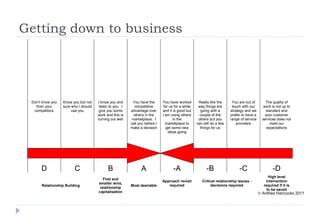
Getting down to business    Anthea Hancocks 2011
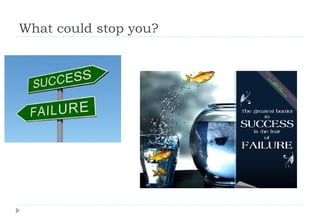
What could stop you?
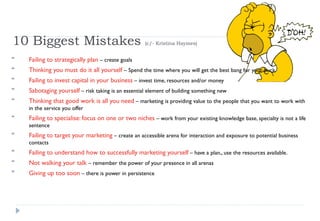
10 Biggest Mistakes  (c/- Kristina Haymes) Failing to strategically plan  – create goals Thinking you must do it all yourself  – Spend the time where you will get the best bang for your buck Failing to invest capital in your business  – invest time, resources and/or money Sabotaging yourself  – risk taking is an essential element of building something new Thinking that good work is all you need  – marketing is providing value to the people that you want to work with in the service you offer Failing to specialise: focus on one or two niches  – work from your existing knowledge base, specialty is not a life sentence Failing to target your marketing  – create an accessible arena for interaction and exposure to potential business contacts  Failing to understand how to successfully marketing yourself  – have a plan,, use the resources available. Not walking your talk  – remember the power of your presence in all arenas Giving up too soon  – there is power in persistence
Your profile  What can you do to raise your profile? 9 ideas in 2 minutes Share them with each other  Share them with the group
Pick a method that works for you….. Writing Speaking/presenting Word of mouth referrals Be a conduit – people, research, services  Strategic follow-up Internet/web presence/social media Press releases/ media engagement  Industry/sector specific  Look for methodologies, tips sheets etc.  Have a brand identity – what do you stand for? Maintain lists  (NB Privacy/SPAM Act) Your personal bio Photo Brochure Testimonials  Excerpts from speeches Partnering with professional colleagues Target organisations using multiple providers  Serve the cause for free (local boards, join trade organisations) Use holidays to your advantage – meet people  Foster referrals  Maintain your networks
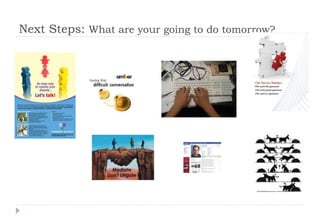
Next Steps:  What are your going to do tomorrow?
Market to your existing clients Focus on clients who have significant opportunity and with whom you enjoy working.  Review your list of top clients For each think about the issues and opportunities that they will face in the coming year, consider financial, economic, business and legal ones.  Rank the list in terms of the size of the opportunity and the depth/quality of your relationship Pick the top client and list three questions you should ask them to see if the opportunities/issues are valid.  Call and schedule a breakfast or lunch meeting with them to discuss
Next Steps:  What are you going to do next week?
Client referrals and introductions Get your clients to call and make introductions for you.  Describe your ideal client in as specific detail as possible Review your client list (above) and a select a client who: Knows a lot of your ideal clients and  Where you have a strong working relationships  Think about what you could do for them and why they will help Call to make an appointment for breakfast or lunch Ask them to make 1-2 introductions for you in the coming month
Networking  Practice a self introduction Arrive at events early and work the room Act like the host not the guest Be a problem finder and a problem solver, be curious Networking is long term, help now, expect results later Have a flexible mind, no two customers are exactly the same Look at who you are spending time with, what type of future will they help you create
Next Steps:  What are you going to do next month?
External development Identify an external professional and figure out a plan to go to market together as a team and be first on each others list for referrals and introductions  Think about the professional you know in related professions such as accounting, investment banks, risk management etc. Identify professional who also work with some of your top clients Prioritise this list based on  Their access to your type of ideal clients Their marketing win work  Your degree of trust and personal chemistry with them Set up a lunch and ask how they plan to build their business over the year. Look for synergies. Identify ways that you can help them.  Discuss 1 - 2 joint marketing efforts eg. write joint case studies, start a “bring a client to lunch” series, or team up with them to conduct a breakfast roundtable Agree on the immediate next steps
External advocates Find someone who already knows many of your ideal prospective  clients and see how you can work together.  Think about someone who is active in an organisation such as an association where you would find your ideal clients eg. a Chairman or Program Chair of the Association Meet and ask them what are their 2 - 3 biggest challenges they face in building their association over the next year. Agree on a role that you could play in solving this problem Ask for their help in making introductions for you to your ideal prospective clients.
Final thought  "Doing business without advertising is like  winking at a girl in the dark.  You  know what you're doing, but nobody else does."

Marketing a mediation_practice[1]

  • 1.
  • 2.
    What are wegoing to do this evening? The Challenge Are you ready? Getting down to business What could stop you? Next Steps
  • 3.
    The Challenge “ Negotiation has hardly ever been the first preference for settling conflict” “ Most resort to negotiation and mediation only as a last resort” “ Most people still prefer to go to lawyers and hesitate, or even refuse to go to a mediator” “ Few people purchase products or services rationally” “ In most disputes one party views the opposing party as more responsible for the conflict and less credible, reasonable or trustworthy and exaggerate their own credibility and strength. People in disputes question the motives and character of the other party, especially if they are an ‘intimate enemy’ such as a spouse, employee or business partner.” “ This bias, or misperception of the other party is commonly joined with an unrealistic sense of confidence and excessive optimism that they will ‘win’ in court or in any other contest of the ‘truth’, skewing the ability to clearly assess the risks and benefits and often leading to greater resistance to negotiation.” A service must enhance the buyers self esteem or moderate a fear and minimise a personal insecurity
  • 4.
    The Response Garnertrust – lead with an emotional appeal that anticipates, addresses and minimises the prospective parties real or perceived fears, risks, desires and needs and weaves in a practical rationale for proceeding to try the process Emphasise personal contact – project competence to manage difficult matters Target their worst fears – help them feel they can make good decisions with sufficient time and information and access to a professional through mediation Turn mediation into a demonstration of the parties strength
  • 5.
    Who are wetalking to? What matters to them? Often not the people that will participate Those that must use the service eg. government, legal entities Those that are accustomed to using the service eg. VCAT, Family Services, government Those you work for in a number of roles Referrers eg. other mediators, agencies etc
  • 6.
    Are you ready?Confidence – projects an air of confidence when dealing with others Drive – Is hungry for success and propels oneself to meet tough targets Resilience – has optimism, perseveres in tough situations and looks out for new opportunities Adaptability – Adopts the most appropriate style to maximise the ability to relate to clients and prospects Listening – Listens sympathetically, observes vigilantly Embracing change – Can adapt to dramatic and continued changes in workplace or the environment
  • 7.
    Getting down tobusiness  Anthea Hancocks 2011
  • 8.
  • 9.
    10 Biggest Mistakes (c/- Kristina Haymes) Failing to strategically plan – create goals Thinking you must do it all yourself – Spend the time where you will get the best bang for your buck Failing to invest capital in your business – invest time, resources and/or money Sabotaging yourself – risk taking is an essential element of building something new Thinking that good work is all you need – marketing is providing value to the people that you want to work with in the service you offer Failing to specialise: focus on one or two niches – work from your existing knowledge base, specialty is not a life sentence Failing to target your marketing – create an accessible arena for interaction and exposure to potential business contacts Failing to understand how to successfully marketing yourself – have a plan,, use the resources available. Not walking your talk – remember the power of your presence in all arenas Giving up too soon – there is power in persistence
  • 10.
    Your profile What can you do to raise your profile? 9 ideas in 2 minutes Share them with each other Share them with the group
  • 11.
    Pick a methodthat works for you….. Writing Speaking/presenting Word of mouth referrals Be a conduit – people, research, services Strategic follow-up Internet/web presence/social media Press releases/ media engagement Industry/sector specific Look for methodologies, tips sheets etc. Have a brand identity – what do you stand for? Maintain lists (NB Privacy/SPAM Act) Your personal bio Photo Brochure Testimonials Excerpts from speeches Partnering with professional colleagues Target organisations using multiple providers Serve the cause for free (local boards, join trade organisations) Use holidays to your advantage – meet people Foster referrals Maintain your networks
  • 12.
    Next Steps: What are your going to do tomorrow?
  • 13.
    Market to yourexisting clients Focus on clients who have significant opportunity and with whom you enjoy working. Review your list of top clients For each think about the issues and opportunities that they will face in the coming year, consider financial, economic, business and legal ones. Rank the list in terms of the size of the opportunity and the depth/quality of your relationship Pick the top client and list three questions you should ask them to see if the opportunities/issues are valid. Call and schedule a breakfast or lunch meeting with them to discuss
  • 14.
    Next Steps: What are you going to do next week?
  • 15.
    Client referrals andintroductions Get your clients to call and make introductions for you. Describe your ideal client in as specific detail as possible Review your client list (above) and a select a client who: Knows a lot of your ideal clients and Where you have a strong working relationships Think about what you could do for them and why they will help Call to make an appointment for breakfast or lunch Ask them to make 1-2 introductions for you in the coming month
  • 16.
    Networking Practicea self introduction Arrive at events early and work the room Act like the host not the guest Be a problem finder and a problem solver, be curious Networking is long term, help now, expect results later Have a flexible mind, no two customers are exactly the same Look at who you are spending time with, what type of future will they help you create
  • 17.
    Next Steps: What are you going to do next month?
  • 18.
    External development Identifyan external professional and figure out a plan to go to market together as a team and be first on each others list for referrals and introductions Think about the professional you know in related professions such as accounting, investment banks, risk management etc. Identify professional who also work with some of your top clients Prioritise this list based on Their access to your type of ideal clients Their marketing win work Your degree of trust and personal chemistry with them Set up a lunch and ask how they plan to build their business over the year. Look for synergies. Identify ways that you can help them. Discuss 1 - 2 joint marketing efforts eg. write joint case studies, start a “bring a client to lunch” series, or team up with them to conduct a breakfast roundtable Agree on the immediate next steps
  • 19.
    External advocates Findsomeone who already knows many of your ideal prospective clients and see how you can work together. Think about someone who is active in an organisation such as an association where you would find your ideal clients eg. a Chairman or Program Chair of the Association Meet and ask them what are their 2 - 3 biggest challenges they face in building their association over the next year. Agree on a role that you could play in solving this problem Ask for their help in making introductions for you to your ideal prospective clients.
  • 20.
    Final thought "Doing business without advertising is like winking at a girl in the dark. You know what you're doing, but nobody else does."