PHIL W. HUDSON
Atlanta Business Chronicle
Welcome to Atlanta Business Chron-
icle’s “Meet the C-Suite,” where each
week we will feature one of the city’s
most high profile c-level executives.
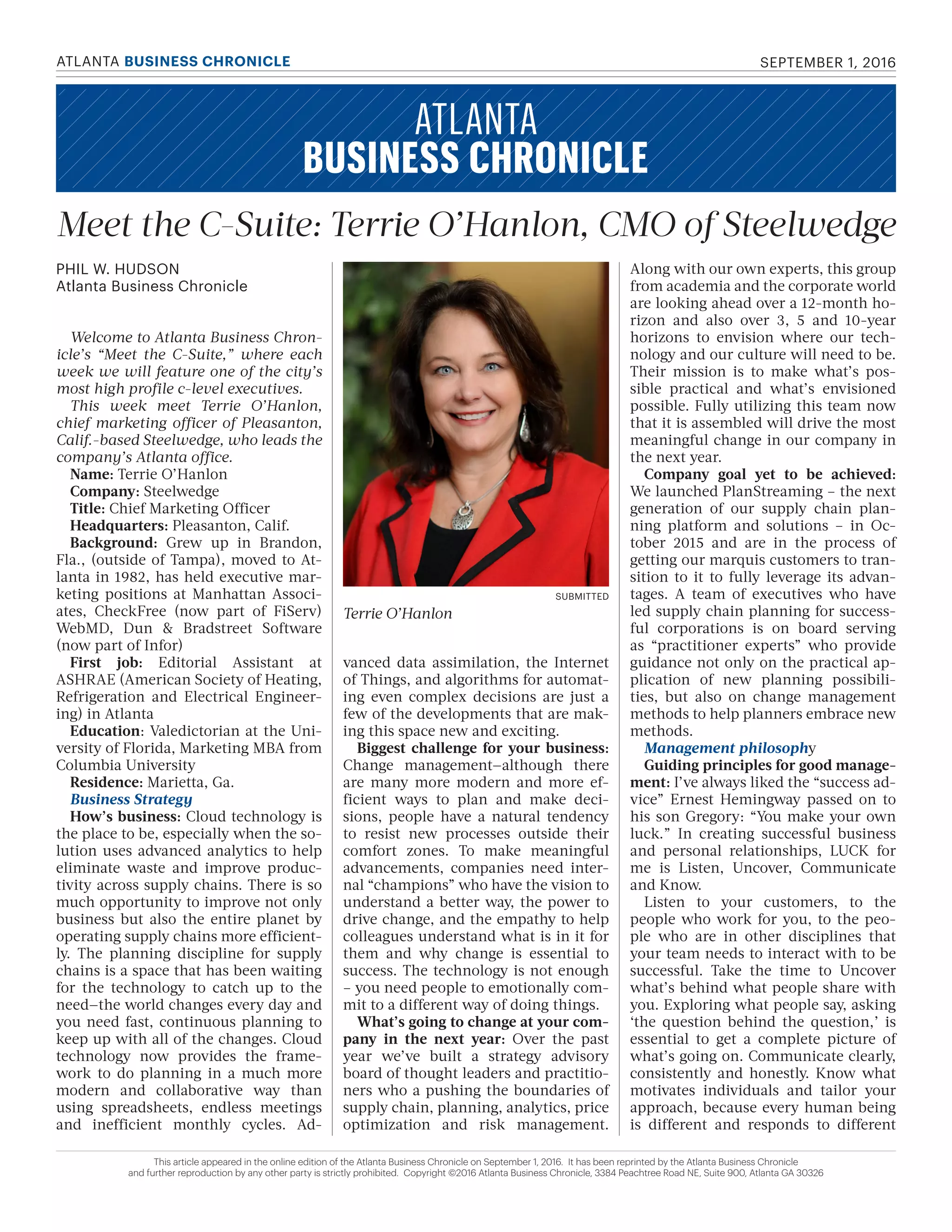
This week meet Terrie O’Hanlon,
chief marketing officer of Pleasanton,
Calif.-based Steelwedge, who leads the
company’s Atlanta office.
Name: Terrie O’Hanlon
Company: Steelwedge
Title: Chief Marketing Officer
Headquarters: Pleasanton, Calif.
Background: Grew up in Brandon,
Fla., (outside of Tampa), moved to At-
lanta in 1982, has held executive mar-
keting positions at Manhattan Associ-
ates, CheckFree (now part of FiServ)
WebMD, Dun & Bradstreet Software
(now part of Infor)
First job: Editorial Assistant at
ASHRAE (American Society of Heating,
Refrigeration and Electrical Engineer-
ing) in Atlanta
Education: Valedictorian at the Uni-
versity of Florida, Marketing MBA from
Columbia University
Residence: Marietta, Ga.
Business Strategy
How’s business: Cloud technology is
the place to be, especially when the so-
lution uses advanced analytics to help
eliminate waste and improve produc-
tivity across supply chains. There is so
much opportunity to improve not only
business but also the entire planet by
operating supply chains more efficient-
ly. The planning discipline for supply
chains is a space that has been waiting
for the technology to catch up to the
need—the world changes every day and
you need fast, continuous planning to
keep up with all of the changes. Cloud
technology now provides the frame-
work to do planning in a much more
modern and collaborative way than
using spreadsheets, endless meetings
and inefficient monthly cycles. Ad-
vanced data assimilation, the Internet
of Things, and algorithms for automat-
ing even complex decisions are just a
few of the developments that are mak-
ing this space new and exciting.
Biggest challenge for your business:
Change management—although there
are many more modern and more ef-
ficient ways to plan and make deci-
sions, people have a natural tendency
to resist new processes outside their
comfort zones. To make meaningful
advancements, companies need inter-
nal “champions” who have the vision to
understand a better way, the power to
drive change, and the empathy to help
colleagues understand what is in it for
them and why change is essential to
success. The technology is not enough
– you need people to emotionally com-
mit to a different way of doing things.
What’s going to change at your com-
pany in the next year: Over the past
year we’ve built a strategy advisory
board of thought leaders and practitio-
ners who a pushing the boundaries of
supply chain, planning, analytics, price
optimization and risk management.
Along with our own experts, this group
from academia and the corporate world
are looking ahead over a 12-month ho-
rizon and also over 3, 5 and 10-year
horizons to envision where our tech-
nology and our culture will need to be.
Their mission is to make what’s pos-
sible practical and what’s envisioned
possible. Fully utilizing this team now
that it is assembled will drive the most
meaningful change in our company in
the next year.
Company goal yet to be achieved:
We launched PlanStreaming – the next
generation of our supply chain plan-
ning platform and solutions – in Oc-
tober 2015 and are in the process of
getting our marquis customers to tran-
sition to it to fully leverage its advan-
tages. A team of executives who have
led supply chain planning for success-
ful corporations is on board serving
as “practitioner experts” who provide
guidance not only on the practical ap-
plication of new planning possibili-
ties, but also on change management
methods to help planners embrace new
methods.
Management philosophy
Guiding principles for good manage-
ment: I’ve always liked the “success ad-
vice” Ernest Hemingway passed on to
his son Gregory: “You make your own
luck.” In creating successful business
and personal relationships, LUCK for
me is Listen, Uncover, Communicate
and Know.
Listen to your customers, to the
people who work for you, to the peo-
ple who are in other disciplines that
your team needs to interact with to be
successful. Take the time to Uncover
what’s behind what people share with
you. Exploring what people say, asking
‘the question behind the question,’ is
essential to get a complete picture of
what’s going on. Communicate clearly,
consistently and honestly. Know what
motivates individuals and tailor your
approach, because every human being
is different and responds to different
Meet the C-Suite: Terrie O’Hanlon, CMO of Steelwedge
SUBMITTED
Terrie O’Hanlon
SEPTEMBER 1, 2016
This article appeared in the online edition of the Atlanta Business Chronicle on September 1, 2016.  It has been reprinted by the Atlanta Business Chronicle
and further reproduction by any other party is strictly prohibited.  Copyright ©2016 Atlanta Business Chronicle, 3384 Peachtree Road NE, Suite 900, Atlanta GA 30326
ATLANTA BUSINESS CHRONICLE
SEPTEMBER 1, 2016
This article appeared in the online edition of the Atlanta Business Chronicle on September 1, 2016.  It has been reprinted by the Atlanta Business Chronicle
and further reproduction by any other party is strictly prohibited.  Copyright ©2016 Atlanta Business Chronicle, 3384 Peachtree Road NE, Suite 900, Atlanta GA 30326
ATLANTA BUSINESS CHRONICLE
challenges, ideas and rewards.
Best way to keep competitive edge:
Curiosity and continuous learning.
Keep your mind on the pulse of ev-
erything happening in the market and
realize that today’s competitors aren’t
necessarily tomorrow’s competitors.
Be continuously tuned into everything
that is changing around you, not just
to what’s happening in your industry.
Stretch your mind to imagine, “What
are different ways this might be done a
year from now, or five years from now.
Will it be done at all?”
Why people like working for you:
I give people space to make their own
mark, not just execute my or someone
else’s vision. The best teams in market-
ing are idea engines that keep a com-
pany fresh and relevant. Tapping every-
one’s talent, giving everyone a voice,
is the best way to sustain remarkable
marketing. I’m not saying every voice
has equal influence, but I am saying
that great ideas can come from any-
where when a team is engaged and feels
heard and respected.
In many companies, marketing
doesn’t have a seat at the executive ta-
ble, or if they do the “legs on the stool”
are shorter than other disciplines enjoy.
I am a passionate advocate for mar-
keting with my peer executives, and I
think teams that have worked for me
appreciate that I champion their con-
tribution to the company’s success.
Finally, I am a marketer at heart.
Many companies fill the CMO position
with executives whose true passion lies
elsewhere, and marketing is just a stop
on their journey. They manage market-
ers, but aren’t really marketers inside. I
truly enjoy marketing, and put a lot of
passion into it, and I think that helps
the people who work for me feel more
passion, too.
Most inspiring entrepreneur: I love
that Sarah Blakely, founder of Spanx,
said to herself, “Hmmm, it would be
great to have a garment like this – I
think I’ll make it.” I admire that she
wasn’t daunted by her idea being re-
jected by all the major hosiery makers
at the time. Instead, she realized they
were run by men who didn’t use the
products they were approving and pro-
moting, and she forged her own path.
I love that she bought a book to help
her write her own patent rather than
pay thousands of dollars to a patent at-
torney. She didn’t let negative people
or a lack of funds stand between her
and her mission. And I love that, hav-
ing achieved success, she has a founda-
tion that helps educate other women on
how to be successful entrepreneurs.
Judgment calls
Best business decision: Joining
CheckFree—Pete Kight is a brilliant in-
novator and it was exciting to be part
of a team that changed the way people
bank and manage money online. Many
of the things that my children do with-
out thinking twice about it, such as
mobile banking and bill paying, were
once “out there” ideas brought to mar-
ket through CheckFree technology. It is
amazing to see people commonly doing
today what the CheckFree team envi-
sioned in the 90s.
Hardest lesson learned and how you
learned it: Listening to others even
when I think I have the answer, getting
other points of view before I weigh in
with my own, has been my toughest
challenge. Like most people do, I’ve
gotten better the hard way, by fall-
ing short in this area and continuing
to course correct. I once worked for a
CEO who pointed out my tendency to
come to him with solutions to problems
about which I had not asked his advice.
I did so because I really appreciate that
style in people who work for me, but I
had never bothered to ask him what his
preference was. That experience under-
scored what a mistake it is to assume
your manager wants from you what you
want from the people you manage.
Toughest business decision: As have
most executives in the technology in-
dustry, I’ve worked for several com-
panies that have had to restructure.
Choosing who stays and who goes as
you reorganize a team is very difficult.
Even when it’s absolutely necessary
for the health of the business, it’s gut-
wrenching to make those decisions, es-
pecially when everyone on the team is a
strong performer.
Biggest missed opportunity: Early
in my career I worked at a technology
start-up that didn’t work out—instead
of jumping into another one where I
had an opportunity, I went to a market-
ing agency because I didn’t want to put
my heart and soul into another venture
that might not work out. Of course, that
company went through a very success-
ful Initial Public Offering and later got
acquired at a premium by another pub-
licly traded company. So financially and
experientially, that was a big miss for
me. I had a fantastic time at the agency
I joined, but I did regret not being part
of that other ride.
True confessions
Like best about job: I love working
with smart people who are creating
technology that can change the world.
Like least about job: The time com-
mitment in technology companies can
be daunting, and the pace of change
requires real stamina. You can’t be a “9
to 5” person and be successful in tech-
nology.
Pet peeve: It really irritates me when
people won’t put away their phones or
tablets in meetings. If your email and
texts are that important, excuse your-
self rather than be blatantly rude to
others who are paying attention and
contributing. I once took a manage-
ment course that emphasized the pow-
er of “being present” mentally wherev-
er you are physically, and that has stuck
with me. If you’re busy doing things not
relevant to where you are, you commu-
nicate that what you are engaged in is
more important that the people you are
with. I think some people hide behind
“multi-tasking” when in fact they are
just being self-absorbed.
First choice for a new career: I’ve al-
ways wanted to be a travel writer.
Predilections
Most influential book: In fiction, At-
las Shrugged by Ayn Rand because I
find its central premise fascinating to
think about. What if all of the most tal-
ented contributors decided to no longer
contribute to a world that lacks appre-
ciation for them? In non-fiction, the
Bible, because of the life lessons that
can be practically applied regardless of
religious beliefs.
Favorite cause: Emotional and fi-
nancial support for veterans and their
families.
Favorite restaurant: Der Biergarten in
the Lucky Marietta district downtown.
It’s the only authentic German restau-
rant in Atlanta
Favorite way to spend free time: Ad-
venturous traveling with my husband
and family
Favorite music: Anything from the
70s. Journey, REO Speedwagon, Amer-
ica, Boston, Foreigner and Queen.
Rock on!

Terrie O Hanlon Meet the C-Suite 9.2016

  • 1.
    PHIL W. HUDSON AtlantaBusiness Chronicle Welcome to Atlanta Business Chron- icle’s “Meet the C-Suite,” where each week we will feature one of the city’s most high profile c-level executives. This week meet Terrie O’Hanlon, chief marketing officer of Pleasanton, Calif.-based Steelwedge, who leads the company’s Atlanta office. Name: Terrie O’Hanlon Company: Steelwedge Title: Chief Marketing Officer Headquarters: Pleasanton, Calif. Background: Grew up in Brandon, Fla., (outside of Tampa), moved to At- lanta in 1982, has held executive mar- keting positions at Manhattan Associ- ates, CheckFree (now part of FiServ) WebMD, Dun & Bradstreet Software (now part of Infor) First job: Editorial Assistant at ASHRAE (American Society of Heating, Refrigeration and Electrical Engineer- ing) in Atlanta Education: Valedictorian at the Uni- versity of Florida, Marketing MBA from Columbia University Residence: Marietta, Ga. Business Strategy How’s business: Cloud technology is the place to be, especially when the so- lution uses advanced analytics to help eliminate waste and improve produc- tivity across supply chains. There is so much opportunity to improve not only business but also the entire planet by operating supply chains more efficient- ly. The planning discipline for supply chains is a space that has been waiting for the technology to catch up to the need—the world changes every day and you need fast, continuous planning to keep up with all of the changes. Cloud technology now provides the frame- work to do planning in a much more modern and collaborative way than using spreadsheets, endless meetings and inefficient monthly cycles. Ad- vanced data assimilation, the Internet of Things, and algorithms for automat- ing even complex decisions are just a few of the developments that are mak- ing this space new and exciting. Biggest challenge for your business: Change management—although there are many more modern and more ef- ficient ways to plan and make deci- sions, people have a natural tendency to resist new processes outside their comfort zones. To make meaningful advancements, companies need inter- nal “champions” who have the vision to understand a better way, the power to drive change, and the empathy to help colleagues understand what is in it for them and why change is essential to success. The technology is not enough – you need people to emotionally com- mit to a different way of doing things. What’s going to change at your com- pany in the next year: Over the past year we’ve built a strategy advisory board of thought leaders and practitio- ners who a pushing the boundaries of supply chain, planning, analytics, price optimization and risk management. Along with our own experts, this group from academia and the corporate world are looking ahead over a 12-month ho- rizon and also over 3, 5 and 10-year horizons to envision where our tech- nology and our culture will need to be. Their mission is to make what’s pos- sible practical and what’s envisioned possible. Fully utilizing this team now that it is assembled will drive the most meaningful change in our company in the next year. Company goal yet to be achieved: We launched PlanStreaming – the next generation of our supply chain plan- ning platform and solutions – in Oc- tober 2015 and are in the process of getting our marquis customers to tran- sition to it to fully leverage its advan- tages. A team of executives who have led supply chain planning for success- ful corporations is on board serving as “practitioner experts” who provide guidance not only on the practical ap- plication of new planning possibili- ties, but also on change management methods to help planners embrace new methods. Management philosophy Guiding principles for good manage- ment: I’ve always liked the “success ad- vice” Ernest Hemingway passed on to his son Gregory: “You make your own luck.” In creating successful business and personal relationships, LUCK for me is Listen, Uncover, Communicate and Know. Listen to your customers, to the people who work for you, to the peo- ple who are in other disciplines that your team needs to interact with to be successful. Take the time to Uncover what’s behind what people share with you. Exploring what people say, asking ‘the question behind the question,’ is essential to get a complete picture of what’s going on. Communicate clearly, consistently and honestly. Know what motivates individuals and tailor your approach, because every human being is different and responds to different Meet the C-Suite: Terrie O’Hanlon, CMO of Steelwedge SUBMITTED Terrie O’Hanlon SEPTEMBER 1, 2016 This article appeared in the online edition of the Atlanta Business Chronicle on September 1, 2016.  It has been reprinted by the Atlanta Business Chronicle and further reproduction by any other party is strictly prohibited.  Copyright ©2016 Atlanta Business Chronicle, 3384 Peachtree Road NE, Suite 900, Atlanta GA 30326 ATLANTA BUSINESS CHRONICLE
  • 2.
    SEPTEMBER 1, 2016 Thisarticle appeared in the online edition of the Atlanta Business Chronicle on September 1, 2016.  It has been reprinted by the Atlanta Business Chronicle and further reproduction by any other party is strictly prohibited.  Copyright ©2016 Atlanta Business Chronicle, 3384 Peachtree Road NE, Suite 900, Atlanta GA 30326 ATLANTA BUSINESS CHRONICLE challenges, ideas and rewards. Best way to keep competitive edge: Curiosity and continuous learning. Keep your mind on the pulse of ev- erything happening in the market and realize that today’s competitors aren’t necessarily tomorrow’s competitors. Be continuously tuned into everything that is changing around you, not just to what’s happening in your industry. Stretch your mind to imagine, “What are different ways this might be done a year from now, or five years from now. Will it be done at all?” Why people like working for you: I give people space to make their own mark, not just execute my or someone else’s vision. The best teams in market- ing are idea engines that keep a com- pany fresh and relevant. Tapping every- one’s talent, giving everyone a voice, is the best way to sustain remarkable marketing. I’m not saying every voice has equal influence, but I am saying that great ideas can come from any- where when a team is engaged and feels heard and respected. In many companies, marketing doesn’t have a seat at the executive ta- ble, or if they do the “legs on the stool” are shorter than other disciplines enjoy. I am a passionate advocate for mar- keting with my peer executives, and I think teams that have worked for me appreciate that I champion their con- tribution to the company’s success. Finally, I am a marketer at heart. Many companies fill the CMO position with executives whose true passion lies elsewhere, and marketing is just a stop on their journey. They manage market- ers, but aren’t really marketers inside. I truly enjoy marketing, and put a lot of passion into it, and I think that helps the people who work for me feel more passion, too. Most inspiring entrepreneur: I love that Sarah Blakely, founder of Spanx, said to herself, “Hmmm, it would be great to have a garment like this – I think I’ll make it.” I admire that she wasn’t daunted by her idea being re- jected by all the major hosiery makers at the time. Instead, she realized they were run by men who didn’t use the products they were approving and pro- moting, and she forged her own path. I love that she bought a book to help her write her own patent rather than pay thousands of dollars to a patent at- torney. She didn’t let negative people or a lack of funds stand between her and her mission. And I love that, hav- ing achieved success, she has a founda- tion that helps educate other women on how to be successful entrepreneurs. Judgment calls Best business decision: Joining CheckFree—Pete Kight is a brilliant in- novator and it was exciting to be part of a team that changed the way people bank and manage money online. Many of the things that my children do with- out thinking twice about it, such as mobile banking and bill paying, were once “out there” ideas brought to mar- ket through CheckFree technology. It is amazing to see people commonly doing today what the CheckFree team envi- sioned in the 90s. Hardest lesson learned and how you learned it: Listening to others even when I think I have the answer, getting other points of view before I weigh in with my own, has been my toughest challenge. Like most people do, I’ve gotten better the hard way, by fall- ing short in this area and continuing to course correct. I once worked for a CEO who pointed out my tendency to come to him with solutions to problems about which I had not asked his advice. I did so because I really appreciate that style in people who work for me, but I had never bothered to ask him what his preference was. That experience under- scored what a mistake it is to assume your manager wants from you what you want from the people you manage. Toughest business decision: As have most executives in the technology in- dustry, I’ve worked for several com- panies that have had to restructure. Choosing who stays and who goes as you reorganize a team is very difficult. Even when it’s absolutely necessary for the health of the business, it’s gut- wrenching to make those decisions, es- pecially when everyone on the team is a strong performer. Biggest missed opportunity: Early in my career I worked at a technology start-up that didn’t work out—instead of jumping into another one where I had an opportunity, I went to a market- ing agency because I didn’t want to put my heart and soul into another venture that might not work out. Of course, that company went through a very success- ful Initial Public Offering and later got acquired at a premium by another pub- licly traded company. So financially and experientially, that was a big miss for me. I had a fantastic time at the agency I joined, but I did regret not being part of that other ride. True confessions Like best about job: I love working with smart people who are creating technology that can change the world. Like least about job: The time com- mitment in technology companies can be daunting, and the pace of change requires real stamina. You can’t be a “9 to 5” person and be successful in tech- nology. Pet peeve: It really irritates me when people won’t put away their phones or tablets in meetings. If your email and texts are that important, excuse your- self rather than be blatantly rude to others who are paying attention and contributing. I once took a manage- ment course that emphasized the pow- er of “being present” mentally wherev- er you are physically, and that has stuck with me. If you’re busy doing things not relevant to where you are, you commu- nicate that what you are engaged in is more important that the people you are with. I think some people hide behind “multi-tasking” when in fact they are just being self-absorbed. First choice for a new career: I’ve al- ways wanted to be a travel writer. Predilections Most influential book: In fiction, At- las Shrugged by Ayn Rand because I find its central premise fascinating to think about. What if all of the most tal- ented contributors decided to no longer contribute to a world that lacks appre- ciation for them? In non-fiction, the Bible, because of the life lessons that can be practically applied regardless of religious beliefs. Favorite cause: Emotional and fi- nancial support for veterans and their families. Favorite restaurant: Der Biergarten in the Lucky Marietta district downtown. It’s the only authentic German restau- rant in Atlanta Favorite way to spend free time: Ad- venturous traveling with my husband and family Favorite music: Anything from the 70s. Journey, REO Speedwagon, Amer- ica, Boston, Foreigner and Queen. Rock on!