



New Mindset “ Rethinking your business”
Sales
Agreeing buy criteria Find out current criteria (if any) Introduce your criteria with probing questions Reinforce your criteria with his/her value on it Counterbalance your uniqueness against your competitors Commit them to ownership Confirm in writing
Keeping the initiative Control meeting agendas End each meeting with their commitment to progress Record commitments on action by whom & by when Diary next meeting date Cross-check with phone contacts between meetings
Face to face objections Most objections are implied needs: Before responding, check your body signals and think Reply confidently Ensure objection is resolved before moving on If benefits not yet established, shelve it
Major and minor objections For major objections: Prioritise Re-state as a need Test close For minor objections use feel, felt, found: ‘ I understand how you feel….’
Negotiating - Preparation Make a list of: Your highest and lowest acceptable objectives Their essential wants and needs Their desirable wants and needs Agreed cost-benefits Minor concessions you can trade
Negotiating - Opening Establish rapport Agree objectives and the follow-up process Summarise their agreed position to date
Negotiating - Middle State your highest objective as a minimum Say you have no room to manoeuvre Soften ‘No’ with a logical preface Use the passive tense to depersonalise sensitive issues Use testimonials
Negotiating – End State price confidently Concede reluctantly in money not percentages Counter-balance with benefits Give only minor concessions Test close on concessions Make them feel like winners
Last resorts to break deadlocks 1. Make a time break 2. Go off the record informally 3. Suggest someone more senior replaces you 4. Refer upwards on their side 5. Appeal for their help
Closing A lways B e C hecking attitudes and reactions
Obtaining commitment Test close Assume close Alternative close Justify why now After asking for the order, shut up!
Ethics Provide choices without pressure Customers should feel they have bought, not been sold Avoid withholding relevant information Be open about limitations
Customer care – Incoming telephone calls Answer within four rings with a smile If answering on outside line, announce ‘Good morning/afternoon, this is XYZ company, Karen speaking, How can we help you?’ Ask caller’s name, company, contact required Transfer: ‘Thank you, transferring you now’ If the contact is out, take telephone number and any message
Avoid: Silences Waiting Multiple transfers Asking people to call back Saying: ‘He’s busy/at a long lunch/don’t know where/not in yet’
Focus on the 20% Prioritise profit potential per client: A - High short-term potential B - High long-term potential C - Low potential Follow the 80/20 rule (Pareto Principle) 80% of your business comes from 20% of your clients. Focus on the 20%.
Referrals Thank them for their business, then ask: What benefits have you obtained from us? Who else could benefit likewise and why? May we say you recommend us?
Surveying satisfaction Use feedback from clients to improve your service Set targets to assess their delight Use simple questionnaires by mail and telephone Check key quality areas When customers stop buying, ask why?
Defusing complaints – By Letter Acknowledge regrets within one day by email, fax or phone Give a solution date and stick to it Summarise issues and invite reply Thank them Follow up by phone for final OK
Defusing complaints - By phone Listen and stay calm Don’t interrupt or pass the buck Ask probing questions to verify facts Check back your understanding Apologise and invite them to suggest compensation Agree action and timeframe Thank them and hang up phone
Key forecast data Company name and location Product/service to be taken Total value % probability Weighted value (total value x % probable) Top signer’s name and title
Key forecast data (continued) Top recommender’s name and title Date of first visit Date of proposal Date order due Date of next appointment Known competitors
Forecasting red flags Each red flag reduces the forecast probability by 10%: Top active decision-maker not met Incomplete fact-find on WANTS Changes in decision-makers/company structure No cost justification Competitor’s proposal was submitted before your first visit No next appointment noted
Sales reports Track your key results with charts Share successes and challenges with the team Assess your own performance
Produce sales reports that: Q uantify in numbers not words U se graphs E ssential data only S elf-analyse T rigger action
Activity ratios Maintain a pipe-line of activities: P lot your actual activity numbers I nsert activity targets P lot current ratios E xamine required ratios
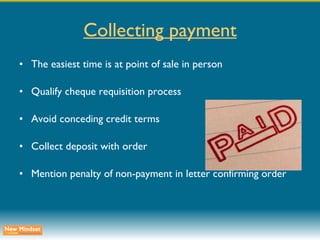
Collecting payment The easiest time is at point of sale in person Qualify cheque requisition process Avoid conceding credit terms Collect deposit with order Mention penalty of non-payment in letter confirming order
If you experience problems with collecting payment: Don’t await call-backs Check there have been no service problems Escalate to top signer Collect in person Persist
Managing relationships Use case studies as signposts of your success Structure: Background scenario Challenges and opportunities presented Choices and options taken Outcomes and returns Publish with customer approval
Relationships with stakeholders Be inclusive with all stakeholders Communicate the impact of the offer: inside your business to service and support staff inside your customer’s supply chain Stakeholders include: customers and suppliers directors and staff the community at large (when appropriate)
Relationships with prospects Get to know prospects as people Disclose your own values and highlight shared values
Creating & retaining relationships Create a keep-in touch campaign Organise social events Share know-how at seminars Forward press articles
Competitors Keep up with competitors Don’t criticise competitors to clients Do ask clients how they perceive other suppliers
Customer partnerships Never take customer partnerships for granted Always look for ways to add value Yesterday’s standard of service excellence is today’s mere satisfaction Use the ‘Business Excellence Model’ benchmark
Manage yourself Invest in personal and professional development Balance life between work and home Seek feedback for continuous improvement

Basic New Mindset Sales Training course Part 5

  • 1.
    New Mindset “Rethinking your business”
  • 2.
  • 3.
    Agreeing buy criteriaFind out current criteria (if any) Introduce your criteria with probing questions Reinforce your criteria with his/her value on it Counterbalance your uniqueness against your competitors Commit them to ownership Confirm in writing
  • 4.
    Keeping the initiativeControl meeting agendas End each meeting with their commitment to progress Record commitments on action by whom & by when Diary next meeting date Cross-check with phone contacts between meetings
  • 5.
    Face to faceobjections Most objections are implied needs: Before responding, check your body signals and think Reply confidently Ensure objection is resolved before moving on If benefits not yet established, shelve it
  • 6.
    Major and minorobjections For major objections: Prioritise Re-state as a need Test close For minor objections use feel, felt, found: ‘ I understand how you feel….’
  • 7.
    Negotiating - PreparationMake a list of: Your highest and lowest acceptable objectives Their essential wants and needs Their desirable wants and needs Agreed cost-benefits Minor concessions you can trade
  • 8.
    Negotiating - OpeningEstablish rapport Agree objectives and the follow-up process Summarise their agreed position to date
  • 9.
    Negotiating - MiddleState your highest objective as a minimum Say you have no room to manoeuvre Soften ‘No’ with a logical preface Use the passive tense to depersonalise sensitive issues Use testimonials
  • 10.
    Negotiating – EndState price confidently Concede reluctantly in money not percentages Counter-balance with benefits Give only minor concessions Test close on concessions Make them feel like winners
  • 11.
    Last resorts tobreak deadlocks 1. Make a time break 2. Go off the record informally 3. Suggest someone more senior replaces you 4. Refer upwards on their side 5. Appeal for their help
  • 12.
    Closing A lwaysB e C hecking attitudes and reactions
  • 13.
    Obtaining commitment Testclose Assume close Alternative close Justify why now After asking for the order, shut up!
  • 14.
    Ethics Provide choiceswithout pressure Customers should feel they have bought, not been sold Avoid withholding relevant information Be open about limitations
  • 15.
    Customer care –Incoming telephone calls Answer within four rings with a smile If answering on outside line, announce ‘Good morning/afternoon, this is XYZ company, Karen speaking, How can we help you?’ Ask caller’s name, company, contact required Transfer: ‘Thank you, transferring you now’ If the contact is out, take telephone number and any message
  • 16.
    Avoid: Silences WaitingMultiple transfers Asking people to call back Saying: ‘He’s busy/at a long lunch/don’t know where/not in yet’
  • 17.
    Focus on the20% Prioritise profit potential per client: A - High short-term potential B - High long-term potential C - Low potential Follow the 80/20 rule (Pareto Principle) 80% of your business comes from 20% of your clients. Focus on the 20%.
  • 18.
    Referrals Thank themfor their business, then ask: What benefits have you obtained from us? Who else could benefit likewise and why? May we say you recommend us?
  • 19.
    Surveying satisfaction Usefeedback from clients to improve your service Set targets to assess their delight Use simple questionnaires by mail and telephone Check key quality areas When customers stop buying, ask why?
  • 20.
    Defusing complaints –By Letter Acknowledge regrets within one day by email, fax or phone Give a solution date and stick to it Summarise issues and invite reply Thank them Follow up by phone for final OK
  • 21.
    Defusing complaints -By phone Listen and stay calm Don’t interrupt or pass the buck Ask probing questions to verify facts Check back your understanding Apologise and invite them to suggest compensation Agree action and timeframe Thank them and hang up phone
  • 22.
    Key forecast dataCompany name and location Product/service to be taken Total value % probability Weighted value (total value x % probable) Top signer’s name and title
  • 23.
    Key forecast data(continued) Top recommender’s name and title Date of first visit Date of proposal Date order due Date of next appointment Known competitors
  • 24.
    Forecasting red flagsEach red flag reduces the forecast probability by 10%: Top active decision-maker not met Incomplete fact-find on WANTS Changes in decision-makers/company structure No cost justification Competitor’s proposal was submitted before your first visit No next appointment noted
  • 25.
    Sales reports Trackyour key results with charts Share successes and challenges with the team Assess your own performance
  • 26.
    Produce sales reportsthat: Q uantify in numbers not words U se graphs E ssential data only S elf-analyse T rigger action
  • 27.
    Activity ratios Maintaina pipe-line of activities: P lot your actual activity numbers I nsert activity targets P lot current ratios E xamine required ratios
  • 28.
    Collecting payment Theeasiest time is at point of sale in person Qualify cheque requisition process Avoid conceding credit terms Collect deposit with order Mention penalty of non-payment in letter confirming order
  • 29.
    If you experienceproblems with collecting payment: Don’t await call-backs Check there have been no service problems Escalate to top signer Collect in person Persist
  • 30.
    Managing relationships Usecase studies as signposts of your success Structure: Background scenario Challenges and opportunities presented Choices and options taken Outcomes and returns Publish with customer approval
  • 31.
    Relationships with stakeholdersBe inclusive with all stakeholders Communicate the impact of the offer: inside your business to service and support staff inside your customer’s supply chain Stakeholders include: customers and suppliers directors and staff the community at large (when appropriate)
  • 32.
    Relationships with prospectsGet to know prospects as people Disclose your own values and highlight shared values
  • 33.
    Creating & retainingrelationships Create a keep-in touch campaign Organise social events Share know-how at seminars Forward press articles
  • 34.
    Competitors Keep upwith competitors Don’t criticise competitors to clients Do ask clients how they perceive other suppliers
  • 35.
    Customer partnerships Nevertake customer partnerships for granted Always look for ways to add value Yesterday’s standard of service excellence is today’s mere satisfaction Use the ‘Business Excellence Model’ benchmark
  • 36.
    Manage yourself Investin personal and professional development Balance life between work and home Seek feedback for continuous improvement

Editor's Notes

  • #4 Agreeing buy criteria Find out current criteria (if any): What are you looking for and why? Introduce your criteria with probing questions: What if? How important is …? Reinforce your criteria with his/her value on it: How much would that save you? Counterbalance your uniqueness against your competitors: Let’s list the key points. Commit them to ownership: You’ve agreed these are all essential then? Confirm in writing: As you stated…..
  • #5 Keeping the initiative Control meeting agendas End each meeting with their commitment to progress Record commitments on action by whom & by when Diary next meeting date Cross-check with phone contacts between meetings
  • #6 Face to face objections Most objections are implied needs. Before responding, pause to check your body signals and think Reply confidently Ensure objection is resolved before moving on: Have we covered that point to your satisfaction? If benefits not yet established, shelve it: Can I come back to that later? Price is not a priority if they want what you are selling. Price objections mean you have not established sufficient benefits.
  • #7 Major and minor objections For major objections Prioritise: How important is that? Re-state as a need: So what you’ve looking for is …? Test close: Is there anything else you need to consider before going ahead? For minor objections use feel, felt, found: I understand how you feel…. our other clients also felt…. then they found …
  • #8 Negotiating – Preparation Before you begin negotiation, make a list of: Your highest and lowest acceptable objectives Their essential wants and needs Their desirable wants and needs Agreed cost-benefits Minor concessions you can trade
  • #9 Negotiating – Opening In the meeting itself: Establish rapport – confirm your commitment to their goals ask permission to take notes Agree objectives and the follow-up process Summarise their agreed position to date: commitment to value not price their priorities their stated buying criteria on your offer benefits of operations and cost savings
  • #10 Negotiating – Middle State your highest objective as a minimum Say you have no room to manoeuvre Soften ‘No’ with a logical preface Use the passive tense to depersonalise sensitive issues Use testimonials
  • #11 Negotiating – End Negotiations should by now have moved to price. When price is asked desire is implied. State price confidently Concede reluctantly in money not percentages Counter-balance with benefits Give only minor concessions Test close on concessions Make them feel like winners
  • #12 Last resorts to break deadlocks 1.Make a time break 2.Go off the record informally 3.Suggest someone more senior replaces you 4.Refer upwards on their side 5.Appeal for their help
  • #13 Closing Always Be Checking attitudes and reactions
  • #14 Obtaining commitment Buying is emotion justified by fact Expressed or implied needs are buying signals. Qualify their importance, then close. Closing means obtaining commitment throughout the sales cycle. Test close. Do you have all the information on which to make a decision. Assume close. When/Where will you want delivery? Alternative close: Shall we deliver this month or next? Justify why now After asking for the order, shut up!
  • #15 Ethics Provide choices without pressure Customers should feel they have bought, not been sold Avoid withholding relevant information Be open about limitations
  • #16 Customer care - Incoming telephone calls People judge you on how well you answer their phone calls: Answer within four rings with a smile If answering on outside line, announce Good morning/afternoon, this is XYZ company, Karen speaking, How can we help you? Ask caller’s name, company, contact required Transfer: Thank you, transferring you now If the contact is out, take telephone number and any message
  • #17 Avoid: Silences Waiting Multiple transfers Asking people to call back Saying: He’s busy/at a long lunch/don’t know where/not in yet
  • #18 Focus on the 20% Prioritise profit potential per client: A - High short-term potential B - High long-term potential C - Low potential Follow the 80/20 rule (Pareto Principle) 80% of your business comes from 20% of your clients. Focus on the 20%.
  • #19 Referrals Thank them for their business, then ask: What benefits have you obtained from us? Who else could benefit likewise and why? May we say you recommend us? Afterwards, let your referrer know the result. Then ask for another!
  • #20 Surveying satisfaction Use feedback from clients to improve your service Set targets to assess their delight Use simple questionnaires by mail and telephone: Ask level of satisfaction, importance and frequency of use Check key quality areas: Delivery, packaging, manuals, installation, training, performance of service personnel (sales, admin, support), performance of product When customers stop buying, ask why?: Less than 10% is because of price. Over 80% is because of poor service!
  • #21 Defusing complaints - By letter One complaint in ten reaches the suppliers BUT one complainer tells ten other prospective clients. Acknowledge regrets within one day by email, fax or phone Give a solution date and stick to it Summarise issues and invite reply Thank them Follow up by phone for final OK
  • #22 Defusing complaints - By phone Listen and stay calm Don’t interrupt or pass the buck Ask probing questions to verify facts Check back your understanding Apologise and invite them to suggest compensation Agree action and timeframe Thank them and hang up phone
  • #23 Key forecast data Company name and location Product/service to be taken Total value % probability Weighted value (total value x % probable) Top signer’s name and title Top recommender’s name and title Date of first visit Date of proposal Date order due Date of next appointment Known competitors
  • #24 Key forecast data (continued) Top recommender’s name and title Date of first visit Date of proposal Date order due Date of next appointment Known competitors
  • #25 Forecasting red flags Each red flag reduces the forecast probability by 10%: Top active decision-maker not met Incomplete fact-find on WANTS Changes in decision-makers/company structure No cost justification Competitor’s proposal was submitted before your first visit No next appointment noted
  • #26 Sales reports Track your key results with charts showing: - Proposals per month - Calls per week - Forecast accuracy per client Share successes and challenges with the team Assess your own performance
  • #27 Produce sales reports that: Quantify in numbers not words Use graphs Essential data only Self-analyse Trigger action
  • #28 Activity ratios Maintain a pipe-line of activities Plot your actual activity numbers Insert activity targets Plot current ratios Examine required ratios
  • #29 Collecting payment The easiest time is at point of sale in person Qualify cheque requisition process Avoid conceding credit terms Collect deposit with order Mention penalty of non-payment in letter confirming order
  • #30 If you experience problems with collecting payment: Don’t await call-backs Check there have been no service problems Escalate to top signer Collect in person Persist
  • #31 Managing relationships Use case studies as signposts of your success Structure: Background scenario Challenges and opportunities presented Choices and options taken Outcomes and returns Publish with customer approval
  • #32 Relationships with stakeholders Be inclusive with all stakeholders Communicate the impact of the offer: inside your business to service and support staff inside your customer’s supply chain Stakeholders include: customers and suppliers directors and staff (and when appropriate) the community at large
  • #33 Relationships with prospects Get to know prospects as people their personal likes and dislikes what they value and why Disclose your own values and highlight shared values
  • #34 Creating & retaining relationships Create a keep-in touch campaign Organise social events Share know-how at seminars Forward press articles
  • #35 Competitors Keep up with competitors: report special offers regularly survey their strengths, weaknesses, opportunities, threats Don’t criticise competitors to clients Do ask clients how they perceive other suppliers, especially if and why they bought from them
  • #36 Customer partnerships Never take customer partnerships for granted Always look for ways to add value Yesterday’s standard of service excellence is today’s mere satisfaction and tomorrow’s reason for dissatisfaction Benchmark against the best by using the Business Excellence Model
  • #37 Manage yourself Invest in personal and professional development Balance life between work and home Seek feedback for continuous improvement Don’t just do things right Do the right things right!