Boost Your Sales!
Zero-Based Thinking Brian Tracy uses this concept in most of his books and seminars. To evaluate a situation one considers the following question.  Knowing what I now know, would I get into this business/job/situation again?  If the answer is yes, then continue your evaluation of the situation and make relevant changes.  But, if the answer is no, then the next step should be to get out of the situation as fast as possible, i.e. going back to zero to before the situation started to the topmost square of the snakes and ladders game and starting from scratch; start afresh.
Boost Your Sales! Sometimes it's hard for a potential client to understand how what you have to offer works.  Sometimes they think they understand how it works when they really don't.  In either case their understanding may lead to objections. You're the expert in whatever it is you do.  You understand how things work.  Those things are easy for you.  Yet, in all likelihood your potential clients don't understand how things work, and when you explain it sounds very hard to them.
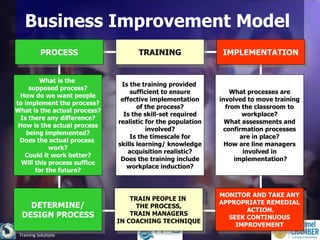
Business Improvement Model  IMPLEMENTATION What processes are involved to move training from the classroom to workplace? What assessments and confirmation processes are in place? How are line managers involved in  implementation? MONITOR AND TAKE ANY APPROPRIATE REMEDIAL ACTION. SEEK CONTINUOUS IMPROVEMENT TRAINING Is the training provided  sufficient to ensure  effective implementation  of the process? Is the skill-set required realistic for the population involved? Is the timescale for skills learning/ knowledge acquisition realistic? Does the training include workplace induction? TRAIN PEOPLE IN  THE PROCESS, TRAIN MANAGERS IN COACHING TECHNIQUE PROCESS What is the  supposed process? How do we want people to implement the process? What is the actual process? Is there any difference? How is the actual process being implemented? Does the actual process  work? Could it work better? Will this process suffice for the future? DETERMINE/ DESIGN PROCESS
 
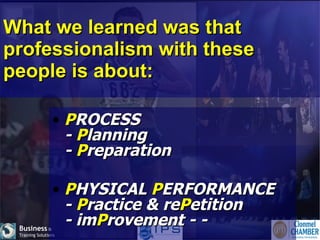
What we learned was that professionalism with these people is about: P ROCESS -  P lanning -  P reparation  P HYSICAL  P ERFORMANCE -  P ractice & re P etition - im P rovement - -
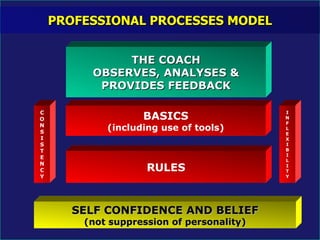
PROFESSIONAL PROCESSES MODEL SELF CONFIDENCE AND BELIEF (not suppression of personality) C O N S I S T E N C Y RULES BASICS (including use of tools) I N F L E X I B I L I T Y THE COACH OBSERVES, ANALYSES & PROVIDES FEEDBACK
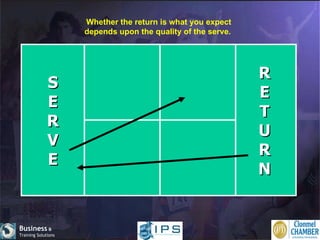
S E R V E R E T U R N Whether the return is what you expect depends upon the quality of the serve.
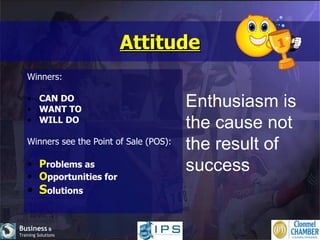
Attitude Winners: CAN DO WANT TO WILL DO Winners see the Point of Sale (POS): P roblems as O pportunities for S olutions Enthusiasm is the cause not the result of success
Ten steps to account development Prioritise objectives List suspects List prospects Qualify want Fact-find Commit to change Fix buy criteria Propose Close Build
Throughout the sales process the Sales Professional should be continually…. Asking questions Listening  Qualifying Discovering hot buttons (WIIFM) Building rapport  Establishing trust Developing credibility and developing a valuable relationship
Throughout the sales process the Sales Professional should be continually…. Addressing concerns  Confirming understanding  Planning next action steps  Asking for referrals Seeking additional opportunities to serve and sell Evaluating responses and results (positive/negative) Affirming decisions Positively expectant
Partnering tactics Your strategy should ensure a win-win result for both parties. Tactics : Focus on big issues Offer quantified financial benefits Install controls to measure benefits Treat them as unique
Partnering tactics (continued) Talk their language Don’t oversell Be a problem-solver Keep contact with the top decision-maker
Partnering Move from : To: Sell Consult Implement Facilitate React Be proactive Tell Listen Your solution Their solution Costs Cost-benefits
Focus on the benefits and features: F eature It is…………… A dvantage It does………….. B enefit It does for you………………
Remember your p’s & q’s Prioritise: How important is it? Quantity: How much will it save? Develop benefit statements related to their interests.  Give them ‘you’ appeal. Appeal to: Personal wants prestige, fear or loss Company needs more profit, lower costs Their job-related goals
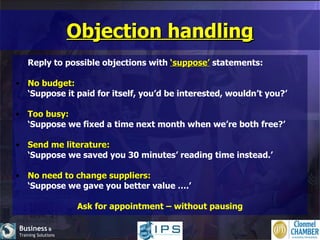
Objection handling Reply to possible objections with  ‘suppose’  statements: No budget: ‘ Suppose it paid for itself, you’d be interested, wouldn’t you?’ Too busy: ‘ Suppose we fixed a time next month when we’re both free?’ Send me literature: ‘ Suppose we saved you 30 minutes’ reading time instead.’ No need to change suppliers: ‘ Suppose we gave you better value ….’ Ask for appointment – without pausing
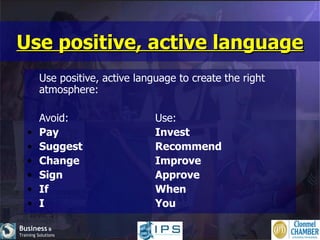
Use positive, active language Use positive, active language to create the right atmosphere: Avoid: Use: Pay Invest Suggest Recommend Change Improve Sign Approve If When I You
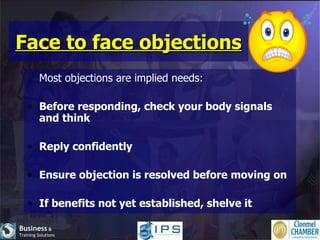
Face to face objections Most objections are implied needs: Before responding, check your body signals and think Reply confidently Ensure objection is resolved before moving on If benefits not yet established, shelve it
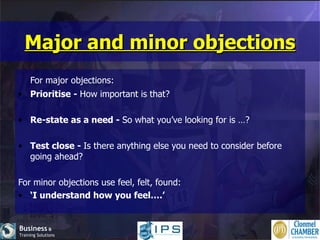
Major and minor objections For major objections: Prioritise -  How important is that? Re-state as a need -  So what you’ve looking for is …? Test close -  Is there anything else you need to consider before going ahead? For minor objections use feel, felt, found: ‘ I understand how you feel….’
Negotiating - Preparation Make a list of: Your highest and lowest acceptable objectives Their essential wants and needs Their desirable wants and needs Agreed cost-benefits Minor concessions you can trade
Negotiating - Opening Establish rapport confirm your commitment to their goals ask permission to take notes Agree objectives and the follow-up process Summarise their agreed position to date commitment to value not price their priorities their stated buying criteria on your offer benefits of operations and cost savings
Negotiating - Middle State your highest objective as a minimum Say you have no room to manoeuvre Soften ‘No’ with a logical preface Use the passive tense to depersonalise sensitive issues Use testimonials
Negotiating – End Negotiations should by now have moved to price.  When price is asked desire is implied. State price confidently Concede reluctantly in money not percentages Counter-balance with benefits Give only minor concessions Test close on concessions Make them feel like winners
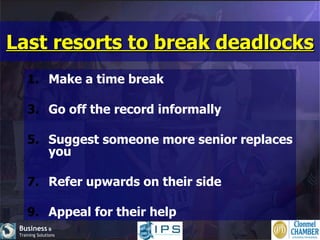
Last resorts to break deadlocks Make a time break Go off the record informally Suggest someone more senior replaces you Refer upwards on their side Appeal for their help
Closing A lways B e C hecking attitudes and reactions
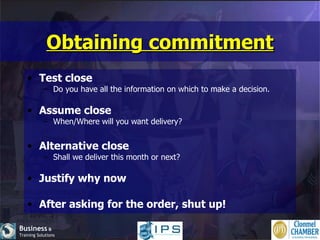
Obtaining commitment Test close Do you have all the information on which to make a decision. Assume close When/Where will you want delivery? Alternative close Shall we deliver this month or next? Justify why now After asking for the order, shut up!
Ethics Provide choices without pressure Customers should feel they have bought, not been sold Avoid withholding relevant information Be open about limitations
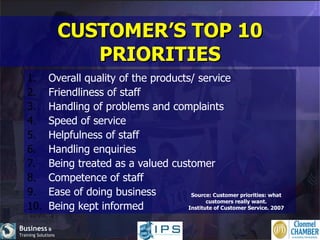
CUSTOMER’S TOP 10 PRIORITIES Overall quality of the products/ service Friendliness of staff Handling of problems and complaints Speed of service Helpfulness of staff Handling enquiries Being treated as a valued customer Competence of staff Ease of doing business Being kept informed Source: Customer priorities: what customers really want. Institute of Customer Service. 2007

Clonmel Chamber Boost Your Sales Workshop

  • 1.
  • 2.
    Zero-Based Thinking BrianTracy uses this concept in most of his books and seminars. To evaluate a situation one considers the following question. Knowing what I now know, would I get into this business/job/situation again? If the answer is yes, then continue your evaluation of the situation and make relevant changes. But, if the answer is no, then the next step should be to get out of the situation as fast as possible, i.e. going back to zero to before the situation started to the topmost square of the snakes and ladders game and starting from scratch; start afresh.
  • 3.
    Boost Your Sales!Sometimes it's hard for a potential client to understand how what you have to offer works. Sometimes they think they understand how it works when they really don't. In either case their understanding may lead to objections. You're the expert in whatever it is you do. You understand how things work. Those things are easy for you. Yet, in all likelihood your potential clients don't understand how things work, and when you explain it sounds very hard to them.
  • 4.
    Business Improvement Model IMPLEMENTATION What processes are involved to move training from the classroom to workplace? What assessments and confirmation processes are in place? How are line managers involved in implementation? MONITOR AND TAKE ANY APPROPRIATE REMEDIAL ACTION. SEEK CONTINUOUS IMPROVEMENT TRAINING Is the training provided sufficient to ensure effective implementation of the process? Is the skill-set required realistic for the population involved? Is the timescale for skills learning/ knowledge acquisition realistic? Does the training include workplace induction? TRAIN PEOPLE IN THE PROCESS, TRAIN MANAGERS IN COACHING TECHNIQUE PROCESS What is the supposed process? How do we want people to implement the process? What is the actual process? Is there any difference? How is the actual process being implemented? Does the actual process work? Could it work better? Will this process suffice for the future? DETERMINE/ DESIGN PROCESS
  • 5.
  • 6.
    What we learnedwas that professionalism with these people is about: P ROCESS - P lanning - P reparation P HYSICAL P ERFORMANCE - P ractice & re P etition - im P rovement - -
  • 7.
    PROFESSIONAL PROCESSES MODELSELF CONFIDENCE AND BELIEF (not suppression of personality) C O N S I S T E N C Y RULES BASICS (including use of tools) I N F L E X I B I L I T Y THE COACH OBSERVES, ANALYSES & PROVIDES FEEDBACK
  • 8.
    S E RV E R E T U R N Whether the return is what you expect depends upon the quality of the serve.
  • 9.
    Attitude Winners: CANDO WANT TO WILL DO Winners see the Point of Sale (POS): P roblems as O pportunities for S olutions Enthusiasm is the cause not the result of success
  • 10.
    Ten steps toaccount development Prioritise objectives List suspects List prospects Qualify want Fact-find Commit to change Fix buy criteria Propose Close Build
  • 11.
    Throughout the salesprocess the Sales Professional should be continually…. Asking questions Listening Qualifying Discovering hot buttons (WIIFM) Building rapport Establishing trust Developing credibility and developing a valuable relationship
  • 12.
    Throughout the salesprocess the Sales Professional should be continually…. Addressing concerns Confirming understanding Planning next action steps Asking for referrals Seeking additional opportunities to serve and sell Evaluating responses and results (positive/negative) Affirming decisions Positively expectant
  • 13.
    Partnering tactics Yourstrategy should ensure a win-win result for both parties. Tactics : Focus on big issues Offer quantified financial benefits Install controls to measure benefits Treat them as unique
  • 14.
    Partnering tactics (continued)Talk their language Don’t oversell Be a problem-solver Keep contact with the top decision-maker
  • 15.
    Partnering Move from: To: Sell Consult Implement Facilitate React Be proactive Tell Listen Your solution Their solution Costs Cost-benefits
  • 16.
    Focus on thebenefits and features: F eature It is…………… A dvantage It does………….. B enefit It does for you………………
  • 17.
    Remember your p’s& q’s Prioritise: How important is it? Quantity: How much will it save? Develop benefit statements related to their interests. Give them ‘you’ appeal. Appeal to: Personal wants prestige, fear or loss Company needs more profit, lower costs Their job-related goals
  • 18.
    Objection handling Replyto possible objections with ‘suppose’ statements: No budget: ‘ Suppose it paid for itself, you’d be interested, wouldn’t you?’ Too busy: ‘ Suppose we fixed a time next month when we’re both free?’ Send me literature: ‘ Suppose we saved you 30 minutes’ reading time instead.’ No need to change suppliers: ‘ Suppose we gave you better value ….’ Ask for appointment – without pausing
  • 19.
    Use positive, activelanguage Use positive, active language to create the right atmosphere: Avoid: Use: Pay Invest Suggest Recommend Change Improve Sign Approve If When I You
  • 20.
    Face to faceobjections Most objections are implied needs: Before responding, check your body signals and think Reply confidently Ensure objection is resolved before moving on If benefits not yet established, shelve it
  • 21.
    Major and minorobjections For major objections: Prioritise - How important is that? Re-state as a need - So what you’ve looking for is …? Test close - Is there anything else you need to consider before going ahead? For minor objections use feel, felt, found: ‘ I understand how you feel….’
  • 22.
    Negotiating - PreparationMake a list of: Your highest and lowest acceptable objectives Their essential wants and needs Their desirable wants and needs Agreed cost-benefits Minor concessions you can trade
  • 23.
    Negotiating - OpeningEstablish rapport confirm your commitment to their goals ask permission to take notes Agree objectives and the follow-up process Summarise their agreed position to date commitment to value not price their priorities their stated buying criteria on your offer benefits of operations and cost savings
  • 24.
    Negotiating - MiddleState your highest objective as a minimum Say you have no room to manoeuvre Soften ‘No’ with a logical preface Use the passive tense to depersonalise sensitive issues Use testimonials
  • 25.
    Negotiating – EndNegotiations should by now have moved to price. When price is asked desire is implied. State price confidently Concede reluctantly in money not percentages Counter-balance with benefits Give only minor concessions Test close on concessions Make them feel like winners
  • 26.
    Last resorts tobreak deadlocks Make a time break Go off the record informally Suggest someone more senior replaces you Refer upwards on their side Appeal for their help
  • 27.
    Closing A lwaysB e C hecking attitudes and reactions
  • 28.
    Obtaining commitment Testclose Do you have all the information on which to make a decision. Assume close When/Where will you want delivery? Alternative close Shall we deliver this month or next? Justify why now After asking for the order, shut up!
  • 29.
    Ethics Provide choiceswithout pressure Customers should feel they have bought, not been sold Avoid withholding relevant information Be open about limitations
  • 30.
    CUSTOMER’S TOP 10PRIORITIES Overall quality of the products/ service Friendliness of staff Handling of problems and complaints Speed of service Helpfulness of staff Handling enquiries Being treated as a valued customer Competence of staff Ease of doing business Being kept informed Source: Customer priorities: what customers really want. Institute of Customer Service. 2007

Editor's Notes

  • #5 We have a unique process for determining best practice when it comes to selling yourself to the customer.
  • #7 What we learned was that in these professions they acquire maintain and improve their skills through identifying and adopting a process (the game plan); they prepare and they plan and then because it’s about a physical performance invest in practice and repetition in order to ensure continuous improvement
  • #8 Structure and rules releases talent – it doesn’t restrict it
  • #9 As with all professions, there's an opening and it brings about a response. When a musician plays the first chords of a piece of music, they expect it to grab the audience?s attention. When an actor delivers the first line of a speech in a play, they want you to sit up and listen. When you see the first scene in a dance movement, the objective is to interest you to make you want to see more. In selling, there's a stimulus and a response. The opening few lines are meant to elicit a response from a customer that should make them want to hear more. You serve your sales proposition and the customer returns the serve by responding. Whether the return is what you expect depends upon the quality of the serve.
  • #10 Attitude Enthusiasm is the cause not the result of success. Winners: CAN DO WANT TO WILL DO Winners see the Point of Sale (POS): Problems as Opportunities for Solutions
  • #14 Partnering tactics Your strategy should ensure a win-win result for both parties. Tactics: Focus on big issues Offer quantified financial benefits Install controls to measure benefits Treat them as unique
  • #15 Partnering tactics (continued) Talk their language Don’t oversell Be a problem-solver; examine alternatives Keep contact with the top decision-maker
  • #16 Partnering Move from: - To: Sell - Consult Implement - Facilitate React - Be proactive Tell - Listen Your solution - Their solution Costs - Cost-benefits
  • #17 Focus on the benefits and features: Focus on the benefits and features (make sure you know the difference) Feature It is Advantage It does Benefit It does for you Eg A light bulb gives light for you to see Test with ‘So what’s in it for them?’
  • #18 Remember your p’s & q’s Prioritise: How important is it? Quantity: How much will it save? Develop benefit statements related to their interests. Give them ‘you’ appeal. Appeal to: Personal wants – prestige, fear or loss Company needs – more profit, lower costs Their job-related goals
  • #19 Objection handling Reply to possible objections with ‘suppose’ statements. Examples: No budget: ‘ Suppose it paid for itself, you’d be interested, wouldn’t you?’ Too busy: ‘ Suppose we fixed a time next month when we’re both free?’ Send me literature: ‘ Suppose we saved you 30 minutes’ reading time instead.’ No need to change suppliers: ‘ Suppose we gave you better value ….’ Then ask for an appointment without pausing.
  • #20 Use positive, active language Use positive, active language to create the right atmosphere. Avoid - Use Negative/Passive - Positive/Active Eg: It could be arranged - Eg: We can arrange Pay - Invest Suggest - Recommend Change - Improve Sign - Approve If - When I- You
  • #21 Face to face objections Most objections are implied needs. Before responding, pause to check your body signals and think Reply confidently Ensure objection is resolved before moving on: Have we covered that point to your satisfaction? If benefits not yet established, shelve it: Can I come back to that later? Price is not a priority if they want what you are selling. Price objections mean you have not established sufficient benefits.
  • #22 Major and minor objections For major objections Prioritise: How important is that? Re-state as a need: So what you’ve looking for is …? Test close: Is there anything else you need to consider before going ahead? For minor objections use feel, felt, found: I understand how you feel…. our other clients also felt…. then they found …
  • #23 Negotiating – Preparation Before you begin negotiation, make a list of: Your highest and lowest acceptable objectives Their essential wants and needs Their desirable wants and needs Agreed cost-benefits Minor concessions you can trade
  • #24 Negotiating – Opening In the meeting itself: Establish rapport – confirm your commitment to their goals ask permission to take notes Agree objectives and the follow-up process Summarise their agreed position to date: commitment to value not price their priorities their stated buying criteria on your offer benefits of operations and cost savings
  • #25 Negotiating – Middle State your highest objective as a minimum Say you have no room to manoeuvre Soften ‘No’ with a logical preface Use the passive tense to depersonalise sensitive issues Use testimonials
  • #26 Negotiating – End Negotiations should by now have moved to price. When price is asked desire is implied. State price confidently Concede reluctantly in money not percentages Counter-balance with benefits Give only minor concessions Test close on concessions Make them feel like winners
  • #27 Last resorts to break deadlocks 1.Make a time break 2.Go off the record informally 3.Suggest someone more senior replaces you 4.Refer upwards on their side 5.Appeal for their help
  • #28 Closing Always Be Checking attitudes and reactions
  • #29 Obtaining commitment Buying is emotion justified by fact Expressed or implied needs are buying signals. Qualify their importance, then close. Closing means obtaining commitment throughout the sales cycle. Test close. Do you have all the information on which to make a decision. Assume close. When/Where will you want delivery? Alternative close: Shall we deliver this month or next? Justify why now After asking for the order, shut up!
  • #30 Ethics Provide choices without pressure Customers should feel they have bought, not been sold Avoid withholding relevant information Be open about limitations