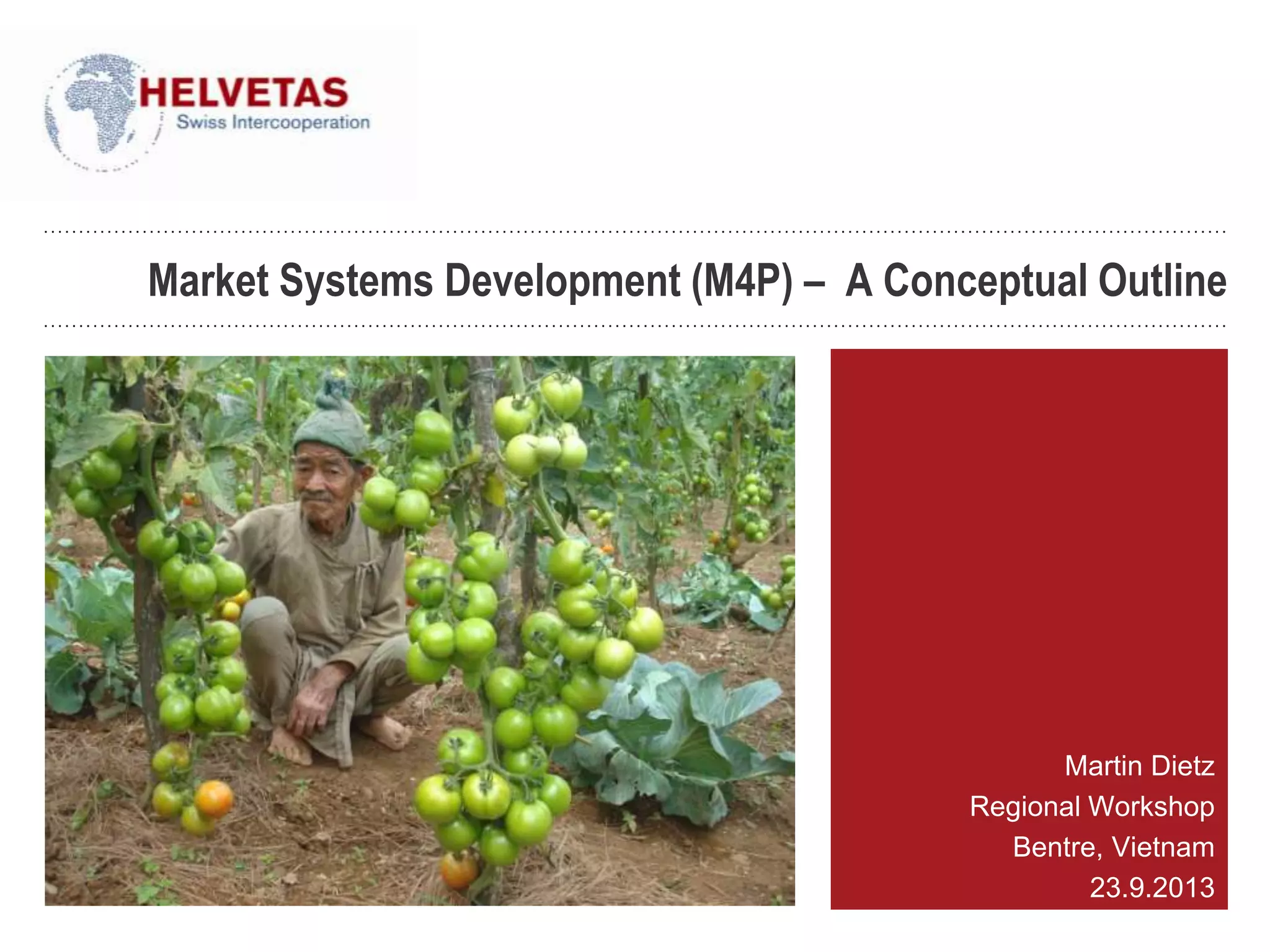
Market Systems Development (M4P) – A Conceptual Outline
Martin Dietz
Regional Workshop
Bentre, Vietnam
23.9.2013
Market Systems and the Poor
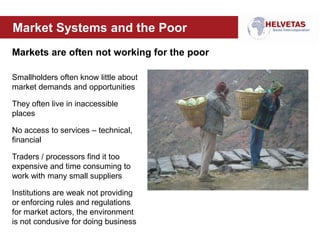
Smallholders often know little about
market demands and opportunities
They often live in inaccessible
places
No access to services – technical,
financial
Traders / processors find it too
expensive and time consuming to
work with many small suppliers
Institutions are weak not providing
or enforcing rules and regulations
for market actors, the environment
is not condusive for doing business
Markets are often not working for the poor
Market Systems and the Poor
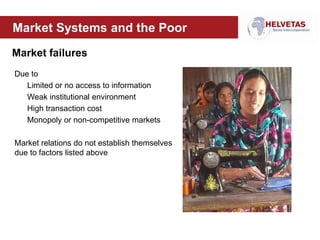
Due to
Limited or no access to information
Weak institutional environment
High transaction cost
Monopoly or non-competitive markets
Market relations do not establish themselves
due to factors listed above
Market failures
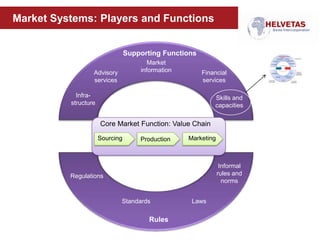
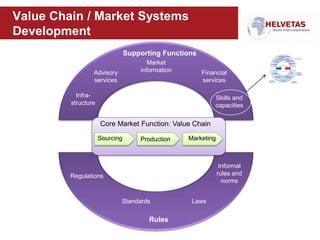
Market Systems: Players and Functions
Infra-
structure
Advisory
services
Market
information Financial
services
Skills and
capacities
Regulations
Standards Laws
Informal
rules and
norms
Supporting Functions
Rules
Core Market Function: Value Chain
Sourcing Production Marketing
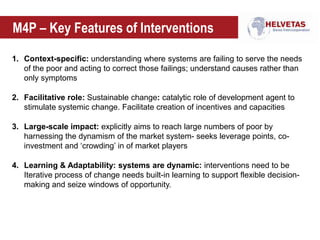
M4P – Key Features of Interventions
1. Context-specific: understanding where systems are failing to serve the needs
of the poor and acting to correct those failings; understand causes rather than
only symptoms
2. Facilitative role: Sustainable change: catalytic role of development agent to
stimulate systemic change. Facilitate creation of incentives and capacities
3. Large-scale impact: explicitly aims to reach large numbers of poor by
harnessing the dynamism of the market system- seeks leverage points, co-
investment and ‘crowding’ in of market players
4. Learning & Adaptability: systems are dynamic: interventions need to be
Iterative process of change needs built-in learning to support flexible decision-
making and seize windows of opportunity.
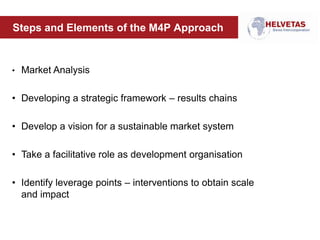
Steps and Elements of the M4P Approach
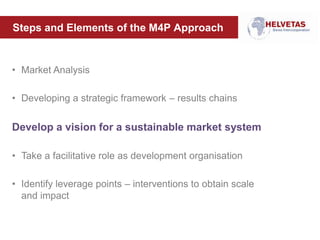
• Market Analysis
• Developing a strategic framework – results chains
• Develop a vision for a sustainable market system
• Take a facilitative role as development organisation
• Identify leverage points – interventions to obtain scale
and impact
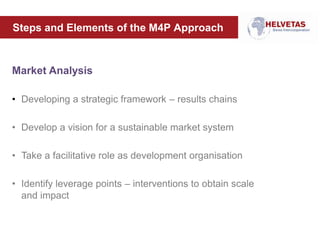
Steps and Elements of the M4P Approach
Market Analysis
• Developing a strategic framework – results chains
• Develop a vision for a sustainable market system
• Take a facilitative role as development organisation
• Identify leverage points – interventions to obtain scale
and impact
Steps and Elements of the M4P Approach
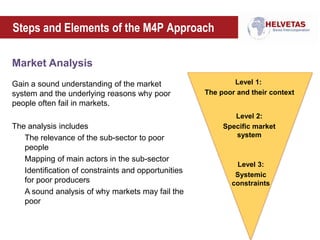
Gain a sound understanding of the market
system and the underlying reasons why poor
people often fail in markets.
The analysis includes
The relevance of the sub-sector to poor
people
Mapping of main actors in the sub-sector
Identification of constraints and opportunities
for poor producers
A sound analysis of why markets may fail the
poor
Market Analysis
Level 1:
The poor and their context
Level 2:
Specific market
system
Level 3:
Systemic
constraints
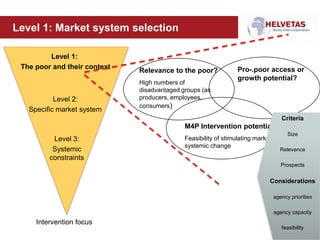
Level 1: Market system selection
Level 1:
The poor and their context
Level 2:
Specific market system
Level 3:
Systemic
constraints
Intervention focus
Relevance to the poor?
High numbers of
disadvantaged groups (as
producers, employees,
consumers)
Pro-.poor access or
growth potential?
M4P Intervention potential
Feasibility of stimulating market
systemic change
Criteria
Size
Relevance
Prospects
Considerations
agency priorities
agency capacity
feasibility
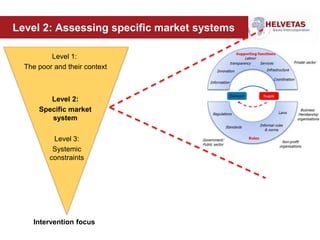
Level 2: Assessing specific market systems
Level 1:
The poor and their context
Level 2:
Specific market
system
Level 3:
Systemic
constraints
Intervention focus
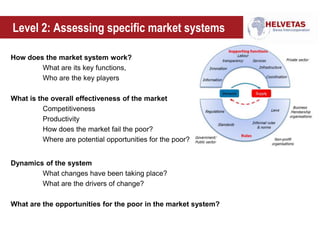
Level 2: Assessing specific market systems
How does the market system work?
What are its key functions,
Who are the key players
What is the overall effectiveness of the market
Competitiveness
Productivity
How does the market fail the poor?
Where are potential opportunities for the poor?
Dynamics of the system
What changes have been taking place?
What are the drivers of change?
What are the opportunities for the poor in the market system?
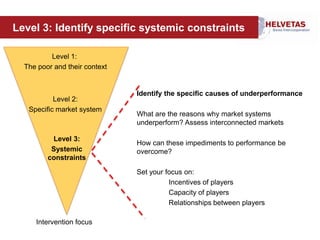
Level 3: Identify specific systemic constraints
Identify the specific causes of underperformance
What are the reasons why market systems
underperform? Assess interconnected markets
How can these impediments to performance be
overcome?
Set your focus on:
Incentives of players
Capacity of players
Relationships between players
Level 1:
The poor and their context
Level 2:
Specific market system
Level 3:
Systemic
constraints
Intervention focus
Four steps to designing interventions
1. Understand
Assessment of market systems
Opportunities, constraints
Why does it not work?
Who could trigger change, and how?
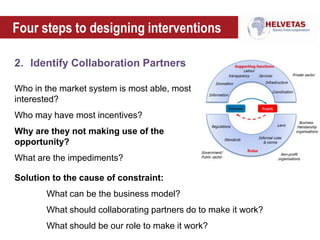
Four steps to designing interventions
2. Identify Collaboration Partners
Who in the market system is most able, most
interested?
Who may have most incentives?
Why are they not making use of the
opportunity?
What are the impediments?
Solution to the cause of constraint:
What can be the business model?
What should collaborating partners do to make it work?
What should be our role to make it work?
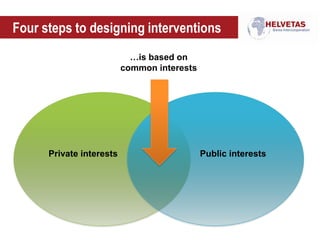
Four steps to designing interventions
Private interests Public interests
…is based on
common interests
Four steps to designing interventions
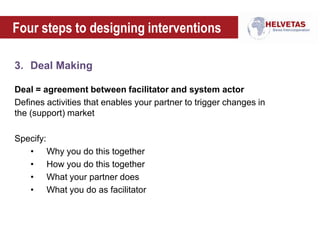
3. Deal Making
Deal = agreement between facilitator and system actor
Defines activities that enables your partner to trigger changes in
the (support) market
Specify:
• Why you do this together
• How you do this together
• What your partner does
• What you do as facilitator
Four steps to designing interventions
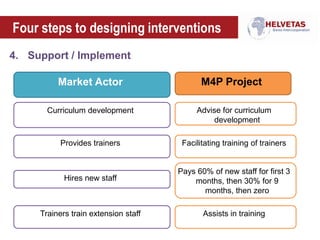
4. Support / Implement
Curriculum development Advise for curriculum
development
Hires new staff
Trainers train extension staff
Provides trainers
Assists in training
Pays 60% of new staff for first 3
months, then 30% for 9
months, then zero
Facilitating training of trainers
Market Actor M4P Project
Steps and Elements of the M4P Approach
• Market Analysis
Developing a strategic framework – results
chains
• Develop a vision for a sustainable market system
• Take a facilitative role as development organisation
• Identify leverage points – interventions to obtain scale
and impact
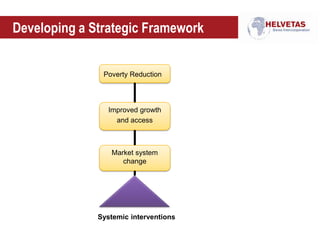
Developing a Strategic Framework
Poverty Reduction
Improved growth
and access
Market system
change
Systemic interventions
Developing a Strategic Framework
Poverty Reduction
Improved growth
and access
Market system
change
Systemic intervention
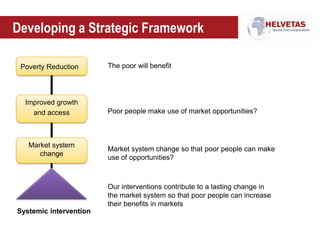
The poor will benefit
Our interventions contribute to a lasting change in
the market system so that poor people can increase
their benefits in markets
Market system change so that poor people can make
use of opportunities?
Poor people make use of market opportunities?
Steps and Elements of the M4P Approach
• Market Analysis
• Developing a strategic framework – results chains
Develop a vision for a sustainable market system
• Take a facilitative role as development organisation
• Identify leverage points – interventions to obtain scale
and impact
Vision for a Sustainable Market System
Infra-
structure
Research &
development
Information
Financial
services
Skills and
capacities
Regulations
Standards Laws
Informal
rules and
norms
Supporting Functions
Rules
Supply
Setting and enforcing rules
Demand
Core
Function
Informing and communicating
Govern-
ment
Informal
networks
Not-for-profit
sector
Private Sector
Membership
organisations
Representative
bodies
Players
Media
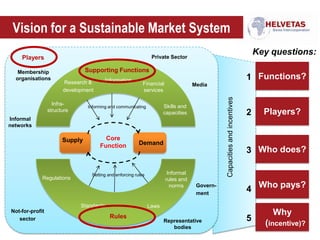
Functions?
Players?
Who does?
Who pays?
Key questions:
1
2
3
4
Capacitiesandincentives
Why
(incentive)?
5
Vision for a Sustainable Market System
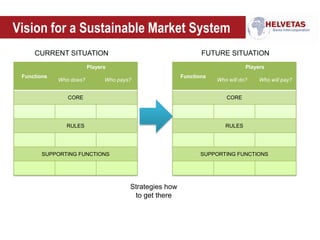
Functions
Players
Who does? Who pays?
CORE
RULES
SUPPORTING FUNCTIONS
Functions
Players
Who will do? Who will pay?
CORE
RULES
SUPPORTING FUNCTIONS
CURRENT SITUATION FUTURE SITUATION
Strategies how
to get there
Steps and Elements of the M4P Approach
• Market Analysis
• Developing a strategic framework – results chains
• Develop a vision for a sustainable market system
Take a facilitative role as development
organisation
• Identify leverage points – interventions to obtain scale
and impact
Facilitating Change
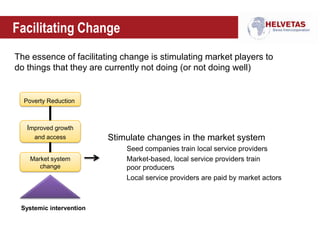
The essence of facilitating change is stimulating market players to
do things that they are currently not doing (or not doing well)
Stimulate changes in the market system
Seed companies train local service providers
Market-based, local service providers train
poor producers
Local service providers are paid by market actors
Poverty Reduction
Improved growth
and access
Market system
change
Systemic intervention
Facilitating Change
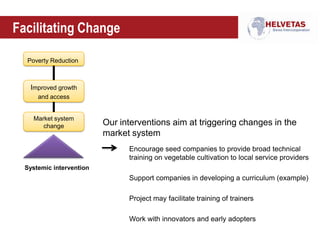
Our interventions aim at triggering changes in the
market system
Encourage seed companies to provide broad technical
training on vegetable cultivation to local service providers
Support companies in developing a curriculum (example)
Project may facilitate training of trainers
Work with innovators and early adopters
Poverty Reduction
Improved growth
and access
Market system
change
Systemic intervention
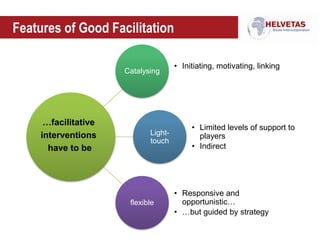
Features of Good Facilitation
Catalysing
• Initiating, motivating, linking
Light-
touch
• Limited levels of support to
players
• Indirect
flexible
• Responsive and
opportunistic…
• …but guided by strategy
…facilitative
interventions
have to be
Facilitating Change
Start small, work with few actors
Monitor closely (against results chain)
Be flexible, adapt, modify
Test the business model: do market systems changes happen?
When successful:
Make business model known (knowledge management &
learning)
Support expansion (scaling up)
Facilitate crowding in
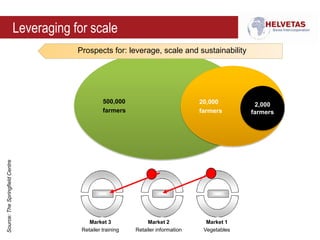
Leveraging for scale
500,000
farmers
20,000
farmers
2,000
farmers
Prospects for: leverage, scale and sustainability
Market 1
Vegetables
Market 2
Retailer information
Market 3
Retailer training
Source:TheSpringfieldCentre
Value Chain / Market Systems
Development
Infra-
structure
Advisory
services
Market
information Financial
services
Skills and
capacities
Regulations
Standards Laws
Informal
rules and
norms
Supporting Functions
Rules
Core Market Function: Value Chain
Sourcing Production Marketing
Value Chain / Market Systems
Development
Infra-
structure
Advisory
services
Market
information Financial
services
Skills and
capacities
Regulations
Standards Laws
Informal
rules and
norms
Supporting Functions
Rules
Value chain approach Market systems approach
Focus on the value chain Focus on the wider market
system and interconnected
markets
Focus on sub-sector rather
individual value chains
No explicit facilitative
approach; development
organisations may take
market actor roles
Explicit facilitative approach
Scale often limited to
specific value chains
Aims for large scale through
leveraging with selected
partners
No explicit focus on
ensuring sustainability
Clear focus on sustainability
Take away message
Context is the starting point
Focus on causes not symptoms
Must consider power dynamics, governance systems
Project rationale – results chains
Sustainability = facilitative role of development actor
Aim for inclusiveness – poor men and women will benefit
Flexibility, adaptability is key

M4P Presentation

  • 1.
    Market Systems Development(M4P) – A Conceptual Outline Martin Dietz Regional Workshop Bentre, Vietnam 23.9.2013
  • 2.
    Market Systems andthe Poor Smallholders often know little about market demands and opportunities They often live in inaccessible places No access to services – technical, financial Traders / processors find it too expensive and time consuming to work with many small suppliers Institutions are weak not providing or enforcing rules and regulations for market actors, the environment is not condusive for doing business Markets are often not working for the poor
  • 3.
    Market Systems andthe Poor Due to Limited or no access to information Weak institutional environment High transaction cost Monopoly or non-competitive markets Market relations do not establish themselves due to factors listed above Market failures
  • 4.
    Market Systems: Playersand Functions Infra- structure Advisory services Market information Financial services Skills and capacities Regulations Standards Laws Informal rules and norms Supporting Functions Rules Core Market Function: Value Chain Sourcing Production Marketing
  • 5.
    M4P – KeyFeatures of Interventions 1. Context-specific: understanding where systems are failing to serve the needs of the poor and acting to correct those failings; understand causes rather than only symptoms 2. Facilitative role: Sustainable change: catalytic role of development agent to stimulate systemic change. Facilitate creation of incentives and capacities 3. Large-scale impact: explicitly aims to reach large numbers of poor by harnessing the dynamism of the market system- seeks leverage points, co- investment and ‘crowding’ in of market players 4. Learning & Adaptability: systems are dynamic: interventions need to be Iterative process of change needs built-in learning to support flexible decision- making and seize windows of opportunity.
  • 6.
    Steps and Elementsof the M4P Approach • Market Analysis • Developing a strategic framework – results chains • Develop a vision for a sustainable market system • Take a facilitative role as development organisation • Identify leverage points – interventions to obtain scale and impact
  • 7.
    Steps and Elementsof the M4P Approach Market Analysis • Developing a strategic framework – results chains • Develop a vision for a sustainable market system • Take a facilitative role as development organisation • Identify leverage points – interventions to obtain scale and impact
  • 8.
    Steps and Elementsof the M4P Approach Gain a sound understanding of the market system and the underlying reasons why poor people often fail in markets. The analysis includes The relevance of the sub-sector to poor people Mapping of main actors in the sub-sector Identification of constraints and opportunities for poor producers A sound analysis of why markets may fail the poor Market Analysis Level 1: The poor and their context Level 2: Specific market system Level 3: Systemic constraints
  • 9.
    Level 1: Marketsystem selection Level 1: The poor and their context Level 2: Specific market system Level 3: Systemic constraints Intervention focus Relevance to the poor? High numbers of disadvantaged groups (as producers, employees, consumers) Pro-.poor access or growth potential? M4P Intervention potential Feasibility of stimulating market systemic change Criteria Size Relevance Prospects Considerations agency priorities agency capacity feasibility
  • 10.
    Level 2: Assessingspecific market systems Level 1: The poor and their context Level 2: Specific market system Level 3: Systemic constraints Intervention focus
  • 11.
    Level 2: Assessingspecific market systems How does the market system work? What are its key functions, Who are the key players What is the overall effectiveness of the market Competitiveness Productivity How does the market fail the poor? Where are potential opportunities for the poor? Dynamics of the system What changes have been taking place? What are the drivers of change? What are the opportunities for the poor in the market system?
  • 12.
    Level 3: Identifyspecific systemic constraints Identify the specific causes of underperformance What are the reasons why market systems underperform? Assess interconnected markets How can these impediments to performance be overcome? Set your focus on: Incentives of players Capacity of players Relationships between players Level 1: The poor and their context Level 2: Specific market system Level 3: Systemic constraints Intervention focus
  • 13.
    Four steps todesigning interventions 1. Understand Assessment of market systems Opportunities, constraints Why does it not work? Who could trigger change, and how?
  • 14.
    Four steps todesigning interventions 2. Identify Collaboration Partners Who in the market system is most able, most interested? Who may have most incentives? Why are they not making use of the opportunity? What are the impediments? Solution to the cause of constraint: What can be the business model? What should collaborating partners do to make it work? What should be our role to make it work?
  • 15.
    Four steps todesigning interventions Private interests Public interests …is based on common interests
  • 16.
    Four steps todesigning interventions 3. Deal Making Deal = agreement between facilitator and system actor Defines activities that enables your partner to trigger changes in the (support) market Specify: • Why you do this together • How you do this together • What your partner does • What you do as facilitator
  • 17.
    Four steps todesigning interventions 4. Support / Implement Curriculum development Advise for curriculum development Hires new staff Trainers train extension staff Provides trainers Assists in training Pays 60% of new staff for first 3 months, then 30% for 9 months, then zero Facilitating training of trainers Market Actor M4P Project
  • 18.
    Steps and Elementsof the M4P Approach • Market Analysis Developing a strategic framework – results chains • Develop a vision for a sustainable market system • Take a facilitative role as development organisation • Identify leverage points – interventions to obtain scale and impact
  • 19.
    Developing a StrategicFramework Poverty Reduction Improved growth and access Market system change Systemic interventions
  • 20.
    Developing a StrategicFramework Poverty Reduction Improved growth and access Market system change Systemic intervention The poor will benefit Our interventions contribute to a lasting change in the market system so that poor people can increase their benefits in markets Market system change so that poor people can make use of opportunities? Poor people make use of market opportunities?
  • 21.
    Steps and Elementsof the M4P Approach • Market Analysis • Developing a strategic framework – results chains Develop a vision for a sustainable market system • Take a facilitative role as development organisation • Identify leverage points – interventions to obtain scale and impact
  • 22.
    Vision for aSustainable Market System Infra- structure Research & development Information Financial services Skills and capacities Regulations Standards Laws Informal rules and norms Supporting Functions Rules Supply Setting and enforcing rules Demand Core Function Informing and communicating Govern- ment Informal networks Not-for-profit sector Private Sector Membership organisations Representative bodies Players Media Functions? Players? Who does? Who pays? Key questions: 1 2 3 4 Capacitiesandincentives Why (incentive)? 5
  • 23.
    Vision for aSustainable Market System Functions Players Who does? Who pays? CORE RULES SUPPORTING FUNCTIONS Functions Players Who will do? Who will pay? CORE RULES SUPPORTING FUNCTIONS CURRENT SITUATION FUTURE SITUATION Strategies how to get there
  • 24.
    Steps and Elementsof the M4P Approach • Market Analysis • Developing a strategic framework – results chains • Develop a vision for a sustainable market system Take a facilitative role as development organisation • Identify leverage points – interventions to obtain scale and impact
  • 25.
    Facilitating Change The essenceof facilitating change is stimulating market players to do things that they are currently not doing (or not doing well) Stimulate changes in the market system Seed companies train local service providers Market-based, local service providers train poor producers Local service providers are paid by market actors Poverty Reduction Improved growth and access Market system change Systemic intervention
  • 26.
    Facilitating Change Our interventionsaim at triggering changes in the market system Encourage seed companies to provide broad technical training on vegetable cultivation to local service providers Support companies in developing a curriculum (example) Project may facilitate training of trainers Work with innovators and early adopters Poverty Reduction Improved growth and access Market system change Systemic intervention
  • 27.
    Features of GoodFacilitation Catalysing • Initiating, motivating, linking Light- touch • Limited levels of support to players • Indirect flexible • Responsive and opportunistic… • …but guided by strategy …facilitative interventions have to be
  • 28.
    Facilitating Change Start small,work with few actors Monitor closely (against results chain) Be flexible, adapt, modify Test the business model: do market systems changes happen? When successful: Make business model known (knowledge management & learning) Support expansion (scaling up) Facilitate crowding in
  • 29.
    Leveraging for scale 500,000 farmers 20,000 farmers 2,000 farmers Prospectsfor: leverage, scale and sustainability Market 1 Vegetables Market 2 Retailer information Market 3 Retailer training Source:TheSpringfieldCentre
  • 30.
    Value Chain /Market Systems Development Infra- structure Advisory services Market information Financial services Skills and capacities Regulations Standards Laws Informal rules and norms Supporting Functions Rules Core Market Function: Value Chain Sourcing Production Marketing
  • 31.
    Value Chain /Market Systems Development Infra- structure Advisory services Market information Financial services Skills and capacities Regulations Standards Laws Informal rules and norms Supporting Functions Rules Value chain approach Market systems approach Focus on the value chain Focus on the wider market system and interconnected markets Focus on sub-sector rather individual value chains No explicit facilitative approach; development organisations may take market actor roles Explicit facilitative approach Scale often limited to specific value chains Aims for large scale through leveraging with selected partners No explicit focus on ensuring sustainability Clear focus on sustainability
  • 32.
    Take away message Contextis the starting point Focus on causes not symptoms Must consider power dynamics, governance systems Project rationale – results chains Sustainability = facilitative role of development actor Aim for inclusiveness – poor men and women will benefit Flexibility, adaptability is key

Editor's Notes

  • #3 Tanzania: Rural Livelihood Development Programme (RLDP)Bangladesh: SamriddhiGeorgia: Market Opportunities for Livelihood Improvement in Kakheti, Georgia (MOLI) Armenia: Markets for Meghri (M4M)Kosovo: Enhancing Youth Employment (EYE) ProjectBosnia: Market Makers Project (generacion de empleosparajovenes)Empezandotambién en otrospaíses: Talleres de formación: Nepal Enero 2012Kirgistan Abril 2012Peru Mayo 2012Kosovo/BosniaOctubre/Diciembre 2012Nicaragua Abril 2013Burkina Faso Junio 2013
  • #4 Tanzania: Rural Livelihood Development Programme (RLDP)Bangladesh: SamriddhiGeorgia: Market Opportunities for Livelihood Improvement in Kakheti, Georgia (MOLI) Armenia: Markets for Meghri (M4M)Kosovo: Enhancing Youth Employment (EYE) ProjectBosnia: Market Makers Project (generacion de empleosparajovenes)Empezandotambién en otrospaíses: Talleres de formación: Nepal Enero 2012Kirgistan Abril 2012Peru Mayo 2012Kosovo/BosniaOctubre/Diciembre 2012Nicaragua Abril 2013Burkina Faso Junio 2013
  • #7 Tanzania: Rural Livelihood Development Programme (RLDP)Bangladesh: SamriddhiGeorgia: Market Opportunities for Livelihood Improvement in Kakheti, Georgia (MOLI) Armenia: Markets for Meghri (M4M)Kosovo: Enhancing Youth Employment (EYE) ProjectBosnia: Market Makers Project (generacion de empleosparajovenes)Empezandotambién en otrospaíses: Talleres de formación: Nepal Enero 2012Kirgistan Abril 2012Peru Mayo 2012Kosovo/BosniaOctubre/Diciembre 2012Nicaragua Abril 2013Burkina Faso Junio 2013
  • #8 Tanzania: Rural Livelihood Development Programme (RLDP)Bangladesh: SamriddhiGeorgia: Market Opportunities for Livelihood Improvement in Kakheti, Georgia (MOLI) Armenia: Markets for Meghri (M4M)Kosovo: Enhancing Youth Employment (EYE) ProjectBosnia: Market Makers Project (generacion de empleosparajovenes)Empezandotambién en otrospaíses: Talleres de formación: Nepal Enero 2012Kirgistan Abril 2012Peru Mayo 2012Kosovo/BosniaOctubre/Diciembre 2012Nicaragua Abril 2013Burkina Faso Junio 2013
  • #9 Tanzania: Rural Livelihood Development Programme (RLDP)Bangladesh: SamriddhiGeorgia: Market Opportunities for Livelihood Improvement in Kakheti, Georgia (MOLI) Armenia: Markets for Meghri (M4M)Kosovo: Enhancing Youth Employment (EYE) ProjectBosnia: Market Makers Project (generacion de empleosparajovenes)Empezandotambién en otrospaíses: Talleres de formación: Nepal Enero 2012Kirgistan Abril 2012Peru Mayo 2012Kosovo/BosniaOctubre/Diciembre 2012Nicaragua Abril 2013Burkina Faso Junio 2013
  • #19 Tanzania: Rural Livelihood Development Programme (RLDP)Bangladesh: SamriddhiGeorgia: Market Opportunities for Livelihood Improvement in Kakheti, Georgia (MOLI) Armenia: Markets for Meghri (M4M)Kosovo: Enhancing Youth Employment (EYE) ProjectBosnia: Market Makers Project (generacion de empleosparajovenes)Empezandotambién en otrospaíses: Talleres de formación: Nepal Enero 2012Kirgistan Abril 2012Peru Mayo 2012Kosovo/BosniaOctubre/Diciembre 2012Nicaragua Abril 2013Burkina Faso Junio 2013
  • #22 Tanzania: Rural Livelihood Development Programme (RLDP)Bangladesh: SamriddhiGeorgia: Market Opportunities for Livelihood Improvement in Kakheti, Georgia (MOLI) Armenia: Markets for Meghri (M4M)Kosovo: Enhancing Youth Employment (EYE) ProjectBosnia: Market Makers Project (generacion de empleosparajovenes)Empezandotambién en otrospaíses: Talleres de formación: Nepal Enero 2012Kirgistan Abril 2012Peru Mayo 2012Kosovo/BosniaOctubre/Diciembre 2012Nicaragua Abril 2013Burkina Faso Junio 2013
  • #23 The importantthingtoemphasiseherefrom an M4P pointofview, isthatthesemarkettransactions do not happen in isolation! Effectiveandefficientmarketshavedeveloped a rangeoffunctionsandrulestosupportandinformthesetransactionsandtoreducetransactioncosts. Forexample: Ifwetake a for-feeservice model for rural advisoryservices. Forthesetofunctioneffectively, weneedtotakeintoaccount: training: howcancapacitydecelopmentofserviceprovidersbeensured in thelongtermInformation: howcanweensurethatserviceprovidersprovide relevant informationtofarmersResearch anddevelopment: how do serviceprovidersensurethattheirservicesremain relevantFinance: arefarmerswillingtopay – ifyes, how?Codes ofconduct: toensurequalityofservicesMarketing: howtofarmersgettoknowabouttheseservicesInfrastructure: how do farmersandserviceprovidersphysicallycommunicate?Etc.The functions – in thecoreand in the wider system – areperformedby a numberof different players. Public and private. Formal and informal. Therearetherefore 4 keyquestionstoaskourselves: Whatarethenecessaryfunctionstomakethistransactionworkbetterformytargetgroup?Who aretheplayers out there?Who isbestsuitedtoperformwhatfunctions?And: Howisthisfinanciallysustained?
  • #24 Askforfactorsthatdeterminefuturevision.FuturevisionisdeterminedbyCapacitiesIncentivesNature ofmarketsystemHistoryInnovation landscape
  • #25 Tanzania: Rural Livelihood Development Programme (RLDP)Bangladesh: SamriddhiGeorgia: Market Opportunities for Livelihood Improvement in Kakheti, Georgia (MOLI) Armenia: Markets for Meghri (M4M)Kosovo: Enhancing Youth Employment (EYE) ProjectBosnia: Market Makers Project (generacion de empleosparajovenes)Empezandotambién en otrospaíses: Talleres de formación: Nepal Enero 2012Kirgistan Abril 2012Peru Mayo 2012Kosovo/BosniaOctubre/Diciembre 2012Nicaragua Abril 2013Burkina Faso Junio 2013
  • #33 Askforfactorsthatdeterminefuturevision.FuturevisionisdeterminedbyCapacitiesIncentivesNature ofmarketsystemHistoryInnovation landscape