LOGO
MARITIME TECHNICAL ENGLISHMARITIME TECHNICAL ENGLISH
REPÚBLICA BOLIVARIANA DE VENEZUELA
UNIVERSIDAD NACIONAL EXPERIMENTAL MARÍTIMA DEL CARIBE
COORDINACIÓN DE DESARROLLO DOCENTE
CÁTEDRA DE IDIOMAS
Prof. César Rivas
JULY 2017
Brief History2
Characteristics of M. E.4
Importance of Maritime English33
English for the Maritime Field31
Contents
Maritime English
seasea portportShippingShipping
ShipbuildingShipbuilding
(Bocanegra, 2013)
Maritime English is an umbrella
term which refers to the English
language used by seafarers
both at sea and in port and by
individuals working in the
shipping and shipbuilding
industry.
(Bocanegra, 2013)
Maritime English
For its background, Maritime
English has gained worldwide
recognition as the international
language of seaborne trade that
employs internationally oriented
individuals who need to be fluent in
English for communicating
successfully while on board and
ashore.
(Bocanegra, 2013)
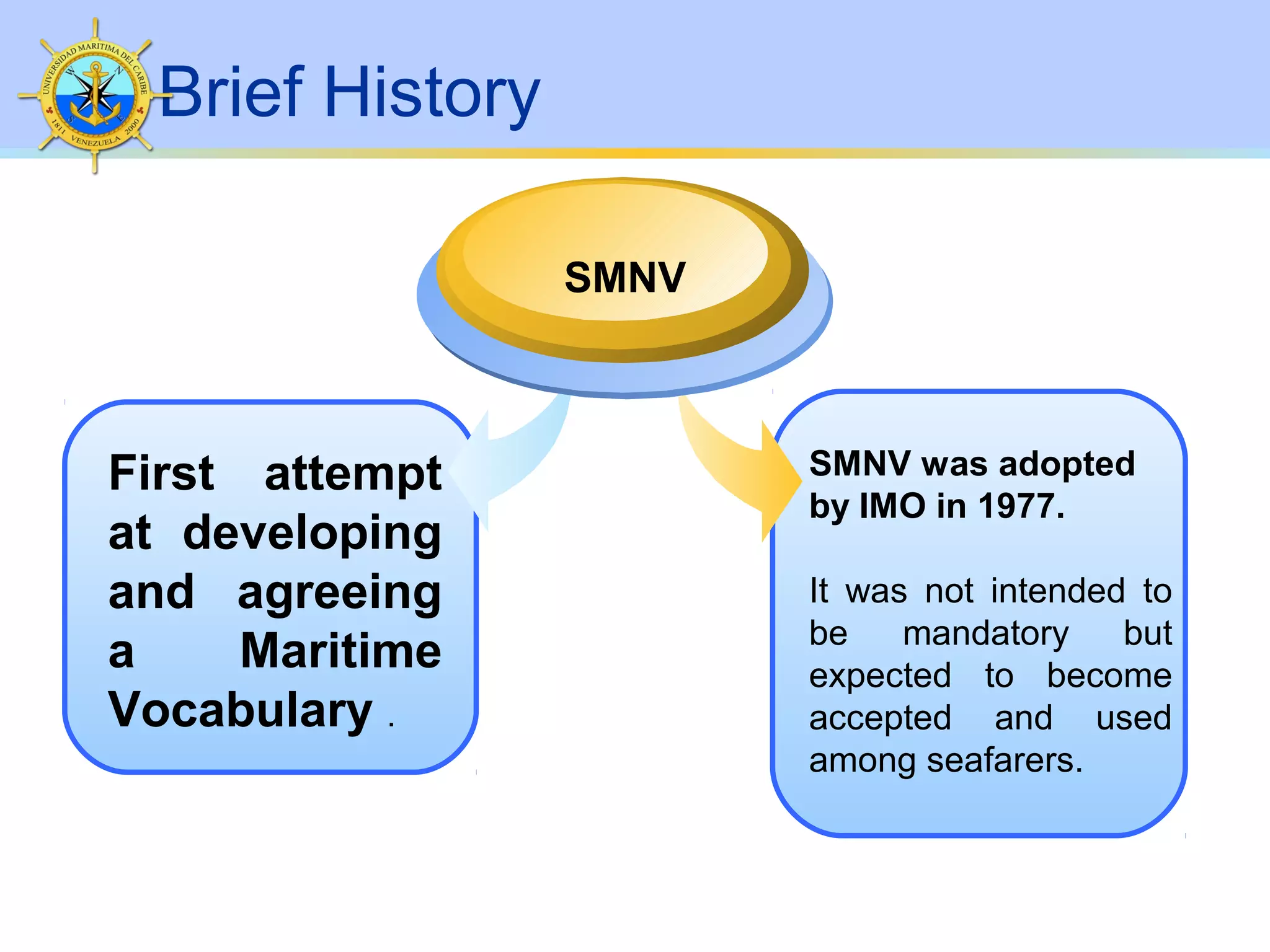
First attempt
at developing
and agreeing
a Maritime
Vocabulary .
SMNV
SMNV was adopted
by IMO in 1977.
It was not intended to
be mandatory but
expected to become
accepted and used
among seafarers.
Brief History
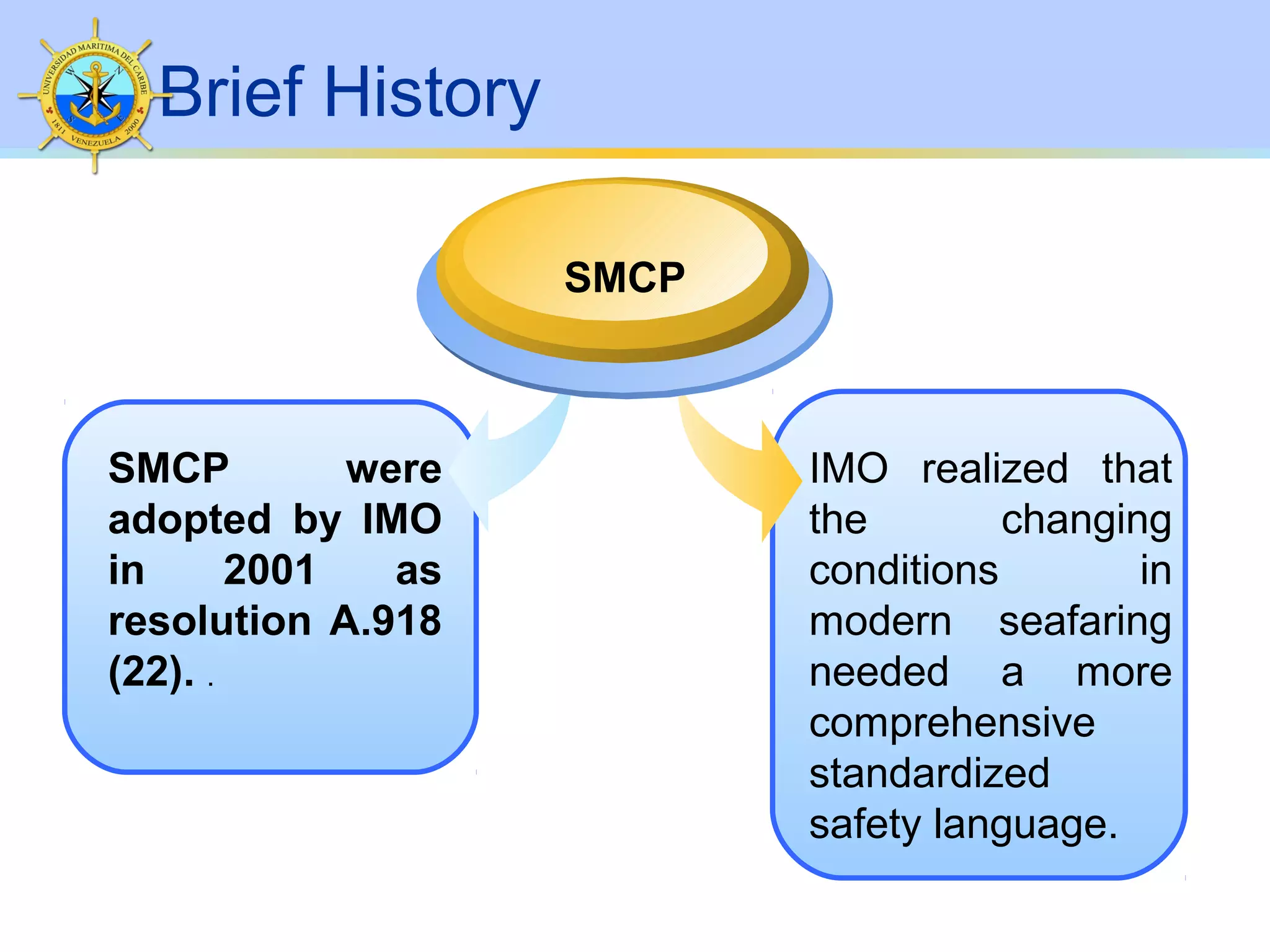
SMCP were
adopted by IMO
in 2001 as
resolution A.918
(22). .
SMCP
IMO realized that
the changing
conditions in
modern seafaring
needed a more
comprehensive
standardized
safety language.
Brief History
Very specialized language
with specific terms used in
the Maritime Field
It is precribed in
the training guidelines
of STCW
All fields of activity in daily
maritime routine and above
all in emergency situations
are covered by M.E.
MaritimeMaritime
EnglishEnglish
Importance of M.E.
English is the international
recognized language of
the sea. (IMO, 2916)
Lingua franca used to
communicate onboard
Manila (2010) amendments
make it compulsory in 2017
MaritimeMaritime
EnglishEnglish
Importance of M.E.
M.E.
Uniform schemes for
questions, answers and
instructions are
standardized.
Specialized and
unfamiliar terminology
There’s a glossary provided.
It has 5 subvarieties
E fr Nav. and Marit. Com.
Mcommerce
Mlaw
MEngineering.
Shipbuilding .
Simple grammar
Characteristics
(Bocanegra, 2013)(Bocanegra, 2013)
REFERENCES
 Bocanegra-Valle, A. (2013). Maritime English. In C. A. Chapelle (Ed.), The
encyclopedia of applied linguistics (pp. 3570-3583). Oxford: Wiley-
Blackwell.
 Glosario de Terminología Marítima (2007). Mundo Sur. Retrieved
from:https://mundosur.files.wordpress.com/2009/07/glosario
maritimo.pdf
 IMO Standard Marine Communication Phrases. (2000) Resolution A.918
(22). Retrieved from:
http://www.imo.org/en/OurWork/safety/navigation/pages/standardmarine
communicationphrases.aspx
LOGO

Maritime English

  • 1.
    LOGO MARITIME TECHNICAL ENGLISHMARITIMETECHNICAL ENGLISH REPÚBLICA BOLIVARIANA DE VENEZUELA UNIVERSIDAD NACIONAL EXPERIMENTAL MARÍTIMA DEL CARIBE COORDINACIÓN DE DESARROLLO DOCENTE CÁTEDRA DE IDIOMAS Prof. César Rivas JULY 2017
  • 2.
    Brief History2 Characteristics ofM. E.4 Importance of Maritime English33 English for the Maritime Field31 Contents
  • 3.
  • 4.
    Maritime English isan umbrella term which refers to the English language used by seafarers both at sea and in port and by individuals working in the shipping and shipbuilding industry. (Bocanegra, 2013) Maritime English
  • 5.
    For its background,Maritime English has gained worldwide recognition as the international language of seaborne trade that employs internationally oriented individuals who need to be fluent in English for communicating successfully while on board and ashore. (Bocanegra, 2013)
  • 6.
    First attempt at developing andagreeing a Maritime Vocabulary . SMNV SMNV was adopted by IMO in 1977. It was not intended to be mandatory but expected to become accepted and used among seafarers. Brief History
  • 7.
    SMCP were adopted byIMO in 2001 as resolution A.918 (22). . SMCP IMO realized that the changing conditions in modern seafaring needed a more comprehensive standardized safety language. Brief History
  • 8.
    Very specialized language withspecific terms used in the Maritime Field It is precribed in the training guidelines of STCW All fields of activity in daily maritime routine and above all in emergency situations are covered by M.E. MaritimeMaritime EnglishEnglish Importance of M.E.
  • 9.
    English is theinternational recognized language of the sea. (IMO, 2916) Lingua franca used to communicate onboard Manila (2010) amendments make it compulsory in 2017 MaritimeMaritime EnglishEnglish Importance of M.E.
  • 10.
    M.E. Uniform schemes for questions,answers and instructions are standardized. Specialized and unfamiliar terminology There’s a glossary provided. It has 5 subvarieties E fr Nav. and Marit. Com. Mcommerce Mlaw MEngineering. Shipbuilding . Simple grammar Characteristics (Bocanegra, 2013)(Bocanegra, 2013)
  • 11.
    REFERENCES  Bocanegra-Valle, A.(2013). Maritime English. In C. A. Chapelle (Ed.), The encyclopedia of applied linguistics (pp. 3570-3583). Oxford: Wiley- Blackwell.  Glosario de Terminología Marítima (2007). Mundo Sur. Retrieved from:https://mundosur.files.wordpress.com/2009/07/glosario maritimo.pdf  IMO Standard Marine Communication Phrases. (2000) Resolution A.918 (22). Retrieved from: http://www.imo.org/en/OurWork/safety/navigation/pages/standardmarine communicationphrases.aspx
  • 12.