Means of communication on board
ship
 As in all workplaces, the ability of the crew persons of
a coastal vessel to contribute to effective
communications and teamwork is pivotal to smooth
running and safe operations.
 As in all workplaces, the ability of the crew persons of
a coastal vessel to contribute to effective
communications and teamwork is pivotal to smooth
running and safe operations.
The Command Structure of
a small coastal vessel:
 The Maritime Industry uses universal communication
techniques, but has also formulated its own methods
to suit its unique workplace, that of a small unit
remote from the outside assistance and services of the
shore. Although the coastal vessel may be at sea for
limited periods as compared to her larger offshore
cousin, a similar crewing of Master, Mate, Engineer,
Cook and Crew accept responsibility and perform all
the duties of a land based community.
The Command Structure of
a small coastal vessel:
 This responsibility for safe operations is stated in the
Inter national Regulations for Preventing Collisions at
sea “Rule two, responsibility”
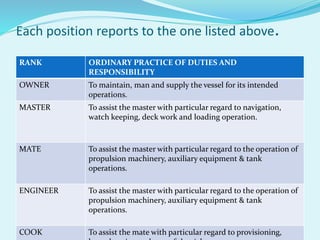
 The command structure will adapt itself to crew size
and the vessel’s operations, but “orders” or
"instructions” will usually follow an order of rank and
may include the duties as shown in the table below:
Each position reports to the one listed above.
RANK ORDINARY PRACTICE OF DUTIES AND
RESPONSIBILITY
OWNER To maintain, man and supply the vessel for its intended
operations.
MASTER To assist the master with particular regard to navigation,
watch keeping, deck work and loading operation.
MATE To assist the master with particular regard to the operation of
propulsion machinery, auxiliary equipment & tank
operations.
ENGINEER To assist the master with particular regard to the operation of
propulsion machinery, auxiliary equipment & tank
operations.
COOK To assist the mate with particular regard to provisioning,
Methods for instruction:
 Methods commonly used for instructions and orders use
non verbal, verbal and written. Signaling, a form of non
verbal has its own particular place at sea.
 Informal signaling requires local knowledge or experience.
Fastening a broom
 to a ships mast (means ship for sale),flying a long pennant
flag (means ship’s last voyage) or a fishing basket displayed
aloft (means keep clear, I am still fishing) are examples of
many local traditions. The experienced watch keeper will
recognize the early and substantial change of course by
another vessel
 ahead as that ship’s body language of her intended side to
pass you.
Methods for instruction:
 Formal signaling is used in both traditional and
state of the art systems. The coded information that is
displayed (transmitted) requires the receiver to
 interpret it using the agreed decoding manual. These
systems include Semaphore, Flags and Code Flags, Morse
code by lights or sound signals and modern radio
communication systems.
 Radio signaling systems can automatic decode to activate
indicator lights or sound alarms, while others systems
require
 the use of published material such as code books and lists
of lights and radio signals.
Means of communication on board
ship:
 Verbal communication.
 Non verbal communication.
 Formal communication.
 Informal communication.
Verbal communication
 Verbal communication may be informal
 such as occurs in casual conversation, advice or instruction
that allows levels of voluntary participation.
 It may alternatively be a formal order or command that is
required to be obeyed and implemented.
 Written communications include reminder memos and
temporary signs, letters and advisories notices, emails and
other print out radio services such as Telex, Digital
Selective Calling, Navtex and Immarsat. All must be
considered as formal by their nature of being an article that
can be stored as permanent evidence.
Written communication
 Clear-it can be easily read
 Concise-it is not too long
 Complete-everything necessary should be included
 Correct-it is accurate
 Log book
 it should not falisfy,otherwise it a legal offence.
 It should not contain oponion,observation or coarse
language.
Log book
 Log book entire should be signed and dated.
 Mistakes should not be erased, but lined through and
initialed.
 Pages should not be removed.
 False entries must not be made
Non verbal communication
.
 Informal non verbal communication is transmitted
 through facial expressions, hand signals, body language,
attire and attitude of the communicators. It can result in
misunderstandings with persons of differing backgrounds
and cultures.
 In a multicultural industry, this concern has led to the
development of formal non verbal communication in
certain operational
 situations, such as saluting in acknowledgment of
instructions from a senior officer or using standardized
hand signals for lifting and cargo operations.
Formal communication
 Traditional ,formal communications at sea are provided in
the written standing orders of the Master.
 The entries in the ship’s logbooks,
 The records of reports .
 The safety management documentation.
 Formal signaling is used in both traditional and state of the
art systems. The coded information that is displayed
(transmitted) requires the receiver to interpret it using the
agreed decoding manual. Radio signals
 These systems include Semaphore, Flags and Code Flags,
Morse code by lights or sound signals and modern radio
communications systems.
Informal communication
 Informal non verbal communication is transmitted
 through facial expressions, hand signals, body
language, attire and attitude of the communicators. It
can result in misunderstandings with persons of
differing backgrounds and cultures.
 Verbal communication may be
 informal such as occurs in casual conversation, advice
or instruction that allows levels of voluntary
participation. It may alternatively be order or formal
order too.
Communication process
 The transmitter.
 The channel-body language,fax,digital signalling,email
 The receiver.
 The interference.-environmental disturbances
 Feedback.
international marItime
organization(IMO)
IMO uses SMCP(standard maritime communication phrases)
 Orders may differ from the coastal vessel u serve:
ORDER MEANING
 Mooring and berthing orders from the Master to the crew
 Untie a rope (line) - securing the vessel.
 Let go (a named line) -Untie all lines securing the vessel.
 Let go all -Secure a line to the vessel.
 Make fast ( a named line) -Allow a line to slip out under
control.
 Ease (a named line) -Hold a line in the present position
temporarily.
 Check (a named line) -Orders are replied to as implemente
IMO
 ORDER MEANING
 Hard to Starboard –turn the steering wheel all the way
to the right and hold it there.
 Ten degrees to Port -Turn the steering wheel until the
indicator reads 10º to Port and hold it there.
 Ease to amidship-Return the steering wheel until the
indicator reads 0º and hold it there.
 Steady as she goes-steer the vessel as she continues to
go ahead.

Communication on boardship

  • 1.
    Means of communicationon board ship  As in all workplaces, the ability of the crew persons of a coastal vessel to contribute to effective communications and teamwork is pivotal to smooth running and safe operations.  As in all workplaces, the ability of the crew persons of a coastal vessel to contribute to effective communications and teamwork is pivotal to smooth running and safe operations.
  • 2.
    The Command Structureof a small coastal vessel:  The Maritime Industry uses universal communication techniques, but has also formulated its own methods to suit its unique workplace, that of a small unit remote from the outside assistance and services of the shore. Although the coastal vessel may be at sea for limited periods as compared to her larger offshore cousin, a similar crewing of Master, Mate, Engineer, Cook and Crew accept responsibility and perform all the duties of a land based community.
  • 3.
    The Command Structureof a small coastal vessel:  This responsibility for safe operations is stated in the Inter national Regulations for Preventing Collisions at sea “Rule two, responsibility”  The command structure will adapt itself to crew size and the vessel’s operations, but “orders” or "instructions” will usually follow an order of rank and may include the duties as shown in the table below:
  • 4.
    Each position reportsto the one listed above. RANK ORDINARY PRACTICE OF DUTIES AND RESPONSIBILITY OWNER To maintain, man and supply the vessel for its intended operations. MASTER To assist the master with particular regard to navigation, watch keeping, deck work and loading operation. MATE To assist the master with particular regard to the operation of propulsion machinery, auxiliary equipment & tank operations. ENGINEER To assist the master with particular regard to the operation of propulsion machinery, auxiliary equipment & tank operations. COOK To assist the mate with particular regard to provisioning,
  • 5.
    Methods for instruction: Methods commonly used for instructions and orders use non verbal, verbal and written. Signaling, a form of non verbal has its own particular place at sea.  Informal signaling requires local knowledge or experience. Fastening a broom  to a ships mast (means ship for sale),flying a long pennant flag (means ship’s last voyage) or a fishing basket displayed aloft (means keep clear, I am still fishing) are examples of many local traditions. The experienced watch keeper will recognize the early and substantial change of course by another vessel  ahead as that ship’s body language of her intended side to pass you.
  • 6.
    Methods for instruction: Formal signaling is used in both traditional and state of the art systems. The coded information that is displayed (transmitted) requires the receiver to  interpret it using the agreed decoding manual. These systems include Semaphore, Flags and Code Flags, Morse code by lights or sound signals and modern radio communication systems.  Radio signaling systems can automatic decode to activate indicator lights or sound alarms, while others systems require  the use of published material such as code books and lists of lights and radio signals.
  • 7.
    Means of communicationon board ship:  Verbal communication.  Non verbal communication.  Formal communication.  Informal communication.
  • 8.
    Verbal communication  Verbalcommunication may be informal  such as occurs in casual conversation, advice or instruction that allows levels of voluntary participation.  It may alternatively be a formal order or command that is required to be obeyed and implemented.  Written communications include reminder memos and temporary signs, letters and advisories notices, emails and other print out radio services such as Telex, Digital Selective Calling, Navtex and Immarsat. All must be considered as formal by their nature of being an article that can be stored as permanent evidence.
  • 9.
    Written communication  Clear-itcan be easily read  Concise-it is not too long  Complete-everything necessary should be included  Correct-it is accurate  Log book  it should not falisfy,otherwise it a legal offence.  It should not contain oponion,observation or coarse language.
  • 10.
    Log book  Logbook entire should be signed and dated.  Mistakes should not be erased, but lined through and initialed.  Pages should not be removed.  False entries must not be made
  • 11.
    Non verbal communication . Informal non verbal communication is transmitted  through facial expressions, hand signals, body language, attire and attitude of the communicators. It can result in misunderstandings with persons of differing backgrounds and cultures.  In a multicultural industry, this concern has led to the development of formal non verbal communication in certain operational  situations, such as saluting in acknowledgment of instructions from a senior officer or using standardized hand signals for lifting and cargo operations.
  • 12.
    Formal communication  Traditional,formal communications at sea are provided in the written standing orders of the Master.  The entries in the ship’s logbooks,  The records of reports .  The safety management documentation.  Formal signaling is used in both traditional and state of the art systems. The coded information that is displayed (transmitted) requires the receiver to interpret it using the agreed decoding manual. Radio signals  These systems include Semaphore, Flags and Code Flags, Morse code by lights or sound signals and modern radio communications systems.
  • 13.
    Informal communication  Informalnon verbal communication is transmitted  through facial expressions, hand signals, body language, attire and attitude of the communicators. It can result in misunderstandings with persons of differing backgrounds and cultures.  Verbal communication may be  informal such as occurs in casual conversation, advice or instruction that allows levels of voluntary participation. It may alternatively be order or formal order too.
  • 14.
    Communication process  Thetransmitter.  The channel-body language,fax,digital signalling,email  The receiver.  The interference.-environmental disturbances  Feedback.
  • 15.
    international marItime organization(IMO) IMO usesSMCP(standard maritime communication phrases)  Orders may differ from the coastal vessel u serve: ORDER MEANING  Mooring and berthing orders from the Master to the crew  Untie a rope (line) - securing the vessel.  Let go (a named line) -Untie all lines securing the vessel.  Let go all -Secure a line to the vessel.  Make fast ( a named line) -Allow a line to slip out under control.  Ease (a named line) -Hold a line in the present position temporarily.  Check (a named line) -Orders are replied to as implemente
  • 16.
    IMO  ORDER MEANING Hard to Starboard –turn the steering wheel all the way to the right and hold it there.  Ten degrees to Port -Turn the steering wheel until the indicator reads 10º to Port and hold it there.  Ease to amidship-Return the steering wheel until the indicator reads 0º and hold it there.  Steady as she goes-steer the vessel as she continues to go ahead.