
Blockchain
Basics
By
Rohit Kumar
Shailesh J. Mehta School of Management, IIT Bombay
Bitcoin
Is blockchain confined to the Bitcoin?
Bitcoin, however, is just the first of many potential applications
of Blockchain Technology.
Did you know?
Who holds the maximum number of bitcoins?
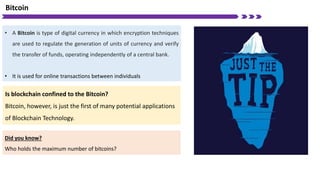
• A Bitcoin is type of digital currency in which encryption techniques
are used to regulate the generation of units of currency and verify
the transfer of funds, operating independently of a central bank.
• It is used for online transactions between individuals
BlockChain Technology
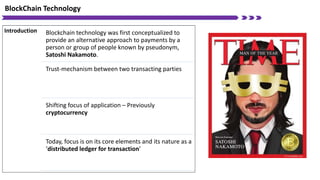
Introduction Blockchain technology was first conceptualized to
provide an alternative approach to payments by a
person or group of people known by pseudonym,
Satoshi Nakamoto.
Trust-mechanism between two transacting parties
Shifting focus of application – Previously
cryptocurrency
Today, focus is on its core elements and its nature as a
‘distributed ledger for transaction’
BlockChain Technology
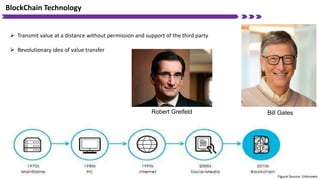
 Transmit value at a distance without permission and support of the third party
 Revolutionary idea of value transfer
Robert Greifeld Bill Gates
Figure Source: Unknown
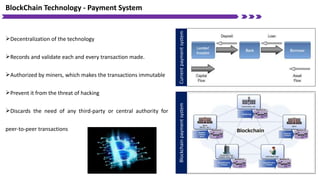
Decentralization of the technology
Records and validate each and every transaction made.
Authorized by miners, which makes the transactions immutable
Prevent it from the threat of hacking
Discards the need of any third-party or central authority for
peer-to-peer transactions
CurrentpaymentsystemBlockchainpaymentsystem
BlockChain Technology - Payment System
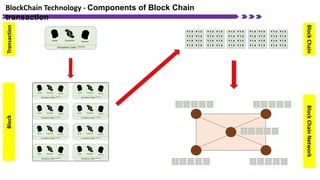
BlockChain Technology - Components of Block Chain
transaction
TransactionBlock
BlockChainBlockChainNetwork
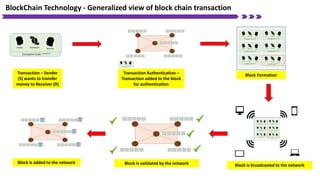
BlockChain Technology - Generalized view of block chain transaction
Transaction – Sender
(S) wants to transfer
money to Receiver (R)
Transaction Authentication –
Transaction added to the block
for authentication
Block Formation
Block is broadcasted to the networkBlock is validated by the networkBlock is added to the network
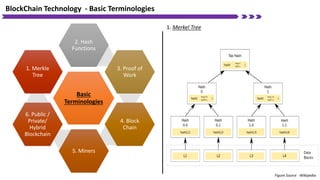
BlockChain Technology - Basic Terminologies
Basic
Terminologies
2. Hash
Functions
3. Proof of
Work
4. Block
Chain
5. Miners
6. Public /
Private/
Hybrid
Blockchain
1. Merkle
Tree
1. Merkel Tree
Figure Source -Wikipedia
BlockChain Technology
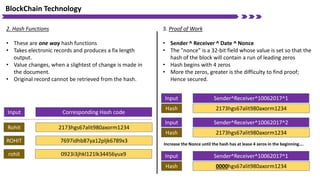
2. Hash Functions
• These are one way hash functions
• Takes electronic records and produces a fix length
output.
• Value changes, when a slightest of change is made in
the document.
• Original record cannot be retrieved from the hash.
Rohit
ROHIT
rohit
2173hgs67alit980axorm1234
7697idhb87ya12pljk6789x3
0923i3jhkl121lk34456yux9
Input Corresponding Hash code
3. Proof of Work
• Sender ^ Receiver ^ Date ^ Nonce
• The "nonce" is a 32-bit field whose value is set so that the
hash of the block will contain a run of leading zeros
• Hash begins with 4 zeros
• More the zeros, greater is the difficulty to find proof;
Hence secured.
2173hgs67alit980axorm1234
Input Sender^Receiver^10062017^1
Hash
2173hgs67alit980axorm1234
Input Sender^Receiver^10062017^2
Hash
0000hgs67alit980axorm1234
Input Sender^Receiver^10062017^1
Hash
Increase the Nonce until the hash has at lease 4 zeros in the beginning….
BlockChain Technology
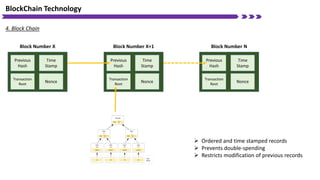
4. Block Chain
Previous
Hash
Time
Stamp
Transaction
Root
Nonce
Block Number X
Previous
Hash
Time
Stamp
Transaction
Root
Nonce
Block Number X+1
Previous
Hash
Time
Stamp
Transaction
Root
Nonce
Block Number N
 Ordered and time stamped records
 Prevents double-spending
 Restricts modification of previous records
BlockChain Technology
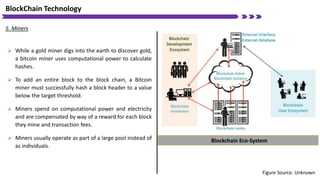
5. Miners
 While a gold miner digs into the earth to discover gold,
a bitcoin miner uses computational power to calculate
hashes.
 To add an entire block to the block chain, a Bitcoin
miner must successfully hash a block header to a value
below the target threshold.
 Miners spend on computational power and electricity
and are compensated by way of a reward for each block
they mine and transaction fees.
 Miners usually operate as part of a large pool instead of
as individuals.
Blockchain Eco-System
Figure Source: Unknown
BlockChain Technology
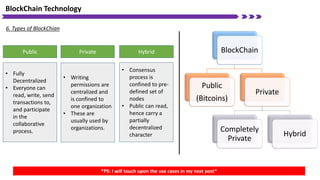
6. Types of BlockChian
BlockChain
Public
(Bitcoins)
Private
Completely
Private
Hybrid
Public Private Hybrid
• Fully
Decentralized
• Everyone can
read, write, send
transactions to,
and participate
in the
collaborative
process.
• Writing
permissions are
centralized and
is confined to
one organization
• These are
usually used by
organizations.
• Consensus
process is
confined to pre-
defined set of
nodes
• Public can read,
hence carry a
partially
decentralized
character
*PS: I will touch upon the use cases in my next post*
BlockChain Technology
Thank You !

Blockchain Basics

  • 1.
    Blockchain Basics By Rohit Kumar Shailesh J.Mehta School of Management, IIT Bombay
  • 2.
    Bitcoin Is blockchain confinedto the Bitcoin? Bitcoin, however, is just the first of many potential applications of Blockchain Technology. Did you know? Who holds the maximum number of bitcoins? • A Bitcoin is type of digital currency in which encryption techniques are used to regulate the generation of units of currency and verify the transfer of funds, operating independently of a central bank. • It is used for online transactions between individuals
  • 3.
    BlockChain Technology Introduction Blockchaintechnology was first conceptualized to provide an alternative approach to payments by a person or group of people known by pseudonym, Satoshi Nakamoto. Trust-mechanism between two transacting parties Shifting focus of application – Previously cryptocurrency Today, focus is on its core elements and its nature as a ‘distributed ledger for transaction’
  • 4.
    BlockChain Technology  Transmitvalue at a distance without permission and support of the third party  Revolutionary idea of value transfer Robert Greifeld Bill Gates Figure Source: Unknown
  • 5.
    Decentralization of thetechnology Records and validate each and every transaction made. Authorized by miners, which makes the transactions immutable Prevent it from the threat of hacking Discards the need of any third-party or central authority for peer-to-peer transactions CurrentpaymentsystemBlockchainpaymentsystem BlockChain Technology - Payment System
  • 6.
    BlockChain Technology -Components of Block Chain transaction TransactionBlock BlockChainBlockChainNetwork
  • 7.
    BlockChain Technology -Generalized view of block chain transaction Transaction – Sender (S) wants to transfer money to Receiver (R) Transaction Authentication – Transaction added to the block for authentication Block Formation Block is broadcasted to the networkBlock is validated by the networkBlock is added to the network
  • 8.
    BlockChain Technology -Basic Terminologies Basic Terminologies 2. Hash Functions 3. Proof of Work 4. Block Chain 5. Miners 6. Public / Private/ Hybrid Blockchain 1. Merkle Tree 1. Merkel Tree Figure Source -Wikipedia
  • 9.
    BlockChain Technology 2. HashFunctions • These are one way hash functions • Takes electronic records and produces a fix length output. • Value changes, when a slightest of change is made in the document. • Original record cannot be retrieved from the hash. Rohit ROHIT rohit 2173hgs67alit980axorm1234 7697idhb87ya12pljk6789x3 0923i3jhkl121lk34456yux9 Input Corresponding Hash code 3. Proof of Work • Sender ^ Receiver ^ Date ^ Nonce • The "nonce" is a 32-bit field whose value is set so that the hash of the block will contain a run of leading zeros • Hash begins with 4 zeros • More the zeros, greater is the difficulty to find proof; Hence secured. 2173hgs67alit980axorm1234 Input Sender^Receiver^10062017^1 Hash 2173hgs67alit980axorm1234 Input Sender^Receiver^10062017^2 Hash 0000hgs67alit980axorm1234 Input Sender^Receiver^10062017^1 Hash Increase the Nonce until the hash has at lease 4 zeros in the beginning….
  • 10.
    BlockChain Technology 4. BlockChain Previous Hash Time Stamp Transaction Root Nonce Block Number X Previous Hash Time Stamp Transaction Root Nonce Block Number X+1 Previous Hash Time Stamp Transaction Root Nonce Block Number N  Ordered and time stamped records  Prevents double-spending  Restricts modification of previous records
  • 11.
    BlockChain Technology 5. Miners While a gold miner digs into the earth to discover gold, a bitcoin miner uses computational power to calculate hashes.  To add an entire block to the block chain, a Bitcoin miner must successfully hash a block header to a value below the target threshold.  Miners spend on computational power and electricity and are compensated by way of a reward for each block they mine and transaction fees.  Miners usually operate as part of a large pool instead of as individuals. Blockchain Eco-System Figure Source: Unknown
  • 12.
    BlockChain Technology 6. Typesof BlockChian BlockChain Public (Bitcoins) Private Completely Private Hybrid Public Private Hybrid • Fully Decentralized • Everyone can read, write, send transactions to, and participate in the collaborative process. • Writing permissions are centralized and is confined to one organization • These are usually used by organizations. • Consensus process is confined to pre- defined set of nodes • Public can read, hence carry a partially decentralized character *PS: I will touch upon the use cases in my next post*
  • 13.