CLONING AND EXPRESSION OF
HPLAT VARIANTS IN E.COLI
Mariana I. León Berríos
Vibha Bansal, Ph. D.
University of Puerto Rico at Cayey
February 28th, 2015.
1
OUTLINE
• Introduce proteins of interest: plasminogen
activators, and associated problems.
• Discuss previous work.
• Present objectives and plan of research during this
semester.
2
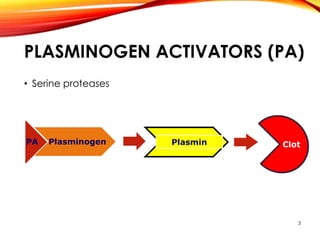
PLASMINOGEN ACTIVATORS (PA)
• Serine proteases
PlasminogenPA Plasmin Clot
3
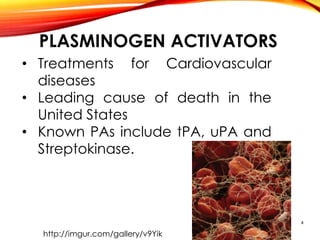
PLASMINOGEN ACTIVATORS
• Treatments for Cardiovascular
diseases
• Leading cause of death in the
United States
• Known PAs include tPA, uPA and
Streptokinase.
http://imgur.com/gallery/v9Yik
4
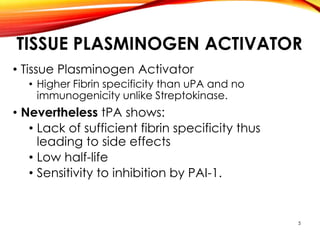
TISSUE PLASMINOGEN ACTIVATOR
• Tissue Plasminogen Activator
• Higher Fibrin specificity than uPA and no
immunogenicity unlike Streptokinase.
• Nevertheless tPA shows:
• Lack of sufficient fibrin specificity thus
leading to side effects
• Low half-life
• Sensitivity to inhibition by PAI-1.
5
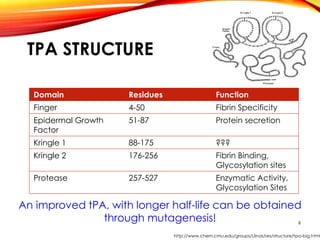
TPA STRUCTURE
Domain Residues Function
Finger 4-50 Fibrin Specificity
Epidermal Growth
Factor
51-87 Protein secretion
Kringle 1 88-175 ???
Kringle 2 176-256 Fibrin Binding,
Glycosylation sites
Protease 257-527 Enzymatic Activity,
Glycosylation Sites
An improved tPA, with longer half-life can be obtained
through mutagenesis!
http://www.chem.cmu.edu/groups/Llinas/res/structure/tpa-big.html
6
7
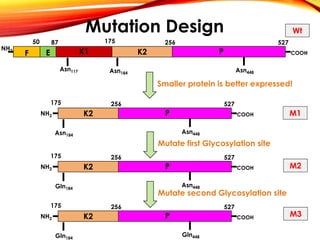
NH2
COOHF E K1 K2 P
50 87 175 256 527
Asn184
Asn448
Asn117
Smaller protein is better expressed!
NH2 COOHK2 P
175 256 527
Asn448Asn184
Mutate first Glycosylation site
NH2 COOHK2 P
175 256 527
Asn448Gln184
Mutate second Glycosylation site
NH2 COOHK2 P
175 256 527
Gln448Gln184
M1
M2
M3
WtMutation Design
PREVIOUS WORK
• We developed pHISp2-hPLAT recombinant plasmid
and cloned it in E.coli DH5-α.
• Mutations of hPLAT gene
8
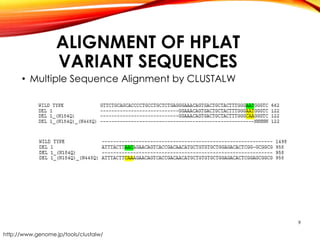
ALIGNMENT OF HPLAT
VARIANT SEQUENCES
• Multiple Sequence Alignment by CLUSTALW
http://www.genome.jp/tools/clustalw/
9
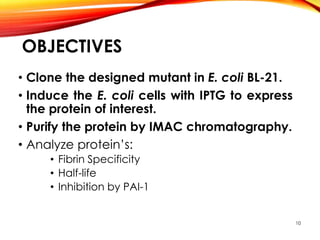
OBJECTIVES
• Clone the designed mutant in E. coli BL-21.
• Induce the E. coli cells with IPTG to express
the protein of interest.
• Purify the protein by IMAC chromatography.
• Analyze protein’s:
• Fibrin Specificity
• Half-life
• Inhibition by PAI-1
10
METHODOLOGY
• Overview:
• Primer Design
• Cloning
• Expression
• Purification
• Analysis
11
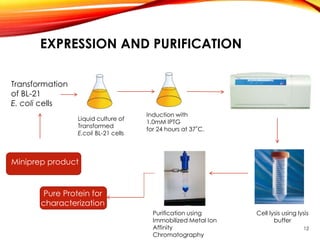
EXPRESSION AND PURIFICATION
Liquid culture of
Transformed
E.coli BL-21 cells
Induction with
1.0mM IPTG
for 24 hours at 37˚C.
Cell lysis using lysis
buffer
Purification using
Immobilized Metal Ion
Affinity
Chromatography
Miniprep product
Transformation
of BL-21
E. coli cells
Pure Protein for
characterization
12
ACKNOWLEDGEMENTS
• Dr. Vibha Bansal
• Dr. Saurabh Chattopadhyay
• Natalia Espada, Alexandra Rosado, and Jose Javier.
• Danilo Pérez and Abimael Santos
• RISE Program UPR-Cayey
• Ricky Padilla, UPR-Mayagüez
• National Center for Research Resources and the
National Institute of General Medical Sciences of the
National Institutes of Health through Grant Number 8
P20 GM 103475.
13
QUESTIONS
14
CLONING AND EXPRESSION OF
HPLAT VARIANTS IN E.COLI
Mariana I. León Berríos
Vibha Bansal, Ph. D.
University of Puerto Rico at Cayey
February 28th, 2015.
15

Mariana mar2015

  • 1.
    CLONING AND EXPRESSIONOF HPLAT VARIANTS IN E.COLI Mariana I. León Berríos Vibha Bansal, Ph. D. University of Puerto Rico at Cayey February 28th, 2015. 1
  • 2.
    OUTLINE • Introduce proteinsof interest: plasminogen activators, and associated problems. • Discuss previous work. • Present objectives and plan of research during this semester. 2
  • 3.
    PLASMINOGEN ACTIVATORS (PA) •Serine proteases PlasminogenPA Plasmin Clot 3
  • 4.
    PLASMINOGEN ACTIVATORS • Treatmentsfor Cardiovascular diseases • Leading cause of death in the United States • Known PAs include tPA, uPA and Streptokinase. http://imgur.com/gallery/v9Yik 4
  • 5.
    TISSUE PLASMINOGEN ACTIVATOR •Tissue Plasminogen Activator • Higher Fibrin specificity than uPA and no immunogenicity unlike Streptokinase. • Nevertheless tPA shows: • Lack of sufficient fibrin specificity thus leading to side effects • Low half-life • Sensitivity to inhibition by PAI-1. 5
  • 6.
    TPA STRUCTURE Domain ResiduesFunction Finger 4-50 Fibrin Specificity Epidermal Growth Factor 51-87 Protein secretion Kringle 1 88-175 ??? Kringle 2 176-256 Fibrin Binding, Glycosylation sites Protease 257-527 Enzymatic Activity, Glycosylation Sites An improved tPA, with longer half-life can be obtained through mutagenesis! http://www.chem.cmu.edu/groups/Llinas/res/structure/tpa-big.html 6
  • 7.
    7 NH2 COOHF E K1K2 P 50 87 175 256 527 Asn184 Asn448 Asn117 Smaller protein is better expressed! NH2 COOHK2 P 175 256 527 Asn448Asn184 Mutate first Glycosylation site NH2 COOHK2 P 175 256 527 Asn448Gln184 Mutate second Glycosylation site NH2 COOHK2 P 175 256 527 Gln448Gln184 M1 M2 M3 WtMutation Design
  • 8.
    PREVIOUS WORK • Wedeveloped pHISp2-hPLAT recombinant plasmid and cloned it in E.coli DH5-α. • Mutations of hPLAT gene 8
  • 9.
    ALIGNMENT OF HPLAT VARIANTSEQUENCES • Multiple Sequence Alignment by CLUSTALW http://www.genome.jp/tools/clustalw/ 9
  • 10.
    OBJECTIVES • Clone thedesigned mutant in E. coli BL-21. • Induce the E. coli cells with IPTG to express the protein of interest. • Purify the protein by IMAC chromatography. • Analyze protein’s: • Fibrin Specificity • Half-life • Inhibition by PAI-1 10
  • 11.
    METHODOLOGY • Overview: • PrimerDesign • Cloning • Expression • Purification • Analysis 11
  • 12.
    EXPRESSION AND PURIFICATION Liquidculture of Transformed E.coli BL-21 cells Induction with 1.0mM IPTG for 24 hours at 37˚C. Cell lysis using lysis buffer Purification using Immobilized Metal Ion Affinity Chromatography Miniprep product Transformation of BL-21 E. coli cells Pure Protein for characterization 12
  • 13.
    ACKNOWLEDGEMENTS • Dr. VibhaBansal • Dr. Saurabh Chattopadhyay • Natalia Espada, Alexandra Rosado, and Jose Javier. • Danilo Pérez and Abimael Santos • RISE Program UPR-Cayey • Ricky Padilla, UPR-Mayagüez • National Center for Research Resources and the National Institute of General Medical Sciences of the National Institutes of Health through Grant Number 8 P20 GM 103475. 13
  • 14.
  • 15.
    CLONING AND EXPRESSIONOF HPLAT VARIANTS IN E.COLI Mariana I. León Berríos Vibha Bansal, Ph. D. University of Puerto Rico at Cayey February 28th, 2015. 15

Editor's Notes

  • #5 There are three common PAs
  • #6 tPA: - Hydrolyzes ARG-VAL bond in plasminogen STREPTOKINASE-from BACTERIA!! Not Human!!! -Second generation Plasminogen Activator -Composed of 562 Amino Acids and 5 domains Domains: The term domain was defined by Jane Richardson in 1981 as a part of a polypeptide chain that is independently stable or could undergo movements as a single entity with respect to the entire protein.
  • #8 Although we expressed the wt-tpa it wasn’t so active because it was too big for the bacteria to express it. The deletions helped the process because in bacteria smaller proteins are better expressed and hence the proteins obtained were REALLY active. The bacteria cloning and expressing system was used because they were less complicated than mammals cells and
  • #9 So for this semester…
  • #11 HOW ARE WE GOING TO DO THIS?
  • #12 tPA Domains…
  • #13 After the protein is pure… smooth transition
  • #15 DH-5alpha have problem with transcription therefore are not used for protein expression, they produce DNA with no mutations. BL-21