Multimedia
Principles
1
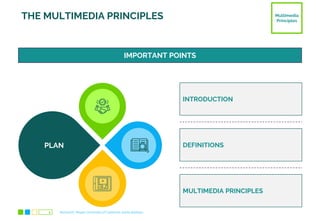
INTRODUCTION
DEFINITIONS
MULTIMEDIA PRINCIPLES
PLAN
IMPORTANT POINTS
THE MULTIMEDIA PRINCIPLES
Richard E. Mayer University of California, Santa Barbara
Multimedia
Principles
2
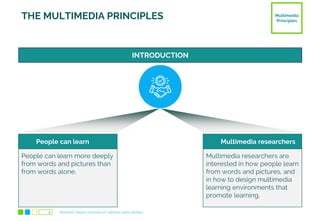
INTRODUCTION
People can learn more deeply
from words and pictures than
from words alone.
People can learn
Multimedia researchers are
interested in how people learn
from words and pictures, and
in how to design multimedia
learning environments that
promote learning.
Multimedia researchers
Richard E. Mayer University of California, Santa Barbara
THE MULTIMEDIA PRINCIPLES
Multimedia
Principles
3
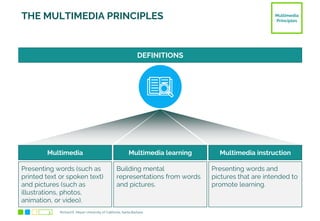
Multimedia
Presenting words (such as
printed text or spoken text)
and pictures (such as
illustrations, photos,
animation, or video).
Building mental
representations from words
and pictures.
Multimedia learning
Presenting words and
pictures that are intended to
promote learning.
Multimedia instruction
DEFINITIONS
Richard E. Mayer University of California, Santa Barbara
THE MULTIMEDIA PRINCIPLES
Multimedia
Principles
4
According to the presentation modes view, multimedia requires verbal and
pictorial representations, such as on-screen text and animation or printed text
and illustrations.
MULTIMEDIA
Richard E. Mayer University of California, Santa Barbara
THE MULTIMEDIA PRINCIPLES
Multimedia
Principles
5
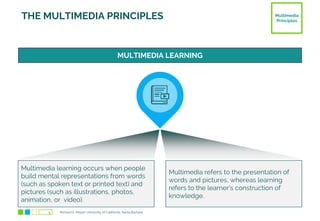
Multimedia learning occurs when people
build mental representations from words
(such as spoken text or printed text) and
pictures (such as illustrations, photos,
animation, or video).
MULTIMEDIA LEARNING
Multimedia refers to the presentation of
words and pictures, whereas learning
refers to the learner’s construction of
knowledge.
Richard E. Mayer University of California, Santa Barbara
THE MULTIMEDIA PRINCIPLES
Multimedia
Principles
6
Multimedia instruction (or a multimedia learning environment) involves presenting words
and pictures that are intended to promote learning. In short, multimedia instruction refers to
designing multimedia presentations in ways that help people build mental representations.
MULTIMEDIA INSTRUCTION
Richard E. Mayer University of California, Santa Barbara
THE MULTIMEDIA PRINCIPLES
Multimedia
Principles
7
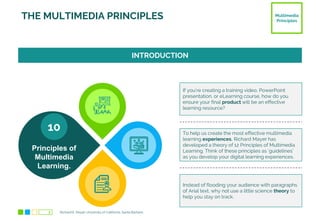
If you’re creating a training video, PowerPoint
presentation, or eLearning course, how do you
ensure your final product will be an effective
learning resource?
To help us create the most effective multimedia
learning experiences, Richard Mayer has
developed a theory of 12 Principles of Multimedia
Learning. Think of these principles as ‘guidelines’
as you develop your digital learning experiences.
Instead of flooding your audience with paragraphs
of Arial text, why not use a little science theory to
help you stay on track.
Principles of
Multimedia
Learning.
INTRODUCTION
10
Richard E. Mayer University of California, Santa Barbara
THE MULTIMEDIA PRINCIPLES
Multimedia
Principles
8
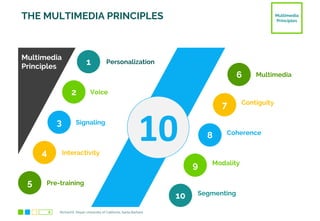
10
Personalization
1
5 Pre-training
Interactivity
4
Signaling
3
Voice
2
Multimedia
6
Segmenting
10
Modality
9
Coherence
8
Contiguity
7
Multimedia
Principles
Richard E. Mayer University of California, Santa Barbara
THE MULTIMEDIA PRINCIPLES
Multimedia
Principles
9
Personalization
Principle
01
You can use this by keeping your
language simple and casual. Try to
avoid overly professional sounding
text, or long, complex words. It also
helps to use the first person (you, I,
we, our).
How to use
The Personalization Principle says
that humans learn best from a more
informal, conversational voice than
an overly formal voice. Having a
more casual voice actually improves
the learning experience.
Definition
Richard E. Mayer University of California, Santa Barbara
THE MULTIMEDIA PRINCIPLES
Multimedia
Principles
10
Voice
Principle
02
This one is simple:
o Narrate your own audio content or
use a voiceover professional.
o If doing it yourself, ensure you
have a high-quality microphone
and use audio editing software.
How to use
People learn better when the words
are spoken in a standard-accented
human voice rather than a machine
voice or foreign-accented human
voice.
Definition
Richard E. Mayer University of California, Santa Barbara
THE MULTIMEDIA PRINCIPLES
Multimedia
Principles
11
Signaling
Principle
03
You can utilize by:
o Highlighting important words and
using animated arrows to point out
significant information.
o Another way you can use by
having slides or scenes that
separate learning sections.
How to use
People learn better when cues that
highlight the organization of the
essential material are added.
Definition
Richard E. Mayer University of California, Santa Barbara
THE MULTIMEDIA PRINCIPLES
Multimedia
Principles
12
Interactivity
Principle
04
Two characteristics appear:
o The use of animated graphics as
soon as depiction of dynamic
system is involved.
o The capability for learners to
interact with the instructional
material.
How to use
People learn better when they can
control the speed of the learning
assets.
Definition
Richard E. Mayer University of California, Santa Barbara
THE MULTIMEDIA PRINCIPLES
Multimedia
Principles
13
Pre-training
Principle
05
How to apply:
o Develop an introductory module
to explain key concepts before
starting the main program.
o Ensure students know how to use
any tools needed to complete
tasks within the course.
How to use
People learn better from a
multimedia lesson when they know
the names and characteristics of the
main concepts.
Definition
Richard E. Mayer University of California, Santa Barbara
THE MULTIMEDIA PRINCIPLES
Multimedia
Principles
14
Multimedia
Principle
06
Some examples include textbook
lessons presented on paper,
slideshow presentations presented
face-to-face, captioned video
presented via computer, or
educational games and simulations
presented on hand-held devices.
How to use
People learn better from words and
pictures than from words alone,
words (such as spoken text or
printed text), and graphic (such as
illustrations, charts, photos,
animation, or video).
Definition
Richard E. Mayer University of California, Santa Barbara
THE MULTIMEDIA PRINCIPLES
Multimedia
Principles
15
Contiguity
Principle
07
o You should keep all related text
and graphics physically close
together in your frame.
o If you’re introducing a new
process, the animation (or visual)
should be occurring at the same
time as the voiceover audio.
How to use
People learn better when:
o Relevant text and visuals are
physically close together.
o Corresponding words and visuals
are presented together, instead
of in consecutive order.
Definition
Richard E. Mayer University of California, Santa Barbara
THE MULTIMEDIA PRINCIPLES
Multimedia
Principles
16
Coherence
Principle
08
As you’re planning your visual
elements, ask yourself:
o Is this image 100% necessary to
help with comprehension?
o Does this message use simple
enough language so the audience
will understand?
How to use
People learn better when
extraneous words, pictures and
sounds are excluded rather than
included.
Definition
Richard E. Mayer University of California, Santa Barbara
THE MULTIMEDIA PRINCIPLES
Multimedia
Principles
17
Modality
Principle
09
o Try to limit the amount of text you
use on screen overall.
o Rely more on visuals, unless you
need to define key terms, list
steps, or provide directions.
How to use
People learn better from graphics
and narration than graphics and
printed text
Definition
Richard E. Mayer University of California, Santa Barbara
THE MULTIMEDIA PRINCIPLES
Multimedia
Principles
18
Segmenting
Principle
10
This principle also suggests:
o Learning is broken up into smaller,
bite-sized chunks.
o Make sure that no one lesson,
slide, or video has too much
information packed in it.
How to use
People learn better from a
multimedia lesson is presented in
user-paced segments rather than as
a continuous unit.
Definition
Richard E. Mayer University of California, Santa Barbara
THE MULTIMEDIA PRINCIPLES
Multimedia
Principles
19
o https://assets.cambridge.org/97805218/38733/excer
pt/9780521838733_excerpt.pdf.
o https://www.hartford.edu/faculty-
staff/faculty/fcld/_files/12%20Principles%20of%20Mu
ltimedia%20Learning.pdf.
o https://www.cambridge.org/core/books/abs/cambr
idge-handbook-of-multimedia-learning/animation-
and-interactivity-principles-in-multimedia-
learning/A2BF18381C32F4E852B7CDB0A8B6581B.
o https://waterbearlearning.com/mayers-principles-
multimedia-learning/
o Icons: https://thenounproject.com/icons/
References
Richard E. Mayer University of California, Santa Barbara
THE MULTIMEDIA PRINCIPLES
THANK YOU
Lotfi Derbali
00216 29 789241
derbalilotfi5@gmail,com

Principles of Multimedia Learning-Col.pptx

  • 1.
    Multimedia Principles 1 INTRODUCTION DEFINITIONS MULTIMEDIA PRINCIPLES PLAN IMPORTANT POINTS THEMULTIMEDIA PRINCIPLES Richard E. Mayer University of California, Santa Barbara
  • 2.
    Multimedia Principles 2 INTRODUCTION People can learnmore deeply from words and pictures than from words alone. People can learn Multimedia researchers are interested in how people learn from words and pictures, and in how to design multimedia learning environments that promote learning. Multimedia researchers Richard E. Mayer University of California, Santa Barbara THE MULTIMEDIA PRINCIPLES
  • 3.
    Multimedia Principles 3 Multimedia Presenting words (suchas printed text or spoken text) and pictures (such as illustrations, photos, animation, or video). Building mental representations from words and pictures. Multimedia learning Presenting words and pictures that are intended to promote learning. Multimedia instruction DEFINITIONS Richard E. Mayer University of California, Santa Barbara THE MULTIMEDIA PRINCIPLES
  • 4.
    Multimedia Principles 4 According to thepresentation modes view, multimedia requires verbal and pictorial representations, such as on-screen text and animation or printed text and illustrations. MULTIMEDIA Richard E. Mayer University of California, Santa Barbara THE MULTIMEDIA PRINCIPLES
  • 5.
    Multimedia Principles 5 Multimedia learning occurswhen people build mental representations from words (such as spoken text or printed text) and pictures (such as illustrations, photos, animation, or video). MULTIMEDIA LEARNING Multimedia refers to the presentation of words and pictures, whereas learning refers to the learner’s construction of knowledge. Richard E. Mayer University of California, Santa Barbara THE MULTIMEDIA PRINCIPLES
  • 6.
    Multimedia Principles 6 Multimedia instruction (ora multimedia learning environment) involves presenting words and pictures that are intended to promote learning. In short, multimedia instruction refers to designing multimedia presentations in ways that help people build mental representations. MULTIMEDIA INSTRUCTION Richard E. Mayer University of California, Santa Barbara THE MULTIMEDIA PRINCIPLES
  • 7.
    Multimedia Principles 7 If you’re creatinga training video, PowerPoint presentation, or eLearning course, how do you ensure your final product will be an effective learning resource? To help us create the most effective multimedia learning experiences, Richard Mayer has developed a theory of 12 Principles of Multimedia Learning. Think of these principles as ‘guidelines’ as you develop your digital learning experiences. Instead of flooding your audience with paragraphs of Arial text, why not use a little science theory to help you stay on track. Principles of Multimedia Learning. INTRODUCTION 10 Richard E. Mayer University of California, Santa Barbara THE MULTIMEDIA PRINCIPLES
  • 8.
  • 9.
    Multimedia Principles 9 Personalization Principle 01 You can usethis by keeping your language simple and casual. Try to avoid overly professional sounding text, or long, complex words. It also helps to use the first person (you, I, we, our). How to use The Personalization Principle says that humans learn best from a more informal, conversational voice than an overly formal voice. Having a more casual voice actually improves the learning experience. Definition Richard E. Mayer University of California, Santa Barbara THE MULTIMEDIA PRINCIPLES
  • 10.
    Multimedia Principles 10 Voice Principle 02 This one issimple: o Narrate your own audio content or use a voiceover professional. o If doing it yourself, ensure you have a high-quality microphone and use audio editing software. How to use People learn better when the words are spoken in a standard-accented human voice rather than a machine voice or foreign-accented human voice. Definition Richard E. Mayer University of California, Santa Barbara THE MULTIMEDIA PRINCIPLES
  • 11.
    Multimedia Principles 11 Signaling Principle 03 You can utilizeby: o Highlighting important words and using animated arrows to point out significant information. o Another way you can use by having slides or scenes that separate learning sections. How to use People learn better when cues that highlight the organization of the essential material are added. Definition Richard E. Mayer University of California, Santa Barbara THE MULTIMEDIA PRINCIPLES
  • 12.
    Multimedia Principles 12 Interactivity Principle 04 Two characteristics appear: oThe use of animated graphics as soon as depiction of dynamic system is involved. o The capability for learners to interact with the instructional material. How to use People learn better when they can control the speed of the learning assets. Definition Richard E. Mayer University of California, Santa Barbara THE MULTIMEDIA PRINCIPLES
  • 13.
    Multimedia Principles 13 Pre-training Principle 05 How to apply: oDevelop an introductory module to explain key concepts before starting the main program. o Ensure students know how to use any tools needed to complete tasks within the course. How to use People learn better from a multimedia lesson when they know the names and characteristics of the main concepts. Definition Richard E. Mayer University of California, Santa Barbara THE MULTIMEDIA PRINCIPLES
  • 14.
    Multimedia Principles 14 Multimedia Principle 06 Some examples includetextbook lessons presented on paper, slideshow presentations presented face-to-face, captioned video presented via computer, or educational games and simulations presented on hand-held devices. How to use People learn better from words and pictures than from words alone, words (such as spoken text or printed text), and graphic (such as illustrations, charts, photos, animation, or video). Definition Richard E. Mayer University of California, Santa Barbara THE MULTIMEDIA PRINCIPLES
  • 15.
    Multimedia Principles 15 Contiguity Principle 07 o You shouldkeep all related text and graphics physically close together in your frame. o If you’re introducing a new process, the animation (or visual) should be occurring at the same time as the voiceover audio. How to use People learn better when: o Relevant text and visuals are physically close together. o Corresponding words and visuals are presented together, instead of in consecutive order. Definition Richard E. Mayer University of California, Santa Barbara THE MULTIMEDIA PRINCIPLES
  • 16.
    Multimedia Principles 16 Coherence Principle 08 As you’re planningyour visual elements, ask yourself: o Is this image 100% necessary to help with comprehension? o Does this message use simple enough language so the audience will understand? How to use People learn better when extraneous words, pictures and sounds are excluded rather than included. Definition Richard E. Mayer University of California, Santa Barbara THE MULTIMEDIA PRINCIPLES
  • 17.
    Multimedia Principles 17 Modality Principle 09 o Try tolimit the amount of text you use on screen overall. o Rely more on visuals, unless you need to define key terms, list steps, or provide directions. How to use People learn better from graphics and narration than graphics and printed text Definition Richard E. Mayer University of California, Santa Barbara THE MULTIMEDIA PRINCIPLES
  • 18.
    Multimedia Principles 18 Segmenting Principle 10 This principle alsosuggests: o Learning is broken up into smaller, bite-sized chunks. o Make sure that no one lesson, slide, or video has too much information packed in it. How to use People learn better from a multimedia lesson is presented in user-paced segments rather than as a continuous unit. Definition Richard E. Mayer University of California, Santa Barbara THE MULTIMEDIA PRINCIPLES
  • 19.
    Multimedia Principles 19 o https://assets.cambridge.org/97805218/38733/excer pt/9780521838733_excerpt.pdf. o https://www.hartford.edu/faculty- staff/faculty/fcld/_files/12%20Principles%20of%20Mu ltimedia%20Learning.pdf. ohttps://www.cambridge.org/core/books/abs/cambr idge-handbook-of-multimedia-learning/animation- and-interactivity-principles-in-multimedia- learning/A2BF18381C32F4E852B7CDB0A8B6581B. o https://waterbearlearning.com/mayers-principles- multimedia-learning/ o Icons: https://thenounproject.com/icons/ References Richard E. Mayer University of California, Santa Barbara THE MULTIMEDIA PRINCIPLES THANK YOU Lotfi Derbali 00216 29 789241 derbalilotfi5@gmail,com