How to optimize your training program
               to reach your potential
                        Pete Pfitzinger
What we will cover

   Principles for designing your marathon training
   Monitoring training intensity using heart rate
   Benefits of 7 types of runs
   Periodization= changing emphasis
   Tapering your training
Principles for Marathon Training
 Improvement comes from adaptations to training
 Adaptations occur from making the training stressful and
  specific to the requirements of the marathon
 Evaluate the benefits of more hard training versus the
  increased risk of injury, illness and over-training
 Understanding the requirements of the marathon allows you
  to make your training specific and effective
Designing your training program
 Switch to marathon-specific training about 12-18 weeks
  before your marathon
 12-18 weeks provides enough time to improve without being
  so prolonged that you lose focus
 We will discuss 7 types of runs and how to select when to do
  each and how often
 Rushing or trying to improve in several ways at the same time
  almost never works
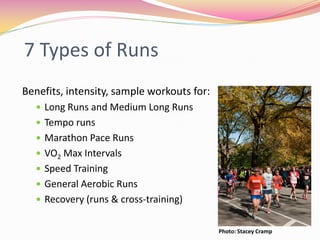
7 Types of Runs
Benefits, intensity, sample workouts for:
    Long Runs and Medium Long Runs
    Tempo runs
    Marathon Pace Runs
    VO2 Max Intervals
    Speed Training
    General Aerobic Runs
    Recovery (runs & cross-training)


                                            Photo: Stacey Cramp
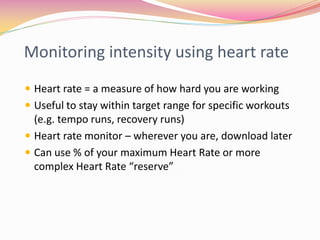
Monitoring intensity using heart rate
 Heart rate = a measure of how hard you are working
 Useful to stay within target range for specific workouts
  (e.g. tempo runs, recovery runs)
 Heart rate monitor – wherever you are, download later
 Can use % of your maximum Heart Rate or more
  complex Heart Rate “reserve”
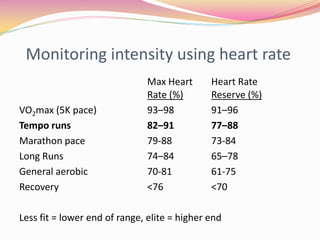
Monitoring intensity using heart rate
                               Max Heart      Heart Rate
                               Rate (%)       Reserve (%)
VO2max (5K pace)               93–98          91–96
Tempo runs                     82–91          77–88
Marathon pace                  79-88          73-84
Long Runs                      74–84          65–78
General aerobic                70-81          61-75
Recovery                       <76            <70

Less fit = lower end of range, elite = higher end
Monitoring intensity using heart rate

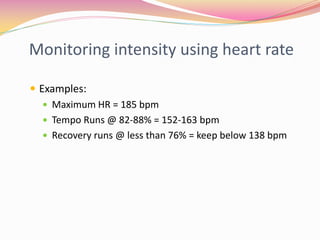
 Examples:
    Maximum HR = 185 bpm
    Tempo Runs @ 82-88% = 152-163 bpm
    Recovery runs @ less than 76% = keep below 138 bpm
Monitoring intensity using heart rate

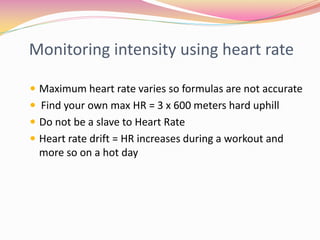
 Maximum heart rate varies so formulas are not accurate
 Find your own max HR = 3 x 600 meters hard uphill
 Do not be a slave to Heart Rate
 Heart rate drift = HR increases during a workout and
  more so on a hot day
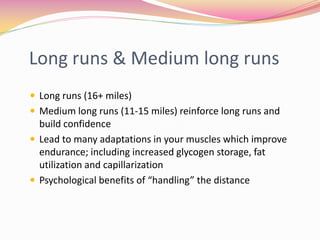
Long runs & Medium long runs
 Long runs (16+ miles)
 Medium long runs (11-15 miles) reinforce long runs and
  build confidence
 Lead to many adaptations in your muscles which improve
  endurance; including increased glycogen storage, fat
  utilization and capillarization
 Psychological benefits of “handling” the distance
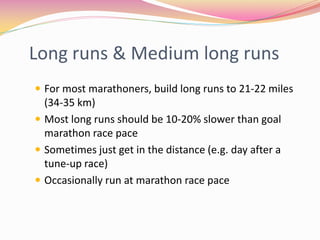
Long runs & Medium long runs
 For most marathoners, build long runs to 21-22 miles
  (34-35 km)
 Most long runs should be 10-20% slower than goal
  marathon race pace
 Sometimes just get in the distance (e.g. day after a
  tune-up race)
 Occasionally run at marathon race pace
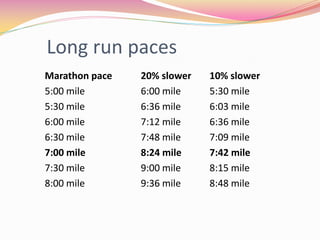
Long run paces
Marathon pace   20% slower   10% slower
5:00 mile       6:00 mile    5:30 mile
5:30 mile       6:36 mile    6:03 mile
6:00 mile       7:12 mile    6:36 mile
6:30 mile       7:48 mile    7:09 mile
7:00 mile       8:24 mile    7:42 mile
7:30 mile       9:00 mile    8:15 mile
8:00 mile       9:36 mile    8:48 mile
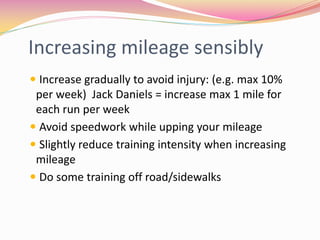
Increasing mileage sensibly
 Increase gradually to avoid injury: (e.g. max 10%
 per week) Jack Daniels = increase max 1 mile for
 each run per week
 Avoid speedwork while upping your mileage
 Slightly reduce training intensity when increasing
 mileage
 Do some training off road/sidewalks
Tempo runs
 Improve lactate threshold: ability to produce energy
  at a fast rate aerobically without high levels of lactate
  in muscles
 Pace you could race for about 1 hour (15K race pace)
 Excellent predictor of marathon race pace (race 15-30
  seconds per mile slower than lactate threshold pace)
Tempo runs
 Maintain lactate threshold pace for 20-40 minutes
 Also Cruise intervals or LT intervals (break up tempo
  run into several segments with short recovery)
 Approx 82-91% max HR or 77-88% HRreserve


 Sample workouts:
   20 min warm-up, 25 min tempo run, 15 min cooldown
   20 min warm-up, 15 min LT interval, (3 min jog), 10 min
    LT interval, 15 min cooldown
Marathon Pace runs
 Most specific type of training
 On road simulating marathon course
 Approx 79-88% Max HR or 73-84% HRreserve
 Practice race pace and maintaining technique
 Start comfortably and build up to race pace
 Include sparingly
 Sample workout:
   18 miles with 14 miles at marathon race pace
VO2 Max Training
 Ability: 1) to transport large amounts of oxygen to muscles
  and 2) of your muscles to use oxygen
 Left ventricle of heart gets bigger and stronger so can
  pump more blood
 Stimulate improvement by training at intensity of 95-100%
  of current VO2 max (3K-5K race pace)
 Marathon focus = less intense, about 5K race pace
VO2 Max Training
 Workout target = time in this intensity range using
  intervals of 800 to 1600m
 Typically 6-8Km of effort
 Recovery approx 50-90% of effort time (70% max HR)
 Sample workouts: (20 min warm-up, 15 min cooldown)
    2 x 1600m, 2 x 1200m, 2 x 1000m. Total = 7,600m
    5 x 1200m. Total = 6K
    Recovery from 1200m @ 4.30 = jog 2.15 to 4 minutes
Increasing speed
 Short repetitions (80-120m) run fast but relaxed
 May improve running economy (ability to use oxygen
  economically) by eliminating unnecessary movement
 Increased stride length and stride rate
 10-15 second uphill reps to build power
 Prevents the marathon shuffle
Increasing speed
 Sample workouts:
   20 min warm-up, 2 sets of 4 laps of stride straights, jog
    bends (jog 5 min btw sets), 15 min cooldown
   20 min warm-up, 2 sets of 4 x 15 sec uphill (jog 5 min btw
    sets), 15 min cooldown
General aerobic runs
 Increase overall training volume
 Approx 15-25% slower than
  marathon pace
 Approx 70-81% Max HR or 61-
  75% HRreserve
 Less important training
 Can be replaced by cross-training
  if injury prone or bad weather


                                      Photo: Stacey Cramp
Recovery
 Recovery is vital to improvement
 If you recovery more quickly, you adapt and progress
  more quickly
 Easy running and cross-training can improve recovery
 Lifestyle factors (sleep, diet, hydration, stress) affect
  recovery
 Recovery training is counterproductive if done too hard
Recovery
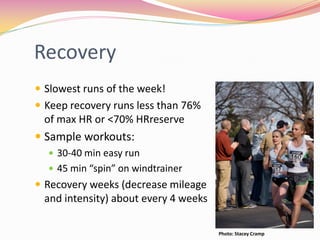
 Slowest runs of the week!
 Keep recovery runs less than 76%
 of max HR or <70% HRreserve
 Sample workouts:
   30-40 min easy run
   45 min “spin” on windtrainer
 Recovery weeks (decrease mileage
 and intensity) about every 4 weeks

                                      Photo: Stacey Cramp
Periodization
 Change the emphasis of training as your marathon
  approaches to target specific areas for improvement
 It takes at least 3 weeks to clearly improve any of the
  physiological variables. After about 6 weeks there is a
  tendency to diminishing returns and need variety
 Typically change the emphasis of training every 3-6
  weeks
 Each 3-6 week unit = a training block or mesocycle
 Each training block has a primary emphasis and a
  secondary emphasis
Periodization
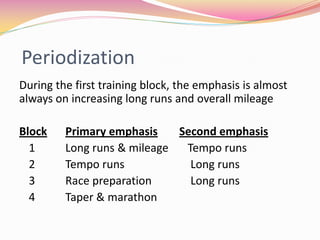
During the first training block, the emphasis is almost
always on increasing long runs and overall mileage

Block    Primary emphasis    Second emphasis
  1      Long runs & mileage  Tempo runs
  2      Tempo runs            Long runs
  3      Race preparation      Long runs
  4      Taper & marathon
Periodization
 Rule of thumb, in each 2 weeks do 3 primary emphasis
  workouts and 2 secondary emphasis workouts
 For example, in training block 1, you would do 3 long runs
  and 2 tempo runs in 2 weeks
Tapering your training
 During the final training block, taper your training so
  you are optimally recovered for the marathon
 Effective tapering maintains peak fitness while re-
  building your energy reserves
 Tapering corrects the wear and tear of training
 Begin taper 3 weeks before your marathon
Effective Tapering
 Maintain training intensity
 Reduce mileage
 Make recovery days very easy or take days off
 Optimize lifestyle recovery strategies (sleep, diet,
  hydration, stress)
 Continue stretching, massage, etc
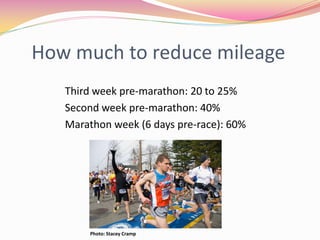
How much to reduce mileage
   Third week pre-marathon: 20 to 25%
   Second week pre-marathon: 40%
   Marathon week (6 days pre-race): 60%


        Photo: Stacey Cramp
Wrap-up
 Principles for designing your marathon training
 Monitoring training intensity using heart rate
 Benefits of 7 types of runs
 Periodizing your training
 Tapering your training leading up to race day
 Final point: Listen to your body and use your
  experience
Questions?


Photo: Stacey Cramp

Marathon training webinar by Pete Pfitzinger

  • 1.
    How to optimizeyour training program to reach your potential Pete Pfitzinger
  • 2.
    What we willcover  Principles for designing your marathon training  Monitoring training intensity using heart rate  Benefits of 7 types of runs  Periodization= changing emphasis  Tapering your training
  • 3.
    Principles for MarathonTraining  Improvement comes from adaptations to training  Adaptations occur from making the training stressful and specific to the requirements of the marathon  Evaluate the benefits of more hard training versus the increased risk of injury, illness and over-training  Understanding the requirements of the marathon allows you to make your training specific and effective
  • 4.
    Designing your trainingprogram  Switch to marathon-specific training about 12-18 weeks before your marathon  12-18 weeks provides enough time to improve without being so prolonged that you lose focus  We will discuss 7 types of runs and how to select when to do each and how often  Rushing or trying to improve in several ways at the same time almost never works
  • 5.
    7 Types ofRuns Benefits, intensity, sample workouts for:  Long Runs and Medium Long Runs  Tempo runs  Marathon Pace Runs  VO2 Max Intervals  Speed Training  General Aerobic Runs  Recovery (runs & cross-training) Photo: Stacey Cramp
  • 6.
    Monitoring intensity usingheart rate  Heart rate = a measure of how hard you are working  Useful to stay within target range for specific workouts (e.g. tempo runs, recovery runs)  Heart rate monitor – wherever you are, download later  Can use % of your maximum Heart Rate or more complex Heart Rate “reserve”
  • 7.
    Monitoring intensity usingheart rate Max Heart Heart Rate Rate (%) Reserve (%) VO2max (5K pace) 93–98 91–96 Tempo runs 82–91 77–88 Marathon pace 79-88 73-84 Long Runs 74–84 65–78 General aerobic 70-81 61-75 Recovery <76 <70 Less fit = lower end of range, elite = higher end
  • 8.
    Monitoring intensity usingheart rate  Examples:  Maximum HR = 185 bpm  Tempo Runs @ 82-88% = 152-163 bpm  Recovery runs @ less than 76% = keep below 138 bpm
  • 9.
    Monitoring intensity usingheart rate  Maximum heart rate varies so formulas are not accurate  Find your own max HR = 3 x 600 meters hard uphill  Do not be a slave to Heart Rate  Heart rate drift = HR increases during a workout and more so on a hot day
  • 10.
    Long runs &Medium long runs  Long runs (16+ miles)  Medium long runs (11-15 miles) reinforce long runs and build confidence  Lead to many adaptations in your muscles which improve endurance; including increased glycogen storage, fat utilization and capillarization  Psychological benefits of “handling” the distance
  • 11.
    Long runs &Medium long runs  For most marathoners, build long runs to 21-22 miles (34-35 km)  Most long runs should be 10-20% slower than goal marathon race pace  Sometimes just get in the distance (e.g. day after a tune-up race)  Occasionally run at marathon race pace
  • 12.
    Long run paces Marathonpace 20% slower 10% slower 5:00 mile 6:00 mile 5:30 mile 5:30 mile 6:36 mile 6:03 mile 6:00 mile 7:12 mile 6:36 mile 6:30 mile 7:48 mile 7:09 mile 7:00 mile 8:24 mile 7:42 mile 7:30 mile 9:00 mile 8:15 mile 8:00 mile 9:36 mile 8:48 mile
  • 13.
    Increasing mileage sensibly Increase gradually to avoid injury: (e.g. max 10% per week) Jack Daniels = increase max 1 mile for each run per week  Avoid speedwork while upping your mileage  Slightly reduce training intensity when increasing mileage  Do some training off road/sidewalks
  • 14.
    Tempo runs  Improvelactate threshold: ability to produce energy at a fast rate aerobically without high levels of lactate in muscles  Pace you could race for about 1 hour (15K race pace)  Excellent predictor of marathon race pace (race 15-30 seconds per mile slower than lactate threshold pace)
  • 15.
    Tempo runs  Maintainlactate threshold pace for 20-40 minutes  Also Cruise intervals or LT intervals (break up tempo run into several segments with short recovery)  Approx 82-91% max HR or 77-88% HRreserve  Sample workouts:  20 min warm-up, 25 min tempo run, 15 min cooldown  20 min warm-up, 15 min LT interval, (3 min jog), 10 min LT interval, 15 min cooldown
  • 16.
    Marathon Pace runs Most specific type of training  On road simulating marathon course  Approx 79-88% Max HR or 73-84% HRreserve  Practice race pace and maintaining technique  Start comfortably and build up to race pace  Include sparingly  Sample workout:  18 miles with 14 miles at marathon race pace
  • 17.
    VO2 Max Training Ability: 1) to transport large amounts of oxygen to muscles and 2) of your muscles to use oxygen  Left ventricle of heart gets bigger and stronger so can pump more blood  Stimulate improvement by training at intensity of 95-100% of current VO2 max (3K-5K race pace)  Marathon focus = less intense, about 5K race pace
  • 18.
    VO2 Max Training Workout target = time in this intensity range using intervals of 800 to 1600m  Typically 6-8Km of effort  Recovery approx 50-90% of effort time (70% max HR)  Sample workouts: (20 min warm-up, 15 min cooldown)  2 x 1600m, 2 x 1200m, 2 x 1000m. Total = 7,600m  5 x 1200m. Total = 6K  Recovery from 1200m @ 4.30 = jog 2.15 to 4 minutes
  • 19.
    Increasing speed  Shortrepetitions (80-120m) run fast but relaxed  May improve running economy (ability to use oxygen economically) by eliminating unnecessary movement  Increased stride length and stride rate  10-15 second uphill reps to build power  Prevents the marathon shuffle
  • 20.
    Increasing speed  Sampleworkouts:  20 min warm-up, 2 sets of 4 laps of stride straights, jog bends (jog 5 min btw sets), 15 min cooldown  20 min warm-up, 2 sets of 4 x 15 sec uphill (jog 5 min btw sets), 15 min cooldown
  • 21.
    General aerobic runs Increase overall training volume  Approx 15-25% slower than marathon pace  Approx 70-81% Max HR or 61- 75% HRreserve  Less important training  Can be replaced by cross-training if injury prone or bad weather Photo: Stacey Cramp
  • 22.
    Recovery  Recovery isvital to improvement  If you recovery more quickly, you adapt and progress more quickly  Easy running and cross-training can improve recovery  Lifestyle factors (sleep, diet, hydration, stress) affect recovery  Recovery training is counterproductive if done too hard
  • 23.
    Recovery  Slowest runsof the week!  Keep recovery runs less than 76% of max HR or <70% HRreserve  Sample workouts:  30-40 min easy run  45 min “spin” on windtrainer  Recovery weeks (decrease mileage and intensity) about every 4 weeks Photo: Stacey Cramp
  • 24.
    Periodization  Change theemphasis of training as your marathon approaches to target specific areas for improvement  It takes at least 3 weeks to clearly improve any of the physiological variables. After about 6 weeks there is a tendency to diminishing returns and need variety  Typically change the emphasis of training every 3-6 weeks  Each 3-6 week unit = a training block or mesocycle  Each training block has a primary emphasis and a secondary emphasis
  • 25.
    Periodization During the firsttraining block, the emphasis is almost always on increasing long runs and overall mileage Block Primary emphasis Second emphasis 1 Long runs & mileage Tempo runs 2 Tempo runs Long runs 3 Race preparation Long runs 4 Taper & marathon
  • 26.
    Periodization  Rule ofthumb, in each 2 weeks do 3 primary emphasis workouts and 2 secondary emphasis workouts  For example, in training block 1, you would do 3 long runs and 2 tempo runs in 2 weeks
  • 27.
    Tapering your training During the final training block, taper your training so you are optimally recovered for the marathon  Effective tapering maintains peak fitness while re- building your energy reserves  Tapering corrects the wear and tear of training  Begin taper 3 weeks before your marathon
  • 28.
    Effective Tapering  Maintaintraining intensity  Reduce mileage  Make recovery days very easy or take days off  Optimize lifestyle recovery strategies (sleep, diet, hydration, stress)  Continue stretching, massage, etc
  • 29.
    How much toreduce mileage Third week pre-marathon: 20 to 25% Second week pre-marathon: 40% Marathon week (6 days pre-race): 60% Photo: Stacey Cramp
  • 30.
    Wrap-up  Principles fordesigning your marathon training  Monitoring training intensity using heart rate  Benefits of 7 types of runs  Periodizing your training  Tapering your training leading up to race day  Final point: Listen to your body and use your experience
  • 31.