Manufacturing
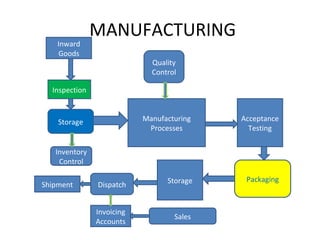
MANUFACTURING Manufacturing Processes Inward Goods Inspection Storage Inventory Control Quality Control Acceptance Testing Packaging Storage Sales Invoicing Accounts Dispatch Shipment
Data Collection Data feed through forms Data feed through interfaces Data cleaning Data formatting Data Storage Past Data Storage and integration
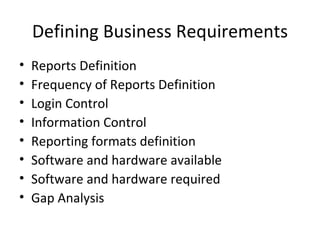
Defining Business Requirements Reports Definition Frequency of Reports Definition Login Control Information Control Reporting formats definition Software and hardware available Software and hardware required Gap Analysis
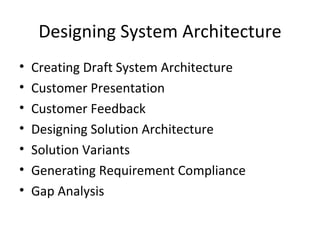
Designing System Architecture Creating Draft System Architecture Customer Presentation Customer Feedback Designing Solution Architecture Solution Variants Generating Requirement Compliance Gap Analysis
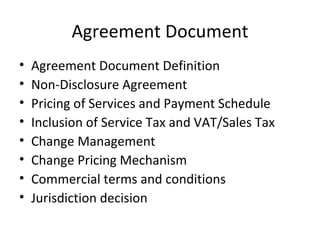
Agreement Document Agreement Document Definition Non-Disclosure Agreement Pricing of Services and Payment Schedule Inclusion of Service Tax and VAT/Sales Tax Change Management Change Pricing Mechanism Commercial terms and conditions Jurisdiction decision
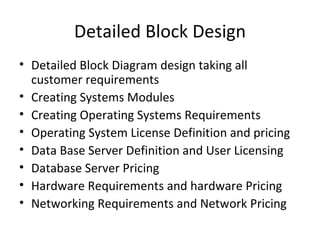
Detailed Block Design Detailed Block Diagram design taking all customer requirements Creating Systems Modules Creating Operating Systems Requirements Operating System License Definition and pricing Data Base Server Definition and User Licensing Database Server Pricing Hardware Requirements and hardware Pricing Networking Requirements and Network Pricing
Data Base Design Architecture of Database Tables Design Stored Procedures Design Triggers Design Interfaces Design Design of Data Integration Applications Design of Reporting Applications Security of Database Logins and passwords management Web interfaces and applications design Data Downloading from web database
Business Intelligence Applications Generating Multi Dimensional Cubes Generating Multiple Dimensions Dimensional Analysis KPI’s Business Intelligence Analyzing Algorithms Formula Storage Reports Generation
Systems Deployment Lab tested systems are deployed on customers servers Integration Customers existing systems Total System Integration System Beta Testing Gap analysis Design Modifications and Application Tuning Re-deloyment of applications
Customer Training Training of Customer staff Training of Customer Information Technology Staff Handover of Complete Systems
Warranty and After Sales support Warranty of applications After sales support for 1 year Annual Maintenance Contract
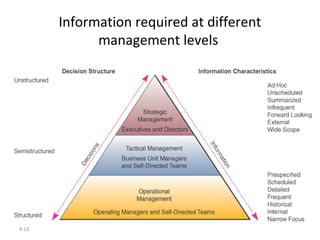
Information required at different management levels  9-
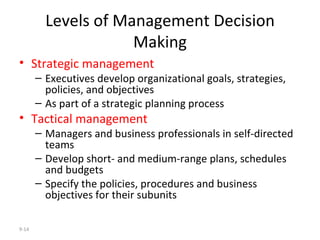
Levels of Management Decision Making Strategic management Executives develop organizational goals, strategies, policies, and objectives  As part of a strategic planning process Tactical management Managers and business professionals in self-directed teams  Develop short- and medium-range plans, schedules and budgets  Specify the policies, procedures and business objectives for their subunits 9-
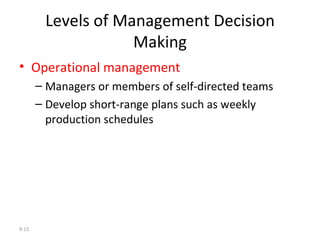
Levels of Management Decision Making Operational management Managers or members of self-directed teams  Develop short-range plans such as weekly production schedules 9-
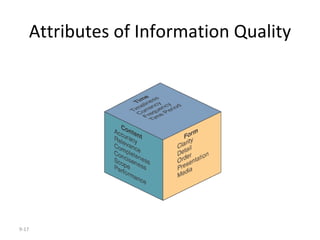
Information Quality Information products whose characteristics, attributes, or qualities make the information more value Information has 3 dimensions: Time Content Form 9-
Attributes of Information Quality 9-
Decision Structure Structured – situations where the procedures to follow when a decision is needed can be specified in advance Unstructured – decision situations where it is not possible to specify in advance most of the decision procedures to follow Semistructured  - decision procedures that can be prespecified, but not enough to lead to a definite recommended decision 9-
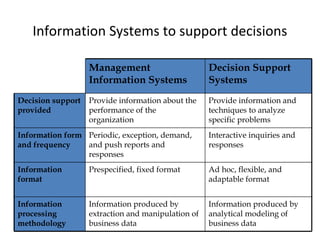
Information Systems to support decisions 9- Management Information Systems Decision Support Systems Decision support provided Provide information about the performance of the organization Provide information and techniques to analyze specific problems Information form and frequency Periodic, exception, demand, and push reports and responses Interactive inquiries and responses Information format Prespecified, fixed format Ad hoc, flexible, and adaptable format Information processing methodology Information produced by extraction and manipulation of business data Information produced by analytical modeling of business data
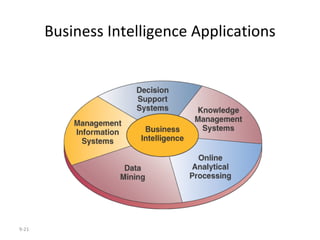
Decision Support Trends Personalized proactive decision analytics Web-Based applications Decisions at lower levels of management and by teams and individuals Business intelligence applications 9-
Business Intelligence Applications 9-
Decision Support Systems DSS Provide interactive information support to managers and business professionals during the decision-making process Use: Analytical models Specialized databases A decision maker’s own insights and judgments Interactive computer-based modeling To support semistructured business decisions 9-
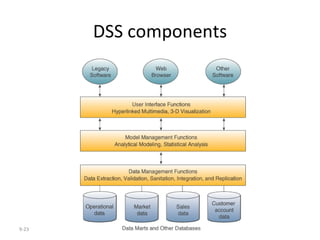
DSS components 9-
DSS Model base Model base A software component that consists of models used in computational and analytical routines that mathematically express relations among variables Examples: Linear programming models, Multiple regression forecasting models Capital budgeting present value models 9-
Management Information Systems MIS Produces information products that support many of the day-to-day decision-making needs of managers and business professionals Prespecified reports, displays and responses Support more structured decisions 9-
MIS Reporting Alternatives Periodic Scheduled Reports Prespecified format on a regular basis Exception Reports Reports about exceptional conditions May be produced regularly or when exception occurs Demand Reports and Responses Information available when demanded Push Reporting Information pushed to manager 9-
Online Analytical Processing OLAP Enables mangers and analysts to examine and manipulate large amounts of detailed and consolidated data from many perspectives Done interactively in real time with rapid response 9-
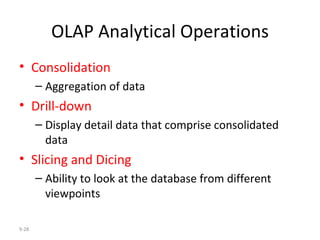
OLAP Analytical Operations Consolidation   Aggregation of data Drill-down   Display detail data that comprise consolidated data Slicing and Dicing Ability to look at the database from different viewpoints 9-
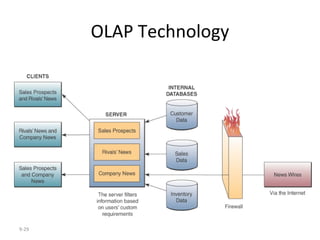
OLAP Technology 9-
Geographic Information Systems GIS DSS that uses geographic databases to construct and display maps and other graphics displays That support decisions affecting the geographic distribution of people and other resources Often used with Global Position Systems (GPS) devices 9-
Data Visualization Systems DVS   DSS that represents complex data using interactive three-dimensional graphical forms such as charts, graphs, and maps DVS tools help users to interactively sort, subdivide, combine, and organize data while it is in its graphical form. 9-
Using DSS What-if Analysis   End user makes changes to variables, or relationships among variables, and observes the resulting changes in the values of other variables Sensitivity Analysis   Value of only one variable is changed repeatedly and the resulting changes in other variables are observed 9-
Using DSS Goal-Seeking Set a target value for a variable and then repeatedly change other variables until the target value is achieved How can analysis Optimization   Goal is to find the optimum value for one or more target variables given certain constraints  One or more other variables are changed repeatedly until the best values for the target variables are discovered 9-
Data Mining Main purpose is to provide decision support to managers and business professionals through  knowledge discovery Analyzes vast store of historical business data Tries to discover patterns, trends, and correlations hidden in the data that can help a company improve its business performance Use regression, decision tree, neural network, cluster analysis, or market basket analysis 9-
Market Basket Analysis One of most common data mining for marketing The purpose is to determine what products customers purchase together with other products 9-
Executive Information Systems EIS Combine many features of MIS and DSS Provide top executives with immediate and easy access to information About the  factors that are critical to accomplishing an organization’s strategic objectives ( Critical success factors ) So popular, expanded to managers, analysts and other knowledge workers 9-
Features of an EIS Information presented in forms tailored to the preferences of the executives using the system Customizable graphical user interfaces Exception reporting Trend analysis Drill down capability 9-
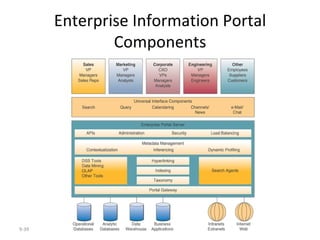
Enterprise Interface Portals EIP Web-based interface  Integration of MIS, DSS, EIS, and other technologies Gives all intranet users and selected extranet users access  To a variety of internal and external business applications and services Typically tailored to the user giving them a personalized  digital dashboard 9-
Enterprise Information Portal Components 9-
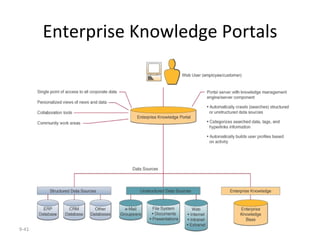
Knowledge Management Systems The use of information technology to help gather, organize, and share business knowledge within an organization Enterprise Knowledge Portals EIPs that are the entry to corporate intranets that serve as knowledge management systems 9-
Enterprise Knowledge Portals 9-
Case 2 Artificial Intelligence The Dawn of the Digital Brain Numenta will translate the way the brain works into an algorithm that can run on a new type of computer The human brain does not work like a computer Intelligence, according to Hawkins, is pattern recognition 9-
Artificial Intelligence (AI) A field of science and technology based on disciplines such as computer science, biology, psychology, linguistics, mathematics, and engineering Goal is to develop computers that can simulate the ability to think, as well as see, hear, walk, talk, and feel 9-
Attributes of Intelligent Behavior Think and reason Use reason to solve problems Learn or understand from experience Acquire and apply knowledge Exhibit creativity and imagination Deal with complex or perplexing situations Respond quickly and successfully to new situations Recognize the relative importance of elements in a situation Handle ambiguous, incomplete, or erroneous information 9-
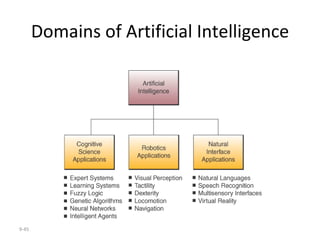
Domains of Artificial Intelligence 9-
Cognitive Science Based in biology, neurology, psychology, etc. Focuses on researching how the human brain works and how humans think and learn 9-
Robotics Based in AI, engineering and physiology Robot machines with computer intelligence and computer controlled, humanlike physical capabilities 9-
Natural Interfaces Based in linguistics, psychology, computer science, etc. Includes natural language and speech recognition Development of multisensory devices that use a variety of body movements to operate computers Virtual reality Using multisensory human-computer interfaces that enable human users to experience computer-simulated objects, spaces and “worlds” as if they actually exist 9-
Expert Systems ES A  knowledge-based information system  (KBIS) that uses its knowledge about a specific, complex application to act as an expert consultant to end users KBIS  is a system that adds a knowledge base to the other components on an IS  9-
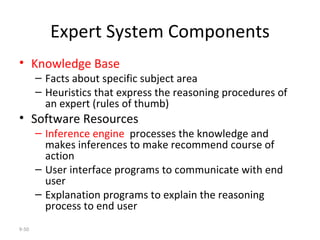
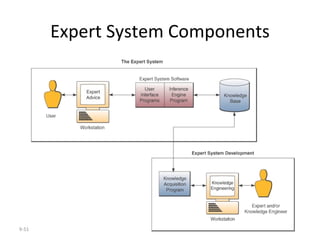
Expert System Components Knowledge Base Facts about specific subject area Heuristics that express the reasoning procedures of an expert (rules of thumb) Software Resources  Inference engine   processes the knowledge and makes inferences to make recommend course of action User interface programs to communicate with end user Explanation programs to explain the reasoning process to end user 9-
Expert System Components 9-
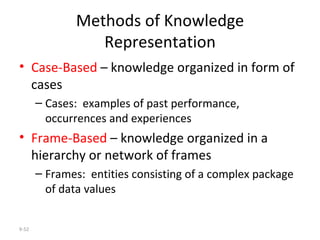
Methods of Knowledge Representation Case-Based  – knowledge organized in form of cases Cases:  examples of past performance, occurrences and experiences Frame-Based  – knowledge organized in a hierarchy or network of frames Frames:  entities consisting of a complex package of data values 9-
Methods of Knowledge Representation Object-Based  – knowledge organized in network of objects Objects:  data elements and the methods or processes that act on those data Rule-Based  – knowledge represented in rules and statements of fact Rules:  statements that typically take the form of a premise and a conclusion Such as, If (condition) then (conclusion) 9-
Expert System Benefits Faster and more consistent than an expert Can have the knowledge of several experts Does not get tired or distracted by overwork or stress Helps preserve and reproduce the knowledge of experts 9-
Expert System Limitations Limited focus Inability to learn Maintenance problems Developmental costs Can only solve specific types of problems in a limited domain of knowledge 9-
Suitability Criteria for Expert Systems Domain :  subject area relatively small and limited to well-defined area Expertise :  solutions require the efforts of an expert Complexity :  solution of the problem is a complex task that requires logical inference processing (not possible in conventional information processing) Structure :  solution process must be able to cope with ill-structured, uncertain, missing and conflicting data Availability :  an expert exists who is articulate and cooperative 9-
Development Tool Expert System Shell Software package consisting of an expert system without its knowledge base Has inference engine and user interface programs 9-
Knowledge Engineer A professional who works with experts to capture the knowledge they possess Builds the knowledge base using an iterative, prototyping process 9-
Neural Networks Computing systems modeled after the brain’s mesh-like network of interconnected processing elements, called neurons Interconnected processors operate in parallel and interact with each other Allows network to learn from data it processes 9-
Fuzzy Logic Method of reasoning that resembles human reasoning  Allows for approximate values and inferences and incomplete or ambiguous data instead of relying only on crisp data Uses terms such as “very high” rather than precise measures 9-
Genetic Algorithms Software that uses  Darwinian (survival of the fittest), randomizing, and other mathematical functions  To simulate an evolutionary process that can yield increasingly better solutions to a problem 9-
Virtual Reality (VR) Computer-simulated reality  Relies on multisensory input/output devices such as a tracking headset with video goggles and stereo earphones,  a data glove or jumpsuit with fiber-optic sensors that track your body movements, and  a walker that monitors the movement of your feet 9-
Intelligent Agents A software surrogate for an end user or a process that fulfills a stated need or activity  Uses its built-in and learned knowledge base  To make decisions and accomplish tasks in a way that fulfills the intentions of a user Also called  software robots  or  bots 9-
User Interface Agents Interface Tutors  – observe user computer operations, correct user mistakes, and provide hints and advice on efficient software use Presentation  – show information in a variety of  forms and media based on user preferences Network Navigation  – discover paths to information and provide ways to view information based on user preferences  Role-Playing  – play what-if games and other roles to help users understand information and make better decisions 9-
Information Management Agents Search Agents  – help users find files and databases, search for desired information, and suggest and find new types of information products, media, and resources Information Brokers  – provide commercial services to discover and develop information resources that fit the business or personal needs of a user Information Filters  – receive, find, filter, discard, save, forward, and notify users about products received or desired 9-

Manufacturing

  • 1.
  • 2.
    MANUFACTURING Manufacturing ProcessesInward Goods Inspection Storage Inventory Control Quality Control Acceptance Testing Packaging Storage Sales Invoicing Accounts Dispatch Shipment
  • 3.
    Data Collection Datafeed through forms Data feed through interfaces Data cleaning Data formatting Data Storage Past Data Storage and integration
  • 4.
    Defining Business RequirementsReports Definition Frequency of Reports Definition Login Control Information Control Reporting formats definition Software and hardware available Software and hardware required Gap Analysis
  • 5.
    Designing System ArchitectureCreating Draft System Architecture Customer Presentation Customer Feedback Designing Solution Architecture Solution Variants Generating Requirement Compliance Gap Analysis
  • 6.
    Agreement Document AgreementDocument Definition Non-Disclosure Agreement Pricing of Services and Payment Schedule Inclusion of Service Tax and VAT/Sales Tax Change Management Change Pricing Mechanism Commercial terms and conditions Jurisdiction decision
  • 7.
    Detailed Block DesignDetailed Block Diagram design taking all customer requirements Creating Systems Modules Creating Operating Systems Requirements Operating System License Definition and pricing Data Base Server Definition and User Licensing Database Server Pricing Hardware Requirements and hardware Pricing Networking Requirements and Network Pricing
  • 8.
    Data Base DesignArchitecture of Database Tables Design Stored Procedures Design Triggers Design Interfaces Design Design of Data Integration Applications Design of Reporting Applications Security of Database Logins and passwords management Web interfaces and applications design Data Downloading from web database
  • 9.
    Business Intelligence ApplicationsGenerating Multi Dimensional Cubes Generating Multiple Dimensions Dimensional Analysis KPI’s Business Intelligence Analyzing Algorithms Formula Storage Reports Generation
  • 10.
    Systems Deployment Labtested systems are deployed on customers servers Integration Customers existing systems Total System Integration System Beta Testing Gap analysis Design Modifications and Application Tuning Re-deloyment of applications
  • 11.
    Customer Training Trainingof Customer staff Training of Customer Information Technology Staff Handover of Complete Systems
  • 12.
    Warranty and AfterSales support Warranty of applications After sales support for 1 year Annual Maintenance Contract
  • 13.
    Information required atdifferent management levels 9-
  • 14.
    Levels of ManagementDecision Making Strategic management Executives develop organizational goals, strategies, policies, and objectives As part of a strategic planning process Tactical management Managers and business professionals in self-directed teams Develop short- and medium-range plans, schedules and budgets Specify the policies, procedures and business objectives for their subunits 9-
  • 15.
    Levels of ManagementDecision Making Operational management Managers or members of self-directed teams Develop short-range plans such as weekly production schedules 9-
  • 16.
    Information Quality Informationproducts whose characteristics, attributes, or qualities make the information more value Information has 3 dimensions: Time Content Form 9-
  • 17.
  • 18.
    Decision Structure Structured– situations where the procedures to follow when a decision is needed can be specified in advance Unstructured – decision situations where it is not possible to specify in advance most of the decision procedures to follow Semistructured - decision procedures that can be prespecified, but not enough to lead to a definite recommended decision 9-
  • 19.
    Information Systems tosupport decisions 9- Management Information Systems Decision Support Systems Decision support provided Provide information about the performance of the organization Provide information and techniques to analyze specific problems Information form and frequency Periodic, exception, demand, and push reports and responses Interactive inquiries and responses Information format Prespecified, fixed format Ad hoc, flexible, and adaptable format Information processing methodology Information produced by extraction and manipulation of business data Information produced by analytical modeling of business data
  • 20.
    Decision Support TrendsPersonalized proactive decision analytics Web-Based applications Decisions at lower levels of management and by teams and individuals Business intelligence applications 9-
  • 21.
  • 22.
    Decision Support SystemsDSS Provide interactive information support to managers and business professionals during the decision-making process Use: Analytical models Specialized databases A decision maker’s own insights and judgments Interactive computer-based modeling To support semistructured business decisions 9-
  • 23.
  • 24.
    DSS Model baseModel base A software component that consists of models used in computational and analytical routines that mathematically express relations among variables Examples: Linear programming models, Multiple regression forecasting models Capital budgeting present value models 9-
  • 25.
    Management Information SystemsMIS Produces information products that support many of the day-to-day decision-making needs of managers and business professionals Prespecified reports, displays and responses Support more structured decisions 9-
  • 26.
    MIS Reporting AlternativesPeriodic Scheduled Reports Prespecified format on a regular basis Exception Reports Reports about exceptional conditions May be produced regularly or when exception occurs Demand Reports and Responses Information available when demanded Push Reporting Information pushed to manager 9-
  • 27.
    Online Analytical ProcessingOLAP Enables mangers and analysts to examine and manipulate large amounts of detailed and consolidated data from many perspectives Done interactively in real time with rapid response 9-
  • 28.
    OLAP Analytical OperationsConsolidation Aggregation of data Drill-down Display detail data that comprise consolidated data Slicing and Dicing Ability to look at the database from different viewpoints 9-
  • 29.
  • 30.
    Geographic Information SystemsGIS DSS that uses geographic databases to construct and display maps and other graphics displays That support decisions affecting the geographic distribution of people and other resources Often used with Global Position Systems (GPS) devices 9-
  • 31.
    Data Visualization SystemsDVS DSS that represents complex data using interactive three-dimensional graphical forms such as charts, graphs, and maps DVS tools help users to interactively sort, subdivide, combine, and organize data while it is in its graphical form. 9-
  • 32.
    Using DSS What-ifAnalysis End user makes changes to variables, or relationships among variables, and observes the resulting changes in the values of other variables Sensitivity Analysis Value of only one variable is changed repeatedly and the resulting changes in other variables are observed 9-
  • 33.
    Using DSS Goal-SeekingSet a target value for a variable and then repeatedly change other variables until the target value is achieved How can analysis Optimization Goal is to find the optimum value for one or more target variables given certain constraints One or more other variables are changed repeatedly until the best values for the target variables are discovered 9-
  • 34.
    Data Mining Mainpurpose is to provide decision support to managers and business professionals through knowledge discovery Analyzes vast store of historical business data Tries to discover patterns, trends, and correlations hidden in the data that can help a company improve its business performance Use regression, decision tree, neural network, cluster analysis, or market basket analysis 9-
  • 35.
    Market Basket AnalysisOne of most common data mining for marketing The purpose is to determine what products customers purchase together with other products 9-
  • 36.
    Executive Information SystemsEIS Combine many features of MIS and DSS Provide top executives with immediate and easy access to information About the factors that are critical to accomplishing an organization’s strategic objectives ( Critical success factors ) So popular, expanded to managers, analysts and other knowledge workers 9-
  • 37.
    Features of anEIS Information presented in forms tailored to the preferences of the executives using the system Customizable graphical user interfaces Exception reporting Trend analysis Drill down capability 9-
  • 38.
    Enterprise Interface PortalsEIP Web-based interface Integration of MIS, DSS, EIS, and other technologies Gives all intranet users and selected extranet users access To a variety of internal and external business applications and services Typically tailored to the user giving them a personalized digital dashboard 9-
  • 39.
  • 40.
    Knowledge Management SystemsThe use of information technology to help gather, organize, and share business knowledge within an organization Enterprise Knowledge Portals EIPs that are the entry to corporate intranets that serve as knowledge management systems 9-
  • 41.
  • 42.
    Case 2 ArtificialIntelligence The Dawn of the Digital Brain Numenta will translate the way the brain works into an algorithm that can run on a new type of computer The human brain does not work like a computer Intelligence, according to Hawkins, is pattern recognition 9-
  • 43.
    Artificial Intelligence (AI)A field of science and technology based on disciplines such as computer science, biology, psychology, linguistics, mathematics, and engineering Goal is to develop computers that can simulate the ability to think, as well as see, hear, walk, talk, and feel 9-
  • 44.
    Attributes of IntelligentBehavior Think and reason Use reason to solve problems Learn or understand from experience Acquire and apply knowledge Exhibit creativity and imagination Deal with complex or perplexing situations Respond quickly and successfully to new situations Recognize the relative importance of elements in a situation Handle ambiguous, incomplete, or erroneous information 9-
  • 45.
    Domains of ArtificialIntelligence 9-
  • 46.
    Cognitive Science Basedin biology, neurology, psychology, etc. Focuses on researching how the human brain works and how humans think and learn 9-
  • 47.
    Robotics Based inAI, engineering and physiology Robot machines with computer intelligence and computer controlled, humanlike physical capabilities 9-
  • 48.
    Natural Interfaces Basedin linguistics, psychology, computer science, etc. Includes natural language and speech recognition Development of multisensory devices that use a variety of body movements to operate computers Virtual reality Using multisensory human-computer interfaces that enable human users to experience computer-simulated objects, spaces and “worlds” as if they actually exist 9-
  • 49.
    Expert Systems ESA knowledge-based information system (KBIS) that uses its knowledge about a specific, complex application to act as an expert consultant to end users KBIS is a system that adds a knowledge base to the other components on an IS 9-
  • 50.
    Expert System ComponentsKnowledge Base Facts about specific subject area Heuristics that express the reasoning procedures of an expert (rules of thumb) Software Resources Inference engine processes the knowledge and makes inferences to make recommend course of action User interface programs to communicate with end user Explanation programs to explain the reasoning process to end user 9-
  • 51.
  • 52.
    Methods of KnowledgeRepresentation Case-Based – knowledge organized in form of cases Cases: examples of past performance, occurrences and experiences Frame-Based – knowledge organized in a hierarchy or network of frames Frames: entities consisting of a complex package of data values 9-
  • 53.
    Methods of KnowledgeRepresentation Object-Based – knowledge organized in network of objects Objects: data elements and the methods or processes that act on those data Rule-Based – knowledge represented in rules and statements of fact Rules: statements that typically take the form of a premise and a conclusion Such as, If (condition) then (conclusion) 9-
  • 54.
    Expert System BenefitsFaster and more consistent than an expert Can have the knowledge of several experts Does not get tired or distracted by overwork or stress Helps preserve and reproduce the knowledge of experts 9-
  • 55.
    Expert System LimitationsLimited focus Inability to learn Maintenance problems Developmental costs Can only solve specific types of problems in a limited domain of knowledge 9-
  • 56.
    Suitability Criteria forExpert Systems Domain : subject area relatively small and limited to well-defined area Expertise : solutions require the efforts of an expert Complexity : solution of the problem is a complex task that requires logical inference processing (not possible in conventional information processing) Structure : solution process must be able to cope with ill-structured, uncertain, missing and conflicting data Availability : an expert exists who is articulate and cooperative 9-
  • 57.
    Development Tool ExpertSystem Shell Software package consisting of an expert system without its knowledge base Has inference engine and user interface programs 9-
  • 58.
    Knowledge Engineer Aprofessional who works with experts to capture the knowledge they possess Builds the knowledge base using an iterative, prototyping process 9-
  • 59.
    Neural Networks Computingsystems modeled after the brain’s mesh-like network of interconnected processing elements, called neurons Interconnected processors operate in parallel and interact with each other Allows network to learn from data it processes 9-
  • 60.
    Fuzzy Logic Methodof reasoning that resembles human reasoning Allows for approximate values and inferences and incomplete or ambiguous data instead of relying only on crisp data Uses terms such as “very high” rather than precise measures 9-
  • 61.
    Genetic Algorithms Softwarethat uses Darwinian (survival of the fittest), randomizing, and other mathematical functions To simulate an evolutionary process that can yield increasingly better solutions to a problem 9-
  • 62.
    Virtual Reality (VR)Computer-simulated reality Relies on multisensory input/output devices such as a tracking headset with video goggles and stereo earphones, a data glove or jumpsuit with fiber-optic sensors that track your body movements, and a walker that monitors the movement of your feet 9-
  • 63.
    Intelligent Agents Asoftware surrogate for an end user or a process that fulfills a stated need or activity Uses its built-in and learned knowledge base To make decisions and accomplish tasks in a way that fulfills the intentions of a user Also called software robots or bots 9-
  • 64.
    User Interface AgentsInterface Tutors – observe user computer operations, correct user mistakes, and provide hints and advice on efficient software use Presentation – show information in a variety of forms and media based on user preferences Network Navigation – discover paths to information and provide ways to view information based on user preferences Role-Playing – play what-if games and other roles to help users understand information and make better decisions 9-
  • 65.
    Information Management AgentsSearch Agents – help users find files and databases, search for desired information, and suggest and find new types of information products, media, and resources Information Brokers – provide commercial services to discover and develop information resources that fit the business or personal needs of a user Information Filters – receive, find, filter, discard, save, forward, and notify users about products received or desired 9-