Joint Mobilization
Joint Mobilization
Techniques Utilized in Rehabilitation
What is Joint Mobilization?
 “Joint Mobs”
 Manual therapy technique
– Used to modulate pain
– Used to increase ROM
– Used to treat joint dysfunctions that limit ROM by
specifically addressing altered joint mechanics
 Factors that may alter joint mechanics:
– Pain & Muscle guarding
– Joint hypomobility
– Joint effusion
– Contractures or adhesions in the joint capsules or
supporting ligaments
– Malalignment or subluxation of bony surfaces
Pondering Thoughts
Pondering Thoughts
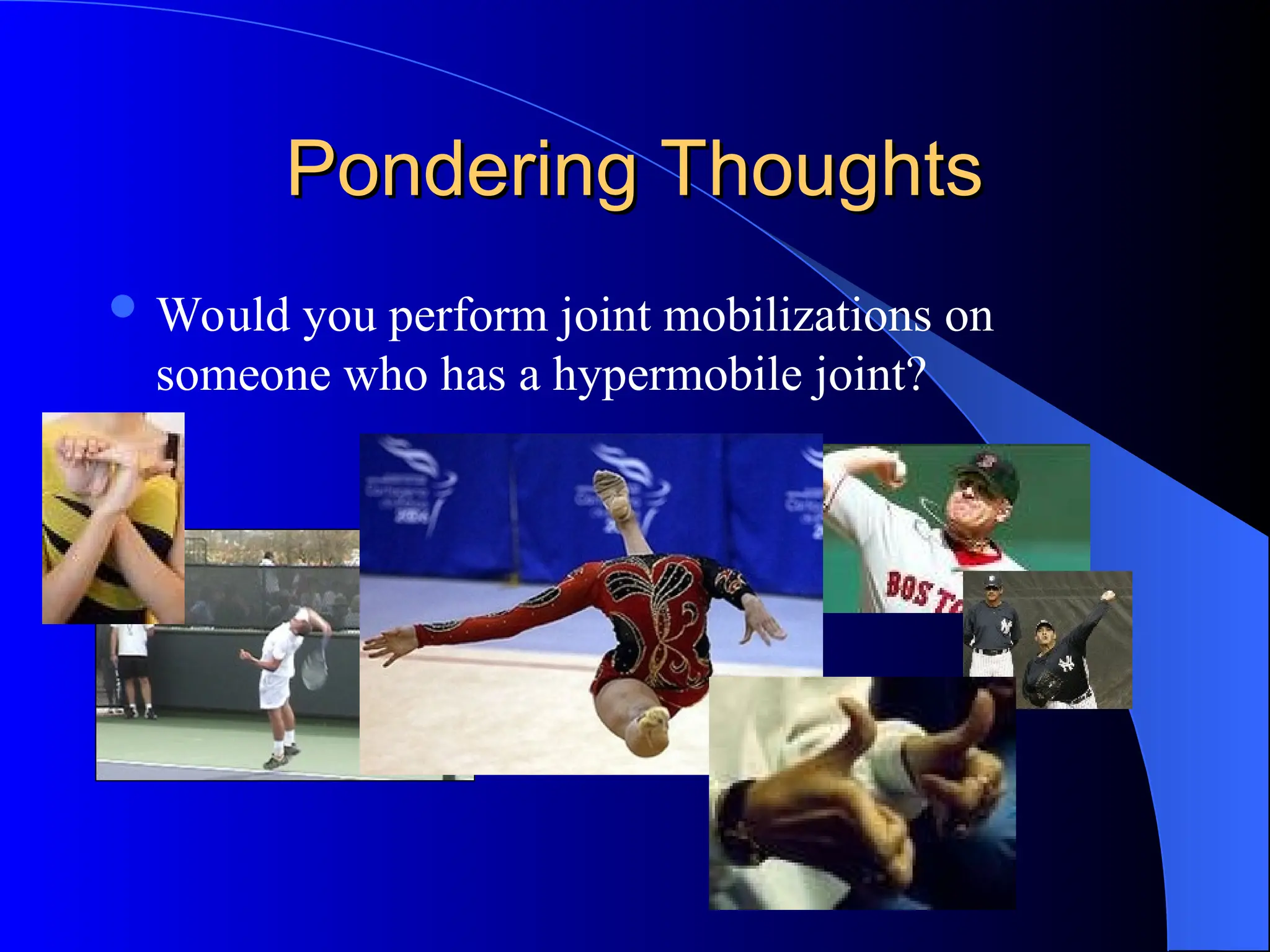
 Would you perform joint mobilizations on
someone who has a hypermobile joint?
Terminology
Terminology
Mobilization – passive joint movement for
increasing ROM or decreasing pain
– Applied to joints & related soft tissues at varying speeds &
amplitudes using physiologic or accessory motions
– Force is light enough that patient’s can stop the movement
Manipulation – passive joint movement for
increasing joint mobility
– Incorporates a sudden, forceful thrust that is beyond the
patient’s control
Terminology
Terminology
Self-Mobilization (Automobilization) – self-
stretching techniques that specifically use joint
traction or glides that direct the stretch force to the
joint capsule
Mobilization with Movement (MWM) –
concurrent application of a sustained accessory
mobilization applied by a clinician & an active
physiologic movement to end range applied by the
patient
– Applied in a pain-free direction
Terminology
Terminology
Physiologic Movements – movements done voluntarily
– Osteokinematics – motions of the bones
Accessory Movements – movements within the joint &
surrounding tissues that are necessary for normal ROM, but
can not be voluntarily performed
– Component motions – motions that accompany active motion,
but are not under voluntary control
 Ex: Upward rotation of scapula & rotation of clavicle that occur with
shoulder flexion
– Joint play – motions that occur within the joint
 Determined by joint capsule’s laxity
 Can be demonstrated passively, but not performed actively
Terminology
Terminology
 Arthrokinematics – motions of bone surfaces within the joint
– 5 motions - Roll, Slide, Spin, Compression, Distraction
 Muscle energy – use an active contraction of deep muscles
that attach near the joint & whose line of pull can cause the
desired accessory motion
– Clinician stabilizes segment on which the distal aspect of the muscle
attaches; command for an isometric contraction of the muscle is given,
which causes the accessory movement of the joint
 Thrust – high-velocity, short-amplitude motion that the patient
can not prevent
– Performed at end of pathologic limit of the joint (snap adhesions,
stimulate joint receptors)
– Techniques that are beyond the scope of our practice!
Terminology
Terminology
Concave – hollowed or rounded inward
Convex – curved or rounded outward
Relationship Between Physiological &
Accessory Motion
Accessory Motion
Biomechanics of joint motion
– Physiological motion
 Result of concentric or eccentric active muscle contractions
 Bones moving about an axis or through flexion, extension,
abduction, adduction or rotation
– Accessory Motion
 Motion of articular surfaces relative to one another
 Generally associated with physiological movement
 Necessary for full range of physiological motion to occur
 Ligament & joint capsule involvement in motion
Joint Shapes & Arthrokinematics
 Ovoid – one surface is
convex, other surface is
concave
– What is an example of an
ovoid joint?
 Sellar (saddle) – one surface
is concave in one direction
& convex in the other, with
the opposing surface convex
& concave respectively
– What is an example of a sellar
joint?
 5 types of joint
arthrokinematics
– Roll
– Slide
– Spin
– Compression
– Distraction
 3 components of joint
mobilization
– Roll, Spin, Slide
– Joint motion usually often
involves a combination of
rolling, sliding & spinning
Roll
Roll
A series of points on one articulating
surface come into contact with a series
of points on another surface
– Rocking chair analogy; ball rolling on ground
– Example: Femoral condyles rolling on tibial plateau
– Roll occurs in direction of movement
– Occurs on incongruent (unequal) surfaces
– Usually occurs in combination with sliding or spinning
Spin
Spin
Occurs when one bone rotates around a
stationary longitudinal mechanical axis
 Same point on the moving surface creates an arc of
a circle as the bone spins
 Example: Radial head at the humeroradial joint
during pronation/supination; shoulder
flexion/extension; hip flexion/extension
– Spin does not occur by itself during normal
joint motion
Slide
Slide
 Specific point on one surface comes
into contact with a series of points on
another surface
 Surfaces are congruent
 When a passive mobilization
technique is applied to produce a
slide in the joint – referred to as a
GLIDE.
 Combined rolling-sliding in a joint
– The more congruent the surfaces are, the
more sliding there is
– The more incongruent the joint surfaces
are, the more rolling there is
Compression –
– Decrease in space between two joint surfaces
– Adds stability to a joint
– Normal reaction of a joint to muscle contraction
Distraction -
– Two surfaces are pulled apart
– Often used in combination with joint
mobilizations to increase stretch of capsule.
Convex-Concave & Concave-Convex Rule
 Basic application of correct mobilization
techniques - **need to understand this!
– Relationship of articulating surfaces associated with
sliding/gliding
 One joint surface is MOBILE & one is STABLE
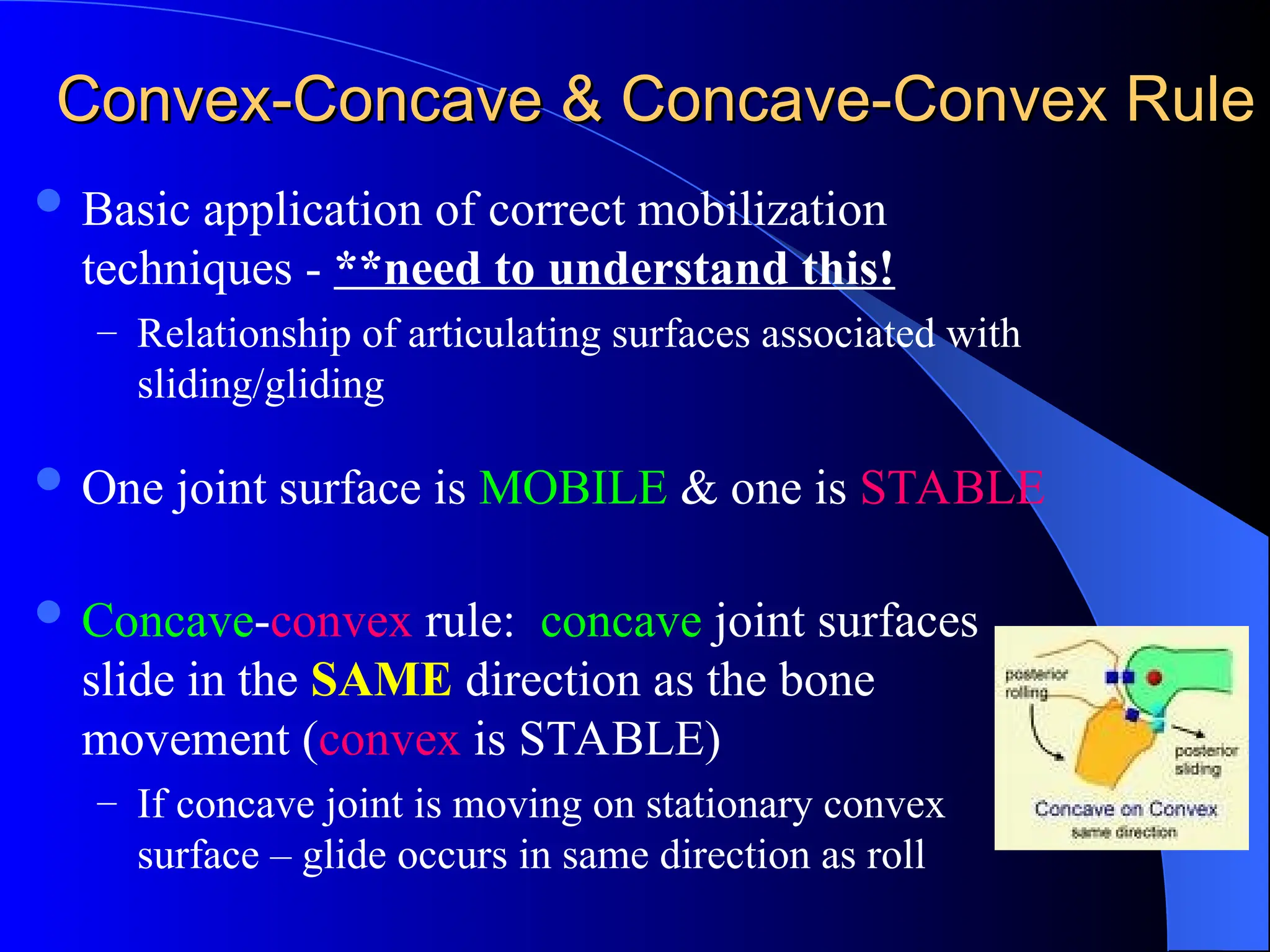
 Concave-convex rule: concave joint surfaces
slide in the SAME direction as the bone
movement (convex is STABLE)
– If concave joint is moving on stationary convex
surface – glide occurs in same direction as roll
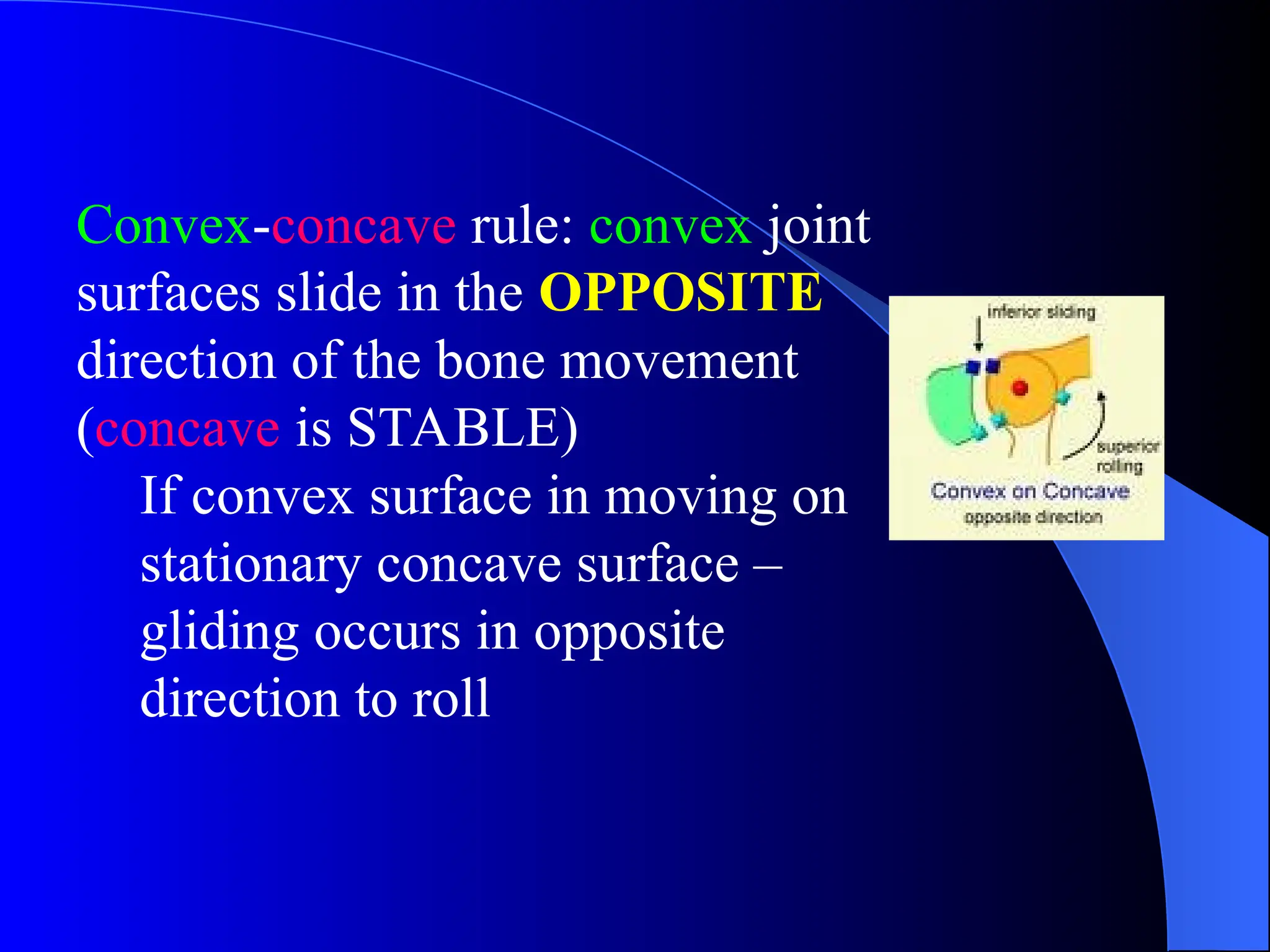
Convex-concave rule: convex joint
surfaces slide in the OPPOSITE
direction of the bone movement
(concave is STABLE)
If convex surface in moving on
stationary concave surface –
gliding occurs in opposite
direction to roll
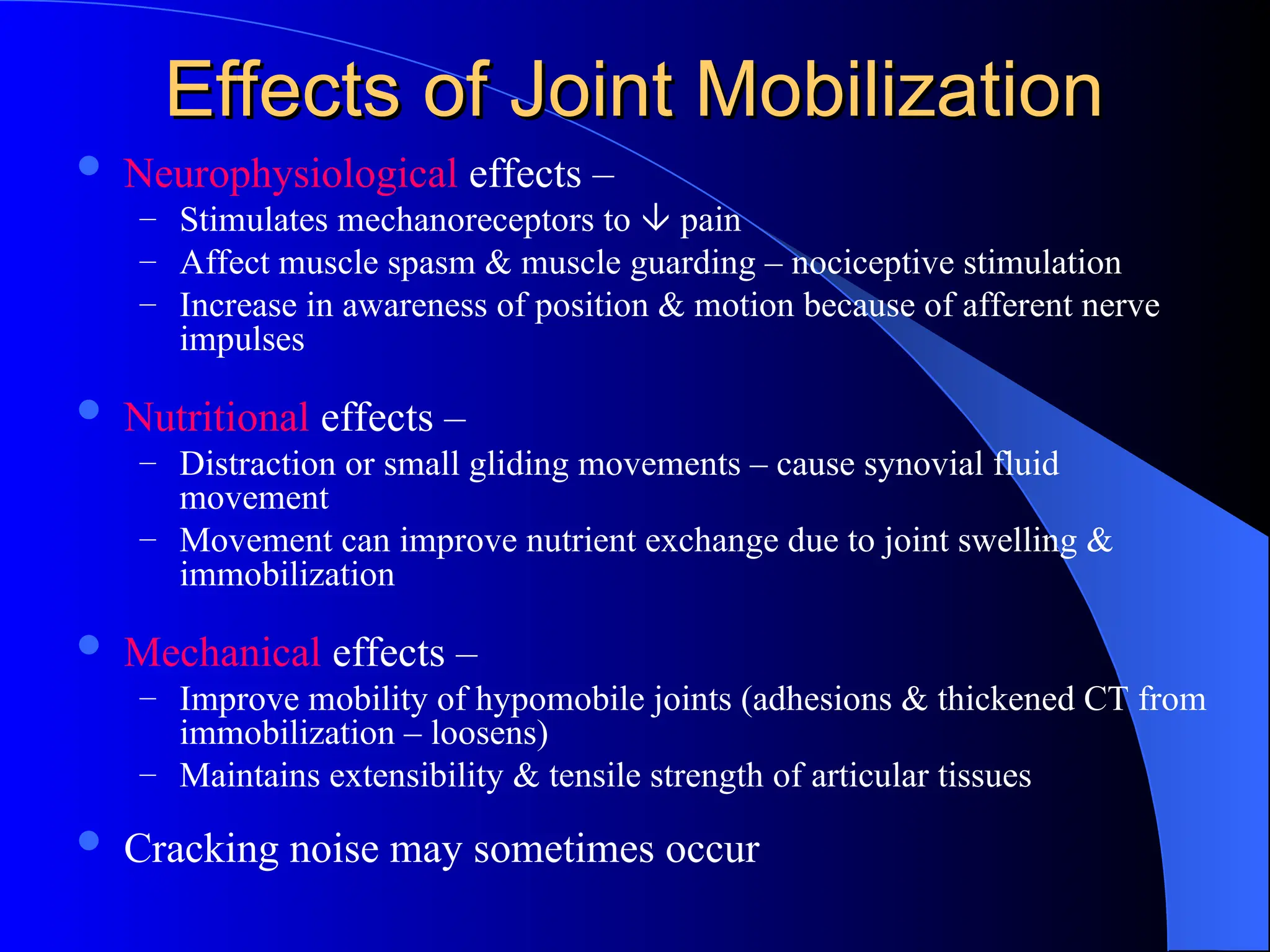
Effects of Joint Mobilization
 Neurophysiological effects –
– Stimulates mechanoreceptors to  pain
– Affect muscle spasm & muscle guarding – nociceptive stimulation
– Increase in awareness of position & motion because of afferent nerve
impulses
 Nutritional effects –
– Distraction or small gliding movements – cause synovial fluid
movement
– Movement can improve nutrient exchange due to joint swelling &
immobilization
 Mechanical effects –
– Improve mobility of hypomobile joints (adhesions & thickened CT from
immobilization – loosens)
– Maintains extensibility & tensile strength of articular tissues
 Cracking noise may sometimes occur
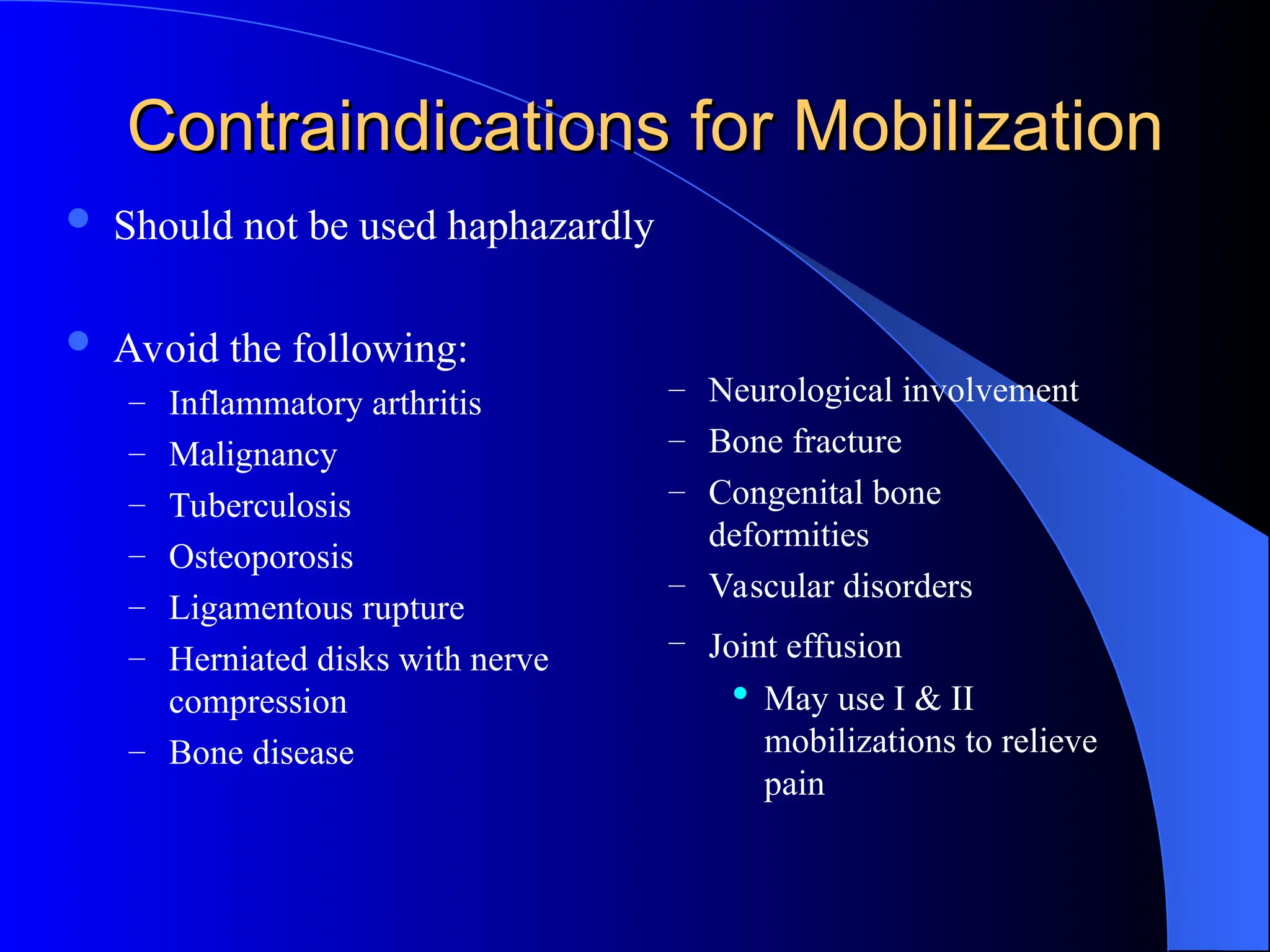
Contraindications for Mobilization
 Should not be used haphazardly
 Avoid the following:
– Inflammatory arthritis
– Malignancy
– Tuberculosis
– Osteoporosis
– Ligamentous rupture
– Herniated disks with nerve
compression
– Bone disease
– Neurological involvement
– Bone fracture
– Congenital bone
deformities
– Vascular disorders
– Joint effusion
 May use I & II
mobilizations to relieve
pain
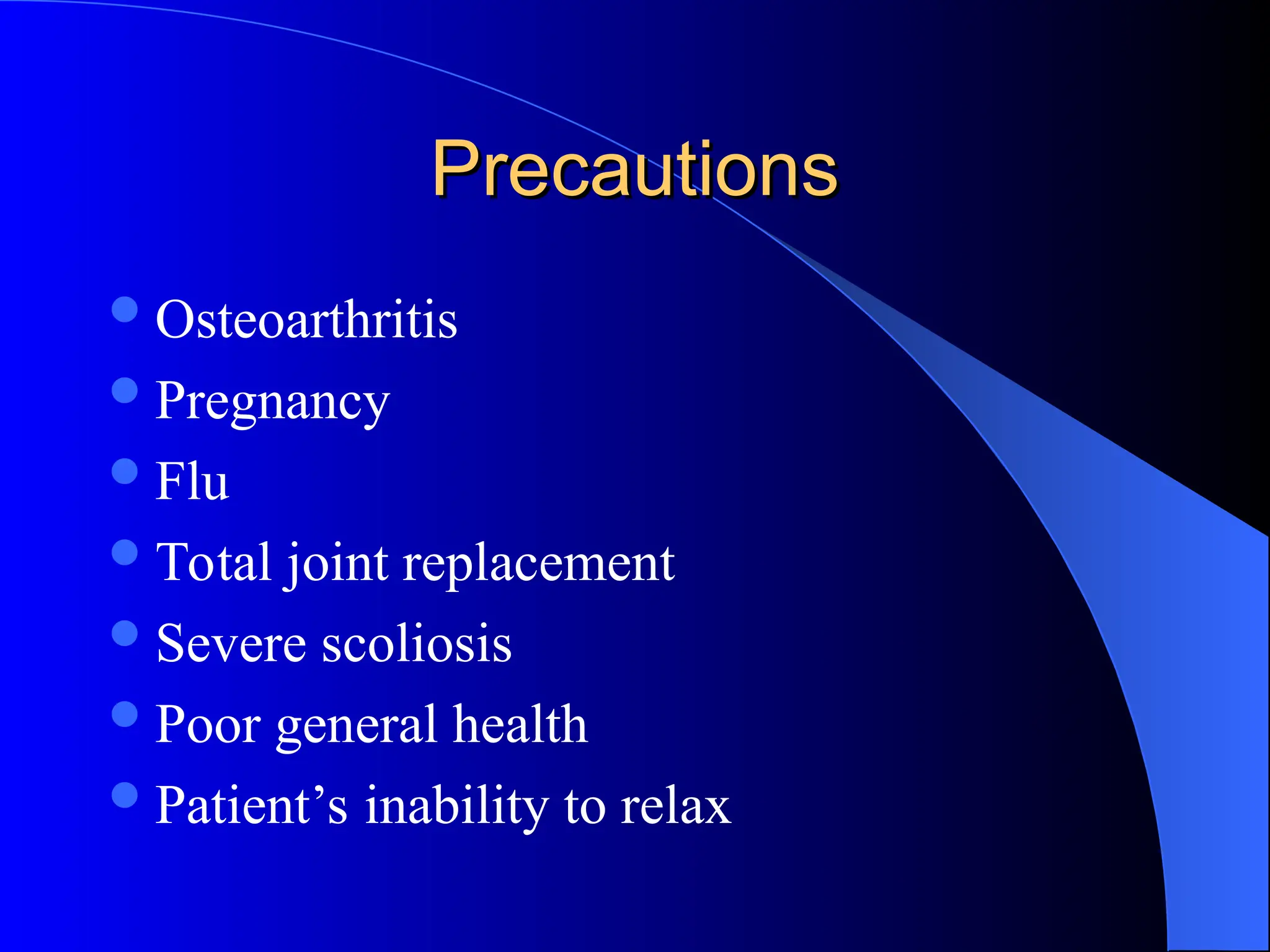
Precautions
Precautions
Osteoarthritis
Pregnancy
Flu
Total joint replacement
Severe scoliosis
Poor general health
Patient’s inability to relax
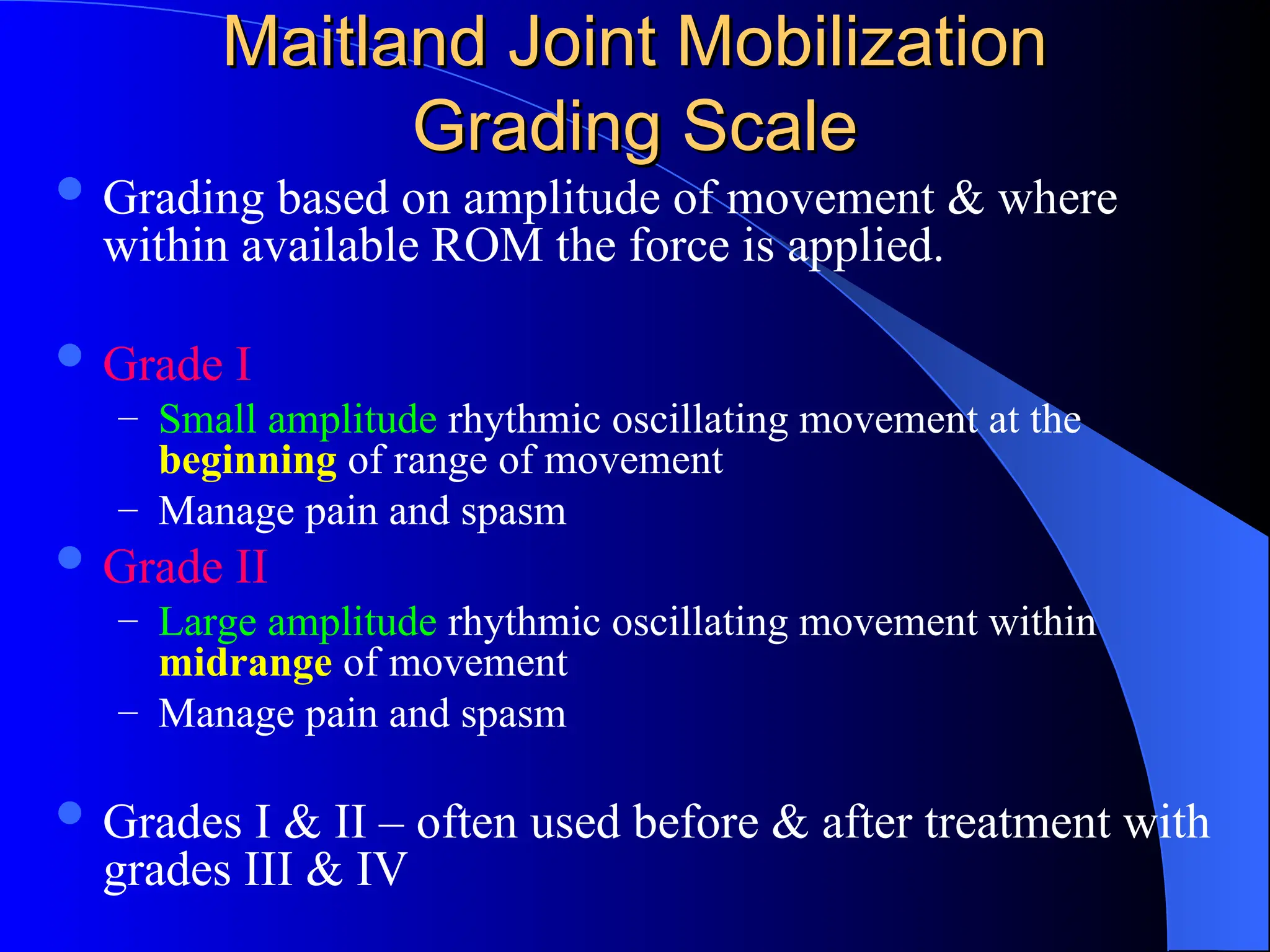
Maitland Joint Mobilization
Grading Scale
Grading Scale
 Grading based on amplitude of movement & where
within available ROM the force is applied.
 Grade I
– Small amplitude rhythmic oscillating movement at the
beginning of range of movement
– Manage pain and spasm
 Grade II
– Large amplitude rhythmic oscillating movement within
midrange of movement
– Manage pain and spasm
 Grades I & II – often used before & after treatment with
grades III & IV
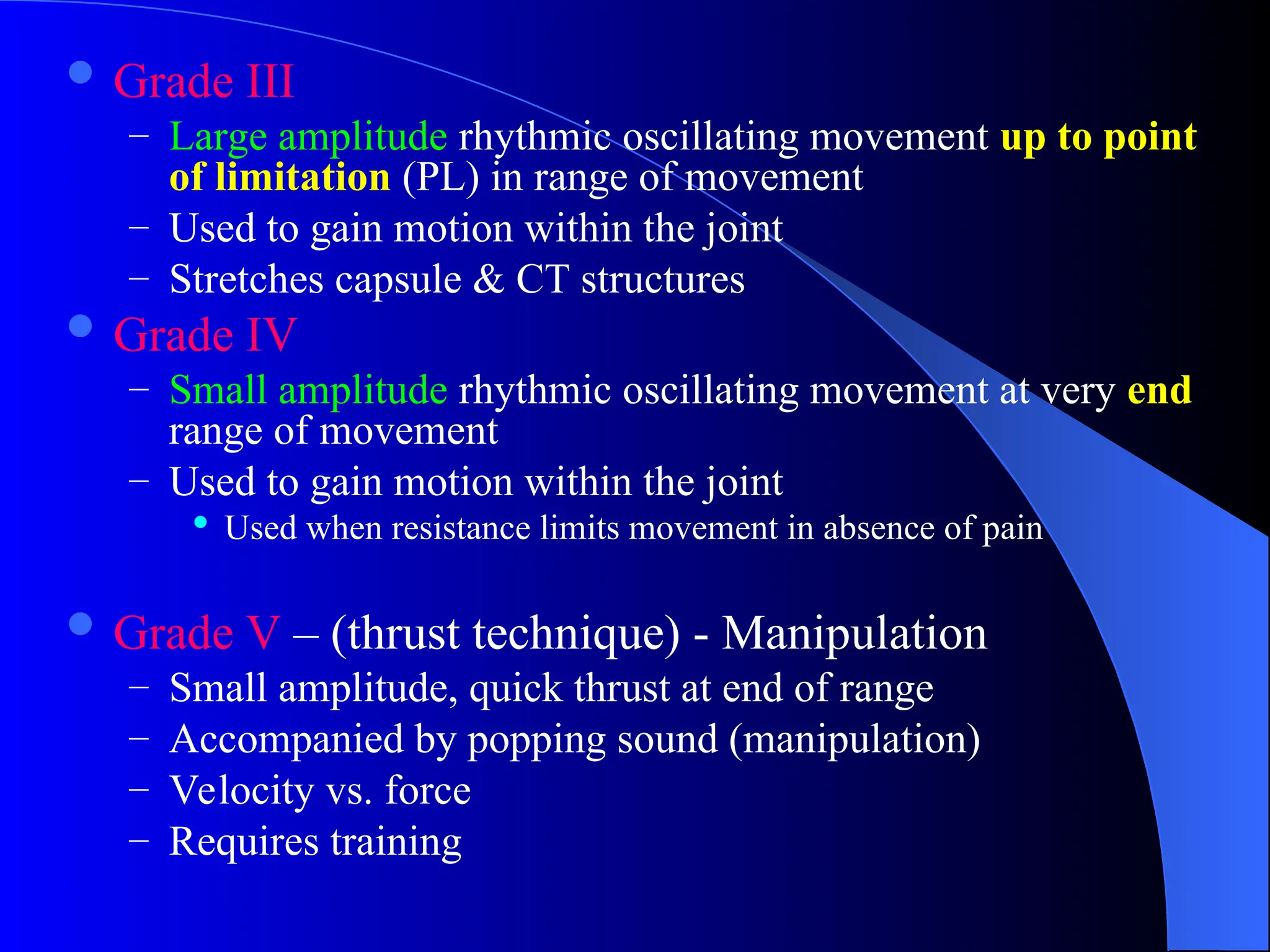
 Grade III
– Large amplitude rhythmic oscillating movement up to point
of limitation (PL) in range of movement
– Used to gain motion within the joint
– Stretches capsule & CT structures
 Grade IV
– Small amplitude rhythmic oscillating movement at very end
range of movement
– Used to gain motion within the joint
 Used when resistance limits movement in absence of pain
 Grade V – (thrust technique) - Manipulation
– Small amplitude, quick thrust at end of range
– Accompanied by popping sound (manipulation)
– Velocity vs. force
– Requires training
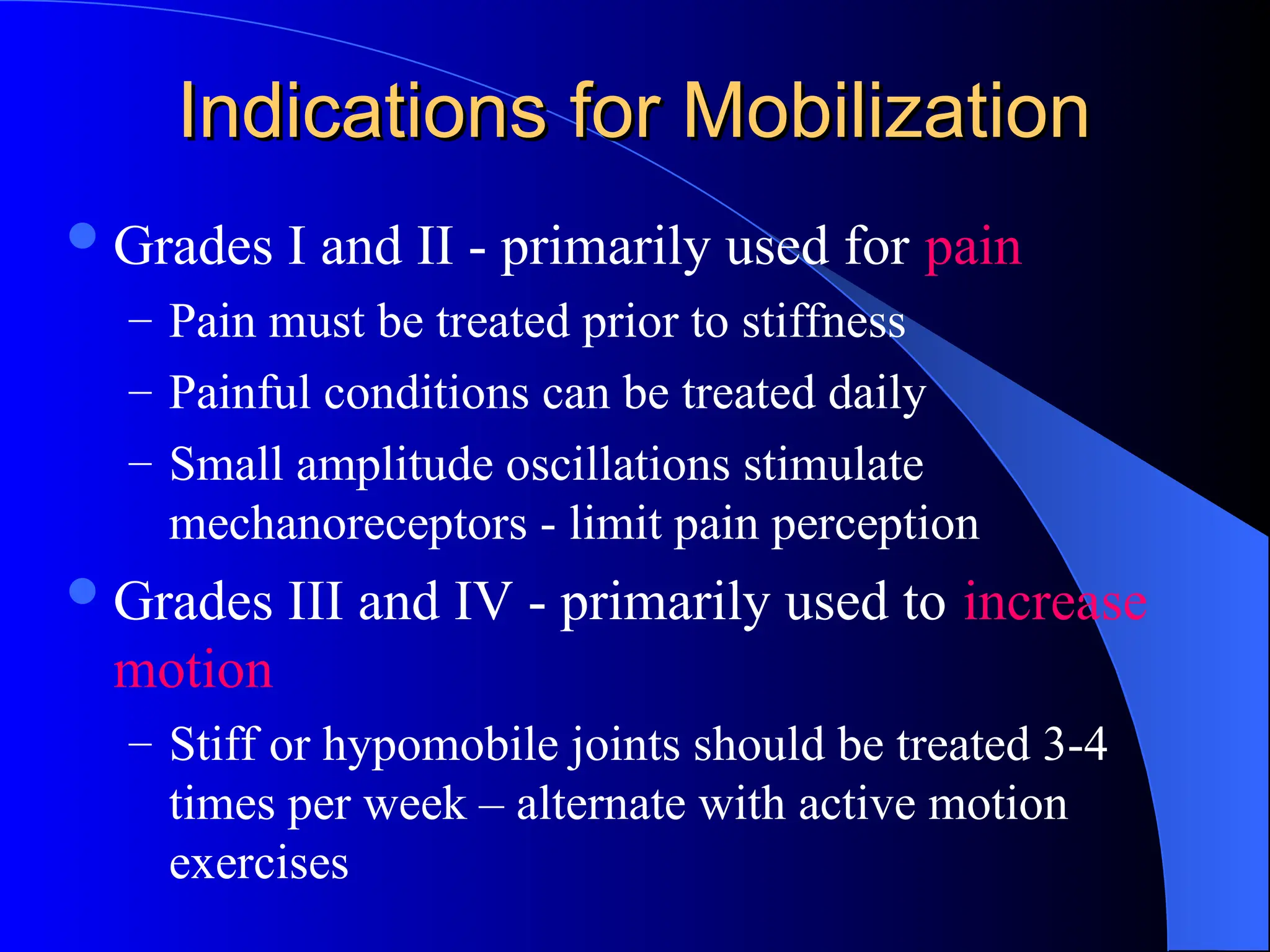
Indications for Mobilization
Grades I and II - primarily used for pain
– Pain must be treated prior to stiffness
– Painful conditions can be treated daily
– Small amplitude oscillations stimulate
mechanoreceptors - limit pain perception
Grades III and IV - primarily used to increase
motion
– Stiff or hypomobile joints should be treated 3-4
times per week – alternate with active motion
exercises
ALWAYS
ALWAYS Examine
Examine PRIOR
PRIOR
to Treatment
to Treatment
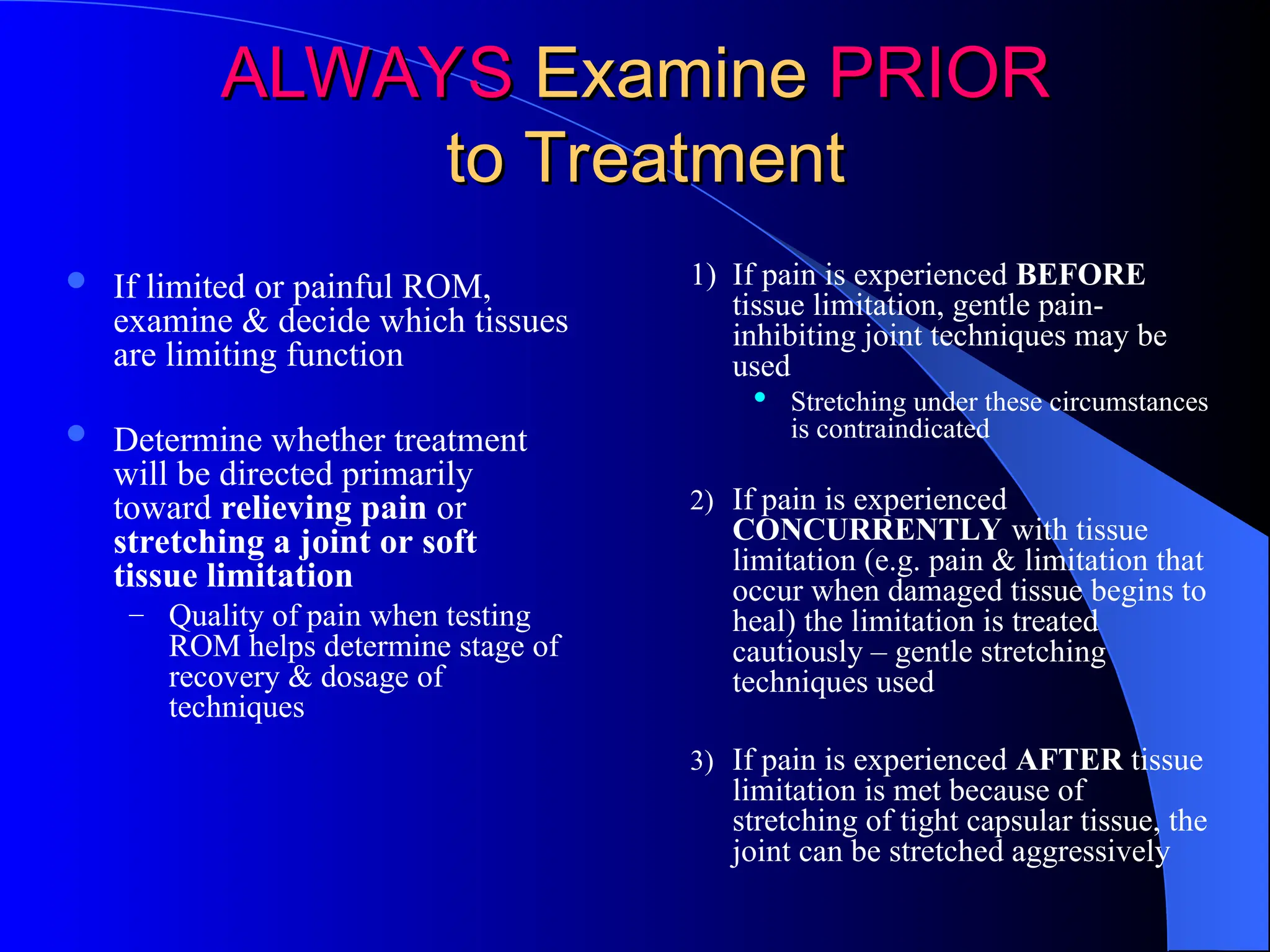
 If limited or painful ROM,
examine & decide which tissues
are limiting function
 Determine whether treatment
will be directed primarily
toward relieving pain or
stretching a joint or soft
tissue limitation
– Quality of pain when testing
ROM helps determine stage of
recovery & dosage of
techniques
1) If pain is experienced BEFORE
tissue limitation, gentle pain-
inhibiting joint techniques may be
used
 Stretching under these circumstances
is contraindicated
2) If pain is experienced
CONCURRENTLY with tissue
limitation (e.g. pain & limitation that
occur when damaged tissue begins to
heal) the limitation is treated
cautiously – gentle stretching
techniques used
3) If pain is experienced AFTER tissue
limitation is met because of
stretching of tight capsular tissue, the
joint can be stretched aggressively
Joint Positions
Joint Positions
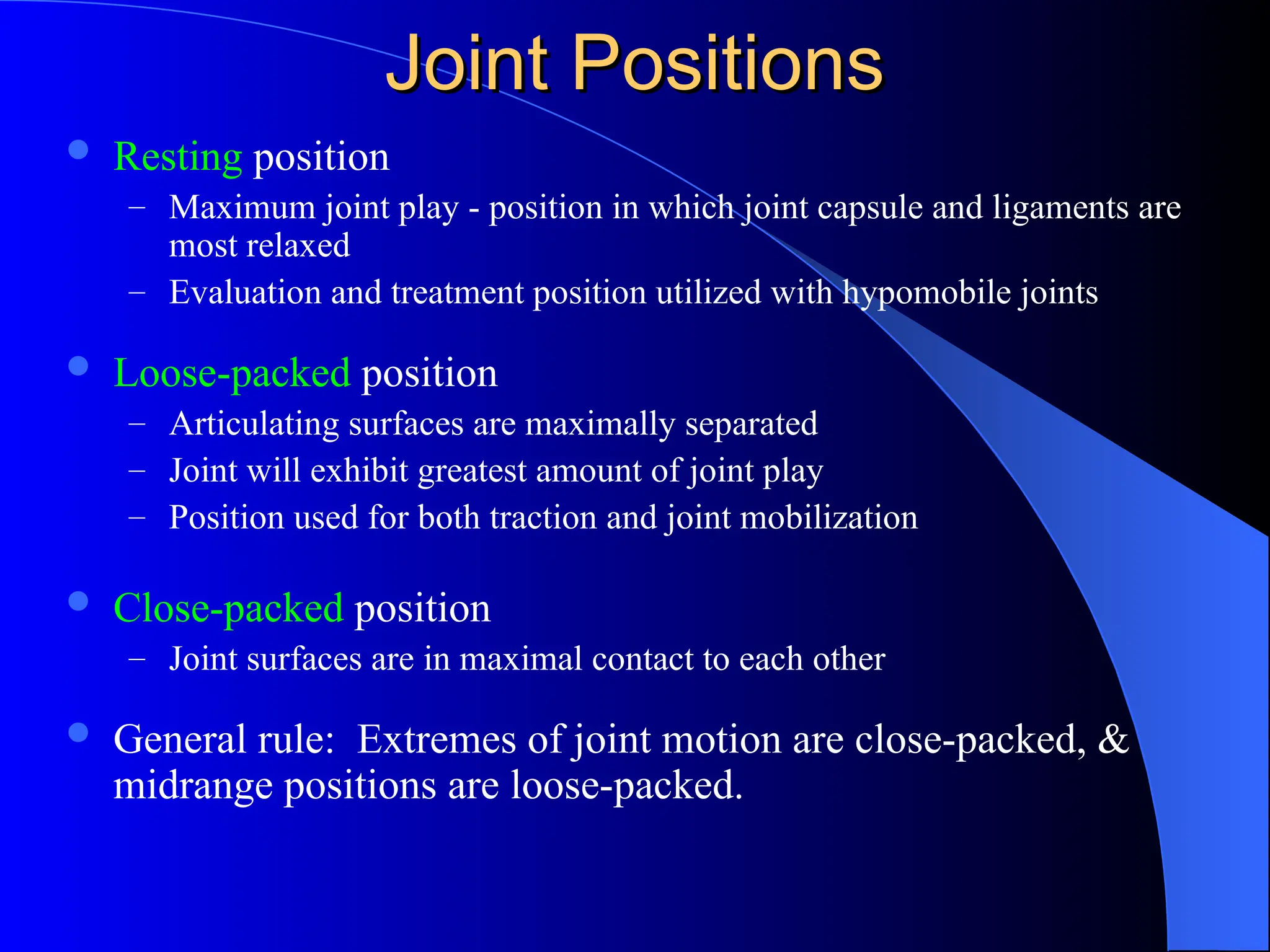
 Resting position
– Maximum joint play - position in which joint capsule and ligaments are
most relaxed
– Evaluation and treatment position utilized with hypomobile joints
 Loose-packed position
– Articulating surfaces are maximally separated
– Joint will exhibit greatest amount of joint play
– Position used for both traction and joint mobilization
 Close-packed position
– Joint surfaces are in maximal contact to each other
 General rule: Extremes of joint motion are close-packed, &
midrange positions are loose-packed.
Joint Mobilization Application
 All joint mobilizations follow the convex-concave rule
 Patient should be relaxed
 Explain purpose of treatment & sensations to expect to
patient
 Evaluate BEFORE & AFTER treatment
 Stop the treatment if it is too painful for the patient
 Use proper body mechanics
 Use gravity to assist the mobilization technique if
possible
 Begin & end treatments with Grade I or II oscillations
Positioning & Stabilization
 Patient & extremity should be positioned so that the
patient can RELAX
 Initial mobilization is performed in a loose-packed
position
– In some cases, the position to use is the one in which the
joint is least painful
 Firmly & comfortably stabilize one joint segment,
usually the proximal bone
– Hand, belt, assistant
– Prevents unwanted stress & makes the stretch force more
specific & effective
Treatment Force & Direction of
Movement
Movement
Treatment force is applied as close to the
opposing joint surface as possible
 The larger the contact surface is, the more comfortable
the procedure will be (use flat surface of hand vs. thumb)
Direction of movement during treatment is
either PARALLEL or PERENDICULAR to the
treatment plane
 Treatment plane lies on
the concave articulating
surface, perpendicular to
a line from the center of
the convex articulating
surface (Kisner & Colby, p.
226 Fig. 6-11)
 Joint traction techniques
are applied
perpendicular to the
treatment plane
 Entire bone is moved so
that the joint surfaces
are separated
Treatment Direction
Treatment Direction
 Gliding techniques are applied parallel to the treatment
plane
 Glide in the direction in which the slide would normally occur for the
desired motion
 Direction of sliding is easily determined by using the convex-concave
rule
 The entire bone is moved so that there is gliding of one joint surface on
the other
 When using grade III gliding techniques, a grade I distraction should
be used
 If gliding in the restricted direction is too painful, begin gliding
mobilizations in the painless direction then progress to gliding in
restricted direction when not as painful
 Reevaluate the joint response the next day or have the
patient report at the next visit
– If increased pain, reduce amplitude of oscillations
– If joint is the same or better, perform either of the following:
 Repeat the same maneuver if goal is to maintain joint play
 Progress to sustained grade III traction or glides if the goal is to increase joint
play
Speed, Rhythm, & Duration of
Movements
Movements
 Joint mobilization sessions
usually involve:
– 3-6 sets of oscillations
– Perform 2-3 oscillations per
second
– Lasting 20-60 seconds for
tightness
– Lasting 1-2 minutes for pain
2-3 oscillations per second
 Apply smooth, regular
oscillations
 Vary speed of oscillations
for different effects
 For painful joints, apply
intermittent distraction for 7-
10 seconds with a few
seconds of rest in between
for several cycles
 For restricted joints, apply a
minimum of a 6-second
stretch force, followed by
partial release then repeat
with slow, intermittent
stretches at 3-4 second
intervals
Patient Response
Patient Response
 May cause soreness
 Perform joint mobilizations on alternate days to
allow soreness to decrease & tissue healing to
occur
 Patient should perform ROM techniques
 Patient’s joint & ROM should be reassessed after
treatment, & again before the next treatment
 Pain is always the guide
Joint Traction Techniques
 Technique involving pulling one articulating surface
away from another – creating separation
 Performed perpendicular to treatment plane
 Used to decrease pain or reduce joint hypomobility
 Kaltenborn classification system
– Combines traction and mobilization
– Joint looseness = slack
Kaltenborn Traction Grading
 Grade I (loosen)
– Neutralizes pressure in joint without actual surface
separation
– Produce pain relief by reducing compressive forces
 Grade II (tighten or take up slack)
– Separates articulating surfaces, taking up slack or
eliminating play within joint capsule
– Used initially to determine joint sensitivity
 Grade III (stretch)
– Involves stretching of soft tissue surrounding joint
– Increase mobility in hypomobile joint
 Grade I traction should be used initially to reduce
chance of painful reaction
 10 second intermittent grade I & II traction can be
used
 Distracting joint surface up to a grade III & releasing
allows for return to resting position
 Grade III traction should be used in conjunction with
mobilization glides for hypomobile joints
– Application of grade III traction (loose-pack position)
– Grade III and IV oscillations within pain limitation to
decrease hypomobility
References
References
 Houglum, P.A. (2005). Therapeutic exercise for
musculoskeletal injuries, 2nd
ed. Human Kinetics:
Champaign, IL
 Kisner, C. & Colby, L.A. (2002). Therapeutic
exercise: Foundations and techniques, 4th
ed. F.A.
Davis: Philadelphia.
 http://www.pt.ntu.edu.tw/hmchai/Kinesiology/
KINmotion/JointStructionAndFunciton.htm
 www.google.com (images)

Joint mobilization techniques for physiotherapy students

  • 1.
  • 2.
    What is JointMobilization? What is Joint Mobilization?  “Joint Mobs”  Manual therapy technique – Used to modulate pain – Used to increase ROM – Used to treat joint dysfunctions that limit ROM by specifically addressing altered joint mechanics  Factors that may alter joint mechanics: – Pain & Muscle guarding – Joint hypomobility – Joint effusion – Contractures or adhesions in the joint capsules or supporting ligaments – Malalignment or subluxation of bony surfaces
  • 3.
    Pondering Thoughts Pondering Thoughts Would you perform joint mobilizations on someone who has a hypermobile joint?
  • 4.
    Terminology Terminology Mobilization – passivejoint movement for increasing ROM or decreasing pain – Applied to joints & related soft tissues at varying speeds & amplitudes using physiologic or accessory motions – Force is light enough that patient’s can stop the movement Manipulation – passive joint movement for increasing joint mobility – Incorporates a sudden, forceful thrust that is beyond the patient’s control
  • 5.
    Terminology Terminology Self-Mobilization (Automobilization) –self- stretching techniques that specifically use joint traction or glides that direct the stretch force to the joint capsule Mobilization with Movement (MWM) – concurrent application of a sustained accessory mobilization applied by a clinician & an active physiologic movement to end range applied by the patient – Applied in a pain-free direction
  • 6.
    Terminology Terminology Physiologic Movements –movements done voluntarily – Osteokinematics – motions of the bones Accessory Movements – movements within the joint & surrounding tissues that are necessary for normal ROM, but can not be voluntarily performed – Component motions – motions that accompany active motion, but are not under voluntary control  Ex: Upward rotation of scapula & rotation of clavicle that occur with shoulder flexion – Joint play – motions that occur within the joint  Determined by joint capsule’s laxity  Can be demonstrated passively, but not performed actively
  • 7.
    Terminology Terminology  Arthrokinematics –motions of bone surfaces within the joint – 5 motions - Roll, Slide, Spin, Compression, Distraction  Muscle energy – use an active contraction of deep muscles that attach near the joint & whose line of pull can cause the desired accessory motion – Clinician stabilizes segment on which the distal aspect of the muscle attaches; command for an isometric contraction of the muscle is given, which causes the accessory movement of the joint  Thrust – high-velocity, short-amplitude motion that the patient can not prevent – Performed at end of pathologic limit of the joint (snap adhesions, stimulate joint receptors) – Techniques that are beyond the scope of our practice!
  • 8.
    Terminology Terminology Concave – hollowedor rounded inward Convex – curved or rounded outward
  • 9.
    Relationship Between Physiological& Relationship Between Physiological & Accessory Motion Accessory Motion Biomechanics of joint motion – Physiological motion  Result of concentric or eccentric active muscle contractions  Bones moving about an axis or through flexion, extension, abduction, adduction or rotation – Accessory Motion  Motion of articular surfaces relative to one another  Generally associated with physiological movement  Necessary for full range of physiological motion to occur  Ligament & joint capsule involvement in motion
  • 10.
    Joint Shapes &Arthrokinematics Joint Shapes & Arthrokinematics  Ovoid – one surface is convex, other surface is concave – What is an example of an ovoid joint?  Sellar (saddle) – one surface is concave in one direction & convex in the other, with the opposing surface convex & concave respectively – What is an example of a sellar joint?  5 types of joint arthrokinematics – Roll – Slide – Spin – Compression – Distraction  3 components of joint mobilization – Roll, Spin, Slide – Joint motion usually often involves a combination of rolling, sliding & spinning
  • 11.
    Roll Roll A series ofpoints on one articulating surface come into contact with a series of points on another surface – Rocking chair analogy; ball rolling on ground – Example: Femoral condyles rolling on tibial plateau – Roll occurs in direction of movement – Occurs on incongruent (unequal) surfaces – Usually occurs in combination with sliding or spinning
  • 12.
    Spin Spin Occurs when onebone rotates around a stationary longitudinal mechanical axis  Same point on the moving surface creates an arc of a circle as the bone spins  Example: Radial head at the humeroradial joint during pronation/supination; shoulder flexion/extension; hip flexion/extension – Spin does not occur by itself during normal joint motion
  • 13.
    Slide Slide  Specific pointon one surface comes into contact with a series of points on another surface  Surfaces are congruent  When a passive mobilization technique is applied to produce a slide in the joint – referred to as a GLIDE.  Combined rolling-sliding in a joint – The more congruent the surfaces are, the more sliding there is – The more incongruent the joint surfaces are, the more rolling there is
  • 14.
    Compression – – Decreasein space between two joint surfaces – Adds stability to a joint – Normal reaction of a joint to muscle contraction Distraction - – Two surfaces are pulled apart – Often used in combination with joint mobilizations to increase stretch of capsule.
  • 15.
    Convex-Concave & Concave-ConvexRule Convex-Concave & Concave-Convex Rule  Basic application of correct mobilization techniques - **need to understand this! – Relationship of articulating surfaces associated with sliding/gliding  One joint surface is MOBILE & one is STABLE  Concave-convex rule: concave joint surfaces slide in the SAME direction as the bone movement (convex is STABLE) – If concave joint is moving on stationary convex surface – glide occurs in same direction as roll
  • 16.
    Convex-concave rule: convexjoint surfaces slide in the OPPOSITE direction of the bone movement (concave is STABLE) If convex surface in moving on stationary concave surface – gliding occurs in opposite direction to roll
  • 17.
    Effects of JointMobilization Effects of Joint Mobilization  Neurophysiological effects – – Stimulates mechanoreceptors to  pain – Affect muscle spasm & muscle guarding – nociceptive stimulation – Increase in awareness of position & motion because of afferent nerve impulses  Nutritional effects – – Distraction or small gliding movements – cause synovial fluid movement – Movement can improve nutrient exchange due to joint swelling & immobilization  Mechanical effects – – Improve mobility of hypomobile joints (adhesions & thickened CT from immobilization – loosens) – Maintains extensibility & tensile strength of articular tissues  Cracking noise may sometimes occur
  • 18.
    Contraindications for Mobilization Contraindicationsfor Mobilization  Should not be used haphazardly  Avoid the following: – Inflammatory arthritis – Malignancy – Tuberculosis – Osteoporosis – Ligamentous rupture – Herniated disks with nerve compression – Bone disease – Neurological involvement – Bone fracture – Congenital bone deformities – Vascular disorders – Joint effusion  May use I & II mobilizations to relieve pain
  • 19.
    Precautions Precautions Osteoarthritis Pregnancy Flu Total joint replacement Severescoliosis Poor general health Patient’s inability to relax
  • 20.
    Maitland Joint Mobilization MaitlandJoint Mobilization Grading Scale Grading Scale  Grading based on amplitude of movement & where within available ROM the force is applied.  Grade I – Small amplitude rhythmic oscillating movement at the beginning of range of movement – Manage pain and spasm  Grade II – Large amplitude rhythmic oscillating movement within midrange of movement – Manage pain and spasm  Grades I & II – often used before & after treatment with grades III & IV
  • 21.
     Grade III –Large amplitude rhythmic oscillating movement up to point of limitation (PL) in range of movement – Used to gain motion within the joint – Stretches capsule & CT structures  Grade IV – Small amplitude rhythmic oscillating movement at very end range of movement – Used to gain motion within the joint  Used when resistance limits movement in absence of pain  Grade V – (thrust technique) - Manipulation – Small amplitude, quick thrust at end of range – Accompanied by popping sound (manipulation) – Velocity vs. force – Requires training
  • 22.
    Indications for Mobilization Indicationsfor Mobilization Grades I and II - primarily used for pain – Pain must be treated prior to stiffness – Painful conditions can be treated daily – Small amplitude oscillations stimulate mechanoreceptors - limit pain perception Grades III and IV - primarily used to increase motion – Stiff or hypomobile joints should be treated 3-4 times per week – alternate with active motion exercises
  • 23.
    ALWAYS ALWAYS Examine Examine PRIOR PRIOR toTreatment to Treatment  If limited or painful ROM, examine & decide which tissues are limiting function  Determine whether treatment will be directed primarily toward relieving pain or stretching a joint or soft tissue limitation – Quality of pain when testing ROM helps determine stage of recovery & dosage of techniques 1) If pain is experienced BEFORE tissue limitation, gentle pain- inhibiting joint techniques may be used  Stretching under these circumstances is contraindicated 2) If pain is experienced CONCURRENTLY with tissue limitation (e.g. pain & limitation that occur when damaged tissue begins to heal) the limitation is treated cautiously – gentle stretching techniques used 3) If pain is experienced AFTER tissue limitation is met because of stretching of tight capsular tissue, the joint can be stretched aggressively
  • 24.
    Joint Positions Joint Positions Resting position – Maximum joint play - position in which joint capsule and ligaments are most relaxed – Evaluation and treatment position utilized with hypomobile joints  Loose-packed position – Articulating surfaces are maximally separated – Joint will exhibit greatest amount of joint play – Position used for both traction and joint mobilization  Close-packed position – Joint surfaces are in maximal contact to each other  General rule: Extremes of joint motion are close-packed, & midrange positions are loose-packed.
  • 25.
    Joint Mobilization Application JointMobilization Application  All joint mobilizations follow the convex-concave rule  Patient should be relaxed  Explain purpose of treatment & sensations to expect to patient  Evaluate BEFORE & AFTER treatment  Stop the treatment if it is too painful for the patient  Use proper body mechanics  Use gravity to assist the mobilization technique if possible  Begin & end treatments with Grade I or II oscillations
  • 26.
    Positioning & Stabilization Positioning& Stabilization  Patient & extremity should be positioned so that the patient can RELAX  Initial mobilization is performed in a loose-packed position – In some cases, the position to use is the one in which the joint is least painful  Firmly & comfortably stabilize one joint segment, usually the proximal bone – Hand, belt, assistant – Prevents unwanted stress & makes the stretch force more specific & effective
  • 27.
    Treatment Force &Direction of Treatment Force & Direction of Movement Movement Treatment force is applied as close to the opposing joint surface as possible  The larger the contact surface is, the more comfortable the procedure will be (use flat surface of hand vs. thumb) Direction of movement during treatment is either PARALLEL or PERENDICULAR to the treatment plane
  • 28.
     Treatment planelies on the concave articulating surface, perpendicular to a line from the center of the convex articulating surface (Kisner & Colby, p. 226 Fig. 6-11)  Joint traction techniques are applied perpendicular to the treatment plane  Entire bone is moved so that the joint surfaces are separated Treatment Direction Treatment Direction
  • 29.
     Gliding techniquesare applied parallel to the treatment plane  Glide in the direction in which the slide would normally occur for the desired motion  Direction of sliding is easily determined by using the convex-concave rule  The entire bone is moved so that there is gliding of one joint surface on the other  When using grade III gliding techniques, a grade I distraction should be used  If gliding in the restricted direction is too painful, begin gliding mobilizations in the painless direction then progress to gliding in restricted direction when not as painful  Reevaluate the joint response the next day or have the patient report at the next visit – If increased pain, reduce amplitude of oscillations – If joint is the same or better, perform either of the following:  Repeat the same maneuver if goal is to maintain joint play  Progress to sustained grade III traction or glides if the goal is to increase joint play
  • 30.
    Speed, Rhythm, &Duration of Speed, Rhythm, & Duration of Movements Movements  Joint mobilization sessions usually involve: – 3-6 sets of oscillations – Perform 2-3 oscillations per second – Lasting 20-60 seconds for tightness – Lasting 1-2 minutes for pain 2-3 oscillations per second  Apply smooth, regular oscillations  Vary speed of oscillations for different effects  For painful joints, apply intermittent distraction for 7- 10 seconds with a few seconds of rest in between for several cycles  For restricted joints, apply a minimum of a 6-second stretch force, followed by partial release then repeat with slow, intermittent stretches at 3-4 second intervals
  • 31.
    Patient Response Patient Response May cause soreness  Perform joint mobilizations on alternate days to allow soreness to decrease & tissue healing to occur  Patient should perform ROM techniques  Patient’s joint & ROM should be reassessed after treatment, & again before the next treatment  Pain is always the guide
  • 32.
    Joint Traction Techniques JointTraction Techniques  Technique involving pulling one articulating surface away from another – creating separation  Performed perpendicular to treatment plane  Used to decrease pain or reduce joint hypomobility  Kaltenborn classification system – Combines traction and mobilization – Joint looseness = slack
  • 33.
    Kaltenborn Traction Grading KaltenbornTraction Grading  Grade I (loosen) – Neutralizes pressure in joint without actual surface separation – Produce pain relief by reducing compressive forces  Grade II (tighten or take up slack) – Separates articulating surfaces, taking up slack or eliminating play within joint capsule – Used initially to determine joint sensitivity  Grade III (stretch) – Involves stretching of soft tissue surrounding joint – Increase mobility in hypomobile joint
  • 34.
     Grade Itraction should be used initially to reduce chance of painful reaction  10 second intermittent grade I & II traction can be used  Distracting joint surface up to a grade III & releasing allows for return to resting position  Grade III traction should be used in conjunction with mobilization glides for hypomobile joints – Application of grade III traction (loose-pack position) – Grade III and IV oscillations within pain limitation to decrease hypomobility
  • 35.
    References References  Houglum, P.A.(2005). Therapeutic exercise for musculoskeletal injuries, 2nd ed. Human Kinetics: Champaign, IL  Kisner, C. & Colby, L.A. (2002). Therapeutic exercise: Foundations and techniques, 4th ed. F.A. Davis: Philadelphia.  http://www.pt.ntu.edu.tw/hmchai/Kinesiology/ KINmotion/JointStructionAndFunciton.htm  www.google.com (images)