Manual Handling Training
WEL COME ‫خوش‬
‫آمدید‬ स्वागतम
Name of the Trainer:
Syed Neyaz Ahmad
Location: Fujairah
Mobile ElevatingWork Platform
WEL COME ‫خوش‬
‫آمدید‬ स्वागतम
Name of the Trainer:
Syed Neyaz Ahmad
Location: Fujairah
Date. 27.07.2022
Company: GDES
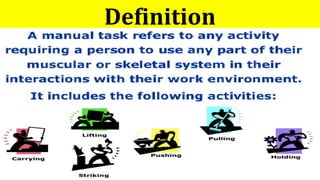
Definition
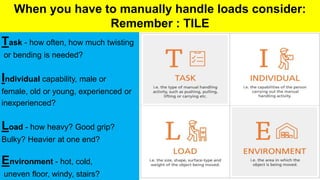
When you have to manually handle loads consider:
Remember : TILE
Task - how often, how much twisting
or bending is needed?
Individual capability, male or
female, old or young, experienced or
inexperienced?
Load - how heavy? Good grip?
Bulky? Heavier at one end?
Environment - hot, cold,
uneven floor, windy, stairs?
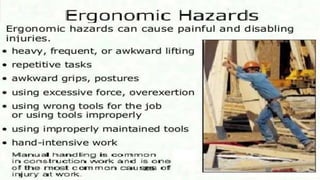
HAZARDS
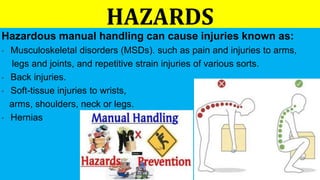
Hazardous manual handling can cause injuries known as:
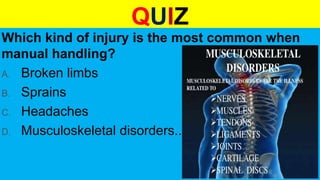
• Musculoskeletal disorders (MSDs). such as pain and injuries to arms,
legs and joints, and repetitive strain injuries of various sorts.
• Back injuries.
• Soft-tissue injuries to wrists,
arms, shoulders, neck or legs.
• Hernias
Consequences
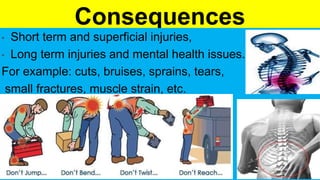
• Short term and superficial injuries,
• Long term injuries and mental health issues.
For example: cuts, bruises, sprains, tears,
small fractures, muscle strain, etc.
Manual Handling Precautions:
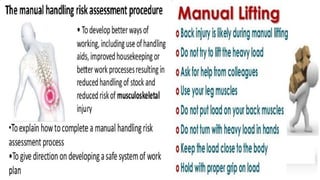
• Your first lift is a mental lift. Think about the lift prior to actually doing it:
• How am I going to lift the item?
• Can I do it myself or should I get some help?
• How heavy is the item? Do I need to use mechanical assistance?
• Where am I taking the item being lifted? Is the area clear
where I need to set it down?
• Is it a difficult path or a distance to go?
• What hazards may hamper the lift or obstruct the travel path?
• Eliminate those hazards before you lift the item. In other words, Plan the Lift First!
• The second lift is the actual physical lift. Here is where you carry out your plan.
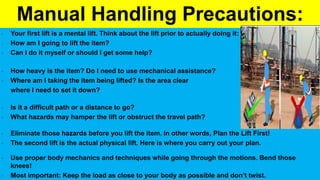
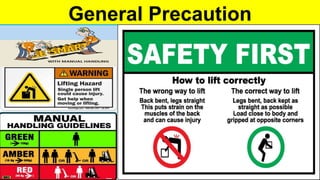
• Use proper body mechanics and techniques while going through the motions. Bend those
knees!
• Most important: Keep the load as close to your body as possible and don’t twist.
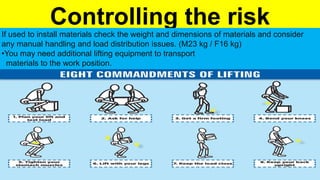
Controlling the risk
If used to install materials check the weight and dimensions of materials and consider
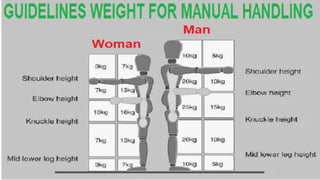
any manual handling and load distribution issues. (M23 kg / F16 kg)
•You may need additional lifting equipment to transport
materials to the work position.
General Precaution
QUIZ
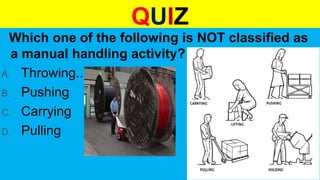
Which one of the following is NOT classified as
a manual handling activity?
A. Throwing..
B. Pushing
C. Carrying
D. Pulling
QUIZ
Which kind of injury is the most common when
manual handling?
A. Broken limbs
B. Sprains
C. Headaches
D. Musculoskeletal disorders..
QUIZ
When carrying a load, which one of the following
would make it more difficult to handle?
A. If the load is in a square box
B. If the load is stable
C. If the load is heavier on one side..
D. If the load is in a sturdy container
Thank you

MANUAL HANDLING TRAINING.pptx

  • 1.
    Manual Handling Training WELCOME ‫خوش‬ ‫آمدید‬ स्वागतम Name of the Trainer: Syed Neyaz Ahmad Location: Fujairah
  • 2.
    Mobile ElevatingWork Platform WELCOME ‫خوش‬ ‫آمدید‬ स्वागतम Name of the Trainer: Syed Neyaz Ahmad Location: Fujairah Date. 27.07.2022 Company: GDES
  • 6.
  • 7.
    When you haveto manually handle loads consider: Remember : TILE Task - how often, how much twisting or bending is needed? Individual capability, male or female, old or young, experienced or inexperienced? Load - how heavy? Good grip? Bulky? Heavier at one end? Environment - hot, cold, uneven floor, windy, stairs?
  • 8.
    HAZARDS Hazardous manual handlingcan cause injuries known as: • Musculoskeletal disorders (MSDs). such as pain and injuries to arms, legs and joints, and repetitive strain injuries of various sorts. • Back injuries. • Soft-tissue injuries to wrists, arms, shoulders, neck or legs. • Hernias
  • 9.
    Consequences • Short termand superficial injuries, • Long term injuries and mental health issues. For example: cuts, bruises, sprains, tears, small fractures, muscle strain, etc.
  • 10.
    Manual Handling Precautions: •Your first lift is a mental lift. Think about the lift prior to actually doing it: • How am I going to lift the item? • Can I do it myself or should I get some help? • How heavy is the item? Do I need to use mechanical assistance? • Where am I taking the item being lifted? Is the area clear where I need to set it down? • Is it a difficult path or a distance to go? • What hazards may hamper the lift or obstruct the travel path? • Eliminate those hazards before you lift the item. In other words, Plan the Lift First! • The second lift is the actual physical lift. Here is where you carry out your plan. • Use proper body mechanics and techniques while going through the motions. Bend those knees! • Most important: Keep the load as close to your body as possible and don’t twist.
  • 11.
    Controlling the risk Ifused to install materials check the weight and dimensions of materials and consider any manual handling and load distribution issues. (M23 kg / F16 kg) •You may need additional lifting equipment to transport materials to the work position.
  • 13.
  • 17.
    QUIZ Which one ofthe following is NOT classified as a manual handling activity? A. Throwing.. B. Pushing C. Carrying D. Pulling
  • 18.
    QUIZ Which kind ofinjury is the most common when manual handling? A. Broken limbs B. Sprains C. Headaches D. Musculoskeletal disorders..
  • 19.
    QUIZ When carrying aload, which one of the following would make it more difficult to handle? A. If the load is in a square box B. If the load is stable C. If the load is heavier on one side.. D. If the load is in a sturdy container
  • 20.