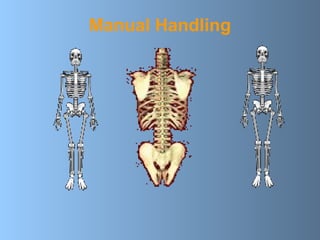
Manual Handling
An Introduction
Manual Handling
Course Content
Statistics
Definition
Anatomy & Injuries
Mechanics
Law
Risk Assessment
Lifting Safely
Anyone Hurt?
Accident Statistics
Largest cause of accidents at work
37% Manual Handling
19% Slips, Trips and Falls
12% Other Causes
20% Struck by an Object
7% Falling from Height
5% Machinery
Accident Statistics
Interpreted another way - the overall figure
of 37% means that:
86000 people are absent daily
26,500,000 working days are lost annually
£1000,000,000 is lost in production,
sickness benefit and medical costs
In terms of suffering each injury results in an
average of 20 days off work – some never
fully recover. Four out of five people suffer
with back related problems at some time – the
risk is greater after the age of 30.
Definition of Manual Handling
The transporting or
supporting of a load by hand
or some other part of the
body including the lifting,
putting down, pushing,
pulling, carrying, moving or
intentionally dropping or
throwing a load
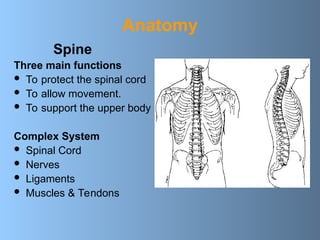
Anatomy
Spine
Three main functions
 To protect the spinal cord
 To allow movement.
 To support the upper body
Complex System
 Spinal Cord
 Nerves
 Ligaments
 Muscles & Tendons
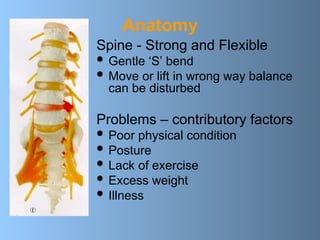
Anatomy
Spine - Strong and Flexible
 Gentle ‘S’ bend
 Move or lift in wrong way balance
can be disturbed
Problems – contributory factors
 Poor physical condition
 Posture
 Lack of exercise
 Excess weight
 Illness
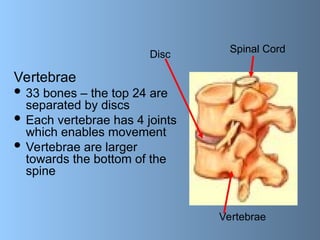
Vertebrae
 33 bones – the top 24 are
separated by discs
 Each vertebrae has 4 joints
which enables movement
 Vertebrae are larger
towards the bottom of the
spine
Vertebrae
Spinal Cord
Disc
Anatomy
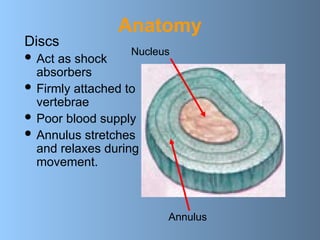
Discs
 Act as shock
absorbers
 Firmly attached to
vertebrae
 Poor blood supply
 Annulus stretches
and relaxes during
movement.
Nucleus
Annulus
Anatomy
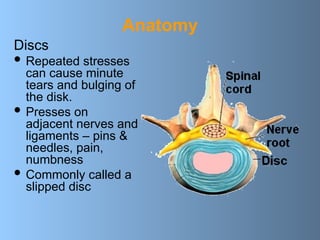
Discs
 Repeated stresses
can cause minute
tears and bulging of
the disk.
 Presses on
adjacent nerves and
ligaments – pins &
needles, pain,
numbness
 Commonly called a
slipped disc
Muscles
 Muscles are bundles of fibre which enable
movement
 Messages from the brain cause them to
contract and relax
 Connected by tendons and when muscles
contract the bones are drawn closer together
 A damaged muscle is called a strain
Mechanics
 Balance point is through centre of body when
standing
 A load held in front disturbs the balance - tension is
generated in the back muscles to compensate
 Forms a lever effect
 Average person holding a 10kg load at arms length
generates a counterbalancing tension up to 10
times more – to avoid falling over
 High or repetitive levels of tension in the back can
cause damage – called muscle strain
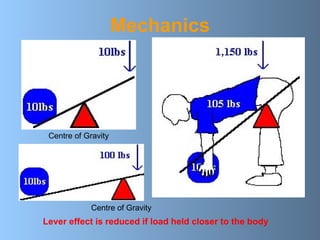
Mechanics
Centre of Gravity
Centre of Gravity
Lever effect is reduced if load held closer to the body
Ligaments & Nerves
Ligaments
 Strong fibrous tissue
 Small degree of
elasticity
 Stooped back
posture can result in
permanent
elongation –
weakness and pain
 Damaged if stretched
too far and torn –
called a sprain.
Nerves
 Millions of fibres
transmitting electrical
impulses
 Vertebrae enclose and
protect
 Nerves branch out from
the spinal cord and pass
between vertebrae
 Irritated nerves can be
felt right along there
length – called sciatica
Manual Handling Regulations 1992
Regulations provide a hierarchy of measures
Employers must:
Avoid manual handling where possible
Assess any hazardous activities where manual handling
can’t be avoided
If the assessment indicates a significant risk of injury a
more specific assessment must be made
Reduce the risk of injury as far as is reasonably
practicable
Employees have duties too:
Follow the laid down systems of work
Make proper use of equipment provided
Co-operate in H&S matters
Advise your manager if you are unwell
Not putting other people at risk
Manual Handling Regulations 1992
Risk Assessment
T Task
I Individual’s
capabilities
L Load
E Environment
any other factors
The Task
Holding loads away
from body
Twisting
Stooping
Reaching upwards
Large vertical
movements
Long travel
distances
Strenuous pushing
and pulling
Unpredictable
movement of load
Repetitive handling
Insufficient rest or
recovery time
Workrate imposed
by the process
Individual Capability
Physical condition
Illness
Pregnancy
Requires unusual capabilities
Call for special information or training
The Load
Heavy
Bulky or unwieldy
Difficult to grasp
Unstable/unpredictable
Harmful ie sharp/hot
The Working Environment
Constraints on posture eg lack of space
Poor floors
Variations in levels
Hot/cold/rain/ice/humid conditions
Strong air movement
Poor lighting conditions
Other Factors
and people!!
 High Stress
 Poor Diet
 Lack of exercise
 Rushing – pressure of work
 Showing off
 Short cuts
 Is movement hindered by clothing or personal
protective clothing
Risk Assessment
Identify the elements of significant risk
Decide who might be harmed and how
Evaluate risks/Control measures
Record the findings of assessment
Review/revise assessment
T Task
I Individual’s
capabilities
L Load
E Environment
Video
Manual Handling – The Facts
Lifting Safely
Ultimate Objective
To Relieve Fatigue & Strain
Use correct handling techniques
Ensure good vision
Change position regularly
Avoid over reaching or stretching
Adjust work surface heights
Relax where possible
Use mechanical aids
Kinetic Lifting
Summarised by:
Plan the Route
Assess the load
Correct position of feet
Straight back
Correct grip
Lift smoothly
Kinetic Lifting
Plan the Route
Where is the load going
Are there obstructions in the way
Is there somewhere to set it down
Kinetic Lifting
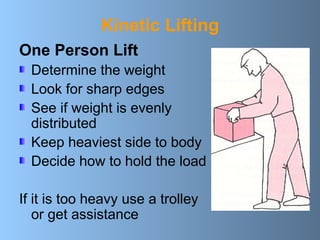
One Person Lift
Determine the weight
Look for sharp edges
See if weight is evenly
distributed
Keep heaviest side to body
Decide how to hold the load
If it is too heavy use a trolley
or get assistance
Kinetic Lifting
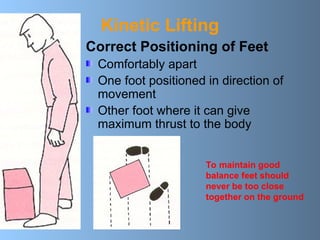
Correct Positioning of Feet
Comfortably apart
One foot positioned in direction of
movement
Other foot where it can give
maximum thrust to the body
To maintain good
balance feet should
never be too close
together on the ground
Kinetic Lifting
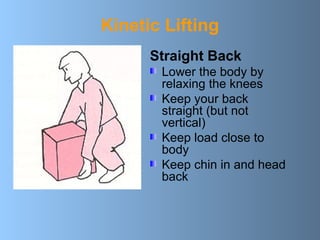
Straight Back
Lower the body by
relaxing the knees
Keep your back
straight (but not
vertical)
Keep load close to
body
Keep chin in and head
back
Kinetic Lifting
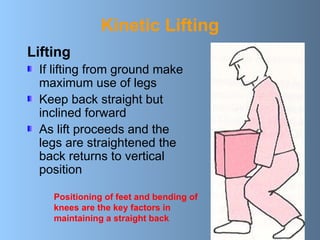
Lifting
If lifting from ground make
maximum use of legs
Keep back straight but
inclined forward
As lift proceeds and the
legs are straightened the
back returns to vertical
position
Positioning of feet and bending of
knees are the key factors in
maintaining a straight back
Kinetic Lifting
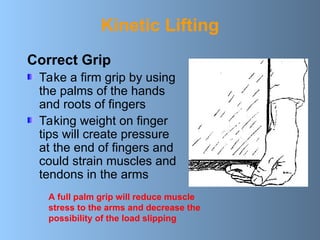
Correct Grip
Take a firm grip by using
the palms of the hands
and roots of fingers
Taking weight on finger
tips will create pressure
at the end of fingers and
could strain muscles and
tendons in the arms
A full palm grip will reduce muscle
stress to the arms and decrease the
possibility of the load slipping
Kinetic Lifting
Lifting Smoothly
Thrust from back foot and straightening of
knees will move body forwards and upwards
– briefly off balance
Immediately countered by bringing the back
foot forward as if walking
Lift now completed - forward movement
results in smooth transition from lifting to
carrying
Kinetic Lifting
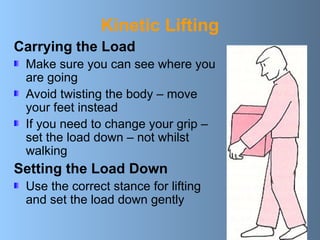
Carrying the Load
Make sure you can see where you
are going
Avoid twisting the body – move
your feet instead
If you need to change your grip –
set the load down – not whilst
walking
Setting the Load Down
Use the correct stance for lifting
and set the load down gently
Kinetic Lifting
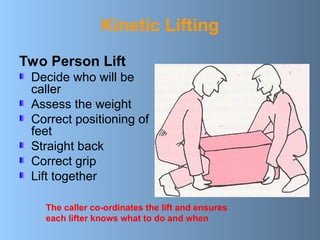
Two Person Lift
Decide who will be
caller
Assess the weight
Correct positioning of
feet
Straight back
Correct grip
Lift together
The caller co-ordinates the lift and ensures
each lifter knows what to do and when
Kinetic Lifting - Summary
 Plan the route, the lift and the set
down point
 Position your feet - bent knees,
straight back
 Firm grip, lift smoothly,
 Move the feet – do not twist body
 Keep the load close to the body
 Put down smoothly – then adjust for
final position
Conclusion?

Manual Handling Introduction presentation

  • 1.
  • 2.
  • 3.
    Course Content Statistics Definition Anatomy &Injuries Mechanics Law Risk Assessment Lifting Safely
  • 4.
  • 5.
    Accident Statistics Largest causeof accidents at work 37% Manual Handling 19% Slips, Trips and Falls 12% Other Causes 20% Struck by an Object 7% Falling from Height 5% Machinery
  • 6.
    Accident Statistics Interpreted anotherway - the overall figure of 37% means that: 86000 people are absent daily 26,500,000 working days are lost annually £1000,000,000 is lost in production, sickness benefit and medical costs In terms of suffering each injury results in an average of 20 days off work – some never fully recover. Four out of five people suffer with back related problems at some time – the risk is greater after the age of 30.
  • 7.
    Definition of ManualHandling The transporting or supporting of a load by hand or some other part of the body including the lifting, putting down, pushing, pulling, carrying, moving or intentionally dropping or throwing a load
  • 8.
    Anatomy Spine Three main functions To protect the spinal cord  To allow movement.  To support the upper body Complex System  Spinal Cord  Nerves  Ligaments  Muscles & Tendons
  • 9.
    Anatomy Spine - Strongand Flexible  Gentle ‘S’ bend  Move or lift in wrong way balance can be disturbed Problems – contributory factors  Poor physical condition  Posture  Lack of exercise  Excess weight  Illness
  • 10.
    Vertebrae  33 bones– the top 24 are separated by discs  Each vertebrae has 4 joints which enables movement  Vertebrae are larger towards the bottom of the spine Vertebrae Spinal Cord Disc
  • 11.
    Anatomy Discs  Act asshock absorbers  Firmly attached to vertebrae  Poor blood supply  Annulus stretches and relaxes during movement. Nucleus Annulus
  • 12.
    Anatomy Discs  Repeated stresses cancause minute tears and bulging of the disk.  Presses on adjacent nerves and ligaments – pins & needles, pain, numbness  Commonly called a slipped disc
  • 13.
    Muscles  Muscles arebundles of fibre which enable movement  Messages from the brain cause them to contract and relax  Connected by tendons and when muscles contract the bones are drawn closer together  A damaged muscle is called a strain
  • 14.
    Mechanics  Balance pointis through centre of body when standing  A load held in front disturbs the balance - tension is generated in the back muscles to compensate  Forms a lever effect  Average person holding a 10kg load at arms length generates a counterbalancing tension up to 10 times more – to avoid falling over  High or repetitive levels of tension in the back can cause damage – called muscle strain
  • 15.
    Mechanics Centre of Gravity Centreof Gravity Lever effect is reduced if load held closer to the body
  • 16.
    Ligaments & Nerves Ligaments Strong fibrous tissue  Small degree of elasticity  Stooped back posture can result in permanent elongation – weakness and pain  Damaged if stretched too far and torn – called a sprain. Nerves  Millions of fibres transmitting electrical impulses  Vertebrae enclose and protect  Nerves branch out from the spinal cord and pass between vertebrae  Irritated nerves can be felt right along there length – called sciatica
  • 17.
    Manual Handling Regulations1992 Regulations provide a hierarchy of measures Employers must: Avoid manual handling where possible Assess any hazardous activities where manual handling can’t be avoided If the assessment indicates a significant risk of injury a more specific assessment must be made Reduce the risk of injury as far as is reasonably practicable
  • 18.
    Employees have dutiestoo: Follow the laid down systems of work Make proper use of equipment provided Co-operate in H&S matters Advise your manager if you are unwell Not putting other people at risk Manual Handling Regulations 1992
  • 19.
    Risk Assessment T Task IIndividual’s capabilities L Load E Environment any other factors
  • 20.
    The Task Holding loadsaway from body Twisting Stooping Reaching upwards Large vertical movements Long travel distances Strenuous pushing and pulling Unpredictable movement of load Repetitive handling Insufficient rest or recovery time Workrate imposed by the process
  • 21.
    Individual Capability Physical condition Illness Pregnancy Requiresunusual capabilities Call for special information or training
  • 22.
    The Load Heavy Bulky orunwieldy Difficult to grasp Unstable/unpredictable Harmful ie sharp/hot
  • 23.
    The Working Environment Constraintson posture eg lack of space Poor floors Variations in levels Hot/cold/rain/ice/humid conditions Strong air movement Poor lighting conditions
  • 24.
    Other Factors and people!! High Stress  Poor Diet  Lack of exercise  Rushing – pressure of work  Showing off  Short cuts  Is movement hindered by clothing or personal protective clothing
  • 25.
    Risk Assessment Identify theelements of significant risk Decide who might be harmed and how Evaluate risks/Control measures Record the findings of assessment Review/revise assessment T Task I Individual’s capabilities L Load E Environment
  • 26.
  • 27.
    Lifting Safely Ultimate Objective ToRelieve Fatigue & Strain Use correct handling techniques Ensure good vision Change position regularly Avoid over reaching or stretching Adjust work surface heights Relax where possible Use mechanical aids
  • 28.
    Kinetic Lifting Summarised by: Planthe Route Assess the load Correct position of feet Straight back Correct grip Lift smoothly
  • 29.
    Kinetic Lifting Plan theRoute Where is the load going Are there obstructions in the way Is there somewhere to set it down
  • 30.
    Kinetic Lifting One PersonLift Determine the weight Look for sharp edges See if weight is evenly distributed Keep heaviest side to body Decide how to hold the load If it is too heavy use a trolley or get assistance
  • 31.
    Kinetic Lifting Correct Positioningof Feet Comfortably apart One foot positioned in direction of movement Other foot where it can give maximum thrust to the body To maintain good balance feet should never be too close together on the ground
  • 32.
    Kinetic Lifting Straight Back Lowerthe body by relaxing the knees Keep your back straight (but not vertical) Keep load close to body Keep chin in and head back
  • 33.
    Kinetic Lifting Lifting If liftingfrom ground make maximum use of legs Keep back straight but inclined forward As lift proceeds and the legs are straightened the back returns to vertical position Positioning of feet and bending of knees are the key factors in maintaining a straight back
  • 34.
    Kinetic Lifting Correct Grip Takea firm grip by using the palms of the hands and roots of fingers Taking weight on finger tips will create pressure at the end of fingers and could strain muscles and tendons in the arms A full palm grip will reduce muscle stress to the arms and decrease the possibility of the load slipping
  • 35.
    Kinetic Lifting Lifting Smoothly Thrustfrom back foot and straightening of knees will move body forwards and upwards – briefly off balance Immediately countered by bringing the back foot forward as if walking Lift now completed - forward movement results in smooth transition from lifting to carrying
  • 36.
    Kinetic Lifting Carrying theLoad Make sure you can see where you are going Avoid twisting the body – move your feet instead If you need to change your grip – set the load down – not whilst walking Setting the Load Down Use the correct stance for lifting and set the load down gently
  • 37.
    Kinetic Lifting Two PersonLift Decide who will be caller Assess the weight Correct positioning of feet Straight back Correct grip Lift together The caller co-ordinates the lift and ensures each lifter knows what to do and when
  • 38.
    Kinetic Lifting -Summary  Plan the route, the lift and the set down point  Position your feet - bent knees, straight back  Firm grip, lift smoothly,  Move the feet – do not twist body  Keep the load close to the body  Put down smoothly – then adjust for final position
  • 39.