Manual
Handling
What is Manual Handling
Manual Handling is the movement of loads
using physical effort.
It includes the lifting, lowering, pulling,
pushing, carrying and supporting of loads.
The Manual Handling Operations
Regulations - Employers Duty
AVOID hazardous manual handling so far as
is reasonably practicable.
ASSESS hazardous manual handling that
cannot be avoided.
Take ACTION to reduce the risks so far as is
reasonably practicable.
Reasonably Practicable
The term reasonably practicable refers to a
balance between the risk a task presents and
the cost (time, trouble, financial and
inconvenience) of remedial action.
The Manual Handling Operations
Regulations – Employees Duty
Take reasonable care of themselves and other people
affected by their acts or omissions.
(Don’t knowingly put yourself or others at risk)
Causes of Back Pain
Twisting, stooping, stretching.
Heavy lifting.
Carrying loads awkwardly.
Repetitive tasks.
Static posture eg. driving.
Stress, fatigue.
Being overweight or unfit.
Back Care
Maintain a good posture when lifting,
carrying, sitting etc.
Know your limits when lifting, carrying etc.
Keep fit.
Listen to your body – take breaks when
needed (don’t over do it).
The Spine
The spine is a delicate but incredibly strong structure.
The spines natural shape is an elongated ‘S’ shape.
Bad posture when sitting, lifting, watching TV etc
puts the shape of the spine in to an elongated ‘C’
shape putting additional strain on muscles, nerves
and other tissues.
Risk Assessment
A manual handling risk assessment should take
account of:
TASK
INDIVIDUAL(S) DOING THE TASK
LOAD
ENVIRONMENT
What would you consider about the above ?
Task
Does the task involve:
Twisting, stooping, bending, holding
loads away from the body, long
carrying distances, large vertical
movement, repetitive, strenuous
pushing or pulling.
Individual(s) doing the
task
Is it possible for one person to do the
job or is help / equipment required.
Does it put people with health problems
at risk eg. should a pregnant worker be
doing it ?
Does it call for specialist training.
Load
Is the load stable, bulky, can it be
reduced eg. remove packages from a
box, too big, awkward shape, difficult to
grasp, awkwardly stacked or stored.
Environment
Are there constraints on posture.
Variations in levels eg. stairs, slopes
etc.
Poor lighting.
Inclement weather.
Bumpy paths, slip hazards, doors etc.
Restricted movement due to personal
protective clothing eg. gloves.
Handling Loads
Think before handling a load – plan first.
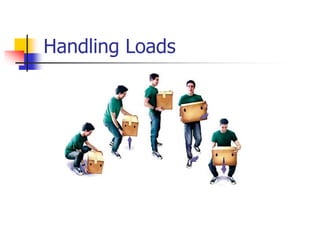
Keep the load close to you.
Adopt a stable position – feet apart with one leg
slightly forward.
Get a good hold of the load.
Posture – bend your knees when lifting, pushing etc.
Maintain the natural curves of your back.
Don’t twist, stretch, stoop or bend your back.
Know your limits and ask for help when you need it.
Use equipment provided for you eg. trolleys.
Handling Loads

manual_handling_presentation.ppt

  • 1.
  • 2.
    What is ManualHandling Manual Handling is the movement of loads using physical effort. It includes the lifting, lowering, pulling, pushing, carrying and supporting of loads.
  • 3.
    The Manual HandlingOperations Regulations - Employers Duty AVOID hazardous manual handling so far as is reasonably practicable. ASSESS hazardous manual handling that cannot be avoided. Take ACTION to reduce the risks so far as is reasonably practicable.
  • 4.
    Reasonably Practicable The termreasonably practicable refers to a balance between the risk a task presents and the cost (time, trouble, financial and inconvenience) of remedial action.
  • 5.
    The Manual HandlingOperations Regulations – Employees Duty Take reasonable care of themselves and other people affected by their acts or omissions. (Don’t knowingly put yourself or others at risk)
  • 6.
    Causes of BackPain Twisting, stooping, stretching. Heavy lifting. Carrying loads awkwardly. Repetitive tasks. Static posture eg. driving. Stress, fatigue. Being overweight or unfit.
  • 7.
    Back Care Maintain agood posture when lifting, carrying, sitting etc. Know your limits when lifting, carrying etc. Keep fit. Listen to your body – take breaks when needed (don’t over do it).
  • 8.
    The Spine The spineis a delicate but incredibly strong structure. The spines natural shape is an elongated ‘S’ shape. Bad posture when sitting, lifting, watching TV etc puts the shape of the spine in to an elongated ‘C’ shape putting additional strain on muscles, nerves and other tissues.
  • 9.
    Risk Assessment A manualhandling risk assessment should take account of: TASK INDIVIDUAL(S) DOING THE TASK LOAD ENVIRONMENT What would you consider about the above ?
  • 10.
    Task Does the taskinvolve: Twisting, stooping, bending, holding loads away from the body, long carrying distances, large vertical movement, repetitive, strenuous pushing or pulling.
  • 11.
    Individual(s) doing the task Isit possible for one person to do the job or is help / equipment required. Does it put people with health problems at risk eg. should a pregnant worker be doing it ? Does it call for specialist training.
  • 12.
    Load Is the loadstable, bulky, can it be reduced eg. remove packages from a box, too big, awkward shape, difficult to grasp, awkwardly stacked or stored.
  • 13.
    Environment Are there constraintson posture. Variations in levels eg. stairs, slopes etc. Poor lighting. Inclement weather. Bumpy paths, slip hazards, doors etc. Restricted movement due to personal protective clothing eg. gloves.
  • 14.
    Handling Loads Think beforehandling a load – plan first. Keep the load close to you. Adopt a stable position – feet apart with one leg slightly forward. Get a good hold of the load. Posture – bend your knees when lifting, pushing etc. Maintain the natural curves of your back. Don’t twist, stretch, stoop or bend your back. Know your limits and ask for help when you need it. Use equipment provided for you eg. trolleys.
  • 15.