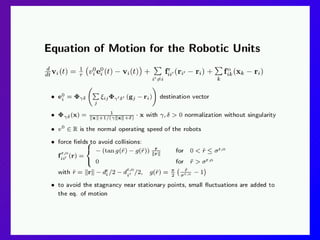
Self-organized Control of 
Manned and Unmanned 
Vehicles 
in Space Colonies 
Péter Molnár 
Kameswara R. Namaduri 
Lance M. Kaplan 
Center for Theoretical Studies of Physical Systems 
Clark Atlanta University
Outline 
• Motivation 
• Concept of distributed 
assignment problem solver 
• Implementation and application 
• Status & Goals
Motivation 
• Space Colonies will host a multitude of mobile entities 
vehicles 
• space ships: usually manned 
• service vehicles: pickup cargo and passengers, transport 
fuel and other supplies 
• maintenance and repair robots, etc. 
• Navigation challenges 
• collision avoidance (basic navigation) 
• path planning: short travel distances, avoid congestion 
• Assignment and scheduling problems: gate assignment, 
dispatcher for service robots.
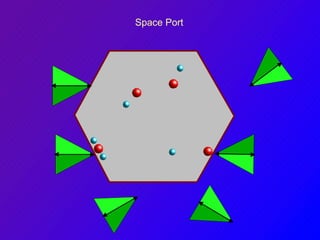
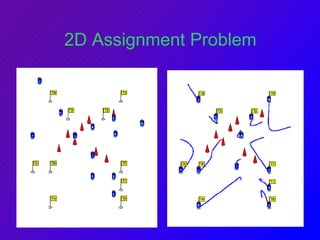
Space Port
2D Assignment Problem
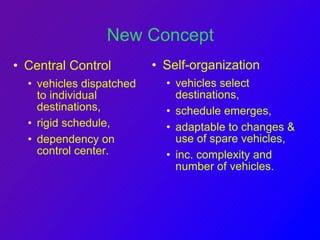
New Concept 
• Central Control 
• vehicles dispatched 
to individual 
destinations, 
• rigid schedule, 
• dependency on 
control center. 
• Self-organization 
• vehicles select 
destinations, 
• schedule emerges, 
• adaptable to changes & 
use of spare vehicles, 
• inc. complexity and 
number of vehicles.
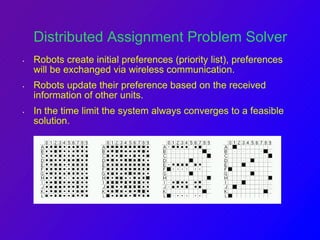
Distributed Assignment Problem Solver 
• Robots create initial preferences (priority list), preferences 
will be exchanged via wireless communication. 
• Robots update their preference based on the received 
information of other units. 
• In the time limit the system always converges to a feasible 
solution.
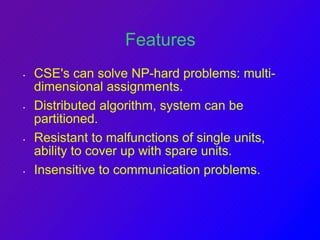
Features 
• CSE's can solve NP-hard problems: multi-dimensional 
assignments. 
• Distributed algorithm, system can be 
partitioned. 
• Resistant to malfunctions of single units, 
ability to cover up with spare units. 
• Insensitive to communication problems.
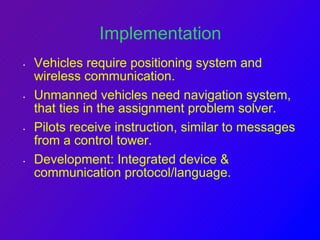
Implementation 
• Vehicles require positioning system and 
wireless communication. 
• Unmanned vehicles need navigation system, 
that ties in the assignment problem solver. 
• Pilots receive instruction, similar to messages 
from a control tower. 
• Development: Integrated device & 
communication protocol/language.
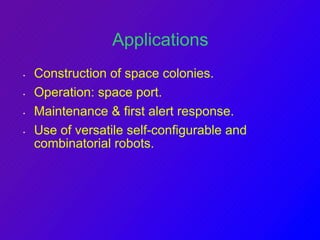
Applications 
• Construction of space colonies. 
• Operation: space port. 
• Maintenance & first alert response. 
• Use of versatile self-configurable and 
combinatorial robots.
Goals & Status 
• Develop simulation program. ½  
• Identify scenario(s)  design simulation(s). 
• Test system for various conditions: 
• failure resistance (vehicles and communication) 
• performance w/ respect to complexity 
• number of vehicles

Manned andunmannedvehiclesinspace

  • 1.
    Self-organized Control of Manned and Unmanned Vehicles in Space Colonies Péter Molnár Kameswara R. Namaduri Lance M. Kaplan Center for Theoretical Studies of Physical Systems Clark Atlanta University
  • 2.
    Outline • Motivation • Concept of distributed assignment problem solver • Implementation and application • Status & Goals
  • 3.
    Motivation • SpaceColonies will host a multitude of mobile entities vehicles • space ships: usually manned • service vehicles: pickup cargo and passengers, transport fuel and other supplies • maintenance and repair robots, etc. • Navigation challenges • collision avoidance (basic navigation) • path planning: short travel distances, avoid congestion • Assignment and scheduling problems: gate assignment, dispatcher for service robots.
  • 4.
  • 5.
  • 6.
    New Concept •Central Control • vehicles dispatched to individual destinations, • rigid schedule, • dependency on control center. • Self-organization • vehicles select destinations, • schedule emerges, • adaptable to changes & use of spare vehicles, • inc. complexity and number of vehicles.
  • 7.
    Distributed Assignment ProblemSolver • Robots create initial preferences (priority list), preferences will be exchanged via wireless communication. • Robots update their preference based on the received information of other units. • In the time limit the system always converges to a feasible solution.
  • 10.
    Features • CSE'scan solve NP-hard problems: multi-dimensional assignments. • Distributed algorithm, system can be partitioned. • Resistant to malfunctions of single units, ability to cover up with spare units. • Insensitive to communication problems.
  • 11.
    Implementation • Vehiclesrequire positioning system and wireless communication. • Unmanned vehicles need navigation system, that ties in the assignment problem solver. • Pilots receive instruction, similar to messages from a control tower. • Development: Integrated device & communication protocol/language.
  • 12.
    Applications • Constructionof space colonies. • Operation: space port. • Maintenance & first alert response. • Use of versatile self-configurable and combinatorial robots.
  • 13.
    Goals & Status • Develop simulation program. ½ • Identify scenario(s) design simulation(s). • Test system for various conditions: • failure resistance (vehicles and communication) • performance w/ respect to complexity • number of vehicles