Autonomous VTOL Scalable 
Logistics Architecture 
Feasibility Study 
USRA Grant 07600-056
Outline 
• Organization description 
• Study description 
• Work plan 
• Initial concepts 
• Relevant Sikorsky experience 
• Payoffs 
• Future Work 
• Opportunities for Collaboration 
• Summary
Organization Description 
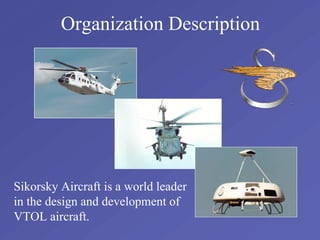
Sikorsky Aircraft is a world leader 
in the design and development of 
VTOL aircraft.
Study Description 
Autonomous VTOL Scalable Logistics 
Architecture (AVSLA) 
• Architecture study 
• Air vehicle independent 
• Study seeks to answer three questions about an 
AVSLA: 
– How are decisions made? 
– How are routes determined? 
– How are responses timed? 
• Focus on Northeast U.S. corridor and regional 
military engagement.
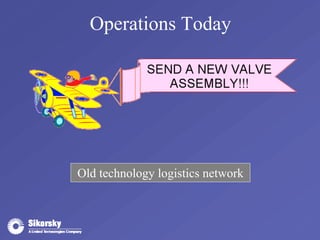
Operations Today 
Old technology logistics network
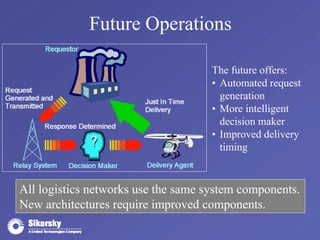
Future Operations 
The future offers: 
• Automated request 
generation 
• More intelligent 
decision maker 
• Improved delivery 
timing 
All logistics networks use the same system components. 
New architectures require improved components.
AVSLA Benefits 
• Autonomy 
– “request and forget” 
– reduced staffing lowers operating costs 
– allows integration with future automatic ordering 
• VTOL 
– flexibility (increases available landing sites) 
– minimizes transport infrastructure investment 
• Scalable 
– responsive to changes in demand level and structure 
– future growth is designed into the system
Key Questions 
The study seeks to answer 3 key questions: 
• How are decisions made? 
– distributed vs. centralized decision making 
• How are routes determined? 
– routing efficiency vs. system flexibility 
• How are responses timed? 
– scheduled service vs. priority and posture-based 
scheduling
Decision Making Models 
• Dictatorship 
– controlled by a single central unit 
• Oligarchy 
– a few power centers make all decisions 
• Republic 
– elected representatives decide together 
– geographic or functional constituencies 
• Democracy 
– all members have equal participation 
– can be global or organic
Routing Options 
• Prescribed 
– destinations and routes are pre-defined 
– minimal flexibility 
• Constrained 
– routes are variable, but constrained 
– constraints may be static or dynamic 
• Unconstrained 
– “free flight”
Scheduling Options 
• Scheduled service 
– reliable customer expectations 
– “public transit” syndrome -- no ability to react to emergencies or 
high priorities 
• Priority-based service 
– pickup and delivery times are based on priority 
– who decides what items are high-priority in a multi-user 
environment? 
• Posture-based service 
– timings are based on current asset posture 
• Predictive-adaptive service 
– future response is pre-planned based on past experience
Work Plan 
1.Logistics Analysis 
– determine the type, amount, and urgency of cargo being 
carried in the study area. 
– understand baseline “hub and spoke” system 
– develop architecture evaluation metrics 
– evaluate alternate concepts 
2.System Architecture Concept Creation 
3.Economic Analysis
Work Plan 
1.Logistics Analysis 
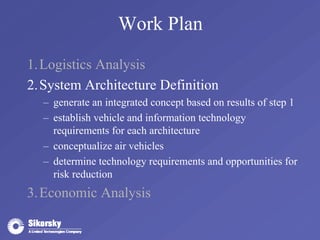
2.System Architecture Definition 
– generate an integrated concept based on results of step 1 
– establish vehicle and information technology 
requirements for each architecture 
– conceptualize air vehicles 
– determine technology requirements and opportunities for 
risk reduction 
3.Economic Analysis
Work Plan 
1.Logistics Analysis 
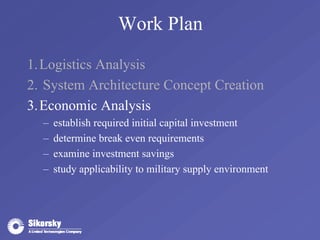
2. System Architecture Concept Creation 
3.Economic Analysis 
– establish required initial capital investment 
– determine break even requirements 
– examine investment savings 
– study applicability to military supply environment
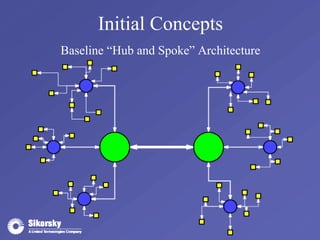
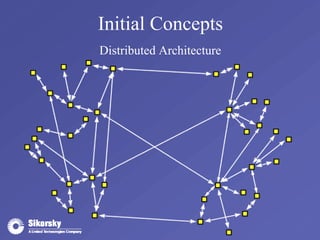
Initial Concepts 
Baseline “Hub and Spoke” Architecture
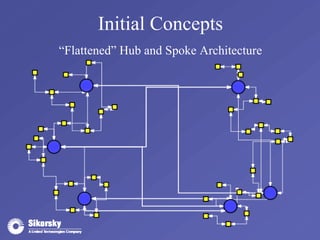
Initial Concepts 
“Flattened” Hub and Spoke Architecture
Initial Concepts 
Distributed Architecture
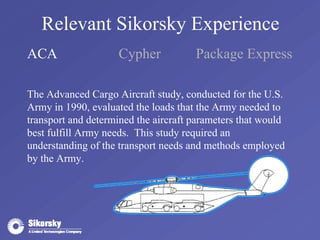
Relevant Sikorsky Experience 
ACA Cypher Package Express 
The Advanced Cargo Aircraft study, conducted for the U.S. 
Army in 1990, evaluated the loads that the Army needed to 
transport and determined the aircraft parameters that would 
best fulfill Army needs. This study required an 
understanding of the transport needs and methods employed 
by the Army.
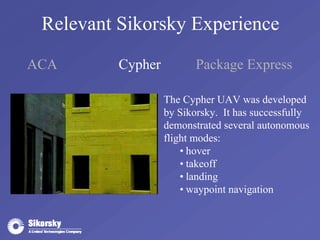
Relevant Sikorsky Experience 
ACA Cypher Package Express 
The Cypher UAV was developed 
by Sikorsky. It has successfully 
demonstrated several autonomous 
flight modes: 
• hover 
• takeoff 
• landing 
• waypoint navigation
Relevant Sikorsky Experience 
ACA Cypher Package Express 
The Package Express AHS student design competition was 
sponsored by Sikorsky and was based on the requirements and 
desires of Federal Express. The project examined the feasibility 
of creating a VTOL cargo transport network to improve FedEx 
operations.
Payoffs 
It is intended that this study will produce 
• Logistics needs of customers 
• Preferred system architecture that drives 
– Technology requirements for AVSLA 
– Vehicle requirements for AVSLA 
– IT requirements for AVSLA 
– Required autonomous capabilities for AVSLA 
vehicles
Future Work 
Planned Phase II efforts will include: 
• Better definition of air vehicle requirements 
• Refinement of autonomous operation mode 
requirements 
• Robustness of scalability 
– National scale 
– Local scale 
• Applicability to other geographic areas 
• Non-terrestrial applications
Opportunities for Collaboration 
Phase I 
– current transportation infrastructure 
– package handling 
– architecture input 
Phase II 
– National Airspace integration (autonomous flight over 
population centers?) 
– vehicle requirements refinement 
– national-scale architecture requirements 
– extra-terrestrial and non-planetary applications
Opportunities for Collaboration 
Beyond NIAC 
– control algorithm development 
– autonomous cargo handling robotics 
– “order-to-delivery” system integration 
– vehicle design 
– concept demonstration
Opportunities for Collaboration 
Potential Partners Include 
– Department of Transportation 
– Express Package Industry 
– Department of Defense 
– Federal Aviation Administration 
– NASA 
– Academia

Autoonomous vtol

  • 1.
    Autonomous VTOL Scalable Logistics Architecture Feasibility Study USRA Grant 07600-056
  • 2.
    Outline • Organizationdescription • Study description • Work plan • Initial concepts • Relevant Sikorsky experience • Payoffs • Future Work • Opportunities for Collaboration • Summary
  • 3.
    Organization Description SikorskyAircraft is a world leader in the design and development of VTOL aircraft.
  • 4.
    Study Description AutonomousVTOL Scalable Logistics Architecture (AVSLA) • Architecture study • Air vehicle independent • Study seeks to answer three questions about an AVSLA: – How are decisions made? – How are routes determined? – How are responses timed? • Focus on Northeast U.S. corridor and regional military engagement.
  • 5.
    Operations Today Oldtechnology logistics network
  • 6.
    Future Operations Thefuture offers: • Automated request generation • More intelligent decision maker • Improved delivery timing All logistics networks use the same system components. New architectures require improved components.
  • 7.
    AVSLA Benefits •Autonomy – “request and forget” – reduced staffing lowers operating costs – allows integration with future automatic ordering • VTOL – flexibility (increases available landing sites) – minimizes transport infrastructure investment • Scalable – responsive to changes in demand level and structure – future growth is designed into the system
  • 8.
    Key Questions Thestudy seeks to answer 3 key questions: • How are decisions made? – distributed vs. centralized decision making • How are routes determined? – routing efficiency vs. system flexibility • How are responses timed? – scheduled service vs. priority and posture-based scheduling
  • 9.
    Decision Making Models • Dictatorship – controlled by a single central unit • Oligarchy – a few power centers make all decisions • Republic – elected representatives decide together – geographic or functional constituencies • Democracy – all members have equal participation – can be global or organic
  • 10.
    Routing Options •Prescribed – destinations and routes are pre-defined – minimal flexibility • Constrained – routes are variable, but constrained – constraints may be static or dynamic • Unconstrained – “free flight”
  • 11.
    Scheduling Options •Scheduled service – reliable customer expectations – “public transit” syndrome -- no ability to react to emergencies or high priorities • Priority-based service – pickup and delivery times are based on priority – who decides what items are high-priority in a multi-user environment? • Posture-based service – timings are based on current asset posture • Predictive-adaptive service – future response is pre-planned based on past experience
  • 12.
    Work Plan 1.LogisticsAnalysis – determine the type, amount, and urgency of cargo being carried in the study area. – understand baseline “hub and spoke” system – develop architecture evaluation metrics – evaluate alternate concepts 2.System Architecture Concept Creation 3.Economic Analysis
  • 13.
    Work Plan 1.LogisticsAnalysis 2.System Architecture Definition – generate an integrated concept based on results of step 1 – establish vehicle and information technology requirements for each architecture – conceptualize air vehicles – determine technology requirements and opportunities for risk reduction 3.Economic Analysis
  • 14.
    Work Plan 1.LogisticsAnalysis 2. System Architecture Concept Creation 3.Economic Analysis – establish required initial capital investment – determine break even requirements – examine investment savings – study applicability to military supply environment
  • 15.
    Initial Concepts Baseline“Hub and Spoke” Architecture
  • 16.
    Initial Concepts “Flattened”Hub and Spoke Architecture
  • 17.
  • 18.
    Relevant Sikorsky Experience ACA Cypher Package Express The Advanced Cargo Aircraft study, conducted for the U.S. Army in 1990, evaluated the loads that the Army needed to transport and determined the aircraft parameters that would best fulfill Army needs. This study required an understanding of the transport needs and methods employed by the Army.
  • 19.
    Relevant Sikorsky Experience ACA Cypher Package Express The Cypher UAV was developed by Sikorsky. It has successfully demonstrated several autonomous flight modes: • hover • takeoff • landing • waypoint navigation
  • 20.
    Relevant Sikorsky Experience ACA Cypher Package Express The Package Express AHS student design competition was sponsored by Sikorsky and was based on the requirements and desires of Federal Express. The project examined the feasibility of creating a VTOL cargo transport network to improve FedEx operations.
  • 21.
    Payoffs It isintended that this study will produce • Logistics needs of customers • Preferred system architecture that drives – Technology requirements for AVSLA – Vehicle requirements for AVSLA – IT requirements for AVSLA – Required autonomous capabilities for AVSLA vehicles
  • 22.
    Future Work PlannedPhase II efforts will include: • Better definition of air vehicle requirements • Refinement of autonomous operation mode requirements • Robustness of scalability – National scale – Local scale • Applicability to other geographic areas • Non-terrestrial applications
  • 23.
    Opportunities for Collaboration Phase I – current transportation infrastructure – package handling – architecture input Phase II – National Airspace integration (autonomous flight over population centers?) – vehicle requirements refinement – national-scale architecture requirements – extra-terrestrial and non-planetary applications
  • 24.
    Opportunities for Collaboration Beyond NIAC – control algorithm development – autonomous cargo handling robotics – “order-to-delivery” system integration – vehicle design – concept demonstration
  • 25.
    Opportunities for Collaboration Potential Partners Include – Department of Transportation – Express Package Industry – Department of Defense – Federal Aviation Administration – NASA – Academia