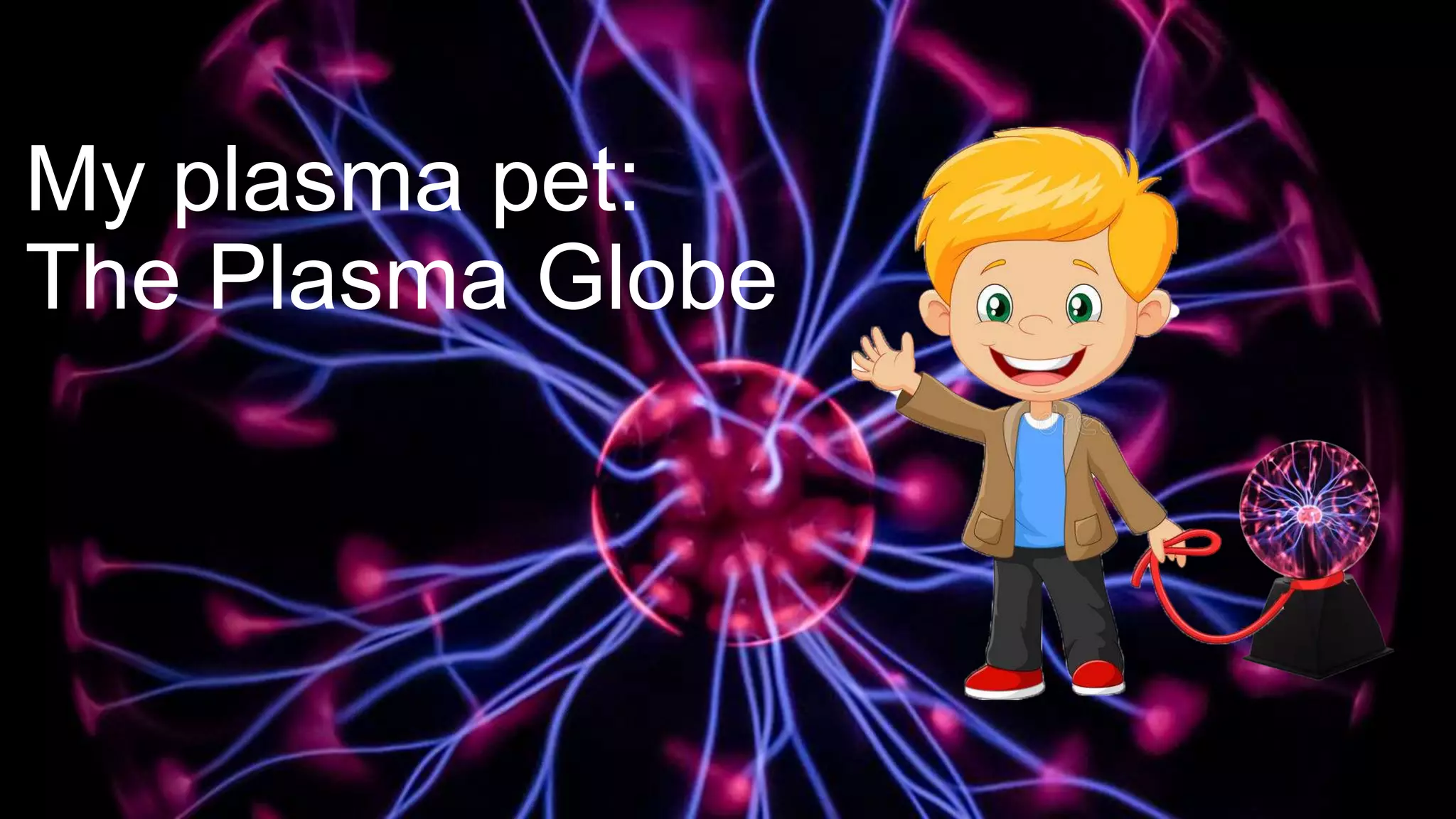
My plasma pet:
The Plasma Globe
Background
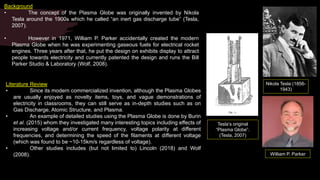
• The concept of the Plasma Globe was originally invented by Nikola
Tesla around the 1900s which he called “an inert gas discharge tube” (Tesla,
2007).
• However in 1971, William P. Parker accidentally created the modern
Plasma Globe when he was experimenting gaseous fuels for electrical rocket
engines. Three years after that, he put the design on exhibits display to attract
people towards electricity and currently patented the design and runs the Bill
Parker Studio & Laboratory (Wolf, 2008).
Nikola Tesla (1856-
1943)
William P. Parker
Tesla’s original
“Plasma Globe”.
(Tesla, 2007)
Literature Review
• Since its modern commercialized invention, although the Plasma Globes
are usually enjoyed as novelty items, toys, and vague demonstrations of
electricity in classrooms, they can still serve as in-depth studies such as on
Gas Discharge, Atomic Structure, and Plasma.
• An example of detailed studies using the Plasma Globe is done by Burin
et al. (2015) whom they investigated many interesting topics including effects of
increasing voltage and/or current frequency, voltage polarity at different
frequencies, and determining the speed of the filaments at different voltage
(which was found to be ~10-15km/s regardless of voltage).
• Other studies includes (but not limited to) Lincoln (2018) and Wolf
(2008).
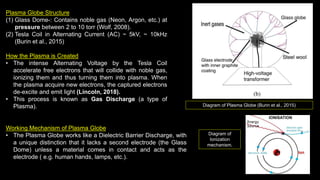
Plasma Globe Structure
(1) Glass Dome-: Contains noble gas (Neon, Argon, etc.) at
pressure between 2 to 10 torr (Wolf, 2008).
(2) Tesla Coil in Alternating Current (AC) ~ 5kV, ~ 10kHz
(Burin et al., 2015)
How the Plasma is Created
• The intense Alternating Voltage by the Tesla Coil
accelerate free electrons that will collide with noble gas,
ionizing them and thus turning them into plasma. When
the plasma acquire new electrons, the captured electrons
de-excite and emit light (Lincoln, 2018).
• This process is known as Gas Discharge (a type of
Plasma).
Working Mechanism of Plasma Globe
• The Plasma Globe works like a Dielectric Barrier Discharge, with
a unique distinction that it lacks a second electrode (the Glass
Dome) unless a material comes in contact and acts as the
electrode ( e.g. human hands, lamps, etc.).
Diagram of Plasma Globe (Burin et al., 2015)
Diagram of
Ionization
mechanism.
What causes the “Bright Tendrils”?
• The temporary plasma created can be imagined
as electrically conductive “wires”, thus the bright
filaments that constantly changes.
• The color of the light depends on the orbitals of
the de-excited electrons in the noble gas (higher
orbital numbers usually have higher energy levels
that causes the color to become bluer).
• The number, intensity and branching of the
tendrils (plasma filament) increases as AC
voltage increases (Burin et al., 2015)
• The tendrils follow the path of least resistance
towards the medium outside of the Glass Dome.
• The tendril curves after some time because the
conducting air is heated and becomes less dense
than insulated air. (denser air sinks down, while
less dense floats up)
Plasma Are Also Created Outside of Glass Dome
• Electrons still flow unobstructed from the Plasma
Globe to the air outside of the Glass Dome, creating
Plasma outside it.
• This can be seen when, for example, a lamp is put
near the Globe. Plasma is also produced inside the
lamp which causes the lamp to light up.
Conducting a fluorescent lamp with the Plasma Globe due to plasma
created outside of glass dome (and inside the lamp). (snapshot from a
Youtuber High School Physics Explained.
Usefulness:
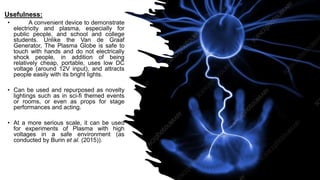
• A convenient device to demonstrate
electricity and plasma, especially for
public people, and school and college
students. Unlike the Van de Graaf
Generator, The Plasma Globe is safe to
touch with hands and do not electrically
shock people, in addition of being
relatively cheap, portable, uses low DC
voltage (around 12V input), and attracts
people easily with its bright lights.
• Can be used and repurposed as novelty
lightings such as in sci-fi themed events
or rooms, or even as props for stage
performances and acting.
• At a more serious scale, it can be used
for experiments of Plasma with high
voltages in a safe environment (as
conducted by Burin et al. (2015)).
References:
Burin, M. J., Simmons, G. G., Ceja, H. G., Zweben, S. J., Nagy, A., & Brunkhorst, C.
(2015). On filament structure and propagation within a commercial plasma globe. Physics of
Plasmas, 22(5), 053509.
Lincoln, J. (2018). Plasma globe revisited. The Physics Teacher, 56(1), 62-63.
Guilbert, N. R. (1999). Deconstructing a plasma globe. The Physics Teacher, 37(1), 11-
13.
Tesla, N. (2007). Experiments with alternate currents of high potential and high
frequency. Book Tree.
Wolf, L. (October 27, 2008), "Plasma Globes: Inert gases and electricity combine to
generate colored streamers of light", Chemical & Engineering News.
Links:
Parker’s 1971 invention: http://pubsapp.acs.org/cen/whatstuff/86/8643sci3.html?
Tesla’s lecture: https://www.pbs.org/tesla/res/res_art05.html
Thank you for your
attention !

Intro to plasma globe

  • 1.
    My plasma pet: ThePlasma Globe
  • 2.
    Background • The conceptof the Plasma Globe was originally invented by Nikola Tesla around the 1900s which he called “an inert gas discharge tube” (Tesla, 2007). • However in 1971, William P. Parker accidentally created the modern Plasma Globe when he was experimenting gaseous fuels for electrical rocket engines. Three years after that, he put the design on exhibits display to attract people towards electricity and currently patented the design and runs the Bill Parker Studio & Laboratory (Wolf, 2008). Nikola Tesla (1856- 1943) William P. Parker Tesla’s original “Plasma Globe”. (Tesla, 2007) Literature Review • Since its modern commercialized invention, although the Plasma Globes are usually enjoyed as novelty items, toys, and vague demonstrations of electricity in classrooms, they can still serve as in-depth studies such as on Gas Discharge, Atomic Structure, and Plasma. • An example of detailed studies using the Plasma Globe is done by Burin et al. (2015) whom they investigated many interesting topics including effects of increasing voltage and/or current frequency, voltage polarity at different frequencies, and determining the speed of the filaments at different voltage (which was found to be ~10-15km/s regardless of voltage). • Other studies includes (but not limited to) Lincoln (2018) and Wolf (2008).
  • 3.
    Plasma Globe Structure (1)Glass Dome-: Contains noble gas (Neon, Argon, etc.) at pressure between 2 to 10 torr (Wolf, 2008). (2) Tesla Coil in Alternating Current (AC) ~ 5kV, ~ 10kHz (Burin et al., 2015) How the Plasma is Created • The intense Alternating Voltage by the Tesla Coil accelerate free electrons that will collide with noble gas, ionizing them and thus turning them into plasma. When the plasma acquire new electrons, the captured electrons de-excite and emit light (Lincoln, 2018). • This process is known as Gas Discharge (a type of Plasma). Working Mechanism of Plasma Globe • The Plasma Globe works like a Dielectric Barrier Discharge, with a unique distinction that it lacks a second electrode (the Glass Dome) unless a material comes in contact and acts as the electrode ( e.g. human hands, lamps, etc.). Diagram of Plasma Globe (Burin et al., 2015) Diagram of Ionization mechanism.
  • 4.
    What causes the“Bright Tendrils”? • The temporary plasma created can be imagined as electrically conductive “wires”, thus the bright filaments that constantly changes. • The color of the light depends on the orbitals of the de-excited electrons in the noble gas (higher orbital numbers usually have higher energy levels that causes the color to become bluer). • The number, intensity and branching of the tendrils (plasma filament) increases as AC voltage increases (Burin et al., 2015) • The tendrils follow the path of least resistance towards the medium outside of the Glass Dome. • The tendril curves after some time because the conducting air is heated and becomes less dense than insulated air. (denser air sinks down, while less dense floats up) Plasma Are Also Created Outside of Glass Dome • Electrons still flow unobstructed from the Plasma Globe to the air outside of the Glass Dome, creating Plasma outside it. • This can be seen when, for example, a lamp is put near the Globe. Plasma is also produced inside the lamp which causes the lamp to light up. Conducting a fluorescent lamp with the Plasma Globe due to plasma created outside of glass dome (and inside the lamp). (snapshot from a Youtuber High School Physics Explained.
  • 5.
    Usefulness: • A convenientdevice to demonstrate electricity and plasma, especially for public people, and school and college students. Unlike the Van de Graaf Generator, The Plasma Globe is safe to touch with hands and do not electrically shock people, in addition of being relatively cheap, portable, uses low DC voltage (around 12V input), and attracts people easily with its bright lights. • Can be used and repurposed as novelty lightings such as in sci-fi themed events or rooms, or even as props for stage performances and acting. • At a more serious scale, it can be used for experiments of Plasma with high voltages in a safe environment (as conducted by Burin et al. (2015)).
  • 6.
    References: Burin, M. J.,Simmons, G. G., Ceja, H. G., Zweben, S. J., Nagy, A., & Brunkhorst, C. (2015). On filament structure and propagation within a commercial plasma globe. Physics of Plasmas, 22(5), 053509. Lincoln, J. (2018). Plasma globe revisited. The Physics Teacher, 56(1), 62-63. Guilbert, N. R. (1999). Deconstructing a plasma globe. The Physics Teacher, 37(1), 11- 13. Tesla, N. (2007). Experiments with alternate currents of high potential and high frequency. Book Tree. Wolf, L. (October 27, 2008), "Plasma Globes: Inert gases and electricity combine to generate colored streamers of light", Chemical & Engineering News. Links: Parker’s 1971 invention: http://pubsapp.acs.org/cen/whatstuff/86/8643sci3.html? Tesla’s lecture: https://www.pbs.org/tesla/res/res_art05.html
  • 7.
    Thank you foryour attention !