
Mangement Stress & Burnout
A research presentation developed by
A. J. Mason
Agenda
• Discuss Stress & Burnout
• Discuss possibilities of how they can be managed


                http://www.managementbridge.com
How do you handle stress?

The stresses of project management may seem excessive
 for whatever rewards the position may offer. However,
 the manager who is aware of the stress inherent in the
 job and knows stress management techniques can face
 this challenge objectively and make it a rewarding
 experience. (Kerzner, 2009, p. 292)

Questions:
• Have you ever been stressed on the job?
• What did you do to resolve/manage your stress?


               http://www.managementbridge.com
Factors that make a job stressful

•   Responsibility without authority
•   Pressure of deadlines
•   Role ambiguity
•   Role conflict
•   Role overload
•   Crossing organizational boundaries
•   Responsibility for actions of others
•   Necessity to keep up with information/breakthroughs

                                         (Kerzner, 2009)

                 http://www.managementbridge.com
Manifestation of stress
•   Being tired
•   Feeling depressed
•   Being physically and emotionally exhausted
•   Burned out
•   Being unhappy
•   Feeling trapped
•   Feeling worthless
•   Feeling resentful and disillusioned about people
•   Feeling hopeless
•   Feeling rejected
•   Feeling anxious                        (Kerzner, 2009)

                  http://www.managementbridge.com
Types of Stress
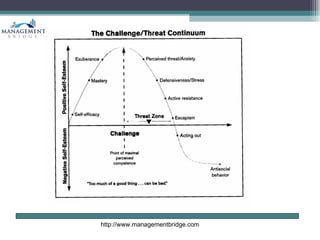
• Distress – the commonly known stress which has
  negative implications
• Eustress – good stress derived from stimulating
  circumstances or challenges Identify Risks (Berglas,
  2001)
• Psychologists have demonstrated that when a person is
  deprived of eustress, he/she will find alternative routes
  for generating eustress or suffer intense psychological
  pain (Berglas, 2001)


                 http://www.managementbridge.com
http://www.managementbridge.com
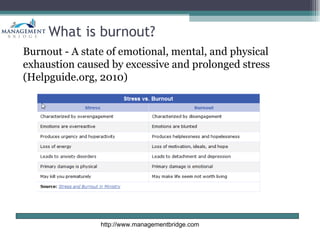
What is burnout?
Burnout - A state of emotional, mental, and physical
exhaustion caused by excessive and prolonged stress
(Helpguide.org, 2010)


                http://www.managementbridge.com
Causes of Burnout
• Care too deeply about the people we are serving and
  suffer either a loss or those people are not considerate,
  grateful, or responsive (Pines & Aronson, 1981)
• The fact that they are experiencing less attachment (for
  their own protection) to clients who are quite demanding
  leads to resenting the very people whom they are
  supposed to be helping (Pines & Aronson, 1981)
• The hard work, resentment, helplessness, hopelessness,
  being tapped, as well as guilt and shame, are continually
  recycled and lead to feelings of exhaustion and malaise,
  which in turn increase the feelings of resentment – and
  the cycle continues (Potter, 1998; Pines & Aronson, 1981,
  p. 4)


                http://www.managementbridge.com
Key notes
• If they attribute the causes to characterological weakness
  or inadequacy, they will take certain actions – quit the
  profession, see therapy, etc (Pines & Aronson, 1981)
• If they see the cause as the situation, they will strive to
  change the situation to make it more tolerable (Pines &
  Aronson, 1981)
• In some cases it is in the individual fit, in vast cases it is
  the situation.
• Highly skilled, highly trained professionals who almost
  always perform routine tasks very well and who almost
  invariably find themselves in a situation where there is
  almost no one around who is both able and willing to
  show appreciation for their work (Pines & Aronson, 1981,
  p.6)
                 http://www.managementbridge.com
Key notes
• For dentists, the most successful cure of burnout is for
  them to see fewer patients and spend more time with
  them (Pines & Aronson, 1981).
• Meet occasionally to provide the kind of support and
  professional appreciation that many people in less
  isolated professions can get more easily from their
  coworkers (Pines & Aronson, 1981)
• When involvement, commitment, and hard work are
  rewarded by continuous success, high achievers can
  sense a meaning for their work indefinitely. They
  burnout when it is impossible to succeed (inadequate
  authority, time, inadequate resources leads to frustration
  that erodes the spirit)


                http://www.managementbridge.com
Key notes
• Burnout(Physical, Emotional, Mental Exhaustion) =
  High Self Expectations + High Ideals + Chronic
  situational stress
• In order to burn out a person, they had to have been on
  fire at one time (Pines & Aronson, 1981)


                http://www.managementbridge.com
Some Tips for preventing burnout
•   Start the day with a relaxing ritual
•   Adopting healthy eating, exercising, and sleeping habits
•   Set boundaries
•   Take a daily break from technology
•   Nourish your creative side
•   Learn how to manage your stress
                                         (Helpguide.org, 2010)


                  http://www.managementbridge.com
Some Tips for overcoming burnout
Regain personal power through
•(P)inpoint, (A)nalyze, (C)hange,(E)valuate
•Successfully managing stress
•Developing new skills
•Developing your social support
•Tailoring the job to fit you (or as a last resort)
•Changing jobs
•Thinking powerfully
•Developing detached concern
                                                  (Potter, 1998)


                 http://www.managementbridge.com
Advice for ages 30+
• Reframe your career path into something to invest in, as
  one would invest in a portfolio of money-making
  holdings (Berglas, 2001, p. 52)
• This portfolio is not built on advice of others but from
  getting in touch with your ego ideal
  ▫ The totality of your wishes, dreams, goals, and of
    course, ideals


                http://www.managementbridge.com
How do I know what those are?
• Personality tests can help
  ▫ StrengthFinders (available only with the purchase of
    their book)
     http://www.strengthsfinder.com/home.aspx
  ▫ Keirsey Temperament Sorter
     http://www.keirsey.com
  ▫ Myers-Briggs
     http://www.cpp-db.com
     http://www.humanmetrics.com/cgi-win/JTypes1.htm


               http://www.managementbridge.com
Other tips
• Think back to the time when you thought everything was
  possible.
• What did you want to do/be?
• What did you used to be excited about?


               http://www.managementbridge.com
My Strengths
• Furistic
  ▫ Ability to create visions of what could be and use those visions as
    inspiration
• Focus
  ▫ Ability to create a clear destination and filter activities that do not align
    with the destination
• Maximizer
  ▫ Compelled to nurture, refine and stretch strengths towards excellence
• Learner
  ▫ Drawn to the process of learning; Ability to thrive in dynamic work
    environments with short project assignments
• Individualization
  ▫ Keen observer of people's strengths; helps build productive teams


                      http://www.managementbridge.com
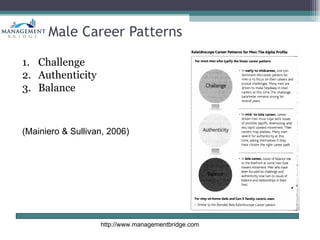
Male Career Patterns

1. Challenge
2. Authenticity
3. Balance


(Mainiero & Sullivan, 2006)


                   http://www.managementbridge.com
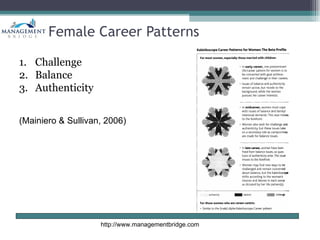
Female Career Patterns

1. Challenge
2. Balance
3. Authenticity


(Mainiero & Sullivan, 2006)


                    http://www.managementbridge.com
Conclusion
• Management can be a very rewarding and financially
  lucrative career track
• Be aware of stress and burnout
• Most of all, be aware of your ideals and how you deal
  with these factors


                http://www.managementbridge.com
References
Berglas, S. Reclaiming the fire: How successful people overcome
   burnout. New York, NY: Random House.
HelpGuide.com. (2010). Preventing burnout: Signs, symptoms, causes,
   and coping strategies. Retrieved from
  http://helpguide.org/mental/burnout_signs_symptoms.htm.
Kerzner, H. (2009). Project Management: A systems approach to
   planning, scheduling, and controlling. Hoboken, New Jersey: John
   Wiley & Sons.
Mainiero, L. A. & Sullivan, S. E. (2006). The Opt-out revolt: Why
   people are leaving companies to create kaleidoscope careers.
   Mountain View, California: Davies-Black Publishing.
Pines, A. & Aronson, E. (1991). Career Burnout: Causes and cures. NY:
   Free Press.


                    http://www.managementbridge.com
References
Potter, B. (1998). Overcoming job burnout: How to renew enthusiasm
   for work. Berkley, CA: Ronin Publishing.


                   http://www.managementbridge.com

Management stress & burnout

  • 1.
    Mangement Stress &Burnout A research presentation developed by A. J. Mason
  • 2.
    Agenda • Discuss Stress& Burnout • Discuss possibilities of how they can be managed http://www.managementbridge.com
  • 3.
    How do youhandle stress? The stresses of project management may seem excessive for whatever rewards the position may offer. However, the manager who is aware of the stress inherent in the job and knows stress management techniques can face this challenge objectively and make it a rewarding experience. (Kerzner, 2009, p. 292) Questions: • Have you ever been stressed on the job? • What did you do to resolve/manage your stress? http://www.managementbridge.com
  • 4.
    Factors that makea job stressful • Responsibility without authority • Pressure of deadlines • Role ambiguity • Role conflict • Role overload • Crossing organizational boundaries • Responsibility for actions of others • Necessity to keep up with information/breakthroughs (Kerzner, 2009) http://www.managementbridge.com
  • 5.
    Manifestation of stress • Being tired • Feeling depressed • Being physically and emotionally exhausted • Burned out • Being unhappy • Feeling trapped • Feeling worthless • Feeling resentful and disillusioned about people • Feeling hopeless • Feeling rejected • Feeling anxious (Kerzner, 2009) http://www.managementbridge.com
  • 6.
    Types of Stress •Distress – the commonly known stress which has negative implications • Eustress – good stress derived from stimulating circumstances or challenges Identify Risks (Berglas, 2001) • Psychologists have demonstrated that when a person is deprived of eustress, he/she will find alternative routes for generating eustress or suffer intense psychological pain (Berglas, 2001) http://www.managementbridge.com
  • 7.
  • 8.
    What is burnout? Burnout- A state of emotional, mental, and physical exhaustion caused by excessive and prolonged stress (Helpguide.org, 2010) http://www.managementbridge.com
  • 9.
    Causes of Burnout •Care too deeply about the people we are serving and suffer either a loss or those people are not considerate, grateful, or responsive (Pines & Aronson, 1981) • The fact that they are experiencing less attachment (for their own protection) to clients who are quite demanding leads to resenting the very people whom they are supposed to be helping (Pines & Aronson, 1981) • The hard work, resentment, helplessness, hopelessness, being tapped, as well as guilt and shame, are continually recycled and lead to feelings of exhaustion and malaise, which in turn increase the feelings of resentment – and the cycle continues (Potter, 1998; Pines & Aronson, 1981, p. 4) http://www.managementbridge.com
  • 10.
    Key notes • Ifthey attribute the causes to characterological weakness or inadequacy, they will take certain actions – quit the profession, see therapy, etc (Pines & Aronson, 1981) • If they see the cause as the situation, they will strive to change the situation to make it more tolerable (Pines & Aronson, 1981) • In some cases it is in the individual fit, in vast cases it is the situation. • Highly skilled, highly trained professionals who almost always perform routine tasks very well and who almost invariably find themselves in a situation where there is almost no one around who is both able and willing to show appreciation for their work (Pines & Aronson, 1981, p.6) http://www.managementbridge.com
  • 11.
    Key notes • Fordentists, the most successful cure of burnout is for them to see fewer patients and spend more time with them (Pines & Aronson, 1981). • Meet occasionally to provide the kind of support and professional appreciation that many people in less isolated professions can get more easily from their coworkers (Pines & Aronson, 1981) • When involvement, commitment, and hard work are rewarded by continuous success, high achievers can sense a meaning for their work indefinitely. They burnout when it is impossible to succeed (inadequate authority, time, inadequate resources leads to frustration that erodes the spirit) http://www.managementbridge.com
  • 12.
    Key notes • Burnout(Physical,Emotional, Mental Exhaustion) = High Self Expectations + High Ideals + Chronic situational stress • In order to burn out a person, they had to have been on fire at one time (Pines & Aronson, 1981) http://www.managementbridge.com
  • 13.
    Some Tips forpreventing burnout • Start the day with a relaxing ritual • Adopting healthy eating, exercising, and sleeping habits • Set boundaries • Take a daily break from technology • Nourish your creative side • Learn how to manage your stress (Helpguide.org, 2010) http://www.managementbridge.com
  • 14.
    Some Tips forovercoming burnout Regain personal power through •(P)inpoint, (A)nalyze, (C)hange,(E)valuate •Successfully managing stress •Developing new skills •Developing your social support •Tailoring the job to fit you (or as a last resort) •Changing jobs •Thinking powerfully •Developing detached concern (Potter, 1998) http://www.managementbridge.com
  • 15.
    Advice for ages30+ • Reframe your career path into something to invest in, as one would invest in a portfolio of money-making holdings (Berglas, 2001, p. 52) • This portfolio is not built on advice of others but from getting in touch with your ego ideal ▫ The totality of your wishes, dreams, goals, and of course, ideals http://www.managementbridge.com
  • 16.
    How do Iknow what those are? • Personality tests can help ▫ StrengthFinders (available only with the purchase of their book)  http://www.strengthsfinder.com/home.aspx ▫ Keirsey Temperament Sorter  http://www.keirsey.com ▫ Myers-Briggs  http://www.cpp-db.com  http://www.humanmetrics.com/cgi-win/JTypes1.htm http://www.managementbridge.com
  • 17.
    Other tips • Thinkback to the time when you thought everything was possible. • What did you want to do/be? • What did you used to be excited about? http://www.managementbridge.com
  • 18.
    My Strengths • Furistic ▫ Ability to create visions of what could be and use those visions as inspiration • Focus ▫ Ability to create a clear destination and filter activities that do not align with the destination • Maximizer ▫ Compelled to nurture, refine and stretch strengths towards excellence • Learner ▫ Drawn to the process of learning; Ability to thrive in dynamic work environments with short project assignments • Individualization ▫ Keen observer of people's strengths; helps build productive teams http://www.managementbridge.com
  • 19.
    Male Career Patterns 1.Challenge 2. Authenticity 3. Balance (Mainiero & Sullivan, 2006) http://www.managementbridge.com
  • 20.
    Female Career Patterns 1.Challenge 2. Balance 3. Authenticity (Mainiero & Sullivan, 2006) http://www.managementbridge.com
  • 21.
    Conclusion • Management canbe a very rewarding and financially lucrative career track • Be aware of stress and burnout • Most of all, be aware of your ideals and how you deal with these factors http://www.managementbridge.com
  • 22.
    References Berglas, S. Reclaimingthe fire: How successful people overcome burnout. New York, NY: Random House. HelpGuide.com. (2010). Preventing burnout: Signs, symptoms, causes, and coping strategies. Retrieved from http://helpguide.org/mental/burnout_signs_symptoms.htm. Kerzner, H. (2009). Project Management: A systems approach to planning, scheduling, and controlling. Hoboken, New Jersey: John Wiley & Sons. Mainiero, L. A. & Sullivan, S. E. (2006). The Opt-out revolt: Why people are leaving companies to create kaleidoscope careers. Mountain View, California: Davies-Black Publishing. Pines, A. & Aronson, E. (1991). Career Burnout: Causes and cures. NY: Free Press. http://www.managementbridge.com
  • 23.
    References Potter, B. (1998).Overcoming job burnout: How to renew enthusiasm for work. Berkley, CA: Ronin Publishing. http://www.managementbridge.com