Doug Gray, CEO/ Founder, Action Learning
Teresa Iafolla, eVisit
How to Address Physician Burnout
July 2015
Who We Are
Teresa Iafolla
Director of Content Marketing, eVisit
tiafolla@evisit.com
Doug Gray, PCC
CEO & Founder, Action Learning
doug@action-learning.com
Host
Speaker
@eVisitapp
#evisitwebinar
Your Presenter
Doug Gray
CEO/Founder, Action Learning
• Current PhD candidate in Organizational Leadership at the
Chicago School of Professional Psychology.
• Researching modes of leadership (direct or virtual, such as
telemedicine) on physician resilience and burnout.
• Since 1997, as founder and CEO of Action Learning
Associates, Inc, I have worked with hundreds of leaders in
multiple businesses.
• Written two books, taught at several colleges and schools.
Connect www.action-learning.com
doug@action-learning.com
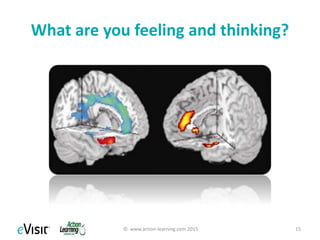
How are you feeling?
© www.action-learning.com 2015 5
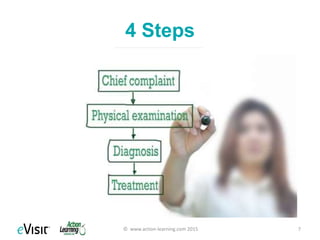
4 Steps
To Diagnosing & Treating Burnout
© www.action-learning.com 2015 6
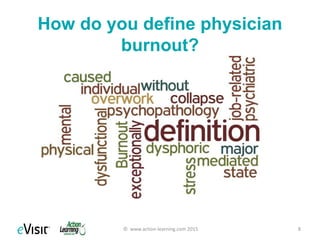
How do you define physician
burnout?
© www.action-learning.com 2015 7
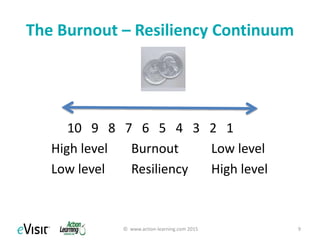
The Burnout – Resiliency Continuum
10 9 8 7 6 5 4 3 2 1
High level Burnout Low level
Low level Resiliency High level
© www.action-learning.com 2015 8
Resiliency can be defined as “the capacity to adapt successfully in the presence of risk
and adversity. Take a moment to write down where you think you are on a scale of
these two measures.
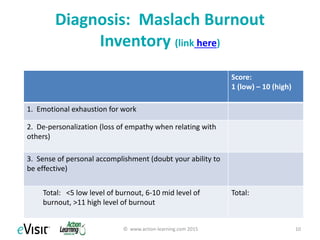
Diagnosis: Maslach Burnout
Inventory (link here)
© www.action-learning.com 2015 9
Score:
1 (low) – 10 (high)
1. Emotional exhaustion for work
2. De-personalization (loss of empathy when relating with
others)
3. Sense of personal accomplishment (doubt your ability to
be effective)
Total: <5 low level of burnout, 6-10 mid level of
burnout, >11 high level of burnout
Total:
Two Key Questions:
1. How do I know if I’m suffering
from burnout ?
2. What are my options for
treatment and care?
© www.action-learning.com 2015 10
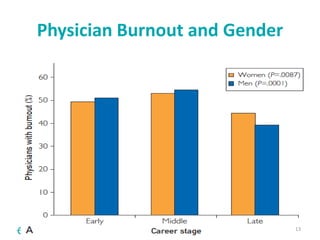
Physician Burnout and Gender
11
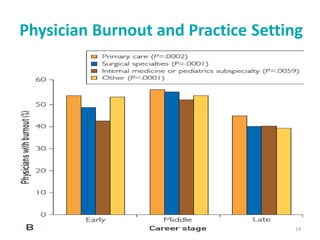
Physician Burnout and Practice Setting
12
Physicians with burnout have:
• High rates of job dissatisfaction
• Elevated rates of suicide, missed work time, and
substance abuse
• Declines in empathy and professionalism resulting in
profound negative effects on the doctor-patient
relationship
• Poor patient care and satisfaction ratings
• Statistically increased medical error rates
© www.action-learning.com 2015 13
Physicians with resilience have:
• Increased career satisfaction
• Higher personal life satisfaction
• Enhanced performance and efficacy
• Engagement with lifelong learning
• Skills that may be modeled and directly
transferable to patients (e.g., CBT)
© www.action-learning.com 2015 14
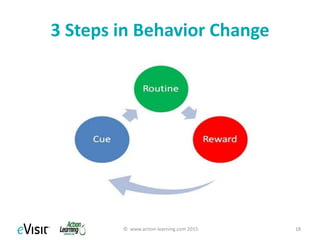
3 Steps in Behavior Change
© www.action-learning.com 2015 15
Treatment & Care: Individual
1. Identify and integrate your values
a. Into daily practices
b. Into your “dream team” (e.g. current and ideal
support teams)
c. Into your billing and operations
d. Debunk the myth of delayed gratification
e. Innovate today
© www.action-learning.com 2015 16
Treatment & Care: Individual
2. Optimize meaning in work
a. Assess and develop flow (e.g. the balance
between effort and results)
b. Choose to focus on ILOC vs. ELOC (internal locus
of control vs. external)
c. Define a shared vision
© www.action-learning.com 2015 17
Treatment & Care: Individual
3. Nurture personal wellness
a. Model self-care (e.g. sleep, exercise, regular
medical care, gratitude, learning)
b. Develop mindfulness and stress reduction skills
c. Foster relationships (e.g. friends, family, best
friend at work, colleagues)
d. Adopt religious/spiritual practices
e. Pursue hobbies
© www.action-learning.com 2015 18
Treatment & Care: Organizational
1. Promote values
a. Of the profession
b. Of the organization
2. Provide adequate resources
a. Efficiency at work unit level
b. Effectiveness at all levels
c. Outcome-focus at all levels
© www.action-learning.com 2015 19
Treatment & Care: Organizational
3. Support autonomy
a. Flexibility, sense of ILOC
b. Mastery
4. Promote work-life integration
a. Healthcare is a calling
b. Financial options
5. Promote meaning in work
© www.action-learning.com 2015 20
Resources
• http://www.scribd.com/doc/112770559/Scori
ng-Abbreviated-Burnout-Inventory
• http://sites.dartmouth.edu/geisel-resilience-
curriculum-resources/
• http://www.centileconference.org/
• https://mind-bodyhealth.osu.edu/
© www.action-learning.com 2015 21
Next steps:
1. Schedule your 30-minute confidential
consultation here
2. Call 704.995.6647 now for executive
coaching or consulting and
guaranteed results
3. Refer any physician to www.action-
learning.com
© www.action-learning.com 2015 22
Questions?
Teresa Iafolla
Director of Content Marketing, eVisit
tiafolla@evisit.com
Doug Gray, PCC
CEO & Founder, Action Learning
doug@action-learning.com
@eVisitapp
#evisitwebinar
Doug Gray, Action Learning and Teresa Iafolla, eVisit
Thank You!
Looking for a telehealth solution?
sales@evisit.com
(844) 693-8474
evisit.com/request-a-demo/
Follow us
@eVisitapp
evisit.com/blog/
July 2015

How to Address Physician Burnout

  • 1.
    Doug Gray, CEO/Founder, Action Learning Teresa Iafolla, eVisit How to Address Physician Burnout July 2015
  • 2.
    Who We Are TeresaIafolla Director of Content Marketing, eVisit tiafolla@evisit.com Doug Gray, PCC CEO & Founder, Action Learning doug@action-learning.com Host Speaker @eVisitapp #evisitwebinar
  • 3.
    Your Presenter Doug Gray CEO/Founder,Action Learning • Current PhD candidate in Organizational Leadership at the Chicago School of Professional Psychology. • Researching modes of leadership (direct or virtual, such as telemedicine) on physician resilience and burnout. • Since 1997, as founder and CEO of Action Learning Associates, Inc, I have worked with hundreds of leaders in multiple businesses. • Written two books, taught at several colleges and schools. Connect www.action-learning.com doug@action-learning.com
  • 4.
    How are youfeeling? © www.action-learning.com 2015 5
  • 5.
    4 Steps To Diagnosing& Treating Burnout © www.action-learning.com 2015 6
  • 6.
    How do youdefine physician burnout? © www.action-learning.com 2015 7
  • 7.
    The Burnout –Resiliency Continuum 10 9 8 7 6 5 4 3 2 1 High level Burnout Low level Low level Resiliency High level © www.action-learning.com 2015 8 Resiliency can be defined as “the capacity to adapt successfully in the presence of risk and adversity. Take a moment to write down where you think you are on a scale of these two measures.
  • 8.
    Diagnosis: Maslach Burnout Inventory(link here) © www.action-learning.com 2015 9 Score: 1 (low) – 10 (high) 1. Emotional exhaustion for work 2. De-personalization (loss of empathy when relating with others) 3. Sense of personal accomplishment (doubt your ability to be effective) Total: <5 low level of burnout, 6-10 mid level of burnout, >11 high level of burnout Total:
  • 9.
    Two Key Questions: 1.How do I know if I’m suffering from burnout ? 2. What are my options for treatment and care? © www.action-learning.com 2015 10
  • 10.
  • 11.
    Physician Burnout andPractice Setting 12
  • 12.
    Physicians with burnouthave: • High rates of job dissatisfaction • Elevated rates of suicide, missed work time, and substance abuse • Declines in empathy and professionalism resulting in profound negative effects on the doctor-patient relationship • Poor patient care and satisfaction ratings • Statistically increased medical error rates © www.action-learning.com 2015 13
  • 13.
    Physicians with resiliencehave: • Increased career satisfaction • Higher personal life satisfaction • Enhanced performance and efficacy • Engagement with lifelong learning • Skills that may be modeled and directly transferable to patients (e.g., CBT) © www.action-learning.com 2015 14
  • 14.
    3 Steps inBehavior Change © www.action-learning.com 2015 15
  • 15.
    Treatment & Care:Individual 1. Identify and integrate your values a. Into daily practices b. Into your “dream team” (e.g. current and ideal support teams) c. Into your billing and operations d. Debunk the myth of delayed gratification e. Innovate today © www.action-learning.com 2015 16
  • 16.
    Treatment & Care:Individual 2. Optimize meaning in work a. Assess and develop flow (e.g. the balance between effort and results) b. Choose to focus on ILOC vs. ELOC (internal locus of control vs. external) c. Define a shared vision © www.action-learning.com 2015 17
  • 17.
    Treatment & Care:Individual 3. Nurture personal wellness a. Model self-care (e.g. sleep, exercise, regular medical care, gratitude, learning) b. Develop mindfulness and stress reduction skills c. Foster relationships (e.g. friends, family, best friend at work, colleagues) d. Adopt religious/spiritual practices e. Pursue hobbies © www.action-learning.com 2015 18
  • 18.
    Treatment & Care:Organizational 1. Promote values a. Of the profession b. Of the organization 2. Provide adequate resources a. Efficiency at work unit level b. Effectiveness at all levels c. Outcome-focus at all levels © www.action-learning.com 2015 19
  • 19.
    Treatment & Care:Organizational 3. Support autonomy a. Flexibility, sense of ILOC b. Mastery 4. Promote work-life integration a. Healthcare is a calling b. Financial options 5. Promote meaning in work © www.action-learning.com 2015 20
  • 20.
  • 21.
    Next steps: 1. Scheduleyour 30-minute confidential consultation here 2. Call 704.995.6647 now for executive coaching or consulting and guaranteed results 3. Refer any physician to www.action- learning.com © www.action-learning.com 2015 22
  • 22.
    Questions? Teresa Iafolla Director ofContent Marketing, eVisit tiafolla@evisit.com Doug Gray, PCC CEO & Founder, Action Learning doug@action-learning.com @eVisitapp #evisitwebinar
  • 23.
    Doug Gray, ActionLearning and Teresa Iafolla, eVisit Thank You! Looking for a telehealth solution? sales@evisit.com (844) 693-8474 evisit.com/request-a-demo/ Follow us @eVisitapp evisit.com/blog/ July 2015

Editor's Notes

  • #3 So first, a little about who we are. My name’s Teresa Iafolla, and I run the content program at eVisit, a telehealth software company for healthcare providers. In case you haven’t heard of eVisit, we offer an affordable, user-friendly telemedicine platform that lets healthcare providers consult their patients through high-res, secure, 2-way video. But as a physician-first company, we’re really in the business of giving healthcare providers solutions to make their practices more efficient, and more profitable. So that includes providing you with valuable content like today’s webinar to help your practice. So then of course we have today’s speaker, Doug Gray, who is the founder and CEO of Action Learning, a leadership consulting company. One of Doug’s specific interests is in addressing physician burnout, and using coaching solutions to help. So he’s going to share a bit of his expertise with us today. And Doug, I’ll let you go into a little bit more about your background now.
  • #4 Thank you Teresa. I’m Doug Gray and I’m currently conducting dissertation research for PhD in Organizational Leadership at the Chicago School of Professional Psychology on modes of leadership (direct or virtual, such as telemedicine) on physician resilience and burnout.  And I am actively seeking research partners, if you can help please contact me.  Since 1997, as founder and CEO of Action Learning Associates, Inc, I have worked with hundreds of leaders in multiple businesses.  Written two books, taught at several colleges and schools.  Humbled by some of the best leaders in the country, who have chosen to trust me and make some behavioral changes.
  • #5 Since the days of Hippocrates, physicians have been taught to ask this question… And some physicians and nurses will state to me, in confidential moments, that they are feeling depressed, overwhelmed, unexcited about providing care to others, unable to pay their lingering $150,000 residency debts or to save $250,000 for their children to attend a great college… Part of the conflict is that physicians have always been taught to “heal thyself.” As if healing is an easy process… My question today is “Who takes care of the care-givers?” You may be on this webinar because you are concerned about a physician, or yourself, or your practice group…