Chanderprabhu Jain College of Higher Studies & School of Law
Plot No. OCF, Sector A-8, Narela, New Delhi – 110040
(Affiliated to Guru Gobind Singh Indraprastha University and Approved by Govt of NCT of Delhi & Bar Council of India)
SEMESTER: THIRD
BBALLB III A+B & BALLB III A+B+C
NAME OF THE SUBJECT: CONSTITUTION – I
UNIT-I
TOPIC: DEFINITION OF CONSTITUTION
FACULTY NAME: Ms. Ridam Aggarwal
(Assistant Professor)
Definition of Constitution &
Classification
• It is the law of the land.
• It is the ultimate criteria existing from which
the validity of any law can be derived.
• It is the “Mirror of the Society”.
• Parent document of the society.
• Drafted by those who dreamt a free India.
• Nothing can be ultra vires to Constitution.
Chanderprabhu Jain College of Higher Studies & School of Law
Plot No. OCF, Sector A-8, Narela, New Delhi – 110040
(Affiliated to Guru Gobind Singh Indraprastha University and Approved by Govt of NCT of Delhi & Bar Council of India)
Classification of Constitution
• Written & Unwritten Constitution
• Rigid & Flexible Constitution
• Federal & Unitary Constitution
Chanderprabhu Jain College of Higher Studies & School of Law
Plot No. OCF, Sector A-8, Narela, New Delhi – 110040
(Affiliated to Guru Gobind Singh Indraprastha University and Approved by Govt of NCT of Delhi & Bar Council of India)
Written & Unwritten Constitution
It is generally agreed that the written/unwritten is false
distinction as there is no constitution which is entirely
unwritten and nor is there a constitution which is entirely
written. What is meant by a Written Constitution is,
therefore, on that is reduced into the form of a document
having special sanctity. The term written constitution, also
designates a rather complete document/instrument in which
the framers of the constitution have attempted to arrange for
every foreseeable contingency in its operation.
Chanderprabhu Jain College of Higher Studies & School of Law
Plot No. OCF, Sector A-8, Narela, New Delhi – 110040
(Affiliated to Guru Gobind Singh Indraprastha University and Approved by Govt of NCT of Delhi & Bar Council of India)
Rigid & Flexible Constitution
The rigidity or otherwise flexibility of a constitution
hinges on whether or not its making is identical to
the making of other ordinary laws. Accordingly, if
the amendment or alteration procedure of a
constitution is made to depend on some conditions
or special procedures, then it may be called Flexible
Constitution. If some conditions or a special
procedure has to be met before the amendment of a
constitution, it is a Rigid Constitution.
Chanderprabhu Jain College of Higher Studies & School of Law
Plot No. OCF, Sector A-8, Narela, New Delhi – 110040
(Affiliated to Guru Gobind Singh Indraprastha University and Approved by Govt of NCT of Delhi & Bar Council of India)
Federal & Unitary Constitution
• In a Federal Constitution, powers of governments are
divided between government for the whole and
governments for parts of the country in such a way that each
government is independent and none is subordinate to the
other, and legislature in both cases have limited powers.
• In a Unitary Constitution, the legislature of the whole
country is the supreme law-making body and it has the
mandate to allow other legislatures to exist and exercise
their powers while reserving the right to overrule them as
they are subordinate to it.
Chanderprabhu Jain College of Higher Studies & School of Law
Plot No. OCF, Sector A-8, Narela, New Delhi – 110040
(Affiliated to Guru Gobind Singh Indraprastha University and Approved by Govt of NCT of Delhi & Bar Council of India)
Case Law- Kesavananda Bharati Sripadagalvaru and
Ors. v. State of Kerala and Anr.
((1973) 4 SCC 225: AIR 1973 SC 1461)
This case discusses about the nature & purpose
of Constitution; talks about preamble and its
importance.
• Amendable under Article 368
• Preamble contains Basic structure of
Constitution
• Source of Constitution – People of India
Chanderprabhu Jain College of Higher Studies & School of Law
Plot No. OCF, Sector A-8, Narela, New Delhi – 110040
(Affiliated to Guru Gobind Singh Indraprastha University and Approved by Govt of NCT of Delhi & Bar Council of India)
Chanderprabhu Jain College of Higher Studies & School of Law
Plot No. OCF, Sector A-8, Narela, New Delhi – 110040
(Affiliated to Guru Gobind Singh Indraprastha University and Approved by Govt of NCT of Delhi & Bar Council of India)
TOPIC: SOURCES & FRAMING OF CONSTITUTION
Sources of Constitution
• Indian Constitution has absorbed those features from other
nations’ constitutions that suited Indian problems and aspirations.
Constituent Assembly took the best of features from everywhere
and made them its own.
• Our constitution has features taken from the Government of India
Act, 1935. Those features are:
– Federal Scheme
– Office of governor
– Judiciary
– Public Service Commissions
– Emergency provisions
– Administrative details
Chanderprabhu Jain College of Higher Studies & School of Law
Plot No. OCF, Sector A-8, Narela, New Delhi – 110040
(Affiliated to Guru Gobind Singh Indraprastha University and Approved by Govt of NCT of Delhi & Bar Council of India)
Sources of Constitution
• UK – Parliamentary Election
• Ireland – Directive Principles of State Policy
• USA – Fundamental Rights
• Canada – Federal System
• France – Preamble terms – republic, liberty,
equality, fraternity
• Australia – Concurrent Lists
Chanderprabhu Jain College of Higher Studies & School of Law
Plot No. OCF, Sector A-8, Narela, New Delhi – 110040
(Affiliated to Guru Gobind Singh Indraprastha University and Approved by Govt of NCT of Delhi & Bar Council of India)
Sources of Constitution
• Russia – Fundamental Duties
• Germany – Suspension of FRs during
Emergency
• Japan – Laws on which Supreme Court
functions
Chanderprabhu Jain College of Higher Studies & School of Law
Plot No. OCF, Sector A-8, Narela, New Delhi – 110040
(Affiliated to Guru Gobind Singh Indraprastha University and Approved by Govt of NCT of Delhi & Bar Council of India)
Is Constitution a borrowed bag?
• Indian Constitution is a unique document drafted
after a hard work of three years of the constituent
assembly. Though some features of the Indian
constitution are borrowed from other nations, it is still
wrong to say that it is a bag of borrowing.
• Reasons to not call the Indian Constitution a bag of
borrowing are given below:
Chanderprabhu Jain College of Higher Studies & School of Law
Plot No. OCF, Sector A-8, Narela, New Delhi – 110040
(Affiliated to Guru Gobind Singh Indraprastha University and Approved by Govt of NCT of Delhi & Bar Council of India)
Is Constitution a borrowed bag?
Cont.
• There are various provisions borrowed from other
nations but they are absorbed in the Indian
Constitution to suit its polity and governance. They
are not exactly copied.
• Indian Constitution is the most detailed constitution
of the world. Where the American Constitution has
only seven articles, Australian Constitution 128
articles, Indian Constitution originally consisted of
395 articles which have now increased to 448 articles.
Chanderprabhu Jain College of Higher Studies & School of Law
Plot No. OCF, Sector A-8, Narela, New Delhi – 110040
(Affiliated to Guru Gobind Singh Indraprastha University and Approved by Govt of NCT of Delhi & Bar Council of India)
Is Constitution a borrowed bag?
Cont.
• Indian Constitution is unique in its content and
spirit.
• It is drafted considering the historical
perspective of Indian Nationalist struggles, the
geographical diversity of India, and its
traditional and characteristics which are totally
different from any other nation.
Chanderprabhu Jain College of Higher Studies & School of Law
Plot No. OCF, Sector A-8, Narela, New Delhi – 110040
(Affiliated to Guru Gobind Singh Indraprastha University and Approved by Govt of NCT of Delhi & Bar Council of India)
Chanderprabhu Jain College of Higher Studies & School of Law
Plot No. OCF, Sector A-8, Narela, New Delhi – 110040
(Affiliated to Guru Gobind Singh Indraprastha University and Approved by Govt of NCT of Delhi & Bar Council of India)
TOPIC: SALIENT FEATURES OF CONSTITUTION
Salient Features of Constitution
The Constitution of India is a unique
constitution. It is the largest written liberal
democratic constitution of the world. It
provides for a mixture of federalism and
Unitarianism, and flexibility and with rigidity.
Since its inauguration on 26th January 1950,
the Constitution India has been successfully
guiding the path and progress of India.
Chanderprabhu Jain College of Higher Studies & School of Law
Plot No. OCF, Sector A-8, Narela, New Delhi – 110040
(Affiliated to Guru Gobind Singh Indraprastha University and Approved by Govt of NCT of Delhi & Bar Council of India)
Written and Detailed
Constitution:
• Fully written
• Fully debated & duly elected by Constituent
Assembly
• 2 years, 11 months and 18 days - time taken to
write & enact Constitution
• Constitution is for both Centre & State
Chanderprabhu Jain College of Higher Studies & School of Law
Plot No. OCF, Sector A-8, Narela, New Delhi – 110040
(Affiliated to Guru Gobind Singh Indraprastha University and Approved by Govt of NCT of Delhi & Bar Council of India)
Self-made and Enacted
Constitution
• Indian Constitution is a constitution made by the people of India
acting through their duly elected and representative body—the
Constituent Assembly that was organised in December 1946
• Its first session was held on 9th December, 1946. It passed the
Objectives Resolution on 22 January, 1947.
• it initiated the process of constitution-making in the right
earnest and was in a position to finally pass and adopt the
constitution on 26th November, 1949.
• The constitution became fully operational with effect from
26th January 1950. We celebrate this day as our Republic Day.
The Constitution of India is thus a self-made and duly enacted
constitution.
Chanderprabhu Jain College of Higher Studies & School of Law
Plot No. OCF, Sector A-8, Narela, New Delhi – 110040
(Affiliated to Guru Gobind Singh Indraprastha University and Approved by Govt of NCT of Delhi & Bar Council of India)
Preamble of the Constitution
• A document stating the philosophy of the
Constitution
• It declares India to be a Sovereign Socialist Secular
Democratic Republic and a welfare state committed
to secure justice, liberty and equality for the people
and for promoting fraternity, dignity the individual,
and unity and integrity of the nation.
• The Preamble is the key to the constitution. It states
in nutshell the nature of Indian state and the
objectives it is committed to secure for the people.
Chanderprabhu Jain College of Higher Studies & School of Law
Plot No. OCF, Sector A-8, Narela, New Delhi – 110040
(Affiliated to Guru Gobind Singh Indraprastha University and Approved by Govt of NCT of Delhi & Bar Council of India)
India is a Democratic Socialist
State
• Although, right from the beginning the Indian
Constitution fully reflected the spirit of
democratic socialism, it was only in 1976 that the
Preamble was amended to include the term
‘Socialism’.
• India is committed to secure social, economic and
political justice for its entire people by ending all
forms of exploitation and by securing equitable
distribution of income, resources and wealth
Chanderprabhu Jain College of Higher Studies & School of Law
Plot No. OCF, Sector A-8, Narela, New Delhi – 110040
(Affiliated to Guru Gobind Singh Indraprastha University and Approved by Govt of NCT of Delhi & Bar Council of India)
India is a Secular State
• India gives special status to no religion. There
is no such thing as a state religion of India.
This makes it different from theocratic states
like the Islamic Republic of Pakistan or other
Islamic countries
• Indian secularism guarantees equal freedom to
all religions. The Constitution grants the Right
to Religious Freedom to all the citizens
Chanderprabhu Jain College of Higher Studies & School of Law
Plot No. OCF, Sector A-8, Narela, New Delhi – 110040
(Affiliated to Guru Gobind Singh Indraprastha University and Approved by Govt of NCT of Delhi & Bar Council of India)
India is a Democratic State
• The Constitution of India provides for a democratic system.
The authority of the government rests upon the sovereignty
of the people. The people enjoy equal political rights. On
the basis of these rights, the people freely participate in the
process of politics. They elect their government.
• Free fair and regular elections are held for electing
governments. For all its activities, the government of India
is responsible before the people. The people can change
their government through elections. No government can
remain in power which does not enjoy the confidence of the
people. India is world’s largest working democracy
Chanderprabhu Jain College of Higher Studies & School of Law
Plot No. OCF, Sector A-8, Narela, New Delhi – 110040
(Affiliated to Guru Gobind Singh Indraprastha University and Approved by Govt of NCT of Delhi & Bar Council of India)
India is a Republic
• The Preamble declares India to be a Republic.
India is not ruled by a monarch or a nominated
head of state. India has an elected head of state
(President of India) who wields power for a
fixed term of 5 years. After every 5 years, the
people of India indirectly elect their President.
Chanderprabhu Jain College of Higher Studies & School of Law
Plot No. OCF, Sector A-8, Narela, New Delhi – 110040
(Affiliated to Guru Gobind Singh Indraprastha University and Approved by Govt of NCT of Delhi & Bar Council of India)
India is a Union of States
Article I of the Constitution declares, that “India
that is Bharat is a Union of States.” The term
‘Union of State’ shows two important facts:
• That Indian Union is not the result of voluntary
agreement among sovereign states, and
• that states of India do not enjoy the right to secede
from the Union. Indian Union has now 28 States
and 8 Union Territories.
Chanderprabhu Jain College of Higher Studies & School of Law
Plot No. OCF, Sector A-8, Narela, New Delhi – 110040
(Affiliated to Guru Gobind Singh Indraprastha University and Approved by Govt of NCT of Delhi & Bar Council of India)
Mixture of Federalism and
Unitarianism
• While describing India as a Union of States,
the Constitution provides for a federal
structure with a unitary spirit. Scholars
describe India as a ‘Quasi-Federation’ (K.C.
Wheare) or as ‘a federation with a unitary bias,
or even as ‘a Unitarian federation.
Chanderprabhu Jain College of Higher Studies & School of Law
Plot No. OCF, Sector A-8, Narela, New Delhi – 110040
(Affiliated to Guru Gobind Singh Indraprastha University and Approved by Govt of NCT of Delhi & Bar Council of India)
Like a federation, the
Constitution of India provides for
• (i) A division of powers between the centre and states,
• (ii) A written, rigid and supreme constitution,
• (iii) Independent judiciary with the power to decide
centre-state disputes and
• (iv) Dual administration i.e. central and state
administrations. However, by providing a very strong
centre, a common constitution, single citizenship,
emergency provisions, common election commission,
common all India services etc. the Constitution clearly
reflects its unitary spirit.
Chanderprabhu Jain College of Higher Studies & School of Law
Plot No. OCF, Sector A-8, Narela, New Delhi – 110040
(Affiliated to Guru Gobind Singh Indraprastha University and Approved by Govt of NCT of Delhi & Bar Council of India)
Mixture of Rigidity and
Flexibility
• The Constitution of India is rigid in parts.
Some of its provisions can be amended in a
difficult way while others can be amended
very easily. In some cases, the Union
Parliament can amend some parts of the
Constitution by passing a simple law.
• Article 368, of the Constitution provides for
two special methods of amendment
Chanderprabhu Jain College of Higher Studies & School of Law
Plot No. OCF, Sector A-8, Narela, New Delhi – 110040
(Affiliated to Guru Gobind Singh Indraprastha University and Approved by Govt of NCT of Delhi & Bar Council of India)
Fundamental Rights
• Under its Part IIIC Articles 12-35), the Constitution of India grants
and guarantees Fundamental Rights to its citizens. It is called the
Indian Bill of Rights. Initially, 7 Fundamental Rights were granted
but after the deletion of the Right to Property from the list of
Fundamental Rights (44th Amendment Act 1979) their number came
down to six.
• Those rights are :
I. Right to Equality
II. Right to Freedom
III. Right to Freedom of Religion
IV. Right against Exploitation
V. Cultural & Educational Rights
VI. Right to Constitutional Remedies (Art. 32)
Chanderprabhu Jain College of Higher Studies & School of Law
Plot No. OCF, Sector A-8, Narela, New Delhi – 110040
(Affiliated to Guru Gobind Singh Indraprastha University and Approved by Govt of NCT of Delhi & Bar Council of India)
Fundamental Duties of the
Citizens
In its Part IVA (Article 51 A) the Constitution describes the
following Fundamental Duties of a citizen:
1. Respect for the Constitution, the national flag and the national
anthem;
2. Cherish the noble ideals of the freedom struggle;
3. Uphold and protect the sovereignty, unity and integrity of India;
4. Defend the country and render national service when called;
5. Promote the common brotherhood of all the people of India and
renounce any practice derogatory to the dignity of women;
6. Preserve the rich heritage of the nation’s composite culture;
Chanderprabhu Jain College of Higher Studies & School of Law
Plot No. OCF, Sector A-8, Narela, New Delhi – 110040
(Affiliated to Guru Gobind Singh Indraprastha University and Approved by Govt of NCT of Delhi & Bar Council of India)
Fundamental Duties of the
Citizens Cont.
7. Project the natural environment and have compassion for
living creatures;
8. Develop scientific temper, humanism and spirit of inquiry
and reform;
9. Safeguard public property and abjure violence; and
10. Strive for excellence in all individual and collective
activity.
11. Duty of the parents to send their children to schools for
getting education.
The Fundamental Duties are, however, not enforceable by
the courts.
Chanderprabhu Jain College of Higher Studies & School of Law
Plot No. OCF, Sector A-8, Narela, New Delhi – 110040
(Affiliated to Guru Gobind Singh Indraprastha University and Approved by Govt of NCT of Delhi & Bar Council of India)
Directive Principles of State
Policy
• Part IV of the Constitution dealing with the
‘Directive Principles of State Policy’ provides
one of the most striking features of the Indian
Constitution. The Directive Principles are
instructions to the state for securing socio-
economic developmental objectives through its
policies. These are to be implemented by both
the Union for the States.
Chanderprabhu Jain College of Higher Studies & School of Law
Plot No. OCF, Sector A-8, Narela, New Delhi – 110040
(Affiliated to Guru Gobind Singh Indraprastha University and Approved by Govt of NCT of Delhi & Bar Council of India)
Parliamentary System
• The Constitution of India provides for a parliamentary system of
government at the Centre as well as in every state of the Union. The
President of India is the constitutional head of state with nominal
powers. The Union Council of Ministers headed by the Prime
Minister is the real executive. Ministers are essentially the members
of the Union Parliament.
• For all its policies and decisions the Council of Ministers is
collectively responsible before the Lok Sabha. The Lok Sabha can
remove the Ministry by passing a vote of no-confidence. The
Cabinet, in fact the Prime Minister has the power to get the Lok
Sabha dissolved by the President. On similar lines a parliamentary
government is also at work in each state.
Chanderprabhu Jain College of Higher Studies & School of Law
Plot No. OCF, Sector A-8, Narela, New Delhi – 110040
(Affiliated to Guru Gobind Singh Indraprastha University and Approved by Govt of NCT of Delhi & Bar Council of India)
Adult-Suffrage
• Another feature of the Constitution is that it
provides for universal adult suffrage. All men
and women enjoy an equal right to vote. Each
adult man and woman above the age of 18
years has the right to vote. All registered voters
get the opportunity to vote in elections
Chanderprabhu Jain College of Higher Studies & School of Law
Plot No. OCF, Sector A-8, Narela, New Delhi – 110040
(Affiliated to Guru Gobind Singh Indraprastha University and Approved by Govt of NCT of Delhi & Bar Council of India)
Single integrated State with
Single Citizenship
• India is the single Independent and Sovereign
integrated state. Presently it has 28 states and 8
Union Territories. All citizens enjoy a common
uniform citizenship. They are entitled to equal
rights and freedoms, and equal protection of
the state.”
Chanderprabhu Jain College of Higher Studies & School of Law
Plot No. OCF, Sector A-8, Narela, New Delhi – 110040
(Affiliated to Guru Gobind Singh Indraprastha University and Approved by Govt of NCT of Delhi & Bar Council of India)
Single Integrated Judiciary
• The Constitution provides for a single integrated
judicial system common for the Union and the states.
The Supreme Court of India works at the apex level,
High Courts at the state level and other courts work
under the High Courts.
• There are 25 State High Courts working in all parts of
India. Orissa High Court has been in existence since
1948 and it is located at Cuttack. The Supreme Court
is the highest court of the land. It controls and runs
the judicial administration of India.
Chanderprabhu Jain College of Higher Studies & School of Law
Plot No. OCF, Sector A-8, Narela, New Delhi – 110040
(Affiliated to Guru Gobind Singh Indraprastha University and Approved by Govt of NCT of Delhi & Bar Council of India)
Independence of Judiciary
• The Indian Constitution makes judiciary truly independent. It is
clear from the following facts:
• (a) Judges are appointed by the President,
• (b) Only persons with high legal qualifications and experience are
appointed as judges,
• (c) Judges of the Supreme Court cannot be removed from office
except through an extremely difficult process of implement.
• (d) The salaries of the judges are very high,
• (e) The Supreme Court has its own staff. Indian judiciary has an
autonomous organization and status. It works as an independent and
powerful judiciary.
Chanderprabhu Jain College of Higher Studies & School of Law
Plot No. OCF, Sector A-8, Narela, New Delhi – 110040
(Affiliated to Guru Gobind Singh Indraprastha University and Approved by Govt of NCT of Delhi & Bar Council of India)
Judicial Review
• The Constitution is the supreme law of the land.
The Supreme Court acts as the guardian protector
and interpreter of the Constitution. It is also the
guardian of the Fundamental Rights of the people.
For this purpose it exercises the power of judicial
review. By it, the Supreme Court determines the
constitutional validity of all laws made by the
legislatures. It can reject any law which is found
to be unconstitutional.
Chanderprabhu Jain College of Higher Studies & School of Law
Plot No. OCF, Sector A-8, Narela, New Delhi – 110040
(Affiliated to Guru Gobind Singh Indraprastha University and Approved by Govt of NCT of Delhi & Bar Council of India)
Judicial Activism
• Currently, Indian judiciary has been becoming
more and more active towards the performance
of its social obligations. Through Public
Interest Litigation system (PIL) as well as
through a more active exercise of its powers,
the Indian judiciary has been now very
actively trying to secure all public demands
and needs due to them under the laws and
policies of the state.
Chanderprabhu Jain College of Higher Studies & School of Law
Plot No. OCF, Sector A-8, Narela, New Delhi – 110040
(Affiliated to Guru Gobind Singh Indraprastha University and Approved by Govt of NCT of Delhi & Bar Council of India)
Emergency Provisions
• The Constitution of India contains special provisions for
dealing with emergencies.
• It recognizes three types of possible emergencies:
(1) National Emergency (Article 352) an emergency resulting
from war or external aggression or threat of external
aggressions against India or from armed rebellion within
India or in any of its part;
(2) Constitutional Emergency in a State (Article 356) an
emergency resulting from the failure of constitutional
machinery in any state; or some states and
Chanderprabhu Jain College of Higher Studies & School of Law
Plot No. OCF, Sector A-8, Narela, New Delhi – 110040
(Affiliated to Guru Gobind Singh Indraprastha University and Approved by Govt of NCT of Delhi & Bar Council of India)
Emergency Provisions Cont.
(3) Financial Emergency (Article 360) an emergency
resulting from a threat to financial stability of India.
• The President of India has been empowered to take
appropriate steps for dealing with these emergencies.
During the period of an emergency, the powers of the
President, actually of the PM and the Union Council
of Ministers Cabinet increase tremendously. President
can take all steps deemed essential for meeting an
emergency. These are called emergency powers of the
President.
Chanderprabhu Jain College of Higher Studies & School of Law
Plot No. OCF, Sector A-8, Narela, New Delhi – 110040
(Affiliated to Guru Gobind Singh Indraprastha University and Approved by Govt of NCT of Delhi & Bar Council of India)
Special Provisions relating to Scheduled
Castes and Scheduled Tribes
• It provides for reservation of seats in the legislatures
for the people belonging to Scheduled Castes and
Scheduled Tribes. President can nominate in Lok
Sabha not more than two members of the Anglo-
Indian Community in case he is of the opinion that
this community is not adequately represented in the
House.
• Reservation of some jobs for the people belonging to
SCs, STs and OBCs has also been in operation.
Chanderprabhu Jain College of Higher Studies & School of Law
Plot No. OCF, Sector A-8, Narela, New Delhi – 110040
(Affiliated to Guru Gobind Singh Indraprastha University and Approved by Govt of NCT of Delhi & Bar Council of India)
Chanderprabhu Jain College of Higher Studies & School of Law
Plot No. OCF, Sector A-8, Narela, New Delhi – 110040
(Affiliated to Guru Gobind Singh Indraprastha University and Approved by Govt of NCT of Delhi & Bar Council of India)
TOPIC: IS CONSTITUTION FEDERAL IN NATURE?
Is Indian Constitution Federal in
Nature?
It has been the matter of debate among the scholars
that whether the Constitution of India is completely
federal or unitary in nature. But actually Indian
constitution contains both features of a federal
constitution and unitary constitution. And that is why,
it is called QUASI – FEDERAL CONSTITUTION
Chanderprabhu Jain College of Higher Studies & School of Law
Plot No. OCF, Sector A-8, Narela, New Delhi – 110040
(Affiliated to Guru Gobind Singh Indraprastha University and Approved by Govt of NCT of Delhi & Bar Council of India)
Quasi Federalism
• Quasi-federalism means an intermediate form of state
between a unitary state and a federation. It combines the
features of a federal government and the features of a
unitary government. India is regarded as a semi-federal state
or a quasi-federal state as described by Prof. K.C. Wheare.
The Supreme Court of India also describes it as a federal
structure with a strong bias towards the Centre.
• Article 1 of the Constitution of India states that ‘India that is
Bharat shall be a union of states’. Indian model of
federalism is called the quasi-federal system as it contains
major features of both a federation and union.
Chanderprabhu Jain College of Higher Studies & School of Law
Plot No. OCF, Sector A-8, Narela, New Delhi – 110040
(Affiliated to Guru Gobind Singh Indraprastha University and Approved by Govt of NCT of Delhi & Bar Council of India)
Federal Features of Constitution
• Supremacy of the Constitution:Constitution is the
supreme law of land in India. A federal state derives its
existence from the Constitution.
• Bicameral Legislature: The main feature of federalism is a
bicameral legislature. The Constitution of India also
provides for a bicameral legislature i.e. Parliament with two
houses of the Lok Sabha and the Rajya Sabha.
• Independent Judiciary: In India, the Constitution has
provided for a Supreme Court. The Supreme Court of India
can declare a law as unconstitutional, if it contravenes any
provisions of the Constitution.
Chanderprabhu Jain College of Higher Studies & School of Law
Plot No. OCF, Sector A-8, Narela, New Delhi – 110040
(Affiliated to Guru Gobind Singh Indraprastha University and Approved by Govt of NCT of Delhi & Bar Council of India)
Federal Features of Constitution
Cont.
• Dual Government Polity: The Constitution of India has
divided powers between the Central government and the state
governments through the 7th schedule. It contains three
legislative lists which enumerate subjects of administration,
viz. Union, State and Concurrent Legislative Lists. Both the
governments have their separate powers and responsibilities.
• Written Constitution: The Indian Constitution is a written
document containing 448 Articles and 12 schedules, and
therefore, fulfils this basic requirement of a federal
government. The Indian Constitution is the most elaborate
Constitution of the world.
Chanderprabhu Jain College of Higher Studies & School of Law
Plot No. OCF, Sector A-8, Narela, New Delhi – 110040
(Affiliated to Guru Gobind Singh Indraprastha University and Approved by Govt of NCT of Delhi & Bar Council of India)
Federal Features of Constitution
Cont.
• Revenue Sharing: In the case of a federal
country there is a system of revenue sharing
between the Center and the State. In India,
there is the principle of dual GST system
adopted by the legislation for the constitutional
requirement of fiscal federalism.
Chanderprabhu Jain College of Higher Studies & School of Law
Plot No. OCF, Sector A-8, Narela, New Delhi – 110040
(Affiliated to Guru Gobind Singh Indraprastha University and Approved by Govt of NCT of Delhi & Bar Council of India)
Unitary Features of Constitution
• Single Constitution: In India, there is only one
Constitution. It is applicable to both the Union as a whole
and the Stares. In a true federation, there are separate
constitutions for the union and the States.
• Rajya Sabha does not represent the States equality: In a
true federation, the upper house of the legislature has equal
representation from the constituting units or the States. But
in Rajya Sabha, the States do not have equal representation.
The populous States have more representatives in the Rajya
Sabha than the less populous States.
Chanderprabhu Jain College of Higher Studies & School of Law
Plot No. OCF, Sector A-8, Narela, New Delhi – 110040
(Affiliated to Guru Gobind Singh Indraprastha University and Approved by Govt of NCT of Delhi & Bar Council of India)
Unitary Features of Constitution
Cont.
• Division of power is not equal: In a federation, power is
divided equally between the two governments. But in India,
the Central government has been given more powers and
made stronger than the State governments.
• Constitution is not strictly rigid:The Constitution of India
can be amended by the Indian Parliament easily. On many
subjects, the Parliament does not need the approval of the
State legislatures to amend the Constitution. In a true
federation, both the Union and the State legislatures take
part in the amendment of the Constitution with respect to all
matters.
Chanderprabhu Jain College of Higher Studies & School of Law
Plot No. OCF, Sector A-8, Narela, New Delhi – 110040
(Affiliated to Guru Gobind Singh Indraprastha University and Approved by Govt of NCT of Delhi & Bar Council of India)
Unitary Features of Constitution
Cont.
• Existence of States depends on the Centre: In India, the existence
of a State or a federal unit depends upon the authority of the Centre.
The boundary of a State can be changed by created out of the
existing States.
• Unified judiciary: India has a unified or integrated judicial system.
The High Courts which work in the States are under the Supreme
Court of India.
• Proclamation of emergency: The Constitution of India has given
emergency powers to the President. When an emergency is declared,
the Union or Central governments become all powerful and the State
governments come under the total control of it. The State
governments lose their autonomy
Chanderprabhu Jain College of Higher Studies & School of Law
Plot No. OCF, Sector A-8, Narela, New Delhi – 110040
(Affiliated to Guru Gobind Singh Indraprastha University and Approved by Govt of NCT of Delhi & Bar Council of India)
Conclusion
On a careful analysis of the federal and unitary
features of the constitution, it is evident that
with every federal feature, there is an ultimate
centralising force which is existing. Therefore,
it would not be wrong to conclude that the
Constitution of India is federal in structure and
unitary in spirit i.e. it is quasi- federal in
nature.
Chanderprabhu Jain College of Higher Studies & School of Law
Plot No. OCF, Sector A-8, Narela, New Delhi – 110040
(Affiliated to Guru Gobind Singh Indraprastha University and Approved by Govt of NCT of Delhi & Bar Council of India)
Chanderprabhu Jain College of Higher Studies & School of Law
Plot No. OCF, Sector A-8, Narela, New Delhi – 110040
(Affiliated to Guru Gobind Singh Indraprastha University and Approved by Govt of NCT of Delhi & Bar Council of India)
UNIT-II
PARLIAMENT: COMPOSITION, PARLIAMENTARY
SOVEREIGNTY & PARLIAMENTARY PRIVILEGES
Parliament - Introduction
• Parliament is the supreme legislative body of India. The Indian Parliament
comprises of the President and the two Houses - Rajya Sabha (Council of States)
and Lok Sabha (House of the People). The President has the power to summon and
prorogue either House of Parliament or to dissolve Lok Sabha. The Constitution of
India came into force on January 26, 1950. The first general elections under the
new Constitution were held during the year 1951-52 and the first elected Parliament
came into existence in April, 1952,
Chanderprabhu Jain College of Higher Studies & School of Law
Plot No. OCF, Sector A-8, Narela, New Delhi – 110040
(Affiliated to Guru Gobind Singh Indraprastha University and Approved by Govt of NCT of Delhi & Bar Council of India)
Composition
• Art. 79 - Constitution of Parliament.
• Art. 80 - Composition of the Council of States
• Art. 81 - Composition of the House of the People
• Art. 82 - Readjustment after each census
• Art. 83 - Duration of Houses of Parliament
• Art. 84 - Qualification for membership of Parliament
• Art. 85 - Sessions of Parliament, prorogation and dissolution
• Art. 86 - Right of President to address and send messages to Houses
• Art. 87 - Special address by the President
• Art. 88 - Rights of Ministers and Attorney-General as respects House
Chanderprabhu Jain College of Higher Studies & School of Law
Plot No. OCF, Sector A-8, Narela, New Delhi – 110040
(Affiliated to Guru Gobind Singh Indraprastha University and Approved by Govt of NCT of Delhi & Bar Council of India)
Procedure
• Art. 118 - Rules of Procedure
• Art. 119 - Regulation by law of procedure in Parliament in relation to financial
business
• Art. 120 - Language to be used in Parliament
• Art. 122 - Courts not to inquire into proceedings of Parliament
Chanderprabhu Jain College of Higher Studies & School of Law
Plot No. OCF, Sector A-8, Narela, New Delhi – 110040
(Affiliated to Guru Gobind Singh Indraprastha University and Approved by Govt of NCT of Delhi & Bar Council of India)
Functions
• Art. 75 (5) - A Minister who for any period of six consecutive months is not a
member of either House of Parliament shall at the expiration of that period cease to
be a Minister.
• Art. 75(3) - The Council of Ministers shall be collectively responsible to the House
of the People.
• Art. 107 - Provisions as to introduction and passing of Bills
• Art. 108 - Joint sitting of both Houses in certain cases
• Art. 109 - Special procedure in respect of Money Bills
Chanderprabhu Jain College of Higher Studies & School of Law
Plot No. OCF, Sector A-8, Narela, New Delhi – 110040
(Affiliated to Guru Gobind Singh Indraprastha University and Approved by Govt of NCT of Delhi & Bar Council of India)
Parliamentary Sovereignty
Meaning - Parliamentary sovereignty means supremacy of the legislative body i.e.,
parliament over all other government institutions including executive and judicial
bodies. Sovereign legislature may change or repeal any previous legislation and is
not bound by any written law like constitution. In India there is no parliament
sovereignty rather there is constitutional sovereignty.
Various features of Parliamentary Sovereignty –
Written Constitution: In India Constitution is written which put limitations on all
organs of the state. Although parliament can amend constitution but it cannot
supersede the written document. In UK, as there is no written constitution, the
Parliament possesses legislative sovereignty. So any law passed by it cannot be
questioned before any court on such grounds.
Chanderprabhu Jain College of Higher Studies & School of Law
Plot No. OCF, Sector A-8, Narela, New Delhi – 110040
(Affiliated to Guru Gobind Singh Indraprastha University and Approved by Govt of NCT of Delhi & Bar Council of India)
Parliamentary Sovereignty Cont.
• Independent judiciary and Judicial review: Judiciary is independent and the
guardian of the Constitution. It can declare any law or ordinance passed by the
legislature void, if any of its provisions violate one or more of the constitutional
provisions.
• Federal structure: Although constitution says India as a union of states, India is a
federal polity. Various federal provisions especially some special powers for
schedule area limit parliament powers where many parliamentary laws are
applicable only on presidential and governor consent.
• Limited amendment power: Parliament can amend most of the part of constitution
but it cannot amend the ‘basic features of the constitution’. Further some
amendments need special majority and states’ legislature resolution.
Chanderprabhu Jain College of Higher Studies & School of Law
Plot No. OCF, Sector A-8, Narela, New Delhi – 110040
(Affiliated to Guru Gobind Singh Indraprastha University and Approved by Govt of NCT of Delhi & Bar Council of India)
Parliamentary Sovereignty Cont.
• Division of powers: Schedule VII divide law making power between centre and
state. Parliament cannot make laws on state list. Any law in state subject would
require state’s consent through majority.
• Limit by Presidential vetoes: A bill cannot become law without presidential
assent. President can practice various veto powers like pocket veto that act as
limitation on parliament sovereignty.
• Limited Doctrine of ‘Separation of Powers’: In India there is no strict application
of doctrine of separation of powers. So if the legislature encroaches into the
functions of the other organs, judiciary can prevent it to do so.
• Bar on discussion of conduct of judges: Article 121 and 211 of Indian
Constitution states that no discussion shall take place in the Legislature of a state or
in the Parliament with respect to the conduct of any judge of the Supreme Court or
of the High court in the discharge of his duties. Thus legislature have no power to
discuss judges conduct.
Chanderprabhu Jain College of Higher Studies & School of Law
Plot No. OCF, Sector A-8, Narela, New Delhi – 110040
(Affiliated to Guru Gobind Singh Indraprastha University and Approved by Govt of NCT of Delhi & Bar Council of India)
Case Laws
• U N Rao V. Indira Gandhi (AIR 1971 SC 1002)
• Indira Nehru Gandhi V. Raj Narain (AIR 1975 SC 2299)
• Rameshwar Prasad V. UOI (2006 AIR SCW 494)
• Ramdas Athawale V. UOI (2010(3) SCALE 412)
Chanderprabhu Jain College of Higher Studies & School of Law
Plot No. OCF, Sector A-8, Narela, New Delhi – 110040
(Affiliated to Guru Gobind Singh Indraprastha University and Approved by Govt of NCT of Delhi & Bar Council of India)
Parliamentary Privileges
• Article 105 & 194 deal with the powers, privileges & immunities of Parliament and
its members, and the State Legislatures and their members respectively. They both
are mutatis mutandis.
• Art. 105 - Powers, privileges, etc., of the Houses of Parliament and of the members
and committees thereof
• Art. 194 - Powers, privileges, etc., of the Houses of Legislatures and of the
members and committees thereof
Chanderprabhu Jain College of Higher Studies & School of Law
Plot No. OCF, Sector A-8, Narela, New Delhi – 110040
(Affiliated to Guru Gobind Singh Indraprastha University and Approved by Govt of NCT of Delhi & Bar Council of India)
Division of Privileges of Houses
• A) those which are enjoyed by the members individually
i) Freedom from arrest
ii) Freedom of attendance as witness
iii) Freedom of Speech
iv) Art. 121 - Restriction on discussion in Parliament
v) Art. 211 - Restriction on discussion in the Legislature
Chanderprabhu Jain College of Higher Studies & School of Law
Plot No. OCF, Sector A-8, Narela, New Delhi – 110040
(Affiliated to Guru Gobind Singh Indraprastha University and Approved by Govt of NCT of Delhi & Bar Council of India)
Division of Privileges of Houses Cont.
• B) those which belong to each Houses of Parliament as a collective body
i) the right to publish debates and proceedings & the right to restrain publication by
others.
ii) the right to exclude strangers from galleries at any time
iii) the right to regulate the internal affairs of House, and to decide matters arising
within its walls
iv) the right to publish Parliamentary behaviour
v) the right to punish members & outsiders for the breach of its privilege.
Chanderprabhu Jain College of Higher Studies & School of Law
Plot No. OCF, Sector A-8, Narela, New Delhi – 110040
(Affiliated to Guru Gobind Singh Indraprastha University and Approved by Govt of NCT of Delhi & Bar Council of India)
Case Laws
• M S M Sharma V. Sri Krishna Sinha (AIR 1959 SC 395)
• Keshav Singh’s case a.k.a The Legislative Privileges Case
• Tej Kiran Jain V. N. Sanjiva Reddy (AIR 1970 SC 1573)
• P V Narsimha Rao V. State (AIR 1998 SC 2120)
• Raja Ram Pal V. Hon’ble Speaker, Lok Sabha & others ((2007) 3 SCC 184) a.k.a
The Case Querry Case
Chanderprabhu Jain College of Higher Studies & School of Law
Plot No. OCF, Sector A-8, Narela, New Delhi – 110040
(Affiliated to Guru Gobind Singh Indraprastha University and Approved by Govt of NCT of Delhi & Bar Council of India)
Chanderprabhu Jain College of Higher Studies & School of Law
Plot No. OCF, Sector A-8, Narela, New Delhi – 110040
(Affiliated to Guru Gobind Singh Indraprastha University and Approved by Govt of NCT of Delhi & Bar Council of India)
EXECUTIVE POWERS: POWERS OF PRESIDENT &
GOVERENOR
Introduction
• The Executive along with the legislature and the judiciary forms one of the three
agencies through which the State functions.
• The two important points to be looked into before analyzing the extent and nature
of ‘executive functions’ in the Indian Constitution according to the Constitution is
what constitutes the executive and what exactly are executive functions.
• In pursuant with the federal structure envisaged in the Constitution, the executive is
divided into
a) Union Executive, enumerated in Part V Chapter 1 Articles. 52 to 78, and
b) State Executive, enumerated in Part VI, Chapter 2 Articles 153 to 167.
Chanderprabhu Jain College of Higher Studies & School of Law
Plot No. OCF, Sector A-8, Narela, New Delhi – 110040
(Affiliated to Guru Gobind Singh Indraprastha University and Approved by Govt of NCT of Delhi & Bar Council of India)
Union Executive
• Art. 52 – The President of India
• Art. 53 – Executive power of the Union
• Art. 54 – Election of President
• Art. 55 – Election of President
• Art. 56 – Term of office of President
• Art. 57 – Eligibility for re-election
• Art. 58 – Qualifications for election as President
• Art. 59 – Conditions of President’s office
• Art. 60 – Oath or affirmation by the President
• Art. 61 – Procedure for impeachment of the President
Chanderprabhu Jain College of Higher Studies & School of Law
Plot No. OCF, Sector A-8, Narela, New Delhi – 110040
(Affiliated to Guru Gobind Singh Indraprastha University and Approved by Govt of NCT of Delhi & Bar Council of India)
Union Executive Cont.
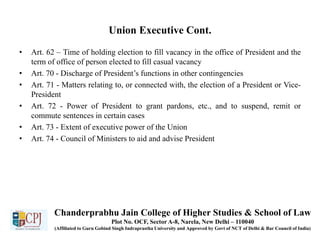
• Art. 62 – Time of holding election to fill vacancy in the office of President and the
term of office of person elected to fill casual vacancy
• Art. 70 - Discharge of President’s functions in other contingencies
• Art. 71 - Matters relating to, or connected with, the election of a President or Vice-
President
• Art. 72 - Power of President to grant pardons, etc., and to suspend, remit or
commute sentences in certain cases
• Art. 73 - Extent of executive power of the Union
• Art. 74 - Council of Ministers to aid and advise President
Chanderprabhu Jain College of Higher Studies & School of Law
Plot No. OCF, Sector A-8, Narela, New Delhi – 110040
(Affiliated to Guru Gobind Singh Indraprastha University and Approved by Govt of NCT of Delhi & Bar Council of India)
State Executive
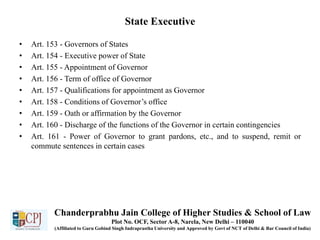
• Art. 153 - Governors of States
• Art. 154 - Executive power of State
• Art. 155 - Appointment of Governor
• Art. 156 - Term of office of Governor
• Art. 157 - Qualifications for appointment as Governor
• Art. 158 - Conditions of Governor’s office
• Art. 159 - Oath or affirmation by the Governor
• Art. 160 - Discharge of the functions of the Governor in certain contingencies
• Art. 161 - Power of Governor to grant pardons, etc., and to suspend, remit or
commute sentences in certain cases
Chanderprabhu Jain College of Higher Studies & School of Law
Plot No. OCF, Sector A-8, Narela, New Delhi – 110040
(Affiliated to Guru Gobind Singh Indraprastha University and Approved by Govt of NCT of Delhi & Bar Council of India)
State Executive Cont.
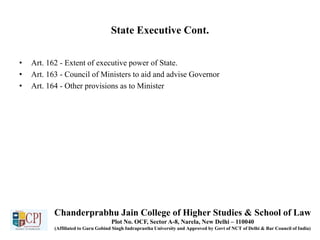
• Art. 162 - Extent of executive power of State.
• Art. 163 - Council of Ministers to aid and advise Governor
• Art. 164 - Other provisions as to Minister
Chanderprabhu Jain College of Higher Studies & School of Law
Plot No. OCF, Sector A-8, Narela, New Delhi – 110040
(Affiliated to Guru Gobind Singh Indraprastha University and Approved by Govt of NCT of Delhi & Bar Council of India)
Case Laws
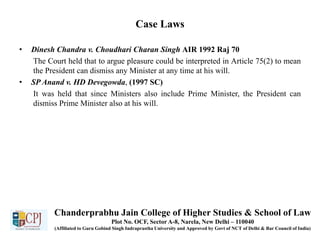
• Dinesh Chandra v. Choudhari Charan Singh AIR 1992 Raj 70
The Court held that to argue pleasure could be interpreted in Article 75(2) to mean
the President can dismiss any Minister at any time at his will.
• SP Anand v. HD Devegowda, (1997 SC)
It was held that since Ministers also include Prime Minister, the President can
dismiss Prime Minister also at his will.
Chanderprabhu Jain College of Higher Studies & School of Law
Plot No. OCF, Sector A-8, Narela, New Delhi – 110040
(Affiliated to Guru Gobind Singh Indraprastha University and Approved by Govt of NCT of Delhi & Bar Council of India)
Case Laws Cont.
• Pal & Co. vs. Lt. Governor of Delhi (1979 AIR 1550), it was ruled that the power
to issue an Ordinance by the President is “co-extensive with the Legislative power
of the Parliament.”
• Swaran Singh v. State of U.P (AIR 1982 SC 849), the Governor of Uttar Pradesh
remitted the whole of the life sentence of an MLA of the State Assembly who had
been convicted of the offence of murder within a period of less than two years of
his conviction. The Supreme Court found that Governor was not posted with
material facts such as the involvement of the accused in 5 other criminal cases, his
unsatisfactory conduct in prison and the Governor’s previous rejection of his
clemency petition in regard to the same case
Chanderprabhu Jain College of Higher Studies & School of Law
Plot No. OCF, Sector A-8, Narela, New Delhi – 110040
(Affiliated to Guru Gobind Singh Indraprastha University and Approved by Govt of NCT of Delhi & Bar Council of India)
Chanderprabhu Jain College of Higher Studies & School of Law
Plot No. OCF, Sector A-8, Narela, New Delhi – 110040
(Affiliated to Guru Gobind Singh Indraprastha University and Approved by Govt of NCT of Delhi & Bar Council of India)
JUDICIARY: JURISDICTION OF HIGH COURT &
SUPREME COURT AND INDEPENDENCE OF
JUDICIARY
Jurisdiction of High Court
The Jurisdiction of High Court can be divided into three parts –
1) Original Jurisdiction- it means that applicant can directly go to High Court and not
by means of appeals. This power is used in the following matters –
• Disputes arising out of relating to members of Parliament and state legislative
assembly
• Relating to marriage, law, admiralty divorce, contempt of court etc
• Enforcement of fundamental rights (Supreme Court also has this power)
• Cases transferred from other court to itself which involves a question of law.
2) Writ Jurisdiction- Article 226 states that High Court shall have power throughout
the territories in relation to which it exercises jurisdiction to issue to any person or
authority including in appropriate cases, any government, within those territories
directions, orders, or writs.
Chanderprabhu Jain College of Higher Studies & School of Law
Plot No. OCF, Sector A-8, Narela, New Delhi – 110040
(Affiliated to Guru Gobind Singh Indraprastha University and Approved by Govt of NCT of Delhi & Bar Council of India)
Jurisdiction of High Court Cont.
3) Appellate Jurisdiction-
• It is said that the high court is the primary court of appeal i.e. it has power to hear
the appeals against the judgment of the subordinate courts within its territories. This
power can be classified in to 2 categories-Civil jurisdiction and Criminal
jurisdiction
• In civil cases its jurisdiction includes to the orders and judgments of the district
courts, additional district courts and other subordinate courts.
• In criminal cases its jurisdiction includes judgments relating to sessions courts and
additional sessions court. These cases should be involving imprisonment for more
than 7 years, confirmation of any death sentence awarded by session court before
execution
Chanderprabhu Jain College of Higher Studies & School of Law
Plot No. OCF, Sector A-8, Narela, New Delhi – 110040
(Affiliated to Guru Gobind Singh Indraprastha University and Approved by Govt of NCT of Delhi & Bar Council of India)
Jurisdiction of Supreme Court
The Jurisdiction of Supreme Court can be broadly divided into three parts :
1) Original Jurisdiction
a) Writ Jurisdiction
b) Election Disputes relating to President/Vice-President of India
c) Original Suits
d) Transfer of Cases
e) Arbitration Matters
f) Contempt Proceedings
Chanderprabhu Jain College of Higher Studies & School of Law
Plot No. OCF, Sector A-8, Narela, New Delhi – 110040
(Affiliated to Guru Gobind Singh Indraprastha University and Approved by Govt of NCT of Delhi & Bar Council of India)
Jurisdiction of Supreme Court Cont.
2) Appellate Jurisdiction
a) General
b) Statutory Appeals
c) Special Leave Petitions
d) Reference
3) Advisory Jurisdiction
Chanderprabhu Jain College of Higher Studies & School of Law
Plot No. OCF, Sector A-8, Narela, New Delhi – 110040
(Affiliated to Guru Gobind Singh Indraprastha University and Approved by Govt of NCT of Delhi & Bar Council of India)
Relevant Articles
• Art. 32 - Remedies for enforcement of rights conferred by this Part
• Art. 137 - Review of judgments or orders by the Supreme Court
• Art. 142 - Enforcement of decrees and orders of Supreme Court and orders as to
discovery, etc.
• Curative Petitions
Chanderprabhu Jain College of Higher Studies & School of Law
Plot No. OCF, Sector A-8, Narela, New Delhi – 110040
(Affiliated to Guru Gobind Singh Indraprastha University and Approved by Govt of NCT of Delhi & Bar Council of India)
Case Laws – Landmark Case
Rupa Ashok Hurra V. Ashok Hurra (AIR 2002 SC 1771)
Issue – Whether an aggrieved person is entitled to any relief against a final
judgment/order of SC, after dismissal of review petition, either under Art. 32 or
otherwise?
Held – A final judgment/order passed by SC cannot be assailed in an application under
Art. 32 by an aggrieved party whether he was a party to the case or not.
Chanderprabhu Jain College of Higher Studies & School of Law
Plot No. OCF, Sector A-8, Narela, New Delhi – 110040
(Affiliated to Guru Gobind Singh Indraprastha University and Approved by Govt of NCT of Delhi & Bar Council of India)
Chanderprabhu Jain College of Higher Studies & School of Law
Plot No. OCF, Sector A-8, Narela, New Delhi – 110040
(Affiliated to Guru Gobind Singh Indraprastha University and Approved by Govt of NCT of Delhi & Bar Council of India)
Administrative Relations between Union and the States
Introduction
• The distribution of powers is an essential feature of federalism. The object for
which a federal state is formed involves a division of authority between the
National Government and separate states. The tendency of federalism to limit on
every side the action of the government and to split up the strength of the state
among co-ordinate and independent authorities is especially noticeable, because it
forms the essential distinction between a federal system. And a unitary system of
Government. ” A Federal Constitution establishes the dual polity with the union at
the centre and the states at a periphery, each endowed with sovereign powers to be
exercised in the field assigned to them respectively by the constitution.” “The one is
not subordinate to the other in its own field, the authority of one is co-ordinate with
that of other”. In fact, the basic principle of federation is that the legislative,
executive and financial authority is divided between the centre and state not by any
law passed by the centre but by constitution itself. This is what Indian constitution
does.
Chanderprabhu Jain College of Higher Studies & School of Law
Plot No. OCF, Sector A-8, Narela, New Delhi – 110040
(Affiliated to Guru Gobind Singh Indraprastha University and Approved by Govt of NCT of Delhi & Bar Council of India)
Article 245 - Extent Of Laws Made By Parliament And By
The Legislatures Of States
(1) Subject to the provisions of this Constitution, Parliament may make laws for the
whole or any part of the territory of India, and the Legislature of a State may make
laws for the whole or any part of the State.
(2) (2) No law made by Parliament shall be deemed to be invalid on the ground that it
would have extraterritorial operation.
Chanderprabhu Jain College of Higher Studies & School of Law
Plot No. OCF, Sector A-8, Narela, New Delhi – 110040
(Affiliated to Guru Gobind Singh Indraprastha University and Approved by Govt of NCT of Delhi & Bar Council of India)
Article 246 - Subject-Matter Of Laws Made By Parliament
And By The Legislatures Of States
(1) Notwithstanding anything in clauses (2) and (3), Parliament has exclusive power to
make laws with respect to any of the matters enumerated in List I in the Seventh
Schedule in this Constitution referred to as the “Union List”.
(2) Notwithstanding anything in clause (3), Parliament, and, subject to clause (1), the
Legislature of any State also, have power to make laws with respect to any of the
matters enumerated in List III in the Seventh Schedule (in this Constitution referred
to as the “Concurrent List”.
(3) Subject to clauses (1) and (2), the Legislature of any State has exclusive power to
make laws for such State or any part thereof with respect to any of the matters
enumerated in List II in the Seventh Schedule in this Constitution referred to as the
“State List”.
(4) Parliament has power to make laws with respect to any matter for any part of the
territory of India not included 2 [in a State] notwithstanding that such matter is a
matter enumerated in the State List.
Chanderprabhu Jain College of Higher Studies & School of Law
Plot No. OCF, Sector A-8, Narela, New Delhi – 110040
(Affiliated to Guru Gobind Singh Indraprastha University and Approved by Govt of NCT of Delhi & Bar Council of India)
Article 247 - Power Of Parliament To Provide For The
Establishment Of Certain Additional Courts
• Notwithstanding anything in this Chapter, Parliament may by law provide for the
establishment of any additional courts for the better administration of laws made by
Parliament or of any existing laws with respect to a matter enumerated in the Union
List.
Chanderprabhu Jain College of Higher Studies & School of Law
Plot No. OCF, Sector A-8, Narela, New Delhi – 110040
(Affiliated to Guru Gobind Singh Indraprastha University and Approved by Govt of NCT of Delhi & Bar Council of India)
Article 248 - Residuary Powers Of Legislation
(1) Subject to article 246A, Parliament has exclusive power to make any law with
respect to any matter not enumerated in the Concurrent List or State List.
(2) (2) Such power shall include the power of making any law imposing a tax not
mentioned in either of those Lists.
Chanderprabhu Jain College of Higher Studies & School of Law
Plot No. OCF, Sector A-8, Narela, New Delhi – 110040
(Affiliated to Guru Gobind Singh Indraprastha University and Approved by Govt of NCT of Delhi & Bar Council of India)
Article 249 - Power Of Parliament To Legislate With Respect
To A Matter In The State List In The National Interest
(1) Notwithstanding anything in the foregoing provisions of this Chapter, if the Council
of States has declared by resolution supported by not less than two-thirds of the
members present and voting that it is necessary or expedient in the national
interest that Parliament should make laws with respect to goods and services tax
provided under article 246A or any matter enumerated in the State List specified in
the resolution, it shall be lawful for Parliament to make laws for the whole or any
part of the territory of India with respect to that matter while the resolution
remains in force.
(2) A resolution passed under clause (1) shall remain in force for such period not
exceeding one year as may be specified therein:
Provided that, if and so often as a resolution approving the continuance in force of any
such resolution is passed in the manner provided in clause (1), such resolution shall
continue in force for a further period of one year from the date on which under this
clause it would otherwise have ceased to be in force.
Chanderprabhu Jain College of Higher Studies & School of Law
Plot No. OCF, Sector A-8, Narela, New Delhi – 110040
(Affiliated to Guru Gobind Singh Indraprastha University and Approved by Govt of NCT of Delhi & Bar Council of India)
Article 249 - Power Of Parliament To Legislate With Respect
To A Matter In The State List In The National Interest
(3) A law made by Parliament which Parliament would not but for the passing of a
resolution under clause (1) have been competent to make shall, to the extent of the
incompetency, cease to have effect on the expiration of a period of six months after the
resolution has ceased to be in force, except as respects things done or omitted to be
done before the expiration of the said period.
Chanderprabhu Jain College of Higher Studies & School of Law
Plot No. OCF, Sector A-8, Narela, New Delhi – 110040
(Affiliated to Guru Gobind Singh Indraprastha University and Approved by Govt of NCT of Delhi & Bar Council of India)
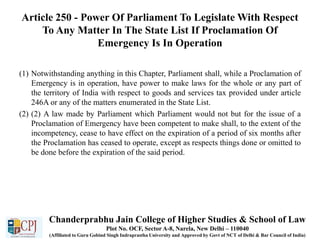
Article 250 - Power Of Parliament To Legislate With Respect
To Any Matter In The State List If Proclamation Of
Emergency Is In Operation
(1) Notwithstanding anything in this Chapter, Parliament shall, while a Proclamation of
Emergency is in operation, have power to make laws for the whole or any part of
the territory of India with respect to goods and services tax provided under article
246A or any of the matters enumerated in the State List.
(2) (2) A law made by Parliament which Parliament would not but for the issue of a
Proclamation of Emergency have been competent to make shall, to the extent of the
incompetency, cease to have effect on the expiration of a period of six months after
the Proclamation has ceased to operate, except as respects things done or omitted to
be done before the expiration of the said period.
Chanderprabhu Jain College of Higher Studies & School of Law
Plot No. OCF, Sector A-8, Narela, New Delhi – 110040
(Affiliated to Guru Gobind Singh Indraprastha University and Approved by Govt of NCT of Delhi & Bar Council of India)
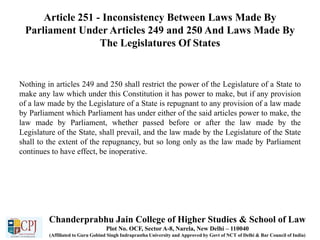
Article 251 - Inconsistency Between Laws Made By
Parliament Under Articles 249 and 250 And Laws Made By
The Legislatures Of States
Nothing in articles 249 and 250 shall restrict the power of the Legislature of a State to
make any law which under this Constitution it has power to make, but if any provision
of a law made by the Legislature of a State is repugnant to any provision of a law made
by Parliament which Parliament has under either of the said articles power to make, the
law made by Parliament, whether passed before or after the law made by the
Legislature of the State, shall prevail, and the law made by the Legislature of the State
shall to the extent of the repugnancy, but so long only as the law made by Parliament
continues to have effect, be inoperative.
Chanderprabhu Jain College of Higher Studies & School of Law
Plot No. OCF, Sector A-8, Narela, New Delhi – 110040
(Affiliated to Guru Gobind Singh Indraprastha University and Approved by Govt of NCT of Delhi & Bar Council of India)
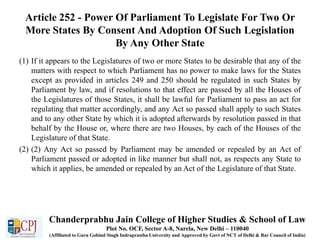
Article 252 - Power Of Parliament To Legislate For Two Or
More States By Consent And Adoption Of Such Legislation
By Any Other State
(1) If it appears to the Legislatures of two or more States to be desirable that any of the
matters with respect to which Parliament has no power to make laws for the States
except as provided in articles 249 and 250 should be regulated in such States by
Parliament by law, and if resolutions to that effect are passed by all the Houses of
the Legislatures of those States, it shall be lawful for Parliament to pass an act for
regulating that matter accordingly, and any Act so passed shall apply to such States
and to any other State by which it is adopted afterwards by resolution passed in that
behalf by the House or, where there are two Houses, by each of the Houses of the
Legislature of that State.
(2) (2) Any Act so passed by Parliament may be amended or repealed by an Act of
Parliament passed or adopted in like manner but shall not, as respects any State to
which it applies, be amended or repealed by an Act of the Legislature of that State.
Chanderprabhu Jain College of Higher Studies & School of Law
Plot No. OCF, Sector A-8, Narela, New Delhi – 110040
(Affiliated to Guru Gobind Singh Indraprastha University and Approved by Govt of NCT of Delhi & Bar Council of India)
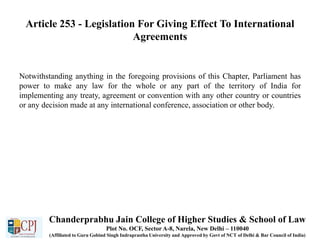
Article 253 - Legislation For Giving Effect To International
Agreements
Notwithstanding anything in the foregoing provisions of this Chapter, Parliament has
power to make any law for the whole or any part of the territory of India for
implementing any treaty, agreement or convention with any other country or countries
or any decision made at any international conference, association or other body.
Chanderprabhu Jain College of Higher Studies & School of Law
Plot No. OCF, Sector A-8, Narela, New Delhi – 110040
(Affiliated to Guru Gobind Singh Indraprastha University and Approved by Govt of NCT of Delhi & Bar Council of India)
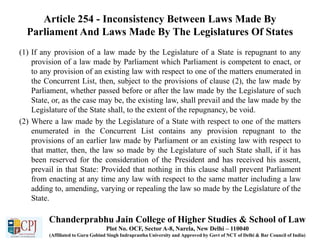
Article 254 - Inconsistency Between Laws Made By
Parliament And Laws Made By The Legislatures Of States
(1) If any provision of a law made by the Legislature of a State is repugnant to any
provision of a law made by Parliament which Parliament is competent to enact, or
to any provision of an existing law with respect to one of the matters enumerated in
the Concurrent List, then, subject to the provisions of clause (2), the law made by
Parliament, whether passed before or after the law made by the Legislature of such
State, or, as the case may be, the existing law, shall prevail and the law made by the
Legislature of the State shall, to the extent of the repugnancy, be void.
(2) Where a law made by the Legislature of a State with respect to one of the matters
enumerated in the Concurrent List contains any provision repugnant to the
provisions of an earlier law made by Parliament or an existing law with respect to
that matter, then, the law so made by the Legislature of such State shall, if it has
been reserved for the consideration of the President and has received his assent,
prevail in that State: Provided that nothing in this clause shall prevent Parliament
from enacting at any time any law with respect to the same matter including a law
adding to, amending, varying or repealing the law so made by the Legislature of the
State.
Chanderprabhu Jain College of Higher Studies & School of Law
Plot No. OCF, Sector A-8, Narela, New Delhi – 110040
(Affiliated to Guru Gobind Singh Indraprastha University and Approved by Govt of NCT of Delhi & Bar Council of India)
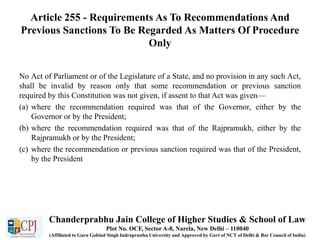
Article 255 - Requirements As To Recommendations And
Previous Sanctions To Be Regarded As Matters Of Procedure
Only
No Act of Parliament or of the Legislature of a State, and no provision in any such Act,
shall be invalid by reason only that some recommendation or previous sanction
required by this Constitution was not given, if assent to that Act was given—
(a) where the recommendation required was that of the Governor, either by the
Governor or by the President;
(b) where the recommendation required was that of the Rajpramukh, either by the
Rajpramukh or by the President;
(c) where the recommendation or previous sanction required was that of the President,
by the President
Chanderprabhu Jain College of Higher Studies & School of Law
Plot No. OCF, Sector A-8, Narela, New Delhi – 110040
(Affiliated to Guru Gobind Singh Indraprastha University and Approved by Govt of NCT of Delhi & Bar Council of India)
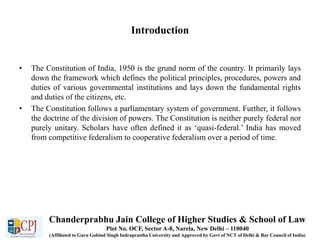
Introduction
• The Constitution of India, 1950 is the grund norm of the country. It primarily lays
down the framework which defines the political principles, procedures, powers and
duties of various governmental institutions and lays down the fundamental rights
and duties of the citizens, etc.
• The Constitution follows a parliamentary system of government. Further, it follows
the doctrine of the division of powers. The Constitution is neither purely federal nor
purely unitary. Scholars have often defined it as ‘quasi-federal.’ India has moved
from competitive federalism to cooperative federalism over a period of time.
Chanderprabhu Jain College of Higher Studies & School of Law
Plot No. OCF, Sector A-8, Narela, New Delhi – 110040
(Affiliated to Guru Gobind Singh Indraprastha University and Approved by Govt of NCT of Delhi & Bar Council of India)
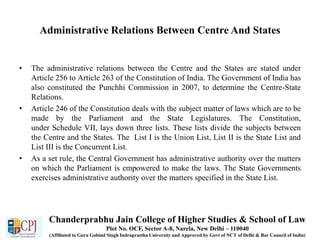
Administrative Relations Between Centre And States
• The administrative relations between the Centre and the States are stated under
Article 256 to Article 263 of the Constitution of India. The Government of India has
also constituted the Punchhi Commission in 2007, to determine the Centre-State
Relations.
• Article 246 of the Constitution deals with the subject matter of laws which are to be
made by the Parliament and the State Legislatures. The Constitution,
under Schedule VII, lays down three lists. These lists divide the subjects between
the Centre and the States. The List I is the Union List, List II is the State List and
List III is the Concurrent List.
• As a set rule, the Central Government has administrative authority over the matters
on which the Parliament is empowered to make the laws. The State Governments
exercises administrative authority over the matters specified in the State List.
Chanderprabhu Jain College of Higher Studies & School of Law
Plot No. OCF, Sector A-8, Narela, New Delhi – 110040
(Affiliated to Guru Gobind Singh Indraprastha University and Approved by Govt of NCT of Delhi & Bar Council of India)
The Obligation Of States And The Union
• Article 256 of the Constitution of India can be divided into two parts.
• Firstly, it lays down that the executive powers of the State are to be exercised in
such a manner that it complies with the laws made by the Parliament or any other
existing laws which are applicable in the State. Secondly, it states that the executive
power of the Union includes in its ambit such directions that are given to the State
by the Central Government, which it deems necessary for the purpose.
• It appears from reading the provision that if the States duly comply with the first
part, then the second part does not seem necessary. Whereas, if the second part
indeed serves its purpose sometimes, then it is evident that the States are guilty of
violating the first part of the provision.
Chanderprabhu Jain College of Higher Studies & School of Law
Plot No. OCF, Sector A-8, Narela, New Delhi – 110040
(Affiliated to Guru Gobind Singh Indraprastha University and Approved by Govt of NCT of Delhi & Bar Council of India)
The Obligation Of States And The Union
• The Constitution lays down this provision with the assumption that the States will
be, at some juncture, guilty of either wilful defiance or negligence of its duties.
• Article 256 is the successor of Section 122 of the Government of India Act,
1935. Although this provision is particularly silent about the consequences in case
of non-compliance, the drastic sanction is laid down in Article 365 of the
Constitution. To explain, if a State fails to comply with the directions issued by the
Centre, then it is lawful for the President to hold that a situation has arisen wherein
the State government cannot be carried on according to the provisions of the
Constitution. Consequently, a state emergency can be imposed. The primary theme
of this provision is that there should be a proper execution of the central laws in all
the states.
Chanderprabhu Jain College of Higher Studies & School of Law
Plot No. OCF, Sector A-8, Narela, New Delhi – 110040
(Affiliated to Guru Gobind Singh Indraprastha University and Approved by Govt of NCT of Delhi & Bar Council of India)
Cases
• In the case of Rameshwar Oraon vs. State of Bihar and Ors. (1995)(AIR 1995 Pat
173), it was observed that it is mandatory for the State Government to act according
to the directions issued by the Central Government.
• In the case of State of Karnataka vs. Union of India (1977) (1978 AIR 68), it was
held that the Centre can issue directions to a State under Article 256 as a legal
entity, not as a geographical or territorial unit. Further, in State of Rajasthan vs.
Union of India (1977) (1977 AIR 1361), the Apex Court held that the issuance of
directions to the State government by the Centre under Article 256 is justified if the
Union Government is of the opinion that the manner in which the executive power
of the State is exercised may be in contravention to the enforcement of Central
Laws.
• In Swaraj Abhiyan vs. Union of India (2017)(Writ Petition (Civil), 857 of 2015), the
Apex Court drew attention to this provision, calling it a ‘forgotten provision’. This
is because of the seldom usage of this provision since the Constitution came into
force.
Chanderprabhu Jain College of Higher Studies & School of Law
Plot No. OCF, Sector A-8, Narela, New Delhi – 110040
(Affiliated to Guru Gobind Singh Indraprastha University and Approved by Govt of NCT of Delhi & Bar Council of India)
Control of the Union over States in certain cases
• Article 257(1) provides that the exercise of the executive powers of the State should
be done in such a manner that it does not hamper or prejudice the exercise of the
executive powers of the Centre. Further, the second part of this clause is similar to
that of Article 256. It lays down that the Centre can issue directions to the State
Governments for purposes deemed necessary.
• Article 257(2) provides that the executive power of the Union to issue directions to
the States shall also extend to the matters of construction and maintenance of means
of communication declared to be of national or military importance. Although
communications is a State subject under Entry 13, List II, Schedule VII of the
Constitution – the Union has been empowered to issue directions.
• The proviso states that nothing in this particular provision will be considered as
restricting the power of the Parliament to:
Chanderprabhu Jain College of Higher Studies & School of Law
Plot No. OCF, Sector A-8, Narela, New Delhi – 110040
(Affiliated to Guru Gobind Singh Indraprastha University and Approved by Govt of NCT of Delhi & Bar Council of India)
Control of the Union over States in certain cases
• Declare certain highways or waterways as national highways or waterways;
• Construct and maintain means of communication as a part of its functions with
reference to naval, military and air force purposes.
• Article 257(3) provides that the executive power of the Union to issue directions to
the States shall also extend to the measures required to be taken for the protection
of the railways within a particular State.
• Article 257(4) provides that for the purpose of compliance to the directions under
clause (2) or clause (3), the States incur excess costs, which would not have
occurred in the discharge of the normal duties of the State in the absence of such
directions, then these costs shall be paid by the Government of India such sum as
may be agreed. If there is a default of agreement, the sum of the extra costs so
incurred by the State will be determined by an arbitrator appointed by the Chief
Justice of India.
Chanderprabhu Jain College of Higher Studies & School of Law
Plot No. OCF, Sector A-8, Narela, New Delhi – 110040
(Affiliated to Guru Gobind Singh Indraprastha University and Approved by Govt of NCT of Delhi & Bar Council of India)
Power Of The Union To Confer Powers, etc. On States In
Certain Cases
• Article 258(1) begins with a non-obstante clause. It states that the President, with
the permission of the Governor of the State, can entrust conditionally or
unconditionally the State Government or its officers to perform functions which are
related to any matter which is included in the ambit of the executive power of the
Union.
• Article 258(2) provides that a Parliament-made law which is applicable in any State
may confer certain powers and impose duties, or authorise such conferring of
powers and imposition of duties upon the State or its officers and the authorities
thereof. The clause has a non-obstante clause within it. It states that even if the
Legislature of the State has no power to make laws on that matter, the Parliament
made law is applicable.
• Article 258(3) states that the extra costs of administration which the States incur, in
connection with the exercise of such conferred powers and imposed duties, shall be
paid by the Government of India – such sum as may be agreed. If there is a default
of agreement, the sum of the extra costs so incurred by the State will be determined
by an arbitrator appointed by the Chief Justice of India.
•Chanderprabhu Jain College of Higher Studies & School of Law
Plot No. OCF, Sector A-8, Narela, New Delhi – 110040
(Affiliated to Guru Gobind Singh Indraprastha University and Approved by Govt of NCT of Delhi & Bar Council of India)
Power Of The States To Entrust Functions To The Union
• This power is laid down under Article 258-A of the Constitution of India. The
article begins with a non-obstante clause. It states that the Governor of a State, with
the consent of the Union Government, may entrust conditionally or unconditionally
to that particular State’s government or its officers, functions which are related to
any matter that is included in the scope of the executive power of the State.
• This provision was inserted into the Constitution by the Constitution (Seventh
Amendment) Act, 1956.
Chanderprabhu Jain College of Higher Studies & School of Law
Plot No. OCF, Sector A-8, Narela, New Delhi – 110040
(Affiliated to Guru Gobind Singh Indraprastha University and Approved by Govt of NCT of Delhi & Bar Council of India)
Jurisdiction Of The Union In Relation To Territories Outside
India
• Article 260 of the Indian Constitution deals with the jurisdiction in relation to
foreign territories. The article states that the Indian Government can enter into an
agreement with the Government of any territory which is not a part of the Indian
territory. This agreement is entered into to undertake any executive, legislative or
judicial functions vested in the Government of that territory. All such agreements
are subjected to and governed by any law which pertains to the exercise of foreign
jurisdiction for the time being in force.
• This is a latent emboldening provision. The Constituent Assembly debated this
provision on three different sessions – July 25, 1947; July 28, 1947, and August 25,
1947. Upon a perusal of these debates, it can be understood that the motive behind
this provision was to facilitate the administration of states that had not acceded to
the Indian Union.
• The Apex Court has ruled in GVK Inds. Ltd. & Anr. vs. The Income Tax Officer &
Anr. (2011), that this Article is to be invoked only in cases when such laws either
have an impact on or consequences for the people of India or the Indian territory.
The Parliament has also enacted the Foreign Jurisdiction Act, 1947 in accordance
with this Article, to provide for the exercise of foreign jurisdiction of the Union
Government.
Chanderprabhu Jain College of Higher Studies & School of Law
Plot No. OCF, Sector A-8, Narela, New Delhi – 110040
(Affiliated to Guru Gobind Singh Indraprastha University and Approved by Govt of NCT of Delhi & Bar Council of India)
Public Acts, Records And Judicial Proceedings
• Article 261(1) provides that full faith and credit must be given to all the public acts,
records and judicial proceedings of the Union and every State, throughout the
territory of India.
• Article 261(2) provides that the manner in which and conditions under which the
aforementioned acts, records and proceedings are to be proved along with the effect
thereof, shall be provided by such law as made by the Parliament.
• Article 261(3) states that final judgments or orders which are delivered or passed by
the civil courts located in any part of the Indian territory are capable of execution
anywhere within that territory, according to the law.
Chanderprabhu Jain College of Higher Studies & School of Law
Plot No. OCF, Sector A-8, Narela, New Delhi – 110040
(Affiliated to Guru Gobind Singh Indraprastha University and Approved by Govt of NCT of Delhi & Bar Council of India)
Adjudication Of Disputes Relating To Waters Of Inter-State
Rivers Or River Valleys
• Article 262(1) states that the Parliament may formulate laws to provide for the
adjudication of any dispute or complaint with reference to the use, distribution or
control of waters of, or in, any inter-State river or inter-State river valley.
• Article 262(2) begins with a non-obstante clause and provides that the Parliament
may by law provide that neither the Apex Court nor any other court shall be able to
exercise their jurisdiction in respect of any such dispute or complaint as mentioned
in clause (1).
• The States have a power to legislate on this issue of water under Entry 17, State
List, Schedule VII. The Union is empowered to legislate upon the same under Entry
56, Union List, Schedule VII.
Chanderprabhu Jain College of Higher Studies & School of Law
Plot No. OCF, Sector A-8, Narela, New Delhi – 110040
(Affiliated to Guru Gobind Singh Indraprastha University and Approved by Govt of NCT of Delhi & Bar Council of India)
Adjudication Of Disputes Relating To Waters Of Inter-State
Rivers Or River Valleys
• In exercise of the powers bestowed by Article 262, the Parliament enacted the Inter-
State Water Disputes Act, 1956. If the water disputes cannot be settled by
negotiations then the Central Government establishes a Water Disputes Tribunal for
the adjudication of such disputes. There are currently five active tribunals – namely,
Ravi and Beas Water Tribunal, Krishna Water Disputes Tribunal – II, Vasundhara
Water Disputes Tribunal, Mahadayi Water Disputes Tribunal and Mahanadi Water
Disputes Tribunal. There are several legal doctrines related to the issue of inter-state
waters. These include – Doctrine of Riparian Rights, Prior Appropriation,
Territorial Sovereignty, Community of Interest and Equitable Apportionment.
• The Supreme Court in the judgment of State of Kerala through the Chief Secretary
to Government vs. State of Tamil Nadu through the Chief Secretary to Government
(2018) (CIVIL APPEAL NO. 2453 OF 2007), finally settled the age-long Cauvery
Water Dispute.
Chanderprabhu Jain College of Higher Studies & School of Law
Plot No. OCF, Sector A-8, Narela, New Delhi – 110040
(Affiliated to Guru Gobind Singh Indraprastha University and Approved by Govt of NCT of Delhi & Bar Council of India)
Provisions With Respect To An
Inter-State Council
• Under Article 263 of the Constitution of India, if the President believes that the
establishment of an inter-state council would help in serving the public interests,
then it is lawful for the President to establish such Council by order. He shall also
define the nature of duties to be performed by the Council, its organisation and the
procedure to be followed.
• The President can charge the Council with the following duties:
– To inquire into and advise upon disputes which may have arisen between
States;
– To investigate and discuss subjects in which some or all of the States, or the
Union and one or more of the States display a common interest;
– To make recommendations upon any subject and in particular, to make
recommendations for enhanced coordination of policy and action pertaining to
that subject.
Chanderprabhu Jain College of Higher Studies & School of Law
Plot No. OCF, Sector A-8, Narela, New Delhi – 110040
(Affiliated to Guru Gobind Singh Indraprastha University and Approved by Govt of NCT of Delhi & Bar Council of India)
Conclusion
• The aim of the Indian Constitution is to establish either collaborative or cooperative
federalism. Through the division of powers between the Centre and the States, a
certain autonomy is granted to the States to ensure that the administration at the
grass-root level remains efficient. Simultaneously, the Centre exercises its power
over the States to maintain a balance.
• There are several challenges in the way of maintenance of a federation but the key
solution is healthy debate and discussion between the parties involved.
Chanderprabhu Jain College of Higher Studies & School of Law
Plot No. OCF, Sector A-8, Narela, New Delhi – 110040
(Affiliated to Guru Gobind Singh Indraprastha University and Approved by Govt of NCT of Delhi & Bar Council of India)
Chanderprabhu Jain College of Higher Studies & School of Law
Plot No. OCF, Sector A-8, Narela, New Delhi – 110040
(Affiliated to Guru Gobind Singh Indraprastha University and Approved by Govt of NCT of Delhi & Bar Council of India)
Financial Relations between Union and the States
Introduction
• India follows a federal structure where the powers are shared between both the
centre and the states. Though however, the distribution of these powers are not
equal, and we often find states raising constant concerns about their extreme
dependence on the Union Government for all the matters, thus limiting their powers
and autonomy. Hence, it is also said that India follows a quasi-federal structure
where the central government enjoys more powers over the states.
• Similarly in the financial field too, the Union Government is more powerful than
the states and though there have been various reforms in fiscal federalism from time
to time still there exists a wide variety of issues that needs to be addressed. As in
the present situation also the states have to rely heavily on the centre for financial
resources.
Chanderprabhu Jain College of Higher Studies & School of Law
Plot No. OCF, Sector A-8, Narela, New Delhi – 110040
(Affiliated to Guru Gobind Singh Indraprastha University and Approved by Govt of NCT of Delhi & Bar Council of India)
Article 246 – Subject Matter Of Union And States To Make
Laws On Taxation
• Article 246 of The Constitution of India, 1949 provides a list of subjects giving
power to the different levels of government to make laws on them. Essentially
speaking there are three kinds of lists mentioned under Article 246 that are as
follows:
• Union list
The Union Government has the authority to make laws relating to the subject matter
given under the list I, called the Union list. It includes taxes like Corporation Tax,
Customs and Excise duties and taxes on income other than agricultural income, etc.
• State List
The State Government is vested with the power to frame laws on the subjects
mentioned under list II, called the state list. It includes taxes on vehicles, liquors, land
revenue, entertainment, luxuries, stamp duties and sale or purchase of goods, etc.
Chanderprabhu Jain College of Higher Studies & School of Law
Plot No. OCF, Sector A-8, Narela, New Delhi – 110040
(Affiliated to Guru Gobind Singh Indraprastha University and Approved by Govt of NCT of Delhi & Bar Council of India)
Article 246 – Subject Matter Of Union And States To Make
Laws On Taxation
• Concurrent List
While there is another list also known as the Concurrent List, which gives power to
both the centre as well as state government to make laws with regards to the subjects
provided by the list III. List III does not include any major tax as such. This helps in
avoiding the competitive exploitation of the same source by both the authorities and the
overlapping of tax-jurisdictions under the Indian Constitution. Further, in the case of
conflict, the central government decision will prevail over the State government
decision.
Chanderprabhu Jain College of Higher Studies & School of Law
Plot No. OCF, Sector A-8, Narela, New Delhi – 110040
(Affiliated to Guru Gobind Singh Indraprastha University and Approved by Govt of NCT of Delhi & Bar Council of India)
Distribution Of Powers – Levying And Collection Of Taxes
• Article 268 to 281 of the Indian Constitution has made elaborate provisions that
provide directions to the centre relating to the distribution of financial resources
amongst the states. It lays down principles for the centre and states to work in
coordination for levying and collection of taxes through systematic arrangements.
• The provisions, for the time being, can be summarised as follows but will be
explained in detail further. It includes:
– Taxes levied by the Union but collected and kept by the States (Article 268).
– Taxes levied and collected by the Union but assigned to the States (Article
269).
– Taxes levied and distributed between the Union and the States (Article 270).
– Grant-in-aid from the Centre to the States (Article 273, Article 275 and Article
282).
– Sharing of proceeds from other taxes.
• In giving recommendations with regards to the distribution of funds between the
centre and state, the Finance commission mentioned under Article 280 plays a very
important role.
Chanderprabhu Jain College of Higher Studies & School of Law
Plot No. OCF, Sector A-8, Narela, New Delhi – 110040
(Affiliated to Guru Gobind Singh Indraprastha University and Approved by Govt of NCT of Delhi & Bar Council of India)
GST Regime – 101st Amendment
• The 101st Amendment in the constitution and the introduction of GST in the Indian
Economy has significantly changed the landscape of financial relations between the
centre and states. Therefore, it is extremely important to have a basic knowledge of
what GST is, its application and its different forms.
• Position before GST
Before the introduction of GST, there were multiple taxes imposed by the centre and
states separately and the distribution of which was confusing and non-uniform. It
included Service Tax, Central Excise, Customs duty and State VAT etc. But after the
GST, the principle of one nation one tax was adopted.
Chanderprabhu Jain College of Higher Studies & School of Law
Plot No. OCF, Sector A-8, Narela, New Delhi – 110040
(Affiliated to Guru Gobind Singh Indraprastha University and Approved by Govt of NCT of Delhi & Bar Council of India)
Position before GST
GST is categorized into CGST, SGST or IGST depending on whether the transaction is
Intrastate or Interstate supplies. Let’s understand what does this means:
• Inter-state and Intra-state Supplies
• i) Intra-State supply of goods or services: In these kinds of transactions, the
location of the supplier and the place of supply are in the same state.
• ii) Inter-State Supply of Goods and Services: As per the Section 7 of The Integrated
Goods, and Services Tax Act 2017 it can be understood that “Inter-state” trade or
commerce basically means:
– when the supplier is located in some other state or union territory and the place
of the supply is in another state/UT, or
– when the supply of goods or services is made to or by a Special economic zone
(SEZ) unit.
Chanderprabhu Jain College of Higher Studies & School of Law
Plot No. OCF, Sector A-8, Narela, New Delhi – 110040
(Affiliated to Guru Gobind Singh Indraprastha University and Approved by Govt of NCT of Delhi & Bar Council of India)
Central Goods and Services Tax (CGST)
• CGST is a tax imposed on Intra-state supplies of goods and services and is
governed by the CGST Act. Along with this SGST/UTGST will also be levied on
the same transaction and shall be governed by the SGST/UTGST Act.
• It implies that in the case of Intra-state supplies of goods and services both CGST
and SGST are combined which are collected simultaneously; where CGST goes to
the centre and SGST goes to the state.
• The proportion of SGST and CGST is equal.
• However, it must be noted that any tax levied on Intra-State supplies of goods
and/or services by the centre and state shall not exceed 14% each.
State Goods and Services Tax (SGST)
• The SGST is a tax levied by the state on the Intra State supplies of goods and/or
services by the State Government.
• It is governed by the SGST Act.
• As already mentioned above it is levied and collected simultaneously with the
CGST.
• In the case of Union territories, it is called UGST and governed by the UGST Act.
•Chanderprabhu Jain College of Higher Studies & School of Law
Plot No. OCF, Sector A-8, Narela, New Delhi – 110040
(Affiliated to Guru Gobind Singh Indraprastha University and Approved by Govt of NCT of Delhi & Bar Council of India)
Position before GST
Integrated Goods and Services Tax (IGST)
• IGST or Integrated Goods and Services Tax is a tax levied on all Inter-State
supplies of goods and/or services.
• It is governed by the IGST Act.
• IGST applies on any supply of goods and/or services in case of both import into
India and export from India. Though the exports will be zero-rated.
• Tax obtained under IGST is shared between centre and states as per Article 269A.
• The biggest achievement of GST is that it introduced a single uniform tax system
with dual tax features where the revenue is shared between both centre and state.
• The GST council as mentioned under Article 279 A, shall make decisions in
relation to the GST rate, inter supply transactions and other matters related to GST
etc.
Chanderprabhu Jain College of Higher Studies & School of Law
Plot No. OCF, Sector A-8, Narela, New Delhi – 110040
(Affiliated to Guru Gobind Singh Indraprastha University and Approved by Govt of NCT of Delhi & Bar Council of India)
Article 265- Taxes not to be imposed save by authority of law
• According to Article 265 of the Constitution of India, the union and state cannot
levy or collect any tax except authorised by law.
• This basically means that the power of the centre or state government to levy and
collect tax is not absolute power; as Article 265 of the Constitution of India imposes
certain general and specific limitations on it.
• In the case of Pratibha R.C.C. Spun, pipe and cement products V/s State of
Karnataka (AIR 1991 Kant 205), the imposition of a certain tax was rejected in the
light of Article 265 of the Indian Constitution. In the instant case, a tax was charged
in the pretext of a fee. Since there was no legislative enactment behind the same,
the imposition of the tax was considered illegal.
Chanderprabhu Jain College of Higher Studies & School of Law
Plot No. OCF, Sector A-8, Narela, New Delhi – 110040
(Affiliated to Guru Gobind Singh Indraprastha University and Approved by Govt of NCT of Delhi & Bar Council of India)
Article 266 - Consolidated Funds and public accounts of
India and of the States
• (1) Subject to the provisions of article 267 and to the provisions of this Chapter
with respect to the assignment of the whole or part of the net proceeds of certain
taxes and duties to States, all revenues received by the Government of India, all
loans raised by that Government by the issue of treasury bills, loans or ways and
means advances and all moneys received by that Government in repayment of loans
shall form one consolidated fund to be entitled “the Consolidated Fund of India”,
and all revenues received by the Government of a State, all loans raised by that
Government by the issue of treasury bills, loans or ways and means advances and
all moneys received by that Government in repayment of loans shall form one
consolidated fund to be entitled “the Consolidated Fund of the State”.
• (2) All other public moneys received by or on behalf of the Government of India or
the Government of a State shall be credited to the public account of India or the
public account of the State, as the case may be.
• (3) No moneys out of the Consolidated Fund of India or the Consolidated Fund of a
State shall be appropriated except in accordance with law and for the purposes and
in the manner provided in this Constitution
Chanderprabhu Jain College of Higher Studies & School of Law
Plot No. OCF, Sector A-8, Narela, New Delhi – 110040
(Affiliated to Guru Gobind Singh Indraprastha University and Approved by Govt of NCT of Delhi & Bar Council of India)
Article 267 – Contingency Fun
• (1) Parliament may by law establish a Contingency Fund in the nature of an interest
to be entitled “the Contingency Fund of India” into which shall be paid from time to
time such sums as may be determined by such law, and the said Fund shall be
placed at the disposal of the President to enable advances to be made by him out of
such Fund for the purposes of meeting unforeseen expenditure pending
authorisation of such expenditure by Parliament by law under article 115 or article
116.
• (2) The Legislature of a State may by law establish a Contingency Fund in the
nature of an interest to be entitled “the Contingency Fund of the State” into which
shall be paid from time to time such sums as may be determined by such law, and
the said Fund shall be placed at the disposal of the Governor 2*** of the State to
enable advances to be made by him out of such Fund for the purposes of meeting
unforeseen expenditure pending authorisation of such expenditure by the
Legislature of the State by law under article 205 or article 206.
Chanderprabhu Jain College of Higher Studies & School of Law
Plot No. OCF, Sector A-8, Narela, New Delhi – 110040
(Affiliated to Guru Gobind Singh Indraprastha University and Approved by Govt of NCT of Delhi & Bar Council of India)
Article 268 - Duties Levied By The Union But Collected And
Appropriated By The States
(1) Such stamp duties as are mentioned in the Union List shall be levied by the
Government of India but shall be collected—
(a)in the case where such duties are leviable within any Union territory, by the
Government of India, and
(b)in other cases, by the States within which such duties are respectively leviable.
(2) The proceeds in any financial year of any such duty leviable within any State shall
not form part of the Consolidated Fund of India, but shall be assigned to that State.
Chanderprabhu Jain College of Higher Studies & School of Law
Plot No. OCF, Sector A-8, Narela, New Delhi – 110040
(Affiliated to Guru Gobind Singh Indraprastha University and Approved by Govt of NCT of Delhi & Bar Council of India)
Article 269 - Taxes Levied And Collected By The Union But
Assigned To The States
(1) Taxes on the sale or purchase of goods and taxes on the consignment of goods 5
[except as provided in article 269A shall be levied and collected by the Government
of India but shall be assigned and shall be deemed to have been assigned to the
States on or after the 1st day of April, 1996 in the manner provided in clause(2).
Explanation.—For the purposes of this clause,—
(a) the expression "taxes on the sale or purchase of goods" shall mean taxes on sale or
purchase of goods other than newspapers, where such sale or purchase takes place
in the course of inter-State trade or commerce;
(b) the expression “taxes on the consignment of goods” shall mean taxes on the
consignment of goods (whether the consignment is to the person making it or to any
other person), where such consignment takes place in the course of inter-State trade
or commerce.
Chanderprabhu Jain College of Higher Studies & School of Law
Plot No. OCF, Sector A-8, Narela, New Delhi – 110040
(Affiliated to Guru Gobind Singh Indraprastha University and Approved by Govt of NCT of Delhi & Bar Council of India)
Article 269 - Taxes Levied And Collected By The Union But
Assigned To The States
(2) The net proceeds in any financial year of any such tax, except in so far as those
proceeds represent proceeds attributable to Union territories, shall not form part of the
Consolidated Fund of India, but shall be assigned to the States within which that tax is
leviable in that year, and shall be distributed among those States in accordance with
such principles of distribution as may be formulated by Parliament by law.
(3) Parliament may by law formulate principles for determining when a sale or
purchase of, or consignment of, goods takes place in the course of inter-State trade or
commerce.
Chanderprabhu Jain College of Higher Studies & School of Law
Plot No. OCF, Sector A-8, Narela, New Delhi – 110040
(Affiliated to Guru Gobind Singh Indraprastha University and Approved by Govt of NCT of Delhi & Bar Council of India)
Article 270- Taxes Levied And Distributed Between The
Union And The States
(1) All taxes and duties referred to in the Union List, except the duties and taxes
referred to in articles 2 [268, 269 and 269A], respectively, surcharge on taxes and
duties referred to in article 271 and any cess levied for specific purposes under any
law made by Parliament shall be levied and collected by the Government of India
and shall be distributed between the Union and the States in the manner provided
in clause (2).
(2) Such percentage, as may be prescribed, of the net proceeds of any such tax or
duty in any financial year shall not form part of the Consolidated Fund of India, but
shall be assigned to the States within which that tax or duty is leviable in that year,
and shall be distributed among those States in such manner and from such time as
may be prescribed in the manner provided in clause (3).
(3) In this article, “prescribed” means,—
(i) until a Finance Commission has been constituted, prescribed by the President by
order, and
(ii) (ii) after a Finance Commission has been constituted, prescribed by the President
by order after considering the recommendations of the Finance Commission.
Chanderprabhu Jain College of Higher Studies & School of Law
Plot No. OCF, Sector A-8, Narela, New Delhi – 110040
(Affiliated to Guru Gobind Singh Indraprastha University and Approved by Govt of NCT of Delhi & Bar Council of India)
Article 271 – Surcharge On Certain Duties And Taxes For
Purposes Of The Union
• Notwithstanding anything in articles 269 and 270, Parliament may at any time
increase any of the duties or taxes referred to in those articles 4 except the goods
and services tax under article 246A, by a surcharge for purposes of the Union and
the whole proceeds of any such surcharge shall form part of the Consolidated Fund
of India.
Chanderprabhu Jain College of Higher Studies & School of Law
Plot No. OCF, Sector A-8, Narela, New Delhi – 110040
(Affiliated to Guru Gobind Singh Indraprastha University and Approved by Govt of NCT of Delhi & Bar Council of India)
Article 273 – Grants In Lieu Of Export Duty On Jute And
Jute Products
(1) There shall be charged on the Consolidated Fund of India in each year as grants-in-
aid of the revenues of the States of Assam, Bihar, 5 [Odisha] and West Bengal, in
lieu of assignment of any share of the net proceeds in each year of export duty on
jute and jute products to those States, such sums as may be prescribed.
(2) The sums so prescribed shall continue to be charged on the Consolidated Fund of
India so long as any export duty on jute or jute products continues to be levied by
the Government of India or until the expiration of ten years from the
commencement of this Constitution whichever is earlier.
(3) In this article, the expression “prescribed” has the same meaning as in article 270
Chanderprabhu Jain College of Higher Studies & School of Law
Plot No. OCF, Sector A-8, Narela, New Delhi – 110040
(Affiliated to Guru Gobind Singh Indraprastha University and Approved by Govt of NCT of Delhi & Bar Council of India)
Article 279 A- GST Council
• Article 279A empowers the president of India to constitute a Council named Goods
and Services Tax Council (GST Council) within 60 days after the commencement
of the 101st Constitution Amendment Act, 2016.
• The members of the council will be as follows:
– The Union Finance Minister of India will serve as the chairperson of this
council.
– The respective states will nominate the State Finance Ministers/ or any other
Minister as the member of the council.
– The Union Minister of State in charge of revenue or finance will also be a
member of this council.
– The representatives of the states shall choose amongst themselves one “Vice-
president”.
• The decision shall be taken by at least three- fourth majority out of which:
– The vote of the Central Government will have one-third of the weightage.
– The vote of all the State Governments shall account for two-third of weightage.
•
Chanderprabhu Jain College of Higher Studies & School of Law
Plot No. OCF, Sector A-8, Narela, New Delhi – 110040
(Affiliated to Guru Gobind Singh Indraprastha University and Approved by Govt of NCT of Delhi & Bar Council of India)
Article 280 - Finance Commission
Constitution
The composition of Finance Commission is mentioned under the Finance Commission
Act, 1951 which when read with provisions of Article 280 lays down that the
Commission basically consists of five members out of which there will be one
Chairman, as appointed by the President of India. The criteria for selection of the
Chairman is that he/she should have a special understanding of public affairs while the
members shall possess the following qualifications:
• He/she may be either a judge of a High Court or qualified enough to be appointed
so.
• He / She must have deep knowledge of the finance and accounts of the
Government.
• He / She must be experienced in the field of financial matters and in administration;
or
• He / She must have a special understanding of economics.
Chanderprabhu Jain College of Higher Studies & School of Law
Plot No. OCF, Sector A-8, Narela, New Delhi – 110040
(Affiliated to Guru Gobind Singh Indraprastha University and Approved by Govt of NCT of Delhi & Bar Council of India)
Article 280 - Finance Commission
Functions
The Finance Commission has the following functions which involve recommending the
President regarding:
• The distribution of the net proceeds between the Union and the States and
allocation of such proceeds between different States.
• To lay down guidelines concerning the grants-in-aid of the revenue of the states out
of the Consolidated Fund of India.
• The suggestions on augmentation of the consolidated Fund of a state to supplement
the resources of the Panchayats and Municipalities in the State.
• Any other matter in the interest of sound finance.
Powers
The Finance Commission has all the powers of a civil court conferring it with a power
to summon the witnesses, requiring any person to furnish any information, production
of documents or any point that the Commission regards relevant or useful.
Chanderprabhu Jain College of Higher Studies & School of Law
Plot No. OCF, Sector A-8, Narela, New Delhi – 110040
(Affiliated to Guru Gobind Singh Indraprastha University and Approved by Govt of NCT of Delhi & Bar Council of India)
Borrowing Power of Centre & State
Article 292 and Article 298 of the constitution confer both the Centre and the States the
power to borrow. However, there is a huge disparity between the scope of powers of the
State and Centre.
• Centre
The Central Government has almost unlimited powers in terms of borrowing. The law
imposes no restrictions on the Centre in relation to both national and international
borrowing. It is subject to only some restrictions which are to be fixed by the
parliament by the law (Article 292).
• State
• In India, the borrowing powers enjoyed by the state government are much less in
comparison to the Central Government. As there are various kinds of territorial and
other limitations on the borrowing powers of the state.
• The Indian States are not allowed to raise loans outside India and only have the
option to raise loans either from the Government of India or through public loans.
But essentially speaking, it is a very difficult and lengthy process for the State to
raise a public loan, as it essentially needs a prior consent of the Government of
India which cannot be issued if a part of a loan advanced to the State by the Union
government or any guarantee in respect to it is still outstanding. This leaves the
States having no independent borrowing powers.
Chanderprabhu Jain College of Higher Studies & School of Law
Plot No. OCF, Sector A-8, Narela, New Delhi – 110040
(Affiliated to Guru Gobind Singh Indraprastha University and Approved by Govt of NCT of Delhi & Bar Council of India)
Financial Emergency
• The Centre-States financial relations changes considerably in case if Financial
Emergency is imposed as per Article 280 of the Indian Constitution. In such cases,
the Centre becomes so powerful and exercises immense control over the States
compelling them to observe certain norms of financial propriety and other essential
safeguards. The Union government can give the following mentioned directions to
the States-
• It includes directions to State Governments regarding the reduction of the salary
and allowances of all the employees engaged in service of the State which even
includes judges of the High Courts.
• In situations of Financial Emergency, the President has the power to make an
alteration in the distribution and allocation of taxes from the Centre to the States
and to direct the States to observe principles of Financial propriety as laid down by
the Parliament.
• Further directions can also be issued compelling the states to reserve the
consideration of the President on all financial and money bills even after they have
been passed by the State Legislature.
Chanderprabhu Jain College of Higher Studies & School of Law
Plot No. OCF, Sector A-8, Narela, New Delhi – 110040
(Affiliated to Guru Gobind Singh Indraprastha University and Approved by Govt of NCT of Delhi & Bar Council of India)
Chanderprabhu Jain College of Higher Studies & School of Law
Plot No. OCF, Sector A-8, Narela, New Delhi – 110040
(Affiliated to Guru Gobind Singh Indraprastha University and Approved by Govt of NCT of Delhi & Bar Council of India)
Relevant Doctrines
Doctrine of Territorial Nexus
• The Doctrine of Territorial Nexus states, that laws that are made by a particular
State Legislature are only applicable in that particular State and not outside the
territorial boundary of that State, except in scenarios where there is a sufficient
nexus between that State and the object. The significance of this can be determined
by the Supreme Court’s observation wherein it has stated that ‘Territorial nexus
doctrine, thus, plays an important part in the assessment of tax. Tax is levied on one
transaction where the operations which may give rise to income make take place
partly in one territory and partly in another. The question which would fall for
consideration is as to whether the income that arises out of the said transaction
would be required to be apportioned to each of the territories or not.
• Income arising out of operation in more than one jurisdiction would have territorial
nexus with each of the jurisdiction on an actual basis. If that be so, it may not be
correct to contend that the entire income “accrues or arises” in each of the
jurisdiction.”
Chanderprabhu Jain College of Higher Studies & School of Law
Plot No. OCF, Sector A-8, Narela, New Delhi – 110040
(Affiliated to Guru Gobind Singh Indraprastha University and Approved by Govt of NCT of Delhi & Bar Council of India)
Case Laws of Territorial Nexus
A.H. Wadia vs Income Tax Commissioner, Bombay, 1947 (1949) 51 Bombay 287
• The Apex Court held, that in the case of a sovereign Legislature question of
extraterritoriality of enactment can never be raised in the municipal court as a
ground for challenging its validity. Further, the Court stated that legislation may
offend the rules of international law, and there are chances that they may not be
recognised by foreign courts also, or there might be practical obstacles in enforcing
them, but these questions are of policy and domestic tribunals should not be
concerned and affected by them.
Chanderprabhu Jain College of Higher Studies & School of Law
Plot No. OCF, Sector A-8, Narela, New Delhi – 110040
(Affiliated to Guru Gobind Singh Indraprastha University and Approved by Govt of NCT of Delhi & Bar Council of India)
Case Laws of Territorial Nexus
GVK Industries Limited vs. Income Tax Officer, 2011:
Civil Appeal No. 7796 of 1997
• In this case, it was questioned as to whether the Parliament is authorized to enact
laws in respect of extra-territorial aspects or in causes that have no nexus with
India, and furthermore, if such laws are bereft of any benefit to India?
• The Supreme Court held that ‘The clue of the answer to this question also lies in the
word for used in article 245(1). The Court derived the responsibility of the
Parliament with the help of the word for used in article 245(1) and stated that
Parliament of India is to act as the Parliament of India and of no other territory,
nation or people.’ The Court derived two related limitations in this regard, which
are as follows:
• The Parliament may only apply its power for the benefit of the Country as per the
necessity and the laws framed by the Parliament may strengthen the welfare of the
people in other territories too but the benefit to or of India will remain the central
and primary purpose.
Chanderprabhu Jain College of Higher Studies & School of Law
Plot No. OCF, Sector A-8, Narela, New Delhi – 110040
(Affiliated to Guru Gobind Singh Indraprastha University and Approved by Govt of NCT of Delhi & Bar Council of India)
Harmonious Construction
• This rule is used to avoid any inconsistency and repugnancy within a section or
between a section and other parts of a statute. The rule follows a very simple
premise that every statute has a purpose and intent as per law, and should be read as
a whole. The interpretation which is consistent with all the provisions and makes
the enactment consistent shall prevail. The doctrine follows a settled rule that an
interpretation that results in injustice, hardship, inconvenience, and anomaly should
be avoided. The interpretation with the closest conformity to justice must be picked.
• The Supreme Court laid down 5 main principles of the ‘Doctrine of Harmonious
Construction’-
– The courts must avoid a ‘head of clash’ of contradictory provisions and they
must construe the contradictory provisions so as to harmonize them.
– When it is not possible to completely reconcile the differences in contradictory
provisions, the court must interpret them in such a way so as to give effect to
both provisions as much as possible.
– Courts must keep in mind that the interpretation which reduces one provision to
a useless standing is against the essence of ‘Harmonious Construction’.
– To harmonize the provisions is not to render them fruitless or destroy any
statutory provision.
Chanderprabhu Jain College of Higher Studies & School of Law
Plot No. OCF, Sector A-8, Narela, New Delhi – 110040
(Affiliated to Guru Gobind Singh Indraprastha University and Approved by Govt of NCT of Delhi & Bar Council of India)
Cases of Harmonious Construction
• In M.S.M. Sharma v. Krishna Sinha (1958 AIR 395), the doctrine was applied to
resolve the conflict between Articles 19(1)(a) and Article 194(3) of the Constitution
and it was held that the right to freedom of speech as guaranteed under Article
19(1)(a) is to be read as subjects of powers and privileges of the House of the
Legislature which is similar to those of the House of Commons of the United
Kingdom as declared under Article 194(3).
• in the case of Venkataramana Devaru v. the State of Mysore (1958 AIR 255),
the Supreme Court applied the doctrine in resolving a conflict between Articles
25(2)(b) and 26(b) of the Constitution and it was held that the right of every
religious denomination or any section thereof to manage its own affairs in matters
of religion [Article 26(b)] is subject to provisions made by the State providing for
social welfare and reform or opening of Hindu religious institutions of a public
character to all classes and sections of Hindus [Article 25(2)(b)].
• The principle of ‘Harmonious Construction’ is also applicable in the case of
construction of provisions relating to subordinate legislation.
•
Chanderprabhu Jain College of Higher Studies & School of Law
Plot No. OCF, Sector A-8, Narela, New Delhi – 110040
(Affiliated to Guru Gobind Singh Indraprastha University and Approved by Govt of NCT of Delhi & Bar Council of India)
Pith & Substance
• This doctrine comes into picture when there is a conflict between the different
subjects in different lists. There is an interpretation of List 1 and List 2 of the
Constitution of India.
• There can be a situation when a subject of one list touche the subject of another
List. Hence this doctrine is applied then.
• Pith and Substance means the true nature of law.
• The real subject matter is challenged and not its incidental effect on another field.
• The doctrine has been applied in India also to provide a degree of flexibility in the
otherwise rigid scheme of distribution of powers.
• The reason for the adoption of this doctrine is that if every legislation were to be
declared invalid on the grounds that it encroached powers, the powers of the
legislature would be drastically circumscribed.
Chanderprabhu Jain College of Higher Studies & School of Law
Plot No. OCF, Sector A-8, Narela, New Delhi – 110040
(Affiliated to Guru Gobind Singh Indraprastha University and Approved by Govt of NCT of Delhi & Bar Council of India)
Cases on Pith & Substance
State of Bombay and another v. F.N Balsara (1951 AIR 318)
This case acquires quite a lot of importance as it was the first case which upheld the
doctrine of Pith and Substance in India.
• The court gave out the judgment stating that the act was in its Pith and Substance
and rightfully fell under the State list even though such an act was said to have a
bearing on the import of liquor in the state.
Prafulla Kumar Mukherjee v. Bank of Khulna ((1959) 49 BOMBAY 568)
• In this case, the validity of the Bombay Money Lenders Act, 1946 came to be
questioned. The main argument here was that promissory notes formed a part of the
central subject and not state subject. But on the contrary, the Privy Council held that
interpreting the doctrine of Pith and Substance, the act is actually a law with respect
to ‘money lending and money lenders’ and this was clearly a state subject, further
the court went ahead and stated an important point that this act was valid even if it
entrenched upon the subject of ‘Promissory note’ which is a central subject, thus
upholding the principle of the doctrine of Pith and Substance.
Chanderprabhu Jain College of Higher Studies & School of Law
Plot No. OCF, Sector A-8, Narela, New Delhi – 110040
(Affiliated to Guru Gobind Singh Indraprastha University and Approved by Govt of NCT of Delhi & Bar Council of India)
Doctrine of Repugnancy
• If any law passed by the legislature of the state enumerated in the concurrent list
which is repugnant to the earlier law made by the parliament or an existing law the
law passed by the state legislature would remain in existence in that state if the
assent is given by the president.
• After receiving the presidential assent the law can still be held void if the
parliament amend, verify and repeal any law in respect to the same matter.
• The state legislature and the parliament have equal competence to legislate in the
concurrent list. It is the duty of the court to interpret the enactments and avoid
conflicts.
• No repugnancy of law passed by the state legislate would be required if the matter
is different. Then Article 254(2) would have no application.
• Under article 254 of the Indian constitution when a law passed by the legislature of
the state which is inconsistent with the law parliament the whole law won’t be held
void it will be held void to the extent of repugnancy.
• To ascertain repugnancy it is necessary to check law made by the parliament is an
exhaustive code if it is not then the state law won’t be held void.
• In order to strike down a law passed by the state legislature in the court it is
necessary to prove both laws are made on the same matter and both are inconsistent
with each other.
Chanderprabhu Jain College of Higher Studies & School of Law
Plot No. OCF, Sector A-8, Narela, New Delhi – 110040
(Affiliated to Guru Gobind Singh Indraprastha University and Approved by Govt of NCT of Delhi & Bar Council of India)
Cases on Doctrine of Repugnancy
M Karunnanaidi vs. Union of India (1979 AIR 898)
• Judgement: The court held that there is no direct conflict between the state and the
central Acts. They are complementary acts which run pari passu to the central act.
In this case court held that the question of repugnancy may arise when two
enactments are irreconcilable or inconsistent and they cannot operate in the same
field together. No question of repugnancy may arise if the statues continue to
operate in the same field without cornering into collusion.
Deep Chand vs. Sate of UP ( 1959 AIR 648)
• Judgement: The court held that both the law were in a direct conflict and occupied
the same field. Therefore it is void to the extent of repugnancy.
Chanderprabhu Jain College of Higher Studies & School of Law
Plot No. OCF, Sector A-8, Narela, New Delhi – 110040
(Affiliated to Guru Gobind Singh Indraprastha University and Approved by Govt of NCT of Delhi & Bar Council of India)
Doctrine of Colourable Legistaltion
In India ' colourable legislation theory ' implies only a restriction of the legislature's
law-making power. While the government purports to act within its authority, it appears
to realize but in fact, it has transgressed certain powers. So, the doctrine becomes valid
whenever a statute tries to do what it can not do specifically in an indirect manner. In
India parliamentary and state legislatures, legislative powers are delegated by Article
246 and allocated in the Seventh Schedule of the Indian Constitution by lists I, II, and
III. Parliament has the power to legislate on any of the List II matters, and Parliament
and the State Legislatures both have the power to make laws on any of the List III
matters, and the residual power of regulation is vested on Parliament by way of Article
248 and Article 97, List I. It is a matter of how legislative power must be exercised
between the Centre and the States, or it relies only on the relationships between them,
to create some legislation or the legitimacy of that rule. The main point is that the
government with punitive authority can not invade the field of competency. It's called
the "constitution scam.
Chanderprabhu Jain College of Higher Studies & School of Law
Plot No. OCF, Sector A-8, Narela, New Delhi – 110040
(Affiliated to Guru Gobind Singh Indraprastha University and Approved by Govt of NCT of Delhi & Bar Council of India)
Cases on Colourable Legislation
K.C. Gajapati Narayana Deo And Other v. The State Of Orissa
(AIR 1953 Ori 185)
• If the Constitution of a State distributes the legislative powers amongst different
bodies, which have to act within their respective spheres marked out by specific
legislative entries, or if there are limitations on the legislative authority in the shape
of fundamental rights, questions do arise as to whether the legislature in a particular
case has or has not, in respect to the subject-matter of the statute or in the method of
enacting it, transgressed the limits of its constitutional powers.
• If the rule is resolved that no malafide could be applied to the Government, the first
respondent does not argue that the provision was enacted only to prosecute the first
respondent. It is not necessary to accuse the government as an individual of having
passed a law for a foreign reason. Therefore, the legislation could not be attributed
to any malafide. A legislature does not operate on outside thought. But a legislative
action based on mala fide can not be struck down for lack of legal integrity or for
being unreasonable.
Chanderprabhu Jain College of Higher Studies & School of Law
Plot No. OCF, Sector A-8, Narela, New Delhi – 110040
(Affiliated to Guru Gobind Singh Indraprastha University and Approved by Govt of NCT of Delhi & Bar Council of India)
Chanderprabhu Jain College of Higher Studies & School of Law
Plot No. OCF, Sector A-8, Narela, New Delhi – 110040
(Affiliated to Guru Gobind Singh Indraprastha University and Approved by Govt of NCT of Delhi & Bar Council of India)
EMERGENCY PROVISIONS : ARTICLES 352-360
Introduction
• A state of emergency in India refers to a period of governance that can be
proclaimed by the President of India during certain crisis situations. Under the
advice of the cabinet of ministers, the President can overrule many provisions of the
Constitution, which guarantees Fundamental Rights to the citizens of India.
• The emergency provisions are contained in Part XVIII of the Constitution of India,
from Article 352 to 360. These provisions enable the Central government to meet
any abnormal situation effectively.
• The rationality behind the incorporation is to safeguard the sovereignty, unity,
integrity and security of the country, the democratic political system and the
Constitution.
• The Constitution stipulates three types of emergencies-
– National Emergency
– Constitutional Emergency
– Financial Emergency
Chanderprabhu Jain College of Higher Studies & School of Law
Plot No. OCF, Sector A-8, Narela, New Delhi – 110040
(Affiliated to Guru Gobind Singh Indraprastha University and Approved by Govt of NCT of Delhi & Bar Council of India)
Article 352 - Proclamation of Emergency
(1) If the President is satisfied that a grave emergency exists whereby the security of
India or of any part of the territory thereof is threatened, whether by war or external
aggression or armed rebellion, he may, by Proclamation, make a declaration to that
effect in respect of the whole of India or of such part of the territory thereof as may be
specified in the Proclamation.
Explanation.—A Proclamation of Emergency declaring that the security of India or any
part of the territory thereof is threatened by war or by external aggression or by armed
rebellion may be made before the actual occurrence of war or of any such aggression or
rebellion, if the President is satisfied that there is imminent danger thereof.
(2) A Proclamation issued under clause (1) may be varied or revoked by a subsequent
Proclamation.
(3) The President shall not issue a Proclamation under clause (1) or a Proclamation
varying such Proclamation unless the decision of the Union Cabinet (that is to say, the
Council consisting of the Prime Minister and other Ministers of Cabinet rank appointed
under article 75) that such a Proclamation may be issued has been communicated to
him in writing.
Chanderprabhu Jain College of Higher Studies & School of Law
Plot No. OCF, Sector A-8, Narela, New Delhi – 110040
(Affiliated to Guru Gobind Singh Indraprastha University and Approved by Govt of NCT of Delhi & Bar Council of India)
Article 352 - Proclamation of Emergency
(4) Every Proclamation issued under this article shall be laid before each House of
Parliament and shall, except where it is a Proclamation revoking a previous
Proclamation, cease to operate at the expiration of one month unless before the
expiration of that period it has been approved by resolutions of both Houses of
Parliament:
Provided that if any such Proclamation (not being a Proclamation revoking a previous
Proclamation) is issued at a time when the House of the People has been dissolved, or
the dissolution of the House of the People takes place during the period of one month
referred to in this clause, and if a resolution approving the Proclamation has been
passed by the Council of States, but no resolution with respect to such Proclamation has
been passed by the House of the People before the expiration of that period, the
Proclamation shall cease to operate at the expiration of thirty days from the date on
which the House of the People first sits after its reconstitution, unless before the
expiration of the said period of thirty days a resolution approving the Proclamation has
been also passed by the House of the People
Chanderprabhu Jain College of Higher Studies & School of Law
Plot No. OCF, Sector A-8, Narela, New Delhi – 110040
(Affiliated to Guru Gobind Singh Indraprastha University and Approved by Govt of NCT of Delhi & Bar Council of India)
Article 352 - Proclamation of Emergency
(5) A Proclamation so approved shall, unless revoked, cease to operate on the
expiration of a period of six months from the date of the passing of the second of the
resolutions approving the Proclamation under clause (4):
Provided that if and so often as a resolution approving the continuance in force of such
a Proclamation is passed by both Houses of Parliament the Proclamation shall, unless
revoked, continue in force for a further period of six months from the date on which it
would otherwise have ceased to operate under this clause:
Provided further that if the dissolution of the House of the People takes place during
any such period of six months and a resolution approving the continuance in force of
such Proclamation has been passed by the Council of States but no resolution with
respect to the continuance in force of such Proclamation has been passed by the House
of the People during the said period, the Proclamation shall cease to operate at the
expiration of thirty days from the date on which the House of the People first sits after
its reconstitution unless before the expiration of the said period of thirty days, a
resolution approving the continuance in force of the Proclamation has been also passed
by the House of the People.
Chanderprabhu Jain College of Higher Studies & School of Law
Plot No. OCF, Sector A-8, Narela, New Delhi – 110040
(Affiliated to Guru Gobind Singh Indraprastha University and Approved by Govt of NCT of Delhi & Bar Council of India)
Article 352 - Proclamation of Emergency
(6) For the purposes of clauses (4) and (5), a resolution may be passed by either House
of Parliament only by a majority of the total membership of that House and by a
majority of not less than two-thirds of the Members of that House present and voting.
(7) Notwithstanding anything contained in the foregoing clauses, the President shall
revoke a Proclamation issued under clause (1) or a Proclamation varying such
Proclamation if the House of the People passes a resolution disapproving, or, as the
case may be, disapproving the continuance in force of, such Proclamation.
(8) Where a notice in writing signed by not less than one-tenth of the total number of
members of the House of the People has been given, of their intention to move a
resolution for disapproving, or, as the case may be, for disapproving the continuance in
force of, a Proclamation issued under clause (1) or a Proclamation varying such
Proclamation,—
(a) to the Speaker, if the House is in session; or
(b) (b) to the President, if the House is not in session, a special sitting of the House
shall be held within fourteen days from the date on which such notice is received by
the Speaker, or, as the case may be, by the President, for the purpose of considering
such resolution.
Chanderprabhu Jain College of Higher Studies & School of Law
Plot No. OCF, Sector A-8, Narela, New Delhi – 110040
(Affiliated to Guru Gobind Singh Indraprastha University and Approved by Govt of NCT of Delhi & Bar Council of India)
Article 352 - Proclamation of Emergency
(9) The power conferred on the President by this article shall include the power to issue
different Proclamations on different grounds, being war or external aggression or armed
rebellion or imminent danger of war or external aggression or armed rebellion, whether
or not there is a Proclamation already issued by the President under clause (1) and such
Proclamation is in operation.
Chanderprabhu Jain College of Higher Studies & School of Law
Plot No. OCF, Sector A-8, Narela, New Delhi – 110040
(Affiliated to Guru Gobind Singh Indraprastha University and Approved by Govt of NCT of Delhi & Bar Council of India)
Article 353 - Effect of Proclamation of Emergency
While a Proclamation of Emergency is in operation, then—
(a) notwithstanding anything in this Constitution, the executive power of the Union
shall extend to the giving of directions to any State as to the manner in which the
executive power thereof is to be exercised;
(b) the power of Parliament to make laws with respect to any matter shall include
power to make laws conferring powers and imposing duties, or authorising the
conferring of powers and the imposition of duties, upon the Union or officers and
authorities of the Union as respects that matter, notwithstanding that it is one which is
not enumerated in the Union List:
Provided that where a Proclamation of Emergency is in operation only in any part of
the territory of India,—
(i) the executive power of the Union to give directions under clause (a), and
(ii) the power of Parliament to make laws under clause (b),
shall also extend to any State other than a State in which or in any part of which the
Proclamation of Emergency is in operation if and in so far as the security of India or
any part of the territory thereof is threatened by activities in or in relation to the part of
the territory of India in which the Proclamation of Emergency is in operation.
Chanderprabhu Jain College of Higher Studies & School of Law
Plot No. OCF, Sector A-8, Narela, New Delhi – 110040
(Affiliated to Guru Gobind Singh Indraprastha University and Approved by Govt of NCT of Delhi & Bar Council of India)
Article 354 - Application Of Provisions Relating To
Distribution Of Revenues While A Proclamation Of
Emergency Is In Operation
(1) The President may, while a Proclamation of Emergency is in operation, by order
direct that all or any of the provisions of articles 268 to 279 shall for such period,
not extending in any case beyond the expiration of the financial year in which such
Proclamation ceases to operate, as may be specified in the order, have effect subject
to such exceptions or modifications as he thinks fit.
(2) Every order made under clause (1) shall, as soon as may be after it is made, be laid
before each House of Parliament.
Chanderprabhu Jain College of Higher Studies & School of Law
Plot No. OCF, Sector A-8, Narela, New Delhi – 110040
(Affiliated to Guru Gobind Singh Indraprastha University and Approved by Govt of NCT of Delhi & Bar Council of India)
Article 355 - Duty Of The Union To Protect States Against
External Aggression And Internal Disturbance.
It shall be the duty of the Union to protect every State against external aggression and
internal disturbance and to ensure that the Government of every State is carried on in
accordance with the provisions of this Constitution.
Chanderprabhu Jain College of Higher Studies & School of Law
Plot No. OCF, Sector A-8, Narela, New Delhi – 110040
(Affiliated to Guru Gobind Singh Indraprastha University and Approved by Govt of NCT of Delhi & Bar Council of India)
Article 356 - Provisions In Case Of Failure Of Constitutional
Machinery In States
(1) If the President, on receipt of a report from the Governor of a State or otherwise,
is satisfied that a situation has arisen in which the Government of the State cannot
be carried on in accordance with the provisions of this Constitution, the President
may by Proclamation—
(a) assume to himself all or any of the functions of the Government of the State and
all or any of the powers vested in or exercisable by the Governor or any body or
authority in the State other than the Legislature of the State;
(b) declare that the powers of the Legislature of the State shall be exercisable by or
under the authority of Parliament;
(c) make such incidental and consequential provisions as appear to the President to
be necessary or desirable for giving effect to the objects of the Proclamation,
including provisions for suspending in whole or in part the operation of any
provisions of this Constitution relating to any body or authority in the State:
Provided that nothing in this clause shall authorise the President to assume to himself
any of the powers vested in or exercisable by a High Court, or to suspend in whole or
in part the operation of any provision of this Constitution relating to High Courts.
Chanderprabhu Jain College of Higher Studies & School of Law
Plot No. OCF, Sector A-8, Narela, New Delhi – 110040
(Affiliated to Guru Gobind Singh Indraprastha University and Approved by Govt of NCT of Delhi & Bar Council of India)
Article 356 - Provisions In Case Of Failure Of Constitutional
Machinery In States
(2) Any such Proclamation may be revoked or varied by a subsequent Proclamation.
(3) Every Proclamation under this article shall be laid before each House of Parliament
and shall, except where it is a Proclamation revoking a previous Proclamation, cease to
operate at the expiration of two months unless before the expiration of that period it has
been approved by resolutions of both Houses of Parliament:
Provided that if any such Proclamation (not being a Proclamation revoking a previous
Proclamation) is issued at a time when the House of the People is dissolved or the
dissolution of the House of the People takes place during the period of two months
referred to in this clause, and if a resolution approving the Proclamation has been
passed by the Council of States, but no resolution with respect to such Proclamation has
been passed by the House of the People before the expiration of that period, the
Proclamation shall cease to operate at the expiration of thirty days from the date on
which the House of the People first sits after its reconstitution unless before the
expiration of the said period of thirty days a resolution approving the Proclamation has
been also passed by the House of the People.
Chanderprabhu Jain College of Higher Studies & School of Law
Plot No. OCF, Sector A-8, Narela, New Delhi – 110040
(Affiliated to Guru Gobind Singh Indraprastha University and Approved by Govt of NCT of Delhi & Bar Council of India)
Article 356 - Provisions In Case Of Failure Of Constitutional
Machinery In States
(4) A Proclamation so approved shall, unless revoked, cease to operate on the
expiration of a period of six months from the date of issue of the Proclamation:
Provided that if and so often as a resolution approving the continuance in force of
such a Proclamation is passed by both Houses of Parliament, the Proclamation shall,
unless revoked, continue in force for a further period of six months from the date on
which under this clause it would otherwise have ceased to operate, but no such
Proclamation shall in any case remain in force for more than three years:
Provided further that if the dissolution of the House of the People takes place during
any such period of six months and a resolution approving the continuance in force of
such Proclamation has been passed by the Council of States, but no resolution with
respect to the continuance in force of such Proclamation has been passed by the
House of the People during the said period, the Proclamation shall cease to operate at
the expiration of thirty days from the date on which the House of the People first sits
after its reconstitution unless before the expiration of the said period of thirty days a
resolution approving the continuance in force of the Proclamation has been also
passed by the House of the People:
Chanderprabhu Jain College of Higher Studies & School of Law
Plot No. OCF, Sector A-8, Narela, New Delhi – 110040
(Affiliated to Guru Gobind Singh Indraprastha University and Approved by Govt of NCT of Delhi & Bar Council of India)
Article 356 - Provisions In Case Of Failure Of Constitutional
Machinery In States
Provided also that in the case of the Proclamation issued under clause (1) on the 11th
day of May, 1987 with respect to the State of Punjab, the reference in the first proviso
to this clause to “three years” shall be construed as a reference to five years.
(5) Notwithstanding anything contained in clause (4), a resolution with respect to the
continuance in force of a Proclamation approved under clause (3) for any period
beyond the expiration of one year from the date of issue of such Proclamation shall not
be passed by either House of Parliament unless—
(a) a Proclamation of Emergency is in operation, in the whole of India or, as the case
may be, in the whole or any part of the State, at the time of the passing of such
resolution, and
(b) the Election Commission certifies that the continuance in force of the Proclamation
approved under clause (3) during the period specified in such resolution is
necessary on account of difficulties in holding general elections to the Legislative
Assembly of the State concerned:
Provided that nothing in this clause shall apply to the Proclamation issued under clause
(1) on the 11th day of May, 1987 with respect to the State of Punjab.
Chanderprabhu Jain College of Higher Studies & School of Law
Plot No. OCF, Sector A-8, Narela, New Delhi – 110040
(Affiliated to Guru Gobind Singh Indraprastha University and Approved by Govt of NCT of Delhi & Bar Council of India)
Article 357 - Exercise Of Legislative Powers Under
Proclamation Issued Under Article 356
(1) Where by a Proclamation issued under clause (1) of article 356, it has been declared
that the powers of the Legislature of the State shall be exercisable by or under the
authority of Parliament, it shall be competent—
(a) for Parliament to confer on the President the power of the Legislature of the State to
make laws, and to authorise the President to delegate, subject to such conditions as
he may think fit to impose, the power so conferred to any other authority to be
specified by him in that behalf;
(b) for Parliament, or for the President or other authority in whom such power to make
laws is vested under sub-clause (a), to make laws conferring powers and imposing
duties, or authorising the conferring of powers and the imposition of duties, upon
the Union or officers and authorities thereof;
(c) for the President to authorise when the House of the People is not in session
expenditure from the Consolidated Fund of the State pending the sanction of such
expenditure by Parliament.
Chanderprabhu Jain College of Higher Studies & School of Law
Plot No. OCF, Sector A-8, Narela, New Delhi – 110040
(Affiliated to Guru Gobind Singh Indraprastha University and Approved by Govt of NCT of Delhi & Bar Council of India)
Article 357 - Exercise Of Legislative Powers Under
Proclamation Issued Under Article 356
(2) Any law made in exercise of the power of the Legislature of the State by Parliament
or the President or other authority referred to in sub-clause (a) of clause (1) which
Parliament or the President or such other authority would not, but for the issue of a
Proclamation under article 356, have been competent to make shall, after the
Proclamation has ceased to operate, continue in force until altered or repealed or
amended by a competent Legislature or other authority.
Chanderprabhu Jain College of Higher Studies & School of Law
Plot No. OCF, Sector A-8, Narela, New Delhi – 110040
(Affiliated to Guru Gobind Singh Indraprastha University and Approved by Govt of NCT of Delhi & Bar Council of India)
Article 358 - Suspension Of Provisions Of Article 19 During
Emergencies
(1) While a Proclamation of Emergency declaring that the security of India or any part
of the territory thereof is threatened by war or by external aggression is in
operation], nothing in article 19 shall restrict the power of the State as defined in
Part III to make any law or to take any executive action which the State would but
for the provisions contained in that Part be competent to make or to take, but any
law so made shall, to the extent of the incompetency, cease to have effect as soon as
the Proclamation ceases to operate, except as respects things done or omitted to be
done before the law so ceases to have effect:
Provided that where such Proclamation of Emergency is in operation only in any part
of the territory of India, any such law may be made, or any such executive action may
be taken, under this article in relation to or in any State or Union territory in which or in
any part of which the Proclamation of Emergency is not in operation, if and in so far as
the security of India or any part of the territory thereof is threatened by activities in or
in relation to the part of the territory of India in which the Proclamation of Emergency
is in operation.
Chanderprabhu Jain College of Higher Studies & School of Law
Plot No. OCF, Sector A-8, Narela, New Delhi – 110040
(Affiliated to Guru Gobind Singh Indraprastha University and Approved by Govt of NCT of Delhi & Bar Council of India)
Article 358 - Suspension Of Provisions Of Article 19 During
Emergencies
(2) Nothing in clause (1) shall apply—
(a) to any law which does not contain a recital to the effect that such law is in relation
to the Proclamation of Emergency in operation when it is made; or
(b) to any executive action taken otherwise than under a law containing such a recital.
Chanderprabhu Jain College of Higher Studies & School of Law
Plot No. OCF, Sector A-8, Narela, New Delhi – 110040
(Affiliated to Guru Gobind Singh Indraprastha University and Approved by Govt of NCT of Delhi & Bar Council of India)
Article 359 - Suspension Of The Enforcement Of The Rights
Conferred By Part III During Emergencies
(1) Where a Proclamation of Emergency is in operation, the President may by order
declare that the right to move any court for the enforcement of such of 6 [the rights
conferred by Part III (except articles 20 and 21)] as may be mentioned in the order
and all proceedings pending in any court for the enforcement of the rights so
mentioned shall remain suspended for the period during which the Proclamation is
in force or for such shorter period as may be specified in the order.
(1A) While an order made under clause (1) mentioning any of the rights conferred by
Part III (except articles 20 and 21) is in operation, nothing in that Part conferring those
rights shall restrict the power of the State as defined in the said Part to make any law or
to take any executive action which the State would but for the provisions contained in
that Part be competent to make or to take, but any law so made shall, to the extent of
the incompetency, cease to have effect as soon as the order aforesaid ceases to operate,
except as respects things done or omitted to be done before the law so ceases to have
effect:
Chanderprabhu Jain College of Higher Studies & School of Law
Plot No. OCF, Sector A-8, Narela, New Delhi – 110040
(Affiliated to Guru Gobind Singh Indraprastha University and Approved by Govt of NCT of Delhi & Bar Council of India)
Article 359 - Suspension Of The Enforcement Of The Rights
Conferred By Part III During Emergencies
Provided that where a Proclamation of Emergency is in operation only in any part of
the territory of India, any such law may be made, or any such executive action may be
taken, under this article in relation to or in any State or Union territory in which or in
any part of which the Proclamation of Emergency is not in operation, if and in so far as
the security of India or any part of the territory thereof is threatened by activities in or
in relation to the part of the territory of India in which the Proclamation of Emergency
is in operation.
(1B) Nothing in clause (1A) shall apply—
(a) to any law which does not contain a recital to the effect that such law is in relation
to the Proclamation of Emergency in operation when it is made; or
(b) to any executive action taken otherwise than under a law containing such a recital
Chanderprabhu Jain College of Higher Studies & School of Law
Plot No. OCF, Sector A-8, Narela, New Delhi – 110040
(Affiliated to Guru Gobind Singh Indraprastha University and Approved by Govt of NCT of Delhi & Bar Council of India)
Article 359 - Suspension Of The Enforcement Of The Rights
Conferred By Part III During Emergencies
(2) An order made as aforesaid may extend to the whole or any part of the territory of
India:
Provided that where a Proclamation of Emergency is in operation only in a part of the
territory of India, any such order shall not extend to any other part of the territory of
India unless the President, being satisfied that the security of India or any part of the
territory thereof is threatened by activities in or in relation to the part of the territory of
India in which the Proclamation of Emergency is in operation, considers such extension
to be necessary.
(3) Every order made under clause (1) shall, as soon as may be after it is made, be laid
before each House of Parliament.
Chanderprabhu Jain College of Higher Studies & School of Law
Plot No. OCF, Sector A-8, Narela, New Delhi – 110040
(Affiliated to Guru Gobind Singh Indraprastha University and Approved by Govt of NCT of Delhi & Bar Council of India)
Article 360 - Provisions As To Financial Emergency
(1) If the President is satisfied that a situation has arisen whereby the financial stability
or credit of India or of any part of the territory thereof is threatened, he may by a
Proclamation make a declaration to that effect.
(2) A Proclamation issued under clause (1)—
(a) may be revoked or varied by a subsequent Proclamation;
(b) shall be laid before each House of Parliament;
(c) shall cease to operate at the expiration of two months, unless before the expiration
of that period it has been approved by resolutions of both Houses of Parliament:
Provided that if any such Proclamation is issued at a time when the House of the People
has been dissolved or the dissolution of the House of the People takes place during the
period of two months referred to in sub-clause (c), and if a resolution approving the
Proclamation has been passed by the Council of States, but no resolution with respect
to such Proclamation has been passed by the House of the People before the expiration
of that period, the Proclamation shall cease to operate at the expiration of thirty days
from the date on which the House of the People first sits after its reconstitution unless
before the expiration of the said period of thirty days a resolution approving the
Proclamation has been also passed by the House of the People.
Chanderprabhu Jain College of Higher Studies & School of Law
Plot No. OCF, Sector A-8, Narela, New Delhi – 110040
(Affiliated to Guru Gobind Singh Indraprastha University and Approved by Govt of NCT of Delhi & Bar Council of India)
Article 360 - Provisions As To Financial Emergency
(3) During the period any such Proclamation as is mentioned in clause (1) is in
operation, the executive authority of the Union shall extend to the giving of directions
to any State to observe such canons of financial propriety as may be specified in the
directions, and to the giving of such other directions as the President may deem
necessary and adequate for the purpose.
(4) Notwithstanding anything in this Constitution—
(a) any such direction may include— (i) a provision requiring the reduction of salaries
and allowances of all or any class of persons serving in connection with the affairs
of a State; (ii) a provision requiring all Money Bills or other Bills to which the
provisions of article 207 apply to be reserved for the consideration of the
President after they are passed by the Legislature of the State;
(b) it shall be competent for the President during the period any Proclamation issued
under this article is in operation to issue directions for the reduction of salaries
and allowances of all or any class of persons serving in connection with the affairs
of the Union including the Judges of the Supreme Court and the High Courts.
Chanderprabhu Jain College of Higher Studies & School of Law
Plot No. OCF, Sector A-8, Narela, New Delhi – 110040
(Affiliated to Guru Gobind Singh Indraprastha University and Approved by Govt of NCT of Delhi & Bar Council of India)
Chanderprabhu Jain College of Higher Studies & School of Law
Plot No. OCF, Sector A-8, Narela, New Delhi – 110040
(Affiliated to Guru Gobind Singh Indraprastha University and Approved by Govt of NCT of Delhi & Bar Council of India)
AMENDMENT OF CONSTITUTION
&
DOCTRINE OF BASIC STRUCTURE
Amendment of Constitution
• Article 368 of the Indian Constitution mentions two types of amendments to the
Indian Constitution. One type of amendment is by a special majority of the
Parliament (Lok Sabha & Rajya Sabha) and the second type of the amendment is
the by a special majority of the Parliament with the ratification by half of the total
states.
Chanderprabhu Jain College of Higher Studies & School of Law
Plot No. OCF, Sector A-8, Narela, New Delhi – 110040
(Affiliated to Guru Gobind Singh Indraprastha University and Approved by Govt of NCT of Delhi & Bar Council of India)
Article 368
• To define constitutional amendment process, Article 368 of Part XX of Indian
Constitution provides for two types of amendments.
• By a special majority of Parliament
• By a special majority of the Parliament with the ratification by half of the total
states
• But, some other articles provide for the amendment of certain provisions of the
Constitution by a simple majority of Parliament, that is, a majority of the members
of each House present and voting (similar to the ordinary legislative process).
Notably, these amendments are not deemed to be amendments of the Constitution
for the purposes of Article 368.
• Any of these amendments follow a certain procedure. Hence, this article will talk in
detail about the types of amendments in the Indian Constitution, the Constitutional
Amendment Process and the scope of amendability.
Chanderprabhu Jain College of Higher Studies & School of Law
Plot No. OCF, Sector A-8, Narela, New Delhi – 110040
(Affiliated to Guru Gobind Singh Indraprastha University and Approved by Govt of NCT of Delhi & Bar Council of India)
Types of Amendments in Indian Constitution
The list of types of amendments can be found below. There are three ways in which the
Constitution can be amended:
• Amendment by simple majority of the Parliament
• Amendment by special majority of the Parliament
• Amendment by special majority of the Parliament and the ratification of at least
half of the state legislatures.
Chanderprabhu Jain College of Higher Studies & School of Law
Plot No. OCF, Sector A-8, Narela, New Delhi – 110040
(Affiliated to Guru Gobind Singh Indraprastha University and Approved by Govt of NCT of Delhi & Bar Council of India)
Simple Majority of Parliament
• A number of provisions in the Constitution can be amended by a simple majority of
the two houses of Parliament outside the scope of Article 368. These provisions
include:
• Admission or establishment of new states.
• Formation of new states and alteration of areas, boundaries or names of existing
states.
• Abolition or creation of legislative councils in states.
• Second Schedule-emoluments,
• Allowances, privileges and so on of the president, the governors, the Speakers,
judges, etc.
• Quorum in Parliament.
• Salaries and allowances of the members of Parliament.
• Rules of procedure in Parliament.
• Privileges of the Parliament, its members and its committees.
Chanderprabhu Jain College of Higher Studies & School of Law
Plot No. OCF, Sector A-8, Narela, New Delhi – 110040
(Affiliated to Guru Gobind Singh Indraprastha University and Approved by Govt of NCT of Delhi & Bar Council of India)
Simple Majority of Parliament
• Use of the English language in Parliament.
• Number of puisne judges in the Supreme Court.
• Conferment of more jurisdiction on the Supreme Court.
• Citizenship-acquisition and termination.
• Elections to Parliament and state legislatures.
• Delimitation of constituencies.
• Union territories
• Fifth Schedule-administration of scheduled areas and scheduled tribes.
• Sixth Schedule-administration of tribal areas.
Chanderprabhu Jain College of Higher Studies & School of Law
Plot No. OCF, Sector A-8, Narela, New Delhi – 110040
(Affiliated to Guru Gobind Singh Indraprastha University and Approved by Govt of NCT of Delhi & Bar Council of India)
Special Majority of Parliament
• The majority of the provisions in the Constitution need to be amended by a special
majority of the Parliament, that is, a majority (that is, more than 50 percent) of the
total membership of each House and a majority of two-thirds of the members of
each House present and voting. The expression ‘total membership’ means the total
number of members comprising the House irrespective of the fact whether there are
vacancies or absentees.
• The special majority is required only for voting at the third reading stage of the bill
but by way of abundant caution, the requirement for the special majority has been
provided for in the rules of the Houses in respect of all the effective stages of the
bill.
• The provisions which can be amended by this way include
(i) Fundamental Rights
(ii) Directive Principles of State Policy
(iii) All other provisions which are not covered by the first and third categories.
Chanderprabhu Jain College of Higher Studies & School of Law
Plot No. OCF, Sector A-8, Narela, New Delhi – 110040
(Affiliated to Guru Gobind Singh Indraprastha University and Approved by Govt of NCT of Delhi & Bar Council of India)
Special Majority of Parliament & Consent of States
• Those provisions of the Constitution which are related to the federal structure of the
polity can be amended by a special majority of the Parliament and also with the
consent of half of the state legislatures by a simple majority. If one or some or all
the remaining states take no action on the bill, it does not matter; the moment half
of the states give their consent, the formality is completed. There is no time limit
within which the states should give their consent to the bill. The following
provisions can be amended in this way:
• Election of the President and its manner.
• Extent of the executive power of the Union and the states.
• Supreme Court and high courts.
• Distribution of legislative powers between
• the Union and the states.
• Any of the lists in the Seventh Schedule.
• Representation of states in Parliament.
• Power of Parliament to amend the Constitution and its procedure (Article 368
itself).
Chanderprabhu Jain College of Higher Studies & School of Law
Plot No. OCF, Sector A-8, Narela, New Delhi – 110040
(Affiliated to Guru Gobind Singh Indraprastha University and Approved by Govt of NCT of Delhi & Bar Council of India)
Constitutional Amendment Process
• The procedure for the amendment of the Constitution as laid down in Article 368 is
as follows:
• An amendment of the Constitution can be initiated only by the introduction of a bill
for the purpose in either House of Parliament (Lok Sabha & Rajya Sabha) and not
in the state legislatures.
• The bill can be introduced either by a minister or by a private member and does not
require prior permission of the president.
• The bill must be passed in each House by a special majority, that is, a majority (that
is, more than 50 per cent) of the total membership of the House and a majority of
two-thirds of the members of the House present and voting.
• Each House must pass the bill separately.
Chanderprabhu Jain College of Higher Studies & School of Law
Plot No. OCF, Sector A-8, Narela, New Delhi – 110040
(Affiliated to Guru Gobind Singh Indraprastha University and Approved by Govt of NCT of Delhi & Bar Council of India)
Constitutional Amendment Process
• In case of a disagreement between the two Houses, there is no provision for holding
a joint sitting of the two Houses for the purpose of deliberation and passage of the
bill.
• If the bill seeks to amend the federal provisions of the Constitution, it must also be
ratified by the legislatures of half of the states by a simple majority, that is, a
majority of the members of the House present and voting.
• After duly passed by both the Houses of Parliament and ratified by the state
legislatures, where necessary, the bill is presented to the president for assent.
• The president must give his assent to the bill. He can neither withhold his assent to
the bill nor return the bill for reconsideration of the Parliament
• After the president’s assent, the bill becomes an Act (i.e., a constitutional
amendment act) and the Constitution stands amended in accordance with the terms
of the Act.
Chanderprabhu Jain College of Higher Studies & School of Law
Plot No. OCF, Sector A-8, Narela, New Delhi – 110040
(Affiliated to Guru Gobind Singh Indraprastha University and Approved by Govt of NCT of Delhi & Bar Council of India)
DOCTRINE OF BASIC STRUCTURE
Chanderprabhu Jain College of Higher Studies & School of Law
Plot No. OCF, Sector A-8, Narela, New Delhi – 110040
(Affiliated to Guru Gobind Singh Indraprastha University and Approved by Govt of NCT of Delhi & Bar Council of India)
Doctrine of Basic Structure
• It was propounded by the Indian Judiciary on 24th April 1973 in Keshavananda
Bharati case to put a limitation on the amending powers of the Parliament so that
the ‘basic structure of the basic law of the land’ cannot be amended in exercise of
its ‘constituent power’ under the Constitution.
• Basic structure though is not exactly defined but through its contents which have
been provided by the judicature clarifies a scope defining the frame or the structure
of the constitution. Some of its constituents are Rule of law, Sovereignty, liberty
and republic nature of Indian polity, judicial review, Separation of power,
secularism, and Republic nature of India etc.
Chanderprabhu Jain College of Higher Studies & School of Law
Plot No. OCF, Sector A-8, Narela, New Delhi – 110040
(Affiliated to Guru Gobind Singh Indraprastha University and Approved by Govt of NCT of Delhi & Bar Council of India)
Case Laws
• Sankari Prasad judgement 1951: Initially judiciary was of the view that the
amendment power of the parliament is unrestricted because it can amend any part
of the constitution, even the Article-368 which provides the power to amend to the
parliament
• Golak Nath V State of Punjab 1967: The Supreme Court adopted a new vision to
see the powers of parliament that it cannot amend the Part III of the constitution i.e
Fundamental rights and thus awarded fundamental rights a “Transcendental
Position”.
• Keshavanada Bharti V State of Kerala 1973: It gave birth to the landmark
judgement which pronounced that the parliaments cannot alter or disturb the basic
structure of the constitution. It was held that, however, the parliament has
unfettered power to amend the constitution but it cannot disturb or emasculate the
basic structure or fundamental features of the constitution as it has only the power
of amendment and not of re-writing constitution.
Chanderprabhu Jain College of Higher Studies & School of Law
Plot No. OCF, Sector A-8, Narela, New Delhi – 110040
(Affiliated to Guru Gobind Singh Indraprastha University and Approved by Govt of NCT of Delhi & Bar Council of India)
Case Laws
• In Indira Nehru Gandhi v. Raj Narain and Minerva Mills v. Union of India,
Constitution Benches of the Supreme Court used the basic structure doctrine to
strike down the 39th Amendment and parts of the 42nd Amendment respectively,
and paved the way for restoration of Indian democracy.The Supreme Court’s
position on constitutional amendments laid out in its judgement is that Parliament
can amend the Constitution but cannot destroy its “basic structure”.
• Minerva Mills case (1980) This case again strengthens the Basic Structure
doctrine. The judgement struck down 2 changes made to the Constitution by
the 42nd Amendment Act 1976, declaring them to be violative of the basic
structure. The judgement makes it clear that the Constitution, and not the
Parliament is supreme. In this case, the Court added two features to the list of basic
structure features. They were: judicial review and balance between Fundamental
Rights and DPSP. The judges ruled that a limited amending power itself is a basic
feature of the Constitution.
Chanderprabhu Jain College of Higher Studies & School of Law
Plot No. OCF, Sector A-8, Narela, New Delhi – 110040
(Affiliated to Guru Gobind Singh Indraprastha University and Approved by Govt of NCT of Delhi & Bar Council of India)
Case Laws
• Waman Rao Case (1981) The SC again reiterated the Basic Structure doctrine. It
also drew a line of demarcation as April 24th, 1973 i.e., the date of the
Kesavananda Bharati judgement, and held that it should not be applied
retrospectively to reopen the validity of any amendment to the Constitution which
took place prior to that date. In the Kesavananda Bharati case, the petitioner had
challenged the Constitution (29th Amendment) Act, 1972, which placed the Kerala
Land Reforms Act, 1963 and its amending Act into the 9th Schedule of the
Constitution.
– The 9th Schedule was added to the Constitution by the First Amendment in
1951 along with Article 31-B to provide a “protective umbrella” to land
reforms laws. This was done in order to prevent them from being challenged in
court.
– Article 13(2) says that the state shall not make any law inconsistent with
fundamental rights and any law made in contravention of fundamental rights
shall be void. Now, Article 31-B protects laws from the above scrutiny. Laws
enacted under it and placed in the 9th Schedule are immune to challenge in a
court, even if they go against fundamental rights.
• The Waman Rao case held that amendments made to the 9th Schedule until the
Kesavananda judgement are valid, and those passed after that date can be subject to
scrutiny.
Chanderprabhu Jain College of Higher Studies & School of Law
Plot No. OCF, Sector A-8, Narela, New Delhi – 110040
(Affiliated to Guru Gobind Singh Indraprastha University and Approved by Govt of NCT of Delhi & Bar Council of India)
Case Laws
• Indra Sawhney and Union of India (1992) SC examined the scope and extent of
Article 16(4), which provides for the reservation of jobs in favour of backward
classes. It upheld the constitutional validity of 27% reservation for the OBCs with
certain conditions (like creamy layer exclusion, no reservation in promotion, total
reserved quota should not exceed 50%, etc.) Here, ‘Rule of Law’ was added to the
list of basic features of the constitution.
• S.R. Bommai case (1994) In this judgement, the SC tried to curb the blatant misuse
of Article 356 (regarding the imposition of President’s Rule on states). Inthis case,
there was no question of constitutional amendment but even so, the concept of basic
doctrine was applied. The Supreme Court held that policies of a state government
directed against an element of the basic structure of the Constitution would be a
valid ground for the exercise of the central power under Article 356.
Chanderprabhu Jain College of Higher Studies & School of Law
Plot No. OCF, Sector A-8, Narela, New Delhi – 110040
(Affiliated to Guru Gobind Singh Indraprastha University and Approved by Govt of NCT of Delhi & Bar Council of India)
Chanderprabhu Jain College of Higher Studies & School of Law
Plot No. OCF, Sector A-8, Narela, New Delhi – 110040
(Affiliated to Guru Gobind Singh Indraprastha University and Approved by Govt of NCT of Delhi & Bar Council of India)
THANK YOU!

Constitutional Law-I (LLB -203)

  • 1.
    Chanderprabhu Jain Collegeof Higher Studies & School of Law Plot No. OCF, Sector A-8, Narela, New Delhi – 110040 (Affiliated to Guru Gobind Singh Indraprastha University and Approved by Govt of NCT of Delhi & Bar Council of India) SEMESTER: THIRD BBALLB III A+B & BALLB III A+B+C NAME OF THE SUBJECT: CONSTITUTION – I UNIT-I TOPIC: DEFINITION OF CONSTITUTION FACULTY NAME: Ms. Ridam Aggarwal (Assistant Professor)
  • 2.
    Definition of Constitution& Classification • It is the law of the land. • It is the ultimate criteria existing from which the validity of any law can be derived. • It is the “Mirror of the Society”. • Parent document of the society. • Drafted by those who dreamt a free India. • Nothing can be ultra vires to Constitution. Chanderprabhu Jain College of Higher Studies & School of Law Plot No. OCF, Sector A-8, Narela, New Delhi – 110040 (Affiliated to Guru Gobind Singh Indraprastha University and Approved by Govt of NCT of Delhi & Bar Council of India)
  • 3.
    Classification of Constitution •Written & Unwritten Constitution • Rigid & Flexible Constitution • Federal & Unitary Constitution Chanderprabhu Jain College of Higher Studies & School of Law Plot No. OCF, Sector A-8, Narela, New Delhi – 110040 (Affiliated to Guru Gobind Singh Indraprastha University and Approved by Govt of NCT of Delhi & Bar Council of India)
  • 4.
    Written & UnwrittenConstitution It is generally agreed that the written/unwritten is false distinction as there is no constitution which is entirely unwritten and nor is there a constitution which is entirely written. What is meant by a Written Constitution is, therefore, on that is reduced into the form of a document having special sanctity. The term written constitution, also designates a rather complete document/instrument in which the framers of the constitution have attempted to arrange for every foreseeable contingency in its operation. Chanderprabhu Jain College of Higher Studies & School of Law Plot No. OCF, Sector A-8, Narela, New Delhi – 110040 (Affiliated to Guru Gobind Singh Indraprastha University and Approved by Govt of NCT of Delhi & Bar Council of India)
  • 5.
    Rigid & FlexibleConstitution The rigidity or otherwise flexibility of a constitution hinges on whether or not its making is identical to the making of other ordinary laws. Accordingly, if the amendment or alteration procedure of a constitution is made to depend on some conditions or special procedures, then it may be called Flexible Constitution. If some conditions or a special procedure has to be met before the amendment of a constitution, it is a Rigid Constitution. Chanderprabhu Jain College of Higher Studies & School of Law Plot No. OCF, Sector A-8, Narela, New Delhi – 110040 (Affiliated to Guru Gobind Singh Indraprastha University and Approved by Govt of NCT of Delhi & Bar Council of India)
  • 6.
    Federal & UnitaryConstitution • In a Federal Constitution, powers of governments are divided between government for the whole and governments for parts of the country in such a way that each government is independent and none is subordinate to the other, and legislature in both cases have limited powers. • In a Unitary Constitution, the legislature of the whole country is the supreme law-making body and it has the mandate to allow other legislatures to exist and exercise their powers while reserving the right to overrule them as they are subordinate to it. Chanderprabhu Jain College of Higher Studies & School of Law Plot No. OCF, Sector A-8, Narela, New Delhi – 110040 (Affiliated to Guru Gobind Singh Indraprastha University and Approved by Govt of NCT of Delhi & Bar Council of India)
  • 7.
    Case Law- KesavanandaBharati Sripadagalvaru and Ors. v. State of Kerala and Anr. ((1973) 4 SCC 225: AIR 1973 SC 1461) This case discusses about the nature & purpose of Constitution; talks about preamble and its importance. • Amendable under Article 368 • Preamble contains Basic structure of Constitution • Source of Constitution – People of India Chanderprabhu Jain College of Higher Studies & School of Law Plot No. OCF, Sector A-8, Narela, New Delhi – 110040 (Affiliated to Guru Gobind Singh Indraprastha University and Approved by Govt of NCT of Delhi & Bar Council of India)
  • 8.
    Chanderprabhu Jain Collegeof Higher Studies & School of Law Plot No. OCF, Sector A-8, Narela, New Delhi – 110040 (Affiliated to Guru Gobind Singh Indraprastha University and Approved by Govt of NCT of Delhi & Bar Council of India) TOPIC: SOURCES & FRAMING OF CONSTITUTION
  • 9.
    Sources of Constitution •Indian Constitution has absorbed those features from other nations’ constitutions that suited Indian problems and aspirations. Constituent Assembly took the best of features from everywhere and made them its own. • Our constitution has features taken from the Government of India Act, 1935. Those features are: – Federal Scheme – Office of governor – Judiciary – Public Service Commissions – Emergency provisions – Administrative details Chanderprabhu Jain College of Higher Studies & School of Law Plot No. OCF, Sector A-8, Narela, New Delhi – 110040 (Affiliated to Guru Gobind Singh Indraprastha University and Approved by Govt of NCT of Delhi & Bar Council of India)
  • 10.
    Sources of Constitution •UK – Parliamentary Election • Ireland – Directive Principles of State Policy • USA – Fundamental Rights • Canada – Federal System • France – Preamble terms – republic, liberty, equality, fraternity • Australia – Concurrent Lists Chanderprabhu Jain College of Higher Studies & School of Law Plot No. OCF, Sector A-8, Narela, New Delhi – 110040 (Affiliated to Guru Gobind Singh Indraprastha University and Approved by Govt of NCT of Delhi & Bar Council of India)
  • 11.
    Sources of Constitution •Russia – Fundamental Duties • Germany – Suspension of FRs during Emergency • Japan – Laws on which Supreme Court functions Chanderprabhu Jain College of Higher Studies & School of Law Plot No. OCF, Sector A-8, Narela, New Delhi – 110040 (Affiliated to Guru Gobind Singh Indraprastha University and Approved by Govt of NCT of Delhi & Bar Council of India)
  • 12.
    Is Constitution aborrowed bag? • Indian Constitution is a unique document drafted after a hard work of three years of the constituent assembly. Though some features of the Indian constitution are borrowed from other nations, it is still wrong to say that it is a bag of borrowing. • Reasons to not call the Indian Constitution a bag of borrowing are given below: Chanderprabhu Jain College of Higher Studies & School of Law Plot No. OCF, Sector A-8, Narela, New Delhi – 110040 (Affiliated to Guru Gobind Singh Indraprastha University and Approved by Govt of NCT of Delhi & Bar Council of India)
  • 13.
    Is Constitution aborrowed bag? Cont. • There are various provisions borrowed from other nations but they are absorbed in the Indian Constitution to suit its polity and governance. They are not exactly copied. • Indian Constitution is the most detailed constitution of the world. Where the American Constitution has only seven articles, Australian Constitution 128 articles, Indian Constitution originally consisted of 395 articles which have now increased to 448 articles. Chanderprabhu Jain College of Higher Studies & School of Law Plot No. OCF, Sector A-8, Narela, New Delhi – 110040 (Affiliated to Guru Gobind Singh Indraprastha University and Approved by Govt of NCT of Delhi & Bar Council of India)
  • 14.
    Is Constitution aborrowed bag? Cont. • Indian Constitution is unique in its content and spirit. • It is drafted considering the historical perspective of Indian Nationalist struggles, the geographical diversity of India, and its traditional and characteristics which are totally different from any other nation. Chanderprabhu Jain College of Higher Studies & School of Law Plot No. OCF, Sector A-8, Narela, New Delhi – 110040 (Affiliated to Guru Gobind Singh Indraprastha University and Approved by Govt of NCT of Delhi & Bar Council of India)
  • 15.
    Chanderprabhu Jain Collegeof Higher Studies & School of Law Plot No. OCF, Sector A-8, Narela, New Delhi – 110040 (Affiliated to Guru Gobind Singh Indraprastha University and Approved by Govt of NCT of Delhi & Bar Council of India) TOPIC: SALIENT FEATURES OF CONSTITUTION
  • 16.
    Salient Features ofConstitution The Constitution of India is a unique constitution. It is the largest written liberal democratic constitution of the world. It provides for a mixture of federalism and Unitarianism, and flexibility and with rigidity. Since its inauguration on 26th January 1950, the Constitution India has been successfully guiding the path and progress of India. Chanderprabhu Jain College of Higher Studies & School of Law Plot No. OCF, Sector A-8, Narela, New Delhi – 110040 (Affiliated to Guru Gobind Singh Indraprastha University and Approved by Govt of NCT of Delhi & Bar Council of India)
  • 17.
    Written and Detailed Constitution: •Fully written • Fully debated & duly elected by Constituent Assembly • 2 years, 11 months and 18 days - time taken to write & enact Constitution • Constitution is for both Centre & State Chanderprabhu Jain College of Higher Studies & School of Law Plot No. OCF, Sector A-8, Narela, New Delhi – 110040 (Affiliated to Guru Gobind Singh Indraprastha University and Approved by Govt of NCT of Delhi & Bar Council of India)
  • 18.
    Self-made and Enacted Constitution •Indian Constitution is a constitution made by the people of India acting through their duly elected and representative body—the Constituent Assembly that was organised in December 1946 • Its first session was held on 9th December, 1946. It passed the Objectives Resolution on 22 January, 1947. • it initiated the process of constitution-making in the right earnest and was in a position to finally pass and adopt the constitution on 26th November, 1949. • The constitution became fully operational with effect from 26th January 1950. We celebrate this day as our Republic Day. The Constitution of India is thus a self-made and duly enacted constitution. Chanderprabhu Jain College of Higher Studies & School of Law Plot No. OCF, Sector A-8, Narela, New Delhi – 110040 (Affiliated to Guru Gobind Singh Indraprastha University and Approved by Govt of NCT of Delhi & Bar Council of India)
  • 19.
    Preamble of theConstitution • A document stating the philosophy of the Constitution • It declares India to be a Sovereign Socialist Secular Democratic Republic and a welfare state committed to secure justice, liberty and equality for the people and for promoting fraternity, dignity the individual, and unity and integrity of the nation. • The Preamble is the key to the constitution. It states in nutshell the nature of Indian state and the objectives it is committed to secure for the people. Chanderprabhu Jain College of Higher Studies & School of Law Plot No. OCF, Sector A-8, Narela, New Delhi – 110040 (Affiliated to Guru Gobind Singh Indraprastha University and Approved by Govt of NCT of Delhi & Bar Council of India)
  • 20.
    India is aDemocratic Socialist State • Although, right from the beginning the Indian Constitution fully reflected the spirit of democratic socialism, it was only in 1976 that the Preamble was amended to include the term ‘Socialism’. • India is committed to secure social, economic and political justice for its entire people by ending all forms of exploitation and by securing equitable distribution of income, resources and wealth Chanderprabhu Jain College of Higher Studies & School of Law Plot No. OCF, Sector A-8, Narela, New Delhi – 110040 (Affiliated to Guru Gobind Singh Indraprastha University and Approved by Govt of NCT of Delhi & Bar Council of India)
  • 21.
    India is aSecular State • India gives special status to no religion. There is no such thing as a state religion of India. This makes it different from theocratic states like the Islamic Republic of Pakistan or other Islamic countries • Indian secularism guarantees equal freedom to all religions. The Constitution grants the Right to Religious Freedom to all the citizens Chanderprabhu Jain College of Higher Studies & School of Law Plot No. OCF, Sector A-8, Narela, New Delhi – 110040 (Affiliated to Guru Gobind Singh Indraprastha University and Approved by Govt of NCT of Delhi & Bar Council of India)
  • 22.
    India is aDemocratic State • The Constitution of India provides for a democratic system. The authority of the government rests upon the sovereignty of the people. The people enjoy equal political rights. On the basis of these rights, the people freely participate in the process of politics. They elect their government. • Free fair and regular elections are held for electing governments. For all its activities, the government of India is responsible before the people. The people can change their government through elections. No government can remain in power which does not enjoy the confidence of the people. India is world’s largest working democracy Chanderprabhu Jain College of Higher Studies & School of Law Plot No. OCF, Sector A-8, Narela, New Delhi – 110040 (Affiliated to Guru Gobind Singh Indraprastha University and Approved by Govt of NCT of Delhi & Bar Council of India)
  • 23.
    India is aRepublic • The Preamble declares India to be a Republic. India is not ruled by a monarch or a nominated head of state. India has an elected head of state (President of India) who wields power for a fixed term of 5 years. After every 5 years, the people of India indirectly elect their President. Chanderprabhu Jain College of Higher Studies & School of Law Plot No. OCF, Sector A-8, Narela, New Delhi – 110040 (Affiliated to Guru Gobind Singh Indraprastha University and Approved by Govt of NCT of Delhi & Bar Council of India)
  • 24.
    India is aUnion of States Article I of the Constitution declares, that “India that is Bharat is a Union of States.” The term ‘Union of State’ shows two important facts: • That Indian Union is not the result of voluntary agreement among sovereign states, and • that states of India do not enjoy the right to secede from the Union. Indian Union has now 28 States and 8 Union Territories. Chanderprabhu Jain College of Higher Studies & School of Law Plot No. OCF, Sector A-8, Narela, New Delhi – 110040 (Affiliated to Guru Gobind Singh Indraprastha University and Approved by Govt of NCT of Delhi & Bar Council of India)
  • 25.
    Mixture of Federalismand Unitarianism • While describing India as a Union of States, the Constitution provides for a federal structure with a unitary spirit. Scholars describe India as a ‘Quasi-Federation’ (K.C. Wheare) or as ‘a federation with a unitary bias, or even as ‘a Unitarian federation. Chanderprabhu Jain College of Higher Studies & School of Law Plot No. OCF, Sector A-8, Narela, New Delhi – 110040 (Affiliated to Guru Gobind Singh Indraprastha University and Approved by Govt of NCT of Delhi & Bar Council of India)
  • 26.
    Like a federation,the Constitution of India provides for • (i) A division of powers between the centre and states, • (ii) A written, rigid and supreme constitution, • (iii) Independent judiciary with the power to decide centre-state disputes and • (iv) Dual administration i.e. central and state administrations. However, by providing a very strong centre, a common constitution, single citizenship, emergency provisions, common election commission, common all India services etc. the Constitution clearly reflects its unitary spirit. Chanderprabhu Jain College of Higher Studies & School of Law Plot No. OCF, Sector A-8, Narela, New Delhi – 110040 (Affiliated to Guru Gobind Singh Indraprastha University and Approved by Govt of NCT of Delhi & Bar Council of India)
  • 27.
    Mixture of Rigidityand Flexibility • The Constitution of India is rigid in parts. Some of its provisions can be amended in a difficult way while others can be amended very easily. In some cases, the Union Parliament can amend some parts of the Constitution by passing a simple law. • Article 368, of the Constitution provides for two special methods of amendment Chanderprabhu Jain College of Higher Studies & School of Law Plot No. OCF, Sector A-8, Narela, New Delhi – 110040 (Affiliated to Guru Gobind Singh Indraprastha University and Approved by Govt of NCT of Delhi & Bar Council of India)
  • 28.
    Fundamental Rights • Underits Part IIIC Articles 12-35), the Constitution of India grants and guarantees Fundamental Rights to its citizens. It is called the Indian Bill of Rights. Initially, 7 Fundamental Rights were granted but after the deletion of the Right to Property from the list of Fundamental Rights (44th Amendment Act 1979) their number came down to six. • Those rights are : I. Right to Equality II. Right to Freedom III. Right to Freedom of Religion IV. Right against Exploitation V. Cultural & Educational Rights VI. Right to Constitutional Remedies (Art. 32) Chanderprabhu Jain College of Higher Studies & School of Law Plot No. OCF, Sector A-8, Narela, New Delhi – 110040 (Affiliated to Guru Gobind Singh Indraprastha University and Approved by Govt of NCT of Delhi & Bar Council of India)
  • 29.
    Fundamental Duties ofthe Citizens In its Part IVA (Article 51 A) the Constitution describes the following Fundamental Duties of a citizen: 1. Respect for the Constitution, the national flag and the national anthem; 2. Cherish the noble ideals of the freedom struggle; 3. Uphold and protect the sovereignty, unity and integrity of India; 4. Defend the country and render national service when called; 5. Promote the common brotherhood of all the people of India and renounce any practice derogatory to the dignity of women; 6. Preserve the rich heritage of the nation’s composite culture; Chanderprabhu Jain College of Higher Studies & School of Law Plot No. OCF, Sector A-8, Narela, New Delhi – 110040 (Affiliated to Guru Gobind Singh Indraprastha University and Approved by Govt of NCT of Delhi & Bar Council of India)
  • 30.
    Fundamental Duties ofthe Citizens Cont. 7. Project the natural environment and have compassion for living creatures; 8. Develop scientific temper, humanism and spirit of inquiry and reform; 9. Safeguard public property and abjure violence; and 10. Strive for excellence in all individual and collective activity. 11. Duty of the parents to send their children to schools for getting education. The Fundamental Duties are, however, not enforceable by the courts. Chanderprabhu Jain College of Higher Studies & School of Law Plot No. OCF, Sector A-8, Narela, New Delhi – 110040 (Affiliated to Guru Gobind Singh Indraprastha University and Approved by Govt of NCT of Delhi & Bar Council of India)
  • 31.
    Directive Principles ofState Policy • Part IV of the Constitution dealing with the ‘Directive Principles of State Policy’ provides one of the most striking features of the Indian Constitution. The Directive Principles are instructions to the state for securing socio- economic developmental objectives through its policies. These are to be implemented by both the Union for the States. Chanderprabhu Jain College of Higher Studies & School of Law Plot No. OCF, Sector A-8, Narela, New Delhi – 110040 (Affiliated to Guru Gobind Singh Indraprastha University and Approved by Govt of NCT of Delhi & Bar Council of India)
  • 32.
    Parliamentary System • TheConstitution of India provides for a parliamentary system of government at the Centre as well as in every state of the Union. The President of India is the constitutional head of state with nominal powers. The Union Council of Ministers headed by the Prime Minister is the real executive. Ministers are essentially the members of the Union Parliament. • For all its policies and decisions the Council of Ministers is collectively responsible before the Lok Sabha. The Lok Sabha can remove the Ministry by passing a vote of no-confidence. The Cabinet, in fact the Prime Minister has the power to get the Lok Sabha dissolved by the President. On similar lines a parliamentary government is also at work in each state. Chanderprabhu Jain College of Higher Studies & School of Law Plot No. OCF, Sector A-8, Narela, New Delhi – 110040 (Affiliated to Guru Gobind Singh Indraprastha University and Approved by Govt of NCT of Delhi & Bar Council of India)
  • 33.
    Adult-Suffrage • Another featureof the Constitution is that it provides for universal adult suffrage. All men and women enjoy an equal right to vote. Each adult man and woman above the age of 18 years has the right to vote. All registered voters get the opportunity to vote in elections Chanderprabhu Jain College of Higher Studies & School of Law Plot No. OCF, Sector A-8, Narela, New Delhi – 110040 (Affiliated to Guru Gobind Singh Indraprastha University and Approved by Govt of NCT of Delhi & Bar Council of India)
  • 34.
    Single integrated Statewith Single Citizenship • India is the single Independent and Sovereign integrated state. Presently it has 28 states and 8 Union Territories. All citizens enjoy a common uniform citizenship. They are entitled to equal rights and freedoms, and equal protection of the state.” Chanderprabhu Jain College of Higher Studies & School of Law Plot No. OCF, Sector A-8, Narela, New Delhi – 110040 (Affiliated to Guru Gobind Singh Indraprastha University and Approved by Govt of NCT of Delhi & Bar Council of India)
  • 35.
    Single Integrated Judiciary •The Constitution provides for a single integrated judicial system common for the Union and the states. The Supreme Court of India works at the apex level, High Courts at the state level and other courts work under the High Courts. • There are 25 State High Courts working in all parts of India. Orissa High Court has been in existence since 1948 and it is located at Cuttack. The Supreme Court is the highest court of the land. It controls and runs the judicial administration of India. Chanderprabhu Jain College of Higher Studies & School of Law Plot No. OCF, Sector A-8, Narela, New Delhi – 110040 (Affiliated to Guru Gobind Singh Indraprastha University and Approved by Govt of NCT of Delhi & Bar Council of India)
  • 36.
    Independence of Judiciary •The Indian Constitution makes judiciary truly independent. It is clear from the following facts: • (a) Judges are appointed by the President, • (b) Only persons with high legal qualifications and experience are appointed as judges, • (c) Judges of the Supreme Court cannot be removed from office except through an extremely difficult process of implement. • (d) The salaries of the judges are very high, • (e) The Supreme Court has its own staff. Indian judiciary has an autonomous organization and status. It works as an independent and powerful judiciary. Chanderprabhu Jain College of Higher Studies & School of Law Plot No. OCF, Sector A-8, Narela, New Delhi – 110040 (Affiliated to Guru Gobind Singh Indraprastha University and Approved by Govt of NCT of Delhi & Bar Council of India)
  • 37.
    Judicial Review • TheConstitution is the supreme law of the land. The Supreme Court acts as the guardian protector and interpreter of the Constitution. It is also the guardian of the Fundamental Rights of the people. For this purpose it exercises the power of judicial review. By it, the Supreme Court determines the constitutional validity of all laws made by the legislatures. It can reject any law which is found to be unconstitutional. Chanderprabhu Jain College of Higher Studies & School of Law Plot No. OCF, Sector A-8, Narela, New Delhi – 110040 (Affiliated to Guru Gobind Singh Indraprastha University and Approved by Govt of NCT of Delhi & Bar Council of India)
  • 38.
    Judicial Activism • Currently,Indian judiciary has been becoming more and more active towards the performance of its social obligations. Through Public Interest Litigation system (PIL) as well as through a more active exercise of its powers, the Indian judiciary has been now very actively trying to secure all public demands and needs due to them under the laws and policies of the state. Chanderprabhu Jain College of Higher Studies & School of Law Plot No. OCF, Sector A-8, Narela, New Delhi – 110040 (Affiliated to Guru Gobind Singh Indraprastha University and Approved by Govt of NCT of Delhi & Bar Council of India)
  • 39.
    Emergency Provisions • TheConstitution of India contains special provisions for dealing with emergencies. • It recognizes three types of possible emergencies: (1) National Emergency (Article 352) an emergency resulting from war or external aggression or threat of external aggressions against India or from armed rebellion within India or in any of its part; (2) Constitutional Emergency in a State (Article 356) an emergency resulting from the failure of constitutional machinery in any state; or some states and Chanderprabhu Jain College of Higher Studies & School of Law Plot No. OCF, Sector A-8, Narela, New Delhi – 110040 (Affiliated to Guru Gobind Singh Indraprastha University and Approved by Govt of NCT of Delhi & Bar Council of India)
  • 40.
    Emergency Provisions Cont. (3)Financial Emergency (Article 360) an emergency resulting from a threat to financial stability of India. • The President of India has been empowered to take appropriate steps for dealing with these emergencies. During the period of an emergency, the powers of the President, actually of the PM and the Union Council of Ministers Cabinet increase tremendously. President can take all steps deemed essential for meeting an emergency. These are called emergency powers of the President. Chanderprabhu Jain College of Higher Studies & School of Law Plot No. OCF, Sector A-8, Narela, New Delhi – 110040 (Affiliated to Guru Gobind Singh Indraprastha University and Approved by Govt of NCT of Delhi & Bar Council of India)
  • 41.
    Special Provisions relatingto Scheduled Castes and Scheduled Tribes • It provides for reservation of seats in the legislatures for the people belonging to Scheduled Castes and Scheduled Tribes. President can nominate in Lok Sabha not more than two members of the Anglo- Indian Community in case he is of the opinion that this community is not adequately represented in the House. • Reservation of some jobs for the people belonging to SCs, STs and OBCs has also been in operation. Chanderprabhu Jain College of Higher Studies & School of Law Plot No. OCF, Sector A-8, Narela, New Delhi – 110040 (Affiliated to Guru Gobind Singh Indraprastha University and Approved by Govt of NCT of Delhi & Bar Council of India)
  • 42.
    Chanderprabhu Jain Collegeof Higher Studies & School of Law Plot No. OCF, Sector A-8, Narela, New Delhi – 110040 (Affiliated to Guru Gobind Singh Indraprastha University and Approved by Govt of NCT of Delhi & Bar Council of India) TOPIC: IS CONSTITUTION FEDERAL IN NATURE?
  • 43.
    Is Indian ConstitutionFederal in Nature? It has been the matter of debate among the scholars that whether the Constitution of India is completely federal or unitary in nature. But actually Indian constitution contains both features of a federal constitution and unitary constitution. And that is why, it is called QUASI – FEDERAL CONSTITUTION Chanderprabhu Jain College of Higher Studies & School of Law Plot No. OCF, Sector A-8, Narela, New Delhi – 110040 (Affiliated to Guru Gobind Singh Indraprastha University and Approved by Govt of NCT of Delhi & Bar Council of India)
  • 44.
    Quasi Federalism • Quasi-federalismmeans an intermediate form of state between a unitary state and a federation. It combines the features of a federal government and the features of a unitary government. India is regarded as a semi-federal state or a quasi-federal state as described by Prof. K.C. Wheare. The Supreme Court of India also describes it as a federal structure with a strong bias towards the Centre. • Article 1 of the Constitution of India states that ‘India that is Bharat shall be a union of states’. Indian model of federalism is called the quasi-federal system as it contains major features of both a federation and union. Chanderprabhu Jain College of Higher Studies & School of Law Plot No. OCF, Sector A-8, Narela, New Delhi – 110040 (Affiliated to Guru Gobind Singh Indraprastha University and Approved by Govt of NCT of Delhi & Bar Council of India)
  • 45.
    Federal Features ofConstitution • Supremacy of the Constitution:Constitution is the supreme law of land in India. A federal state derives its existence from the Constitution. • Bicameral Legislature: The main feature of federalism is a bicameral legislature. The Constitution of India also provides for a bicameral legislature i.e. Parliament with two houses of the Lok Sabha and the Rajya Sabha. • Independent Judiciary: In India, the Constitution has provided for a Supreme Court. The Supreme Court of India can declare a law as unconstitutional, if it contravenes any provisions of the Constitution. Chanderprabhu Jain College of Higher Studies & School of Law Plot No. OCF, Sector A-8, Narela, New Delhi – 110040 (Affiliated to Guru Gobind Singh Indraprastha University and Approved by Govt of NCT of Delhi & Bar Council of India)
  • 46.
    Federal Features ofConstitution Cont. • Dual Government Polity: The Constitution of India has divided powers between the Central government and the state governments through the 7th schedule. It contains three legislative lists which enumerate subjects of administration, viz. Union, State and Concurrent Legislative Lists. Both the governments have their separate powers and responsibilities. • Written Constitution: The Indian Constitution is a written document containing 448 Articles and 12 schedules, and therefore, fulfils this basic requirement of a federal government. The Indian Constitution is the most elaborate Constitution of the world. Chanderprabhu Jain College of Higher Studies & School of Law Plot No. OCF, Sector A-8, Narela, New Delhi – 110040 (Affiliated to Guru Gobind Singh Indraprastha University and Approved by Govt of NCT of Delhi & Bar Council of India)
  • 47.
    Federal Features ofConstitution Cont. • Revenue Sharing: In the case of a federal country there is a system of revenue sharing between the Center and the State. In India, there is the principle of dual GST system adopted by the legislation for the constitutional requirement of fiscal federalism. Chanderprabhu Jain College of Higher Studies & School of Law Plot No. OCF, Sector A-8, Narela, New Delhi – 110040 (Affiliated to Guru Gobind Singh Indraprastha University and Approved by Govt of NCT of Delhi & Bar Council of India)
  • 48.
    Unitary Features ofConstitution • Single Constitution: In India, there is only one Constitution. It is applicable to both the Union as a whole and the Stares. In a true federation, there are separate constitutions for the union and the States. • Rajya Sabha does not represent the States equality: In a true federation, the upper house of the legislature has equal representation from the constituting units or the States. But in Rajya Sabha, the States do not have equal representation. The populous States have more representatives in the Rajya Sabha than the less populous States. Chanderprabhu Jain College of Higher Studies & School of Law Plot No. OCF, Sector A-8, Narela, New Delhi – 110040 (Affiliated to Guru Gobind Singh Indraprastha University and Approved by Govt of NCT of Delhi & Bar Council of India)
  • 49.
    Unitary Features ofConstitution Cont. • Division of power is not equal: In a federation, power is divided equally between the two governments. But in India, the Central government has been given more powers and made stronger than the State governments. • Constitution is not strictly rigid:The Constitution of India can be amended by the Indian Parliament easily. On many subjects, the Parliament does not need the approval of the State legislatures to amend the Constitution. In a true federation, both the Union and the State legislatures take part in the amendment of the Constitution with respect to all matters. Chanderprabhu Jain College of Higher Studies & School of Law Plot No. OCF, Sector A-8, Narela, New Delhi – 110040 (Affiliated to Guru Gobind Singh Indraprastha University and Approved by Govt of NCT of Delhi & Bar Council of India)
  • 50.
    Unitary Features ofConstitution Cont. • Existence of States depends on the Centre: In India, the existence of a State or a federal unit depends upon the authority of the Centre. The boundary of a State can be changed by created out of the existing States. • Unified judiciary: India has a unified or integrated judicial system. The High Courts which work in the States are under the Supreme Court of India. • Proclamation of emergency: The Constitution of India has given emergency powers to the President. When an emergency is declared, the Union or Central governments become all powerful and the State governments come under the total control of it. The State governments lose their autonomy Chanderprabhu Jain College of Higher Studies & School of Law Plot No. OCF, Sector A-8, Narela, New Delhi – 110040 (Affiliated to Guru Gobind Singh Indraprastha University and Approved by Govt of NCT of Delhi & Bar Council of India)
  • 51.
    Conclusion On a carefulanalysis of the federal and unitary features of the constitution, it is evident that with every federal feature, there is an ultimate centralising force which is existing. Therefore, it would not be wrong to conclude that the Constitution of India is federal in structure and unitary in spirit i.e. it is quasi- federal in nature. Chanderprabhu Jain College of Higher Studies & School of Law Plot No. OCF, Sector A-8, Narela, New Delhi – 110040 (Affiliated to Guru Gobind Singh Indraprastha University and Approved by Govt of NCT of Delhi & Bar Council of India)
  • 52.
    Chanderprabhu Jain Collegeof Higher Studies & School of Law Plot No. OCF, Sector A-8, Narela, New Delhi – 110040 (Affiliated to Guru Gobind Singh Indraprastha University and Approved by Govt of NCT of Delhi & Bar Council of India) UNIT-II PARLIAMENT: COMPOSITION, PARLIAMENTARY SOVEREIGNTY & PARLIAMENTARY PRIVILEGES
  • 53.
    Parliament - Introduction •Parliament is the supreme legislative body of India. The Indian Parliament comprises of the President and the two Houses - Rajya Sabha (Council of States) and Lok Sabha (House of the People). The President has the power to summon and prorogue either House of Parliament or to dissolve Lok Sabha. The Constitution of India came into force on January 26, 1950. The first general elections under the new Constitution were held during the year 1951-52 and the first elected Parliament came into existence in April, 1952, Chanderprabhu Jain College of Higher Studies & School of Law Plot No. OCF, Sector A-8, Narela, New Delhi – 110040 (Affiliated to Guru Gobind Singh Indraprastha University and Approved by Govt of NCT of Delhi & Bar Council of India)
  • 54.
    Composition • Art. 79- Constitution of Parliament. • Art. 80 - Composition of the Council of States • Art. 81 - Composition of the House of the People • Art. 82 - Readjustment after each census • Art. 83 - Duration of Houses of Parliament • Art. 84 - Qualification for membership of Parliament • Art. 85 - Sessions of Parliament, prorogation and dissolution • Art. 86 - Right of President to address and send messages to Houses • Art. 87 - Special address by the President • Art. 88 - Rights of Ministers and Attorney-General as respects House Chanderprabhu Jain College of Higher Studies & School of Law Plot No. OCF, Sector A-8, Narela, New Delhi – 110040 (Affiliated to Guru Gobind Singh Indraprastha University and Approved by Govt of NCT of Delhi & Bar Council of India)
  • 55.
    Procedure • Art. 118- Rules of Procedure • Art. 119 - Regulation by law of procedure in Parliament in relation to financial business • Art. 120 - Language to be used in Parliament • Art. 122 - Courts not to inquire into proceedings of Parliament Chanderprabhu Jain College of Higher Studies & School of Law Plot No. OCF, Sector A-8, Narela, New Delhi – 110040 (Affiliated to Guru Gobind Singh Indraprastha University and Approved by Govt of NCT of Delhi & Bar Council of India)
  • 56.
    Functions • Art. 75(5) - A Minister who for any period of six consecutive months is not a member of either House of Parliament shall at the expiration of that period cease to be a Minister. • Art. 75(3) - The Council of Ministers shall be collectively responsible to the House of the People. • Art. 107 - Provisions as to introduction and passing of Bills • Art. 108 - Joint sitting of both Houses in certain cases • Art. 109 - Special procedure in respect of Money Bills Chanderprabhu Jain College of Higher Studies & School of Law Plot No. OCF, Sector A-8, Narela, New Delhi – 110040 (Affiliated to Guru Gobind Singh Indraprastha University and Approved by Govt of NCT of Delhi & Bar Council of India)
  • 57.
    Parliamentary Sovereignty Meaning -Parliamentary sovereignty means supremacy of the legislative body i.e., parliament over all other government institutions including executive and judicial bodies. Sovereign legislature may change or repeal any previous legislation and is not bound by any written law like constitution. In India there is no parliament sovereignty rather there is constitutional sovereignty. Various features of Parliamentary Sovereignty – Written Constitution: In India Constitution is written which put limitations on all organs of the state. Although parliament can amend constitution but it cannot supersede the written document. In UK, as there is no written constitution, the Parliament possesses legislative sovereignty. So any law passed by it cannot be questioned before any court on such grounds. Chanderprabhu Jain College of Higher Studies & School of Law Plot No. OCF, Sector A-8, Narela, New Delhi – 110040 (Affiliated to Guru Gobind Singh Indraprastha University and Approved by Govt of NCT of Delhi & Bar Council of India)
  • 58.
    Parliamentary Sovereignty Cont. •Independent judiciary and Judicial review: Judiciary is independent and the guardian of the Constitution. It can declare any law or ordinance passed by the legislature void, if any of its provisions violate one or more of the constitutional provisions. • Federal structure: Although constitution says India as a union of states, India is a federal polity. Various federal provisions especially some special powers for schedule area limit parliament powers where many parliamentary laws are applicable only on presidential and governor consent. • Limited amendment power: Parliament can amend most of the part of constitution but it cannot amend the ‘basic features of the constitution’. Further some amendments need special majority and states’ legislature resolution. Chanderprabhu Jain College of Higher Studies & School of Law Plot No. OCF, Sector A-8, Narela, New Delhi – 110040 (Affiliated to Guru Gobind Singh Indraprastha University and Approved by Govt of NCT of Delhi & Bar Council of India)
  • 59.
    Parliamentary Sovereignty Cont. •Division of powers: Schedule VII divide law making power between centre and state. Parliament cannot make laws on state list. Any law in state subject would require state’s consent through majority. • Limit by Presidential vetoes: A bill cannot become law without presidential assent. President can practice various veto powers like pocket veto that act as limitation on parliament sovereignty. • Limited Doctrine of ‘Separation of Powers’: In India there is no strict application of doctrine of separation of powers. So if the legislature encroaches into the functions of the other organs, judiciary can prevent it to do so. • Bar on discussion of conduct of judges: Article 121 and 211 of Indian Constitution states that no discussion shall take place in the Legislature of a state or in the Parliament with respect to the conduct of any judge of the Supreme Court or of the High court in the discharge of his duties. Thus legislature have no power to discuss judges conduct. Chanderprabhu Jain College of Higher Studies & School of Law Plot No. OCF, Sector A-8, Narela, New Delhi – 110040 (Affiliated to Guru Gobind Singh Indraprastha University and Approved by Govt of NCT of Delhi & Bar Council of India)
  • 60.
    Case Laws • UN Rao V. Indira Gandhi (AIR 1971 SC 1002) • Indira Nehru Gandhi V. Raj Narain (AIR 1975 SC 2299) • Rameshwar Prasad V. UOI (2006 AIR SCW 494) • Ramdas Athawale V. UOI (2010(3) SCALE 412) Chanderprabhu Jain College of Higher Studies & School of Law Plot No. OCF, Sector A-8, Narela, New Delhi – 110040 (Affiliated to Guru Gobind Singh Indraprastha University and Approved by Govt of NCT of Delhi & Bar Council of India)
  • 61.
    Parliamentary Privileges • Article105 & 194 deal with the powers, privileges & immunities of Parliament and its members, and the State Legislatures and their members respectively. They both are mutatis mutandis. • Art. 105 - Powers, privileges, etc., of the Houses of Parliament and of the members and committees thereof • Art. 194 - Powers, privileges, etc., of the Houses of Legislatures and of the members and committees thereof Chanderprabhu Jain College of Higher Studies & School of Law Plot No. OCF, Sector A-8, Narela, New Delhi – 110040 (Affiliated to Guru Gobind Singh Indraprastha University and Approved by Govt of NCT of Delhi & Bar Council of India)
  • 62.
    Division of Privilegesof Houses • A) those which are enjoyed by the members individually i) Freedom from arrest ii) Freedom of attendance as witness iii) Freedom of Speech iv) Art. 121 - Restriction on discussion in Parliament v) Art. 211 - Restriction on discussion in the Legislature Chanderprabhu Jain College of Higher Studies & School of Law Plot No. OCF, Sector A-8, Narela, New Delhi – 110040 (Affiliated to Guru Gobind Singh Indraprastha University and Approved by Govt of NCT of Delhi & Bar Council of India)
  • 63.
    Division of Privilegesof Houses Cont. • B) those which belong to each Houses of Parliament as a collective body i) the right to publish debates and proceedings & the right to restrain publication by others. ii) the right to exclude strangers from galleries at any time iii) the right to regulate the internal affairs of House, and to decide matters arising within its walls iv) the right to publish Parliamentary behaviour v) the right to punish members & outsiders for the breach of its privilege. Chanderprabhu Jain College of Higher Studies & School of Law Plot No. OCF, Sector A-8, Narela, New Delhi – 110040 (Affiliated to Guru Gobind Singh Indraprastha University and Approved by Govt of NCT of Delhi & Bar Council of India)
  • 64.
    Case Laws • MS M Sharma V. Sri Krishna Sinha (AIR 1959 SC 395) • Keshav Singh’s case a.k.a The Legislative Privileges Case • Tej Kiran Jain V. N. Sanjiva Reddy (AIR 1970 SC 1573) • P V Narsimha Rao V. State (AIR 1998 SC 2120) • Raja Ram Pal V. Hon’ble Speaker, Lok Sabha & others ((2007) 3 SCC 184) a.k.a The Case Querry Case Chanderprabhu Jain College of Higher Studies & School of Law Plot No. OCF, Sector A-8, Narela, New Delhi – 110040 (Affiliated to Guru Gobind Singh Indraprastha University and Approved by Govt of NCT of Delhi & Bar Council of India)
  • 65.
    Chanderprabhu Jain Collegeof Higher Studies & School of Law Plot No. OCF, Sector A-8, Narela, New Delhi – 110040 (Affiliated to Guru Gobind Singh Indraprastha University and Approved by Govt of NCT of Delhi & Bar Council of India) EXECUTIVE POWERS: POWERS OF PRESIDENT & GOVERENOR
  • 66.
    Introduction • The Executivealong with the legislature and the judiciary forms one of the three agencies through which the State functions. • The two important points to be looked into before analyzing the extent and nature of ‘executive functions’ in the Indian Constitution according to the Constitution is what constitutes the executive and what exactly are executive functions. • In pursuant with the federal structure envisaged in the Constitution, the executive is divided into a) Union Executive, enumerated in Part V Chapter 1 Articles. 52 to 78, and b) State Executive, enumerated in Part VI, Chapter 2 Articles 153 to 167. Chanderprabhu Jain College of Higher Studies & School of Law Plot No. OCF, Sector A-8, Narela, New Delhi – 110040 (Affiliated to Guru Gobind Singh Indraprastha University and Approved by Govt of NCT of Delhi & Bar Council of India)
  • 67.
    Union Executive • Art.52 – The President of India • Art. 53 – Executive power of the Union • Art. 54 – Election of President • Art. 55 – Election of President • Art. 56 – Term of office of President • Art. 57 – Eligibility for re-election • Art. 58 – Qualifications for election as President • Art. 59 – Conditions of President’s office • Art. 60 – Oath or affirmation by the President • Art. 61 – Procedure for impeachment of the President Chanderprabhu Jain College of Higher Studies & School of Law Plot No. OCF, Sector A-8, Narela, New Delhi – 110040 (Affiliated to Guru Gobind Singh Indraprastha University and Approved by Govt of NCT of Delhi & Bar Council of India)
  • 68.
    Union Executive Cont. •Art. 62 – Time of holding election to fill vacancy in the office of President and the term of office of person elected to fill casual vacancy • Art. 70 - Discharge of President’s functions in other contingencies • Art. 71 - Matters relating to, or connected with, the election of a President or Vice- President • Art. 72 - Power of President to grant pardons, etc., and to suspend, remit or commute sentences in certain cases • Art. 73 - Extent of executive power of the Union • Art. 74 - Council of Ministers to aid and advise President Chanderprabhu Jain College of Higher Studies & School of Law Plot No. OCF, Sector A-8, Narela, New Delhi – 110040 (Affiliated to Guru Gobind Singh Indraprastha University and Approved by Govt of NCT of Delhi & Bar Council of India)
  • 69.
    State Executive • Art.153 - Governors of States • Art. 154 - Executive power of State • Art. 155 - Appointment of Governor • Art. 156 - Term of office of Governor • Art. 157 - Qualifications for appointment as Governor • Art. 158 - Conditions of Governor’s office • Art. 159 - Oath or affirmation by the Governor • Art. 160 - Discharge of the functions of the Governor in certain contingencies • Art. 161 - Power of Governor to grant pardons, etc., and to suspend, remit or commute sentences in certain cases Chanderprabhu Jain College of Higher Studies & School of Law Plot No. OCF, Sector A-8, Narela, New Delhi – 110040 (Affiliated to Guru Gobind Singh Indraprastha University and Approved by Govt of NCT of Delhi & Bar Council of India)
  • 70.
    State Executive Cont. •Art. 162 - Extent of executive power of State. • Art. 163 - Council of Ministers to aid and advise Governor • Art. 164 - Other provisions as to Minister Chanderprabhu Jain College of Higher Studies & School of Law Plot No. OCF, Sector A-8, Narela, New Delhi – 110040 (Affiliated to Guru Gobind Singh Indraprastha University and Approved by Govt of NCT of Delhi & Bar Council of India)
  • 71.
    Case Laws • DineshChandra v. Choudhari Charan Singh AIR 1992 Raj 70 The Court held that to argue pleasure could be interpreted in Article 75(2) to mean the President can dismiss any Minister at any time at his will. • SP Anand v. HD Devegowda, (1997 SC) It was held that since Ministers also include Prime Minister, the President can dismiss Prime Minister also at his will. Chanderprabhu Jain College of Higher Studies & School of Law Plot No. OCF, Sector A-8, Narela, New Delhi – 110040 (Affiliated to Guru Gobind Singh Indraprastha University and Approved by Govt of NCT of Delhi & Bar Council of India)
  • 72.
    Case Laws Cont. •Pal & Co. vs. Lt. Governor of Delhi (1979 AIR 1550), it was ruled that the power to issue an Ordinance by the President is “co-extensive with the Legislative power of the Parliament.” • Swaran Singh v. State of U.P (AIR 1982 SC 849), the Governor of Uttar Pradesh remitted the whole of the life sentence of an MLA of the State Assembly who had been convicted of the offence of murder within a period of less than two years of his conviction. The Supreme Court found that Governor was not posted with material facts such as the involvement of the accused in 5 other criminal cases, his unsatisfactory conduct in prison and the Governor’s previous rejection of his clemency petition in regard to the same case Chanderprabhu Jain College of Higher Studies & School of Law Plot No. OCF, Sector A-8, Narela, New Delhi – 110040 (Affiliated to Guru Gobind Singh Indraprastha University and Approved by Govt of NCT of Delhi & Bar Council of India)
  • 73.
    Chanderprabhu Jain Collegeof Higher Studies & School of Law Plot No. OCF, Sector A-8, Narela, New Delhi – 110040 (Affiliated to Guru Gobind Singh Indraprastha University and Approved by Govt of NCT of Delhi & Bar Council of India) JUDICIARY: JURISDICTION OF HIGH COURT & SUPREME COURT AND INDEPENDENCE OF JUDICIARY
  • 74.
    Jurisdiction of HighCourt The Jurisdiction of High Court can be divided into three parts – 1) Original Jurisdiction- it means that applicant can directly go to High Court and not by means of appeals. This power is used in the following matters – • Disputes arising out of relating to members of Parliament and state legislative assembly • Relating to marriage, law, admiralty divorce, contempt of court etc • Enforcement of fundamental rights (Supreme Court also has this power) • Cases transferred from other court to itself which involves a question of law. 2) Writ Jurisdiction- Article 226 states that High Court shall have power throughout the territories in relation to which it exercises jurisdiction to issue to any person or authority including in appropriate cases, any government, within those territories directions, orders, or writs. Chanderprabhu Jain College of Higher Studies & School of Law Plot No. OCF, Sector A-8, Narela, New Delhi – 110040 (Affiliated to Guru Gobind Singh Indraprastha University and Approved by Govt of NCT of Delhi & Bar Council of India)
  • 75.
    Jurisdiction of HighCourt Cont. 3) Appellate Jurisdiction- • It is said that the high court is the primary court of appeal i.e. it has power to hear the appeals against the judgment of the subordinate courts within its territories. This power can be classified in to 2 categories-Civil jurisdiction and Criminal jurisdiction • In civil cases its jurisdiction includes to the orders and judgments of the district courts, additional district courts and other subordinate courts. • In criminal cases its jurisdiction includes judgments relating to sessions courts and additional sessions court. These cases should be involving imprisonment for more than 7 years, confirmation of any death sentence awarded by session court before execution Chanderprabhu Jain College of Higher Studies & School of Law Plot No. OCF, Sector A-8, Narela, New Delhi – 110040 (Affiliated to Guru Gobind Singh Indraprastha University and Approved by Govt of NCT of Delhi & Bar Council of India)
  • 76.
    Jurisdiction of SupremeCourt The Jurisdiction of Supreme Court can be broadly divided into three parts : 1) Original Jurisdiction a) Writ Jurisdiction b) Election Disputes relating to President/Vice-President of India c) Original Suits d) Transfer of Cases e) Arbitration Matters f) Contempt Proceedings Chanderprabhu Jain College of Higher Studies & School of Law Plot No. OCF, Sector A-8, Narela, New Delhi – 110040 (Affiliated to Guru Gobind Singh Indraprastha University and Approved by Govt of NCT of Delhi & Bar Council of India)
  • 77.
    Jurisdiction of SupremeCourt Cont. 2) Appellate Jurisdiction a) General b) Statutory Appeals c) Special Leave Petitions d) Reference 3) Advisory Jurisdiction Chanderprabhu Jain College of Higher Studies & School of Law Plot No. OCF, Sector A-8, Narela, New Delhi – 110040 (Affiliated to Guru Gobind Singh Indraprastha University and Approved by Govt of NCT of Delhi & Bar Council of India)
  • 78.
    Relevant Articles • Art.32 - Remedies for enforcement of rights conferred by this Part • Art. 137 - Review of judgments or orders by the Supreme Court • Art. 142 - Enforcement of decrees and orders of Supreme Court and orders as to discovery, etc. • Curative Petitions Chanderprabhu Jain College of Higher Studies & School of Law Plot No. OCF, Sector A-8, Narela, New Delhi – 110040 (Affiliated to Guru Gobind Singh Indraprastha University and Approved by Govt of NCT of Delhi & Bar Council of India)
  • 79.
    Case Laws –Landmark Case Rupa Ashok Hurra V. Ashok Hurra (AIR 2002 SC 1771) Issue – Whether an aggrieved person is entitled to any relief against a final judgment/order of SC, after dismissal of review petition, either under Art. 32 or otherwise? Held – A final judgment/order passed by SC cannot be assailed in an application under Art. 32 by an aggrieved party whether he was a party to the case or not. Chanderprabhu Jain College of Higher Studies & School of Law Plot No. OCF, Sector A-8, Narela, New Delhi – 110040 (Affiliated to Guru Gobind Singh Indraprastha University and Approved by Govt of NCT of Delhi & Bar Council of India)
  • 80.
    Chanderprabhu Jain Collegeof Higher Studies & School of Law Plot No. OCF, Sector A-8, Narela, New Delhi – 110040 (Affiliated to Guru Gobind Singh Indraprastha University and Approved by Govt of NCT of Delhi & Bar Council of India) Administrative Relations between Union and the States
  • 81.
    Introduction • The distributionof powers is an essential feature of federalism. The object for which a federal state is formed involves a division of authority between the National Government and separate states. The tendency of federalism to limit on every side the action of the government and to split up the strength of the state among co-ordinate and independent authorities is especially noticeable, because it forms the essential distinction between a federal system. And a unitary system of Government. ” A Federal Constitution establishes the dual polity with the union at the centre and the states at a periphery, each endowed with sovereign powers to be exercised in the field assigned to them respectively by the constitution.” “The one is not subordinate to the other in its own field, the authority of one is co-ordinate with that of other”. In fact, the basic principle of federation is that the legislative, executive and financial authority is divided between the centre and state not by any law passed by the centre but by constitution itself. This is what Indian constitution does. Chanderprabhu Jain College of Higher Studies & School of Law Plot No. OCF, Sector A-8, Narela, New Delhi – 110040 (Affiliated to Guru Gobind Singh Indraprastha University and Approved by Govt of NCT of Delhi & Bar Council of India)
  • 82.
    Article 245 -Extent Of Laws Made By Parliament And By The Legislatures Of States (1) Subject to the provisions of this Constitution, Parliament may make laws for the whole or any part of the territory of India, and the Legislature of a State may make laws for the whole or any part of the State. (2) (2) No law made by Parliament shall be deemed to be invalid on the ground that it would have extraterritorial operation. Chanderprabhu Jain College of Higher Studies & School of Law Plot No. OCF, Sector A-8, Narela, New Delhi – 110040 (Affiliated to Guru Gobind Singh Indraprastha University and Approved by Govt of NCT of Delhi & Bar Council of India)
  • 83.
    Article 246 -Subject-Matter Of Laws Made By Parliament And By The Legislatures Of States (1) Notwithstanding anything in clauses (2) and (3), Parliament has exclusive power to make laws with respect to any of the matters enumerated in List I in the Seventh Schedule in this Constitution referred to as the “Union List”. (2) Notwithstanding anything in clause (3), Parliament, and, subject to clause (1), the Legislature of any State also, have power to make laws with respect to any of the matters enumerated in List III in the Seventh Schedule (in this Constitution referred to as the “Concurrent List”. (3) Subject to clauses (1) and (2), the Legislature of any State has exclusive power to make laws for such State or any part thereof with respect to any of the matters enumerated in List II in the Seventh Schedule in this Constitution referred to as the “State List”. (4) Parliament has power to make laws with respect to any matter for any part of the territory of India not included 2 [in a State] notwithstanding that such matter is a matter enumerated in the State List. Chanderprabhu Jain College of Higher Studies & School of Law Plot No. OCF, Sector A-8, Narela, New Delhi – 110040 (Affiliated to Guru Gobind Singh Indraprastha University and Approved by Govt of NCT of Delhi & Bar Council of India)
  • 84.
    Article 247 -Power Of Parliament To Provide For The Establishment Of Certain Additional Courts • Notwithstanding anything in this Chapter, Parliament may by law provide for the establishment of any additional courts for the better administration of laws made by Parliament or of any existing laws with respect to a matter enumerated in the Union List. Chanderprabhu Jain College of Higher Studies & School of Law Plot No. OCF, Sector A-8, Narela, New Delhi – 110040 (Affiliated to Guru Gobind Singh Indraprastha University and Approved by Govt of NCT of Delhi & Bar Council of India)
  • 85.
    Article 248 -Residuary Powers Of Legislation (1) Subject to article 246A, Parliament has exclusive power to make any law with respect to any matter not enumerated in the Concurrent List or State List. (2) (2) Such power shall include the power of making any law imposing a tax not mentioned in either of those Lists. Chanderprabhu Jain College of Higher Studies & School of Law Plot No. OCF, Sector A-8, Narela, New Delhi – 110040 (Affiliated to Guru Gobind Singh Indraprastha University and Approved by Govt of NCT of Delhi & Bar Council of India)
  • 86.
    Article 249 -Power Of Parliament To Legislate With Respect To A Matter In The State List In The National Interest (1) Notwithstanding anything in the foregoing provisions of this Chapter, if the Council of States has declared by resolution supported by not less than two-thirds of the members present and voting that it is necessary or expedient in the national interest that Parliament should make laws with respect to goods and services tax provided under article 246A or any matter enumerated in the State List specified in the resolution, it shall be lawful for Parliament to make laws for the whole or any part of the territory of India with respect to that matter while the resolution remains in force. (2) A resolution passed under clause (1) shall remain in force for such period not exceeding one year as may be specified therein: Provided that, if and so often as a resolution approving the continuance in force of any such resolution is passed in the manner provided in clause (1), such resolution shall continue in force for a further period of one year from the date on which under this clause it would otherwise have ceased to be in force. Chanderprabhu Jain College of Higher Studies & School of Law Plot No. OCF, Sector A-8, Narela, New Delhi – 110040 (Affiliated to Guru Gobind Singh Indraprastha University and Approved by Govt of NCT of Delhi & Bar Council of India)
  • 87.
    Article 249 -Power Of Parliament To Legislate With Respect To A Matter In The State List In The National Interest (3) A law made by Parliament which Parliament would not but for the passing of a resolution under clause (1) have been competent to make shall, to the extent of the incompetency, cease to have effect on the expiration of a period of six months after the resolution has ceased to be in force, except as respects things done or omitted to be done before the expiration of the said period. Chanderprabhu Jain College of Higher Studies & School of Law Plot No. OCF, Sector A-8, Narela, New Delhi – 110040 (Affiliated to Guru Gobind Singh Indraprastha University and Approved by Govt of NCT of Delhi & Bar Council of India)
  • 88.
    Article 250 -Power Of Parliament To Legislate With Respect To Any Matter In The State List If Proclamation Of Emergency Is In Operation (1) Notwithstanding anything in this Chapter, Parliament shall, while a Proclamation of Emergency is in operation, have power to make laws for the whole or any part of the territory of India with respect to goods and services tax provided under article 246A or any of the matters enumerated in the State List. (2) (2) A law made by Parliament which Parliament would not but for the issue of a Proclamation of Emergency have been competent to make shall, to the extent of the incompetency, cease to have effect on the expiration of a period of six months after the Proclamation has ceased to operate, except as respects things done or omitted to be done before the expiration of the said period. Chanderprabhu Jain College of Higher Studies & School of Law Plot No. OCF, Sector A-8, Narela, New Delhi – 110040 (Affiliated to Guru Gobind Singh Indraprastha University and Approved by Govt of NCT of Delhi & Bar Council of India)
  • 89.
    Article 251 -Inconsistency Between Laws Made By Parliament Under Articles 249 and 250 And Laws Made By The Legislatures Of States Nothing in articles 249 and 250 shall restrict the power of the Legislature of a State to make any law which under this Constitution it has power to make, but if any provision of a law made by the Legislature of a State is repugnant to any provision of a law made by Parliament which Parliament has under either of the said articles power to make, the law made by Parliament, whether passed before or after the law made by the Legislature of the State, shall prevail, and the law made by the Legislature of the State shall to the extent of the repugnancy, but so long only as the law made by Parliament continues to have effect, be inoperative. Chanderprabhu Jain College of Higher Studies & School of Law Plot No. OCF, Sector A-8, Narela, New Delhi – 110040 (Affiliated to Guru Gobind Singh Indraprastha University and Approved by Govt of NCT of Delhi & Bar Council of India)
  • 90.
    Article 252 -Power Of Parliament To Legislate For Two Or More States By Consent And Adoption Of Such Legislation By Any Other State (1) If it appears to the Legislatures of two or more States to be desirable that any of the matters with respect to which Parliament has no power to make laws for the States except as provided in articles 249 and 250 should be regulated in such States by Parliament by law, and if resolutions to that effect are passed by all the Houses of the Legislatures of those States, it shall be lawful for Parliament to pass an act for regulating that matter accordingly, and any Act so passed shall apply to such States and to any other State by which it is adopted afterwards by resolution passed in that behalf by the House or, where there are two Houses, by each of the Houses of the Legislature of that State. (2) (2) Any Act so passed by Parliament may be amended or repealed by an Act of Parliament passed or adopted in like manner but shall not, as respects any State to which it applies, be amended or repealed by an Act of the Legislature of that State. Chanderprabhu Jain College of Higher Studies & School of Law Plot No. OCF, Sector A-8, Narela, New Delhi – 110040 (Affiliated to Guru Gobind Singh Indraprastha University and Approved by Govt of NCT of Delhi & Bar Council of India)
  • 91.
    Article 253 -Legislation For Giving Effect To International Agreements Notwithstanding anything in the foregoing provisions of this Chapter, Parliament has power to make any law for the whole or any part of the territory of India for implementing any treaty, agreement or convention with any other country or countries or any decision made at any international conference, association or other body. Chanderprabhu Jain College of Higher Studies & School of Law Plot No. OCF, Sector A-8, Narela, New Delhi – 110040 (Affiliated to Guru Gobind Singh Indraprastha University and Approved by Govt of NCT of Delhi & Bar Council of India)
  • 92.
    Article 254 -Inconsistency Between Laws Made By Parliament And Laws Made By The Legislatures Of States (1) If any provision of a law made by the Legislature of a State is repugnant to any provision of a law made by Parliament which Parliament is competent to enact, or to any provision of an existing law with respect to one of the matters enumerated in the Concurrent List, then, subject to the provisions of clause (2), the law made by Parliament, whether passed before or after the law made by the Legislature of such State, or, as the case may be, the existing law, shall prevail and the law made by the Legislature of the State shall, to the extent of the repugnancy, be void. (2) Where a law made by the Legislature of a State with respect to one of the matters enumerated in the Concurrent List contains any provision repugnant to the provisions of an earlier law made by Parliament or an existing law with respect to that matter, then, the law so made by the Legislature of such State shall, if it has been reserved for the consideration of the President and has received his assent, prevail in that State: Provided that nothing in this clause shall prevent Parliament from enacting at any time any law with respect to the same matter including a law adding to, amending, varying or repealing the law so made by the Legislature of the State. Chanderprabhu Jain College of Higher Studies & School of Law Plot No. OCF, Sector A-8, Narela, New Delhi – 110040 (Affiliated to Guru Gobind Singh Indraprastha University and Approved by Govt of NCT of Delhi & Bar Council of India)
  • 93.
    Article 255 -Requirements As To Recommendations And Previous Sanctions To Be Regarded As Matters Of Procedure Only No Act of Parliament or of the Legislature of a State, and no provision in any such Act, shall be invalid by reason only that some recommendation or previous sanction required by this Constitution was not given, if assent to that Act was given— (a) where the recommendation required was that of the Governor, either by the Governor or by the President; (b) where the recommendation required was that of the Rajpramukh, either by the Rajpramukh or by the President; (c) where the recommendation or previous sanction required was that of the President, by the President Chanderprabhu Jain College of Higher Studies & School of Law Plot No. OCF, Sector A-8, Narela, New Delhi – 110040 (Affiliated to Guru Gobind Singh Indraprastha University and Approved by Govt of NCT of Delhi & Bar Council of India)
  • 94.
    Introduction • The Constitutionof India, 1950 is the grund norm of the country. It primarily lays down the framework which defines the political principles, procedures, powers and duties of various governmental institutions and lays down the fundamental rights and duties of the citizens, etc. • The Constitution follows a parliamentary system of government. Further, it follows the doctrine of the division of powers. The Constitution is neither purely federal nor purely unitary. Scholars have often defined it as ‘quasi-federal.’ India has moved from competitive federalism to cooperative federalism over a period of time. Chanderprabhu Jain College of Higher Studies & School of Law Plot No. OCF, Sector A-8, Narela, New Delhi – 110040 (Affiliated to Guru Gobind Singh Indraprastha University and Approved by Govt of NCT of Delhi & Bar Council of India)
  • 95.
    Administrative Relations BetweenCentre And States • The administrative relations between the Centre and the States are stated under Article 256 to Article 263 of the Constitution of India. The Government of India has also constituted the Punchhi Commission in 2007, to determine the Centre-State Relations. • Article 246 of the Constitution deals with the subject matter of laws which are to be made by the Parliament and the State Legislatures. The Constitution, under Schedule VII, lays down three lists. These lists divide the subjects between the Centre and the States. The List I is the Union List, List II is the State List and List III is the Concurrent List. • As a set rule, the Central Government has administrative authority over the matters on which the Parliament is empowered to make the laws. The State Governments exercises administrative authority over the matters specified in the State List. Chanderprabhu Jain College of Higher Studies & School of Law Plot No. OCF, Sector A-8, Narela, New Delhi – 110040 (Affiliated to Guru Gobind Singh Indraprastha University and Approved by Govt of NCT of Delhi & Bar Council of India)
  • 96.
    The Obligation OfStates And The Union • Article 256 of the Constitution of India can be divided into two parts. • Firstly, it lays down that the executive powers of the State are to be exercised in such a manner that it complies with the laws made by the Parliament or any other existing laws which are applicable in the State. Secondly, it states that the executive power of the Union includes in its ambit such directions that are given to the State by the Central Government, which it deems necessary for the purpose. • It appears from reading the provision that if the States duly comply with the first part, then the second part does not seem necessary. Whereas, if the second part indeed serves its purpose sometimes, then it is evident that the States are guilty of violating the first part of the provision. Chanderprabhu Jain College of Higher Studies & School of Law Plot No. OCF, Sector A-8, Narela, New Delhi – 110040 (Affiliated to Guru Gobind Singh Indraprastha University and Approved by Govt of NCT of Delhi & Bar Council of India)
  • 97.
    The Obligation OfStates And The Union • The Constitution lays down this provision with the assumption that the States will be, at some juncture, guilty of either wilful defiance or negligence of its duties. • Article 256 is the successor of Section 122 of the Government of India Act, 1935. Although this provision is particularly silent about the consequences in case of non-compliance, the drastic sanction is laid down in Article 365 of the Constitution. To explain, if a State fails to comply with the directions issued by the Centre, then it is lawful for the President to hold that a situation has arisen wherein the State government cannot be carried on according to the provisions of the Constitution. Consequently, a state emergency can be imposed. The primary theme of this provision is that there should be a proper execution of the central laws in all the states. Chanderprabhu Jain College of Higher Studies & School of Law Plot No. OCF, Sector A-8, Narela, New Delhi – 110040 (Affiliated to Guru Gobind Singh Indraprastha University and Approved by Govt of NCT of Delhi & Bar Council of India)
  • 98.
    Cases • In thecase of Rameshwar Oraon vs. State of Bihar and Ors. (1995)(AIR 1995 Pat 173), it was observed that it is mandatory for the State Government to act according to the directions issued by the Central Government. • In the case of State of Karnataka vs. Union of India (1977) (1978 AIR 68), it was held that the Centre can issue directions to a State under Article 256 as a legal entity, not as a geographical or territorial unit. Further, in State of Rajasthan vs. Union of India (1977) (1977 AIR 1361), the Apex Court held that the issuance of directions to the State government by the Centre under Article 256 is justified if the Union Government is of the opinion that the manner in which the executive power of the State is exercised may be in contravention to the enforcement of Central Laws. • In Swaraj Abhiyan vs. Union of India (2017)(Writ Petition (Civil), 857 of 2015), the Apex Court drew attention to this provision, calling it a ‘forgotten provision’. This is because of the seldom usage of this provision since the Constitution came into force. Chanderprabhu Jain College of Higher Studies & School of Law Plot No. OCF, Sector A-8, Narela, New Delhi – 110040 (Affiliated to Guru Gobind Singh Indraprastha University and Approved by Govt of NCT of Delhi & Bar Council of India)
  • 99.
    Control of theUnion over States in certain cases • Article 257(1) provides that the exercise of the executive powers of the State should be done in such a manner that it does not hamper or prejudice the exercise of the executive powers of the Centre. Further, the second part of this clause is similar to that of Article 256. It lays down that the Centre can issue directions to the State Governments for purposes deemed necessary. • Article 257(2) provides that the executive power of the Union to issue directions to the States shall also extend to the matters of construction and maintenance of means of communication declared to be of national or military importance. Although communications is a State subject under Entry 13, List II, Schedule VII of the Constitution – the Union has been empowered to issue directions. • The proviso states that nothing in this particular provision will be considered as restricting the power of the Parliament to: Chanderprabhu Jain College of Higher Studies & School of Law Plot No. OCF, Sector A-8, Narela, New Delhi – 110040 (Affiliated to Guru Gobind Singh Indraprastha University and Approved by Govt of NCT of Delhi & Bar Council of India)
  • 100.
    Control of theUnion over States in certain cases • Declare certain highways or waterways as national highways or waterways; • Construct and maintain means of communication as a part of its functions with reference to naval, military and air force purposes. • Article 257(3) provides that the executive power of the Union to issue directions to the States shall also extend to the measures required to be taken for the protection of the railways within a particular State. • Article 257(4) provides that for the purpose of compliance to the directions under clause (2) or clause (3), the States incur excess costs, which would not have occurred in the discharge of the normal duties of the State in the absence of such directions, then these costs shall be paid by the Government of India such sum as may be agreed. If there is a default of agreement, the sum of the extra costs so incurred by the State will be determined by an arbitrator appointed by the Chief Justice of India. Chanderprabhu Jain College of Higher Studies & School of Law Plot No. OCF, Sector A-8, Narela, New Delhi – 110040 (Affiliated to Guru Gobind Singh Indraprastha University and Approved by Govt of NCT of Delhi & Bar Council of India)
  • 101.
    Power Of TheUnion To Confer Powers, etc. On States In Certain Cases • Article 258(1) begins with a non-obstante clause. It states that the President, with the permission of the Governor of the State, can entrust conditionally or unconditionally the State Government or its officers to perform functions which are related to any matter which is included in the ambit of the executive power of the Union. • Article 258(2) provides that a Parliament-made law which is applicable in any State may confer certain powers and impose duties, or authorise such conferring of powers and imposition of duties upon the State or its officers and the authorities thereof. The clause has a non-obstante clause within it. It states that even if the Legislature of the State has no power to make laws on that matter, the Parliament made law is applicable. • Article 258(3) states that the extra costs of administration which the States incur, in connection with the exercise of such conferred powers and imposed duties, shall be paid by the Government of India – such sum as may be agreed. If there is a default of agreement, the sum of the extra costs so incurred by the State will be determined by an arbitrator appointed by the Chief Justice of India. •Chanderprabhu Jain College of Higher Studies & School of Law Plot No. OCF, Sector A-8, Narela, New Delhi – 110040 (Affiliated to Guru Gobind Singh Indraprastha University and Approved by Govt of NCT of Delhi & Bar Council of India)
  • 102.
    Power Of TheStates To Entrust Functions To The Union • This power is laid down under Article 258-A of the Constitution of India. The article begins with a non-obstante clause. It states that the Governor of a State, with the consent of the Union Government, may entrust conditionally or unconditionally to that particular State’s government or its officers, functions which are related to any matter that is included in the scope of the executive power of the State. • This provision was inserted into the Constitution by the Constitution (Seventh Amendment) Act, 1956. Chanderprabhu Jain College of Higher Studies & School of Law Plot No. OCF, Sector A-8, Narela, New Delhi – 110040 (Affiliated to Guru Gobind Singh Indraprastha University and Approved by Govt of NCT of Delhi & Bar Council of India)
  • 103.
    Jurisdiction Of TheUnion In Relation To Territories Outside India • Article 260 of the Indian Constitution deals with the jurisdiction in relation to foreign territories. The article states that the Indian Government can enter into an agreement with the Government of any territory which is not a part of the Indian territory. This agreement is entered into to undertake any executive, legislative or judicial functions vested in the Government of that territory. All such agreements are subjected to and governed by any law which pertains to the exercise of foreign jurisdiction for the time being in force. • This is a latent emboldening provision. The Constituent Assembly debated this provision on three different sessions – July 25, 1947; July 28, 1947, and August 25, 1947. Upon a perusal of these debates, it can be understood that the motive behind this provision was to facilitate the administration of states that had not acceded to the Indian Union. • The Apex Court has ruled in GVK Inds. Ltd. & Anr. vs. The Income Tax Officer & Anr. (2011), that this Article is to be invoked only in cases when such laws either have an impact on or consequences for the people of India or the Indian territory. The Parliament has also enacted the Foreign Jurisdiction Act, 1947 in accordance with this Article, to provide for the exercise of foreign jurisdiction of the Union Government. Chanderprabhu Jain College of Higher Studies & School of Law Plot No. OCF, Sector A-8, Narela, New Delhi – 110040 (Affiliated to Guru Gobind Singh Indraprastha University and Approved by Govt of NCT of Delhi & Bar Council of India)
  • 104.
    Public Acts, RecordsAnd Judicial Proceedings • Article 261(1) provides that full faith and credit must be given to all the public acts, records and judicial proceedings of the Union and every State, throughout the territory of India. • Article 261(2) provides that the manner in which and conditions under which the aforementioned acts, records and proceedings are to be proved along with the effect thereof, shall be provided by such law as made by the Parliament. • Article 261(3) states that final judgments or orders which are delivered or passed by the civil courts located in any part of the Indian territory are capable of execution anywhere within that territory, according to the law. Chanderprabhu Jain College of Higher Studies & School of Law Plot No. OCF, Sector A-8, Narela, New Delhi – 110040 (Affiliated to Guru Gobind Singh Indraprastha University and Approved by Govt of NCT of Delhi & Bar Council of India)
  • 105.
    Adjudication Of DisputesRelating To Waters Of Inter-State Rivers Or River Valleys • Article 262(1) states that the Parliament may formulate laws to provide for the adjudication of any dispute or complaint with reference to the use, distribution or control of waters of, or in, any inter-State river or inter-State river valley. • Article 262(2) begins with a non-obstante clause and provides that the Parliament may by law provide that neither the Apex Court nor any other court shall be able to exercise their jurisdiction in respect of any such dispute or complaint as mentioned in clause (1). • The States have a power to legislate on this issue of water under Entry 17, State List, Schedule VII. The Union is empowered to legislate upon the same under Entry 56, Union List, Schedule VII. Chanderprabhu Jain College of Higher Studies & School of Law Plot No. OCF, Sector A-8, Narela, New Delhi – 110040 (Affiliated to Guru Gobind Singh Indraprastha University and Approved by Govt of NCT of Delhi & Bar Council of India)
  • 106.
    Adjudication Of DisputesRelating To Waters Of Inter-State Rivers Or River Valleys • In exercise of the powers bestowed by Article 262, the Parliament enacted the Inter- State Water Disputes Act, 1956. If the water disputes cannot be settled by negotiations then the Central Government establishes a Water Disputes Tribunal for the adjudication of such disputes. There are currently five active tribunals – namely, Ravi and Beas Water Tribunal, Krishna Water Disputes Tribunal – II, Vasundhara Water Disputes Tribunal, Mahadayi Water Disputes Tribunal and Mahanadi Water Disputes Tribunal. There are several legal doctrines related to the issue of inter-state waters. These include – Doctrine of Riparian Rights, Prior Appropriation, Territorial Sovereignty, Community of Interest and Equitable Apportionment. • The Supreme Court in the judgment of State of Kerala through the Chief Secretary to Government vs. State of Tamil Nadu through the Chief Secretary to Government (2018) (CIVIL APPEAL NO. 2453 OF 2007), finally settled the age-long Cauvery Water Dispute. Chanderprabhu Jain College of Higher Studies & School of Law Plot No. OCF, Sector A-8, Narela, New Delhi – 110040 (Affiliated to Guru Gobind Singh Indraprastha University and Approved by Govt of NCT of Delhi & Bar Council of India)
  • 107.
    Provisions With RespectTo An Inter-State Council • Under Article 263 of the Constitution of India, if the President believes that the establishment of an inter-state council would help in serving the public interests, then it is lawful for the President to establish such Council by order. He shall also define the nature of duties to be performed by the Council, its organisation and the procedure to be followed. • The President can charge the Council with the following duties: – To inquire into and advise upon disputes which may have arisen between States; – To investigate and discuss subjects in which some or all of the States, or the Union and one or more of the States display a common interest; – To make recommendations upon any subject and in particular, to make recommendations for enhanced coordination of policy and action pertaining to that subject. Chanderprabhu Jain College of Higher Studies & School of Law Plot No. OCF, Sector A-8, Narela, New Delhi – 110040 (Affiliated to Guru Gobind Singh Indraprastha University and Approved by Govt of NCT of Delhi & Bar Council of India)
  • 108.
    Conclusion • The aimof the Indian Constitution is to establish either collaborative or cooperative federalism. Through the division of powers between the Centre and the States, a certain autonomy is granted to the States to ensure that the administration at the grass-root level remains efficient. Simultaneously, the Centre exercises its power over the States to maintain a balance. • There are several challenges in the way of maintenance of a federation but the key solution is healthy debate and discussion between the parties involved. Chanderprabhu Jain College of Higher Studies & School of Law Plot No. OCF, Sector A-8, Narela, New Delhi – 110040 (Affiliated to Guru Gobind Singh Indraprastha University and Approved by Govt of NCT of Delhi & Bar Council of India)
  • 109.
    Chanderprabhu Jain Collegeof Higher Studies & School of Law Plot No. OCF, Sector A-8, Narela, New Delhi – 110040 (Affiliated to Guru Gobind Singh Indraprastha University and Approved by Govt of NCT of Delhi & Bar Council of India) Financial Relations between Union and the States
  • 110.
    Introduction • India followsa federal structure where the powers are shared between both the centre and the states. Though however, the distribution of these powers are not equal, and we often find states raising constant concerns about their extreme dependence on the Union Government for all the matters, thus limiting their powers and autonomy. Hence, it is also said that India follows a quasi-federal structure where the central government enjoys more powers over the states. • Similarly in the financial field too, the Union Government is more powerful than the states and though there have been various reforms in fiscal federalism from time to time still there exists a wide variety of issues that needs to be addressed. As in the present situation also the states have to rely heavily on the centre for financial resources. Chanderprabhu Jain College of Higher Studies & School of Law Plot No. OCF, Sector A-8, Narela, New Delhi – 110040 (Affiliated to Guru Gobind Singh Indraprastha University and Approved by Govt of NCT of Delhi & Bar Council of India)
  • 111.
    Article 246 –Subject Matter Of Union And States To Make Laws On Taxation • Article 246 of The Constitution of India, 1949 provides a list of subjects giving power to the different levels of government to make laws on them. Essentially speaking there are three kinds of lists mentioned under Article 246 that are as follows: • Union list The Union Government has the authority to make laws relating to the subject matter given under the list I, called the Union list. It includes taxes like Corporation Tax, Customs and Excise duties and taxes on income other than agricultural income, etc. • State List The State Government is vested with the power to frame laws on the subjects mentioned under list II, called the state list. It includes taxes on vehicles, liquors, land revenue, entertainment, luxuries, stamp duties and sale or purchase of goods, etc. Chanderprabhu Jain College of Higher Studies & School of Law Plot No. OCF, Sector A-8, Narela, New Delhi – 110040 (Affiliated to Guru Gobind Singh Indraprastha University and Approved by Govt of NCT of Delhi & Bar Council of India)
  • 112.
    Article 246 –Subject Matter Of Union And States To Make Laws On Taxation • Concurrent List While there is another list also known as the Concurrent List, which gives power to both the centre as well as state government to make laws with regards to the subjects provided by the list III. List III does not include any major tax as such. This helps in avoiding the competitive exploitation of the same source by both the authorities and the overlapping of tax-jurisdictions under the Indian Constitution. Further, in the case of conflict, the central government decision will prevail over the State government decision. Chanderprabhu Jain College of Higher Studies & School of Law Plot No. OCF, Sector A-8, Narela, New Delhi – 110040 (Affiliated to Guru Gobind Singh Indraprastha University and Approved by Govt of NCT of Delhi & Bar Council of India)
  • 113.
    Distribution Of Powers– Levying And Collection Of Taxes • Article 268 to 281 of the Indian Constitution has made elaborate provisions that provide directions to the centre relating to the distribution of financial resources amongst the states. It lays down principles for the centre and states to work in coordination for levying and collection of taxes through systematic arrangements. • The provisions, for the time being, can be summarised as follows but will be explained in detail further. It includes: – Taxes levied by the Union but collected and kept by the States (Article 268). – Taxes levied and collected by the Union but assigned to the States (Article 269). – Taxes levied and distributed between the Union and the States (Article 270). – Grant-in-aid from the Centre to the States (Article 273, Article 275 and Article 282). – Sharing of proceeds from other taxes. • In giving recommendations with regards to the distribution of funds between the centre and state, the Finance commission mentioned under Article 280 plays a very important role. Chanderprabhu Jain College of Higher Studies & School of Law Plot No. OCF, Sector A-8, Narela, New Delhi – 110040 (Affiliated to Guru Gobind Singh Indraprastha University and Approved by Govt of NCT of Delhi & Bar Council of India)
  • 114.
    GST Regime –101st Amendment • The 101st Amendment in the constitution and the introduction of GST in the Indian Economy has significantly changed the landscape of financial relations between the centre and states. Therefore, it is extremely important to have a basic knowledge of what GST is, its application and its different forms. • Position before GST Before the introduction of GST, there were multiple taxes imposed by the centre and states separately and the distribution of which was confusing and non-uniform. It included Service Tax, Central Excise, Customs duty and State VAT etc. But after the GST, the principle of one nation one tax was adopted. Chanderprabhu Jain College of Higher Studies & School of Law Plot No. OCF, Sector A-8, Narela, New Delhi – 110040 (Affiliated to Guru Gobind Singh Indraprastha University and Approved by Govt of NCT of Delhi & Bar Council of India)
  • 115.
    Position before GST GSTis categorized into CGST, SGST or IGST depending on whether the transaction is Intrastate or Interstate supplies. Let’s understand what does this means: • Inter-state and Intra-state Supplies • i) Intra-State supply of goods or services: In these kinds of transactions, the location of the supplier and the place of supply are in the same state. • ii) Inter-State Supply of Goods and Services: As per the Section 7 of The Integrated Goods, and Services Tax Act 2017 it can be understood that “Inter-state” trade or commerce basically means: – when the supplier is located in some other state or union territory and the place of the supply is in another state/UT, or – when the supply of goods or services is made to or by a Special economic zone (SEZ) unit. Chanderprabhu Jain College of Higher Studies & School of Law Plot No. OCF, Sector A-8, Narela, New Delhi – 110040 (Affiliated to Guru Gobind Singh Indraprastha University and Approved by Govt of NCT of Delhi & Bar Council of India)
  • 116.
    Central Goods andServices Tax (CGST) • CGST is a tax imposed on Intra-state supplies of goods and services and is governed by the CGST Act. Along with this SGST/UTGST will also be levied on the same transaction and shall be governed by the SGST/UTGST Act. • It implies that in the case of Intra-state supplies of goods and services both CGST and SGST are combined which are collected simultaneously; where CGST goes to the centre and SGST goes to the state. • The proportion of SGST and CGST is equal. • However, it must be noted that any tax levied on Intra-State supplies of goods and/or services by the centre and state shall not exceed 14% each. State Goods and Services Tax (SGST) • The SGST is a tax levied by the state on the Intra State supplies of goods and/or services by the State Government. • It is governed by the SGST Act. • As already mentioned above it is levied and collected simultaneously with the CGST. • In the case of Union territories, it is called UGST and governed by the UGST Act. •Chanderprabhu Jain College of Higher Studies & School of Law Plot No. OCF, Sector A-8, Narela, New Delhi – 110040 (Affiliated to Guru Gobind Singh Indraprastha University and Approved by Govt of NCT of Delhi & Bar Council of India)
  • 117.
    Position before GST IntegratedGoods and Services Tax (IGST) • IGST or Integrated Goods and Services Tax is a tax levied on all Inter-State supplies of goods and/or services. • It is governed by the IGST Act. • IGST applies on any supply of goods and/or services in case of both import into India and export from India. Though the exports will be zero-rated. • Tax obtained under IGST is shared between centre and states as per Article 269A. • The biggest achievement of GST is that it introduced a single uniform tax system with dual tax features where the revenue is shared between both centre and state. • The GST council as mentioned under Article 279 A, shall make decisions in relation to the GST rate, inter supply transactions and other matters related to GST etc. Chanderprabhu Jain College of Higher Studies & School of Law Plot No. OCF, Sector A-8, Narela, New Delhi – 110040 (Affiliated to Guru Gobind Singh Indraprastha University and Approved by Govt of NCT of Delhi & Bar Council of India)
  • 118.
    Article 265- Taxesnot to be imposed save by authority of law • According to Article 265 of the Constitution of India, the union and state cannot levy or collect any tax except authorised by law. • This basically means that the power of the centre or state government to levy and collect tax is not absolute power; as Article 265 of the Constitution of India imposes certain general and specific limitations on it. • In the case of Pratibha R.C.C. Spun, pipe and cement products V/s State of Karnataka (AIR 1991 Kant 205), the imposition of a certain tax was rejected in the light of Article 265 of the Indian Constitution. In the instant case, a tax was charged in the pretext of a fee. Since there was no legislative enactment behind the same, the imposition of the tax was considered illegal. Chanderprabhu Jain College of Higher Studies & School of Law Plot No. OCF, Sector A-8, Narela, New Delhi – 110040 (Affiliated to Guru Gobind Singh Indraprastha University and Approved by Govt of NCT of Delhi & Bar Council of India)
  • 119.
    Article 266 -Consolidated Funds and public accounts of India and of the States • (1) Subject to the provisions of article 267 and to the provisions of this Chapter with respect to the assignment of the whole or part of the net proceeds of certain taxes and duties to States, all revenues received by the Government of India, all loans raised by that Government by the issue of treasury bills, loans or ways and means advances and all moneys received by that Government in repayment of loans shall form one consolidated fund to be entitled “the Consolidated Fund of India”, and all revenues received by the Government of a State, all loans raised by that Government by the issue of treasury bills, loans or ways and means advances and all moneys received by that Government in repayment of loans shall form one consolidated fund to be entitled “the Consolidated Fund of the State”. • (2) All other public moneys received by or on behalf of the Government of India or the Government of a State shall be credited to the public account of India or the public account of the State, as the case may be. • (3) No moneys out of the Consolidated Fund of India or the Consolidated Fund of a State shall be appropriated except in accordance with law and for the purposes and in the manner provided in this Constitution Chanderprabhu Jain College of Higher Studies & School of Law Plot No. OCF, Sector A-8, Narela, New Delhi – 110040 (Affiliated to Guru Gobind Singh Indraprastha University and Approved by Govt of NCT of Delhi & Bar Council of India)
  • 120.
    Article 267 –Contingency Fun • (1) Parliament may by law establish a Contingency Fund in the nature of an interest to be entitled “the Contingency Fund of India” into which shall be paid from time to time such sums as may be determined by such law, and the said Fund shall be placed at the disposal of the President to enable advances to be made by him out of such Fund for the purposes of meeting unforeseen expenditure pending authorisation of such expenditure by Parliament by law under article 115 or article 116. • (2) The Legislature of a State may by law establish a Contingency Fund in the nature of an interest to be entitled “the Contingency Fund of the State” into which shall be paid from time to time such sums as may be determined by such law, and the said Fund shall be placed at the disposal of the Governor 2*** of the State to enable advances to be made by him out of such Fund for the purposes of meeting unforeseen expenditure pending authorisation of such expenditure by the Legislature of the State by law under article 205 or article 206. Chanderprabhu Jain College of Higher Studies & School of Law Plot No. OCF, Sector A-8, Narela, New Delhi – 110040 (Affiliated to Guru Gobind Singh Indraprastha University and Approved by Govt of NCT of Delhi & Bar Council of India)
  • 121.
    Article 268 -Duties Levied By The Union But Collected And Appropriated By The States (1) Such stamp duties as are mentioned in the Union List shall be levied by the Government of India but shall be collected— (a)in the case where such duties are leviable within any Union territory, by the Government of India, and (b)in other cases, by the States within which such duties are respectively leviable. (2) The proceeds in any financial year of any such duty leviable within any State shall not form part of the Consolidated Fund of India, but shall be assigned to that State. Chanderprabhu Jain College of Higher Studies & School of Law Plot No. OCF, Sector A-8, Narela, New Delhi – 110040 (Affiliated to Guru Gobind Singh Indraprastha University and Approved by Govt of NCT of Delhi & Bar Council of India)
  • 122.
    Article 269 -Taxes Levied And Collected By The Union But Assigned To The States (1) Taxes on the sale or purchase of goods and taxes on the consignment of goods 5 [except as provided in article 269A shall be levied and collected by the Government of India but shall be assigned and shall be deemed to have been assigned to the States on or after the 1st day of April, 1996 in the manner provided in clause(2). Explanation.—For the purposes of this clause,— (a) the expression "taxes on the sale or purchase of goods" shall mean taxes on sale or purchase of goods other than newspapers, where such sale or purchase takes place in the course of inter-State trade or commerce; (b) the expression “taxes on the consignment of goods” shall mean taxes on the consignment of goods (whether the consignment is to the person making it or to any other person), where such consignment takes place in the course of inter-State trade or commerce. Chanderprabhu Jain College of Higher Studies & School of Law Plot No. OCF, Sector A-8, Narela, New Delhi – 110040 (Affiliated to Guru Gobind Singh Indraprastha University and Approved by Govt of NCT of Delhi & Bar Council of India)
  • 123.
    Article 269 -Taxes Levied And Collected By The Union But Assigned To The States (2) The net proceeds in any financial year of any such tax, except in so far as those proceeds represent proceeds attributable to Union territories, shall not form part of the Consolidated Fund of India, but shall be assigned to the States within which that tax is leviable in that year, and shall be distributed among those States in accordance with such principles of distribution as may be formulated by Parliament by law. (3) Parliament may by law formulate principles for determining when a sale or purchase of, or consignment of, goods takes place in the course of inter-State trade or commerce. Chanderprabhu Jain College of Higher Studies & School of Law Plot No. OCF, Sector A-8, Narela, New Delhi – 110040 (Affiliated to Guru Gobind Singh Indraprastha University and Approved by Govt of NCT of Delhi & Bar Council of India)
  • 124.
    Article 270- TaxesLevied And Distributed Between The Union And The States (1) All taxes and duties referred to in the Union List, except the duties and taxes referred to in articles 2 [268, 269 and 269A], respectively, surcharge on taxes and duties referred to in article 271 and any cess levied for specific purposes under any law made by Parliament shall be levied and collected by the Government of India and shall be distributed between the Union and the States in the manner provided in clause (2). (2) Such percentage, as may be prescribed, of the net proceeds of any such tax or duty in any financial year shall not form part of the Consolidated Fund of India, but shall be assigned to the States within which that tax or duty is leviable in that year, and shall be distributed among those States in such manner and from such time as may be prescribed in the manner provided in clause (3). (3) In this article, “prescribed” means,— (i) until a Finance Commission has been constituted, prescribed by the President by order, and (ii) (ii) after a Finance Commission has been constituted, prescribed by the President by order after considering the recommendations of the Finance Commission. Chanderprabhu Jain College of Higher Studies & School of Law Plot No. OCF, Sector A-8, Narela, New Delhi – 110040 (Affiliated to Guru Gobind Singh Indraprastha University and Approved by Govt of NCT of Delhi & Bar Council of India)
  • 125.
    Article 271 –Surcharge On Certain Duties And Taxes For Purposes Of The Union • Notwithstanding anything in articles 269 and 270, Parliament may at any time increase any of the duties or taxes referred to in those articles 4 except the goods and services tax under article 246A, by a surcharge for purposes of the Union and the whole proceeds of any such surcharge shall form part of the Consolidated Fund of India. Chanderprabhu Jain College of Higher Studies & School of Law Plot No. OCF, Sector A-8, Narela, New Delhi – 110040 (Affiliated to Guru Gobind Singh Indraprastha University and Approved by Govt of NCT of Delhi & Bar Council of India)
  • 126.
    Article 273 –Grants In Lieu Of Export Duty On Jute And Jute Products (1) There shall be charged on the Consolidated Fund of India in each year as grants-in- aid of the revenues of the States of Assam, Bihar, 5 [Odisha] and West Bengal, in lieu of assignment of any share of the net proceeds in each year of export duty on jute and jute products to those States, such sums as may be prescribed. (2) The sums so prescribed shall continue to be charged on the Consolidated Fund of India so long as any export duty on jute or jute products continues to be levied by the Government of India or until the expiration of ten years from the commencement of this Constitution whichever is earlier. (3) In this article, the expression “prescribed” has the same meaning as in article 270 Chanderprabhu Jain College of Higher Studies & School of Law Plot No. OCF, Sector A-8, Narela, New Delhi – 110040 (Affiliated to Guru Gobind Singh Indraprastha University and Approved by Govt of NCT of Delhi & Bar Council of India)
  • 127.
    Article 279 A-GST Council • Article 279A empowers the president of India to constitute a Council named Goods and Services Tax Council (GST Council) within 60 days after the commencement of the 101st Constitution Amendment Act, 2016. • The members of the council will be as follows: – The Union Finance Minister of India will serve as the chairperson of this council. – The respective states will nominate the State Finance Ministers/ or any other Minister as the member of the council. – The Union Minister of State in charge of revenue or finance will also be a member of this council. – The representatives of the states shall choose amongst themselves one “Vice- president”. • The decision shall be taken by at least three- fourth majority out of which: – The vote of the Central Government will have one-third of the weightage. – The vote of all the State Governments shall account for two-third of weightage. • Chanderprabhu Jain College of Higher Studies & School of Law Plot No. OCF, Sector A-8, Narela, New Delhi – 110040 (Affiliated to Guru Gobind Singh Indraprastha University and Approved by Govt of NCT of Delhi & Bar Council of India)
  • 128.
    Article 280 -Finance Commission Constitution The composition of Finance Commission is mentioned under the Finance Commission Act, 1951 which when read with provisions of Article 280 lays down that the Commission basically consists of five members out of which there will be one Chairman, as appointed by the President of India. The criteria for selection of the Chairman is that he/she should have a special understanding of public affairs while the members shall possess the following qualifications: • He/she may be either a judge of a High Court or qualified enough to be appointed so. • He / She must have deep knowledge of the finance and accounts of the Government. • He / She must be experienced in the field of financial matters and in administration; or • He / She must have a special understanding of economics. Chanderprabhu Jain College of Higher Studies & School of Law Plot No. OCF, Sector A-8, Narela, New Delhi – 110040 (Affiliated to Guru Gobind Singh Indraprastha University and Approved by Govt of NCT of Delhi & Bar Council of India)
  • 129.
    Article 280 -Finance Commission Functions The Finance Commission has the following functions which involve recommending the President regarding: • The distribution of the net proceeds between the Union and the States and allocation of such proceeds between different States. • To lay down guidelines concerning the grants-in-aid of the revenue of the states out of the Consolidated Fund of India. • The suggestions on augmentation of the consolidated Fund of a state to supplement the resources of the Panchayats and Municipalities in the State. • Any other matter in the interest of sound finance. Powers The Finance Commission has all the powers of a civil court conferring it with a power to summon the witnesses, requiring any person to furnish any information, production of documents or any point that the Commission regards relevant or useful. Chanderprabhu Jain College of Higher Studies & School of Law Plot No. OCF, Sector A-8, Narela, New Delhi – 110040 (Affiliated to Guru Gobind Singh Indraprastha University and Approved by Govt of NCT of Delhi & Bar Council of India)
  • 130.
    Borrowing Power ofCentre & State Article 292 and Article 298 of the constitution confer both the Centre and the States the power to borrow. However, there is a huge disparity between the scope of powers of the State and Centre. • Centre The Central Government has almost unlimited powers in terms of borrowing. The law imposes no restrictions on the Centre in relation to both national and international borrowing. It is subject to only some restrictions which are to be fixed by the parliament by the law (Article 292). • State • In India, the borrowing powers enjoyed by the state government are much less in comparison to the Central Government. As there are various kinds of territorial and other limitations on the borrowing powers of the state. • The Indian States are not allowed to raise loans outside India and only have the option to raise loans either from the Government of India or through public loans. But essentially speaking, it is a very difficult and lengthy process for the State to raise a public loan, as it essentially needs a prior consent of the Government of India which cannot be issued if a part of a loan advanced to the State by the Union government or any guarantee in respect to it is still outstanding. This leaves the States having no independent borrowing powers. Chanderprabhu Jain College of Higher Studies & School of Law Plot No. OCF, Sector A-8, Narela, New Delhi – 110040 (Affiliated to Guru Gobind Singh Indraprastha University and Approved by Govt of NCT of Delhi & Bar Council of India)
  • 131.
    Financial Emergency • TheCentre-States financial relations changes considerably in case if Financial Emergency is imposed as per Article 280 of the Indian Constitution. In such cases, the Centre becomes so powerful and exercises immense control over the States compelling them to observe certain norms of financial propriety and other essential safeguards. The Union government can give the following mentioned directions to the States- • It includes directions to State Governments regarding the reduction of the salary and allowances of all the employees engaged in service of the State which even includes judges of the High Courts. • In situations of Financial Emergency, the President has the power to make an alteration in the distribution and allocation of taxes from the Centre to the States and to direct the States to observe principles of Financial propriety as laid down by the Parliament. • Further directions can also be issued compelling the states to reserve the consideration of the President on all financial and money bills even after they have been passed by the State Legislature. Chanderprabhu Jain College of Higher Studies & School of Law Plot No. OCF, Sector A-8, Narela, New Delhi – 110040 (Affiliated to Guru Gobind Singh Indraprastha University and Approved by Govt of NCT of Delhi & Bar Council of India)
  • 132.
    Chanderprabhu Jain Collegeof Higher Studies & School of Law Plot No. OCF, Sector A-8, Narela, New Delhi – 110040 (Affiliated to Guru Gobind Singh Indraprastha University and Approved by Govt of NCT of Delhi & Bar Council of India) Relevant Doctrines
  • 133.
    Doctrine of TerritorialNexus • The Doctrine of Territorial Nexus states, that laws that are made by a particular State Legislature are only applicable in that particular State and not outside the territorial boundary of that State, except in scenarios where there is a sufficient nexus between that State and the object. The significance of this can be determined by the Supreme Court’s observation wherein it has stated that ‘Territorial nexus doctrine, thus, plays an important part in the assessment of tax. Tax is levied on one transaction where the operations which may give rise to income make take place partly in one territory and partly in another. The question which would fall for consideration is as to whether the income that arises out of the said transaction would be required to be apportioned to each of the territories or not. • Income arising out of operation in more than one jurisdiction would have territorial nexus with each of the jurisdiction on an actual basis. If that be so, it may not be correct to contend that the entire income “accrues or arises” in each of the jurisdiction.” Chanderprabhu Jain College of Higher Studies & School of Law Plot No. OCF, Sector A-8, Narela, New Delhi – 110040 (Affiliated to Guru Gobind Singh Indraprastha University and Approved by Govt of NCT of Delhi & Bar Council of India)
  • 134.
    Case Laws ofTerritorial Nexus A.H. Wadia vs Income Tax Commissioner, Bombay, 1947 (1949) 51 Bombay 287 • The Apex Court held, that in the case of a sovereign Legislature question of extraterritoriality of enactment can never be raised in the municipal court as a ground for challenging its validity. Further, the Court stated that legislation may offend the rules of international law, and there are chances that they may not be recognised by foreign courts also, or there might be practical obstacles in enforcing them, but these questions are of policy and domestic tribunals should not be concerned and affected by them. Chanderprabhu Jain College of Higher Studies & School of Law Plot No. OCF, Sector A-8, Narela, New Delhi – 110040 (Affiliated to Guru Gobind Singh Indraprastha University and Approved by Govt of NCT of Delhi & Bar Council of India)
  • 135.
    Case Laws ofTerritorial Nexus GVK Industries Limited vs. Income Tax Officer, 2011: Civil Appeal No. 7796 of 1997 • In this case, it was questioned as to whether the Parliament is authorized to enact laws in respect of extra-territorial aspects or in causes that have no nexus with India, and furthermore, if such laws are bereft of any benefit to India? • The Supreme Court held that ‘The clue of the answer to this question also lies in the word for used in article 245(1). The Court derived the responsibility of the Parliament with the help of the word for used in article 245(1) and stated that Parliament of India is to act as the Parliament of India and of no other territory, nation or people.’ The Court derived two related limitations in this regard, which are as follows: • The Parliament may only apply its power for the benefit of the Country as per the necessity and the laws framed by the Parliament may strengthen the welfare of the people in other territories too but the benefit to or of India will remain the central and primary purpose. Chanderprabhu Jain College of Higher Studies & School of Law Plot No. OCF, Sector A-8, Narela, New Delhi – 110040 (Affiliated to Guru Gobind Singh Indraprastha University and Approved by Govt of NCT of Delhi & Bar Council of India)
  • 136.
    Harmonious Construction • Thisrule is used to avoid any inconsistency and repugnancy within a section or between a section and other parts of a statute. The rule follows a very simple premise that every statute has a purpose and intent as per law, and should be read as a whole. The interpretation which is consistent with all the provisions and makes the enactment consistent shall prevail. The doctrine follows a settled rule that an interpretation that results in injustice, hardship, inconvenience, and anomaly should be avoided. The interpretation with the closest conformity to justice must be picked. • The Supreme Court laid down 5 main principles of the ‘Doctrine of Harmonious Construction’- – The courts must avoid a ‘head of clash’ of contradictory provisions and they must construe the contradictory provisions so as to harmonize them. – When it is not possible to completely reconcile the differences in contradictory provisions, the court must interpret them in such a way so as to give effect to both provisions as much as possible. – Courts must keep in mind that the interpretation which reduces one provision to a useless standing is against the essence of ‘Harmonious Construction’. – To harmonize the provisions is not to render them fruitless or destroy any statutory provision. Chanderprabhu Jain College of Higher Studies & School of Law Plot No. OCF, Sector A-8, Narela, New Delhi – 110040 (Affiliated to Guru Gobind Singh Indraprastha University and Approved by Govt of NCT of Delhi & Bar Council of India)
  • 137.
    Cases of HarmoniousConstruction • In M.S.M. Sharma v. Krishna Sinha (1958 AIR 395), the doctrine was applied to resolve the conflict between Articles 19(1)(a) and Article 194(3) of the Constitution and it was held that the right to freedom of speech as guaranteed under Article 19(1)(a) is to be read as subjects of powers and privileges of the House of the Legislature which is similar to those of the House of Commons of the United Kingdom as declared under Article 194(3). • in the case of Venkataramana Devaru v. the State of Mysore (1958 AIR 255), the Supreme Court applied the doctrine in resolving a conflict between Articles 25(2)(b) and 26(b) of the Constitution and it was held that the right of every religious denomination or any section thereof to manage its own affairs in matters of religion [Article 26(b)] is subject to provisions made by the State providing for social welfare and reform or opening of Hindu religious institutions of a public character to all classes and sections of Hindus [Article 25(2)(b)]. • The principle of ‘Harmonious Construction’ is also applicable in the case of construction of provisions relating to subordinate legislation. • Chanderprabhu Jain College of Higher Studies & School of Law Plot No. OCF, Sector A-8, Narela, New Delhi – 110040 (Affiliated to Guru Gobind Singh Indraprastha University and Approved by Govt of NCT of Delhi & Bar Council of India)
  • 138.
    Pith & Substance •This doctrine comes into picture when there is a conflict between the different subjects in different lists. There is an interpretation of List 1 and List 2 of the Constitution of India. • There can be a situation when a subject of one list touche the subject of another List. Hence this doctrine is applied then. • Pith and Substance means the true nature of law. • The real subject matter is challenged and not its incidental effect on another field. • The doctrine has been applied in India also to provide a degree of flexibility in the otherwise rigid scheme of distribution of powers. • The reason for the adoption of this doctrine is that if every legislation were to be declared invalid on the grounds that it encroached powers, the powers of the legislature would be drastically circumscribed. Chanderprabhu Jain College of Higher Studies & School of Law Plot No. OCF, Sector A-8, Narela, New Delhi – 110040 (Affiliated to Guru Gobind Singh Indraprastha University and Approved by Govt of NCT of Delhi & Bar Council of India)
  • 139.
    Cases on Pith& Substance State of Bombay and another v. F.N Balsara (1951 AIR 318) This case acquires quite a lot of importance as it was the first case which upheld the doctrine of Pith and Substance in India. • The court gave out the judgment stating that the act was in its Pith and Substance and rightfully fell under the State list even though such an act was said to have a bearing on the import of liquor in the state. Prafulla Kumar Mukherjee v. Bank of Khulna ((1959) 49 BOMBAY 568) • In this case, the validity of the Bombay Money Lenders Act, 1946 came to be questioned. The main argument here was that promissory notes formed a part of the central subject and not state subject. But on the contrary, the Privy Council held that interpreting the doctrine of Pith and Substance, the act is actually a law with respect to ‘money lending and money lenders’ and this was clearly a state subject, further the court went ahead and stated an important point that this act was valid even if it entrenched upon the subject of ‘Promissory note’ which is a central subject, thus upholding the principle of the doctrine of Pith and Substance. Chanderprabhu Jain College of Higher Studies & School of Law Plot No. OCF, Sector A-8, Narela, New Delhi – 110040 (Affiliated to Guru Gobind Singh Indraprastha University and Approved by Govt of NCT of Delhi & Bar Council of India)
  • 140.
    Doctrine of Repugnancy •If any law passed by the legislature of the state enumerated in the concurrent list which is repugnant to the earlier law made by the parliament or an existing law the law passed by the state legislature would remain in existence in that state if the assent is given by the president. • After receiving the presidential assent the law can still be held void if the parliament amend, verify and repeal any law in respect to the same matter. • The state legislature and the parliament have equal competence to legislate in the concurrent list. It is the duty of the court to interpret the enactments and avoid conflicts. • No repugnancy of law passed by the state legislate would be required if the matter is different. Then Article 254(2) would have no application. • Under article 254 of the Indian constitution when a law passed by the legislature of the state which is inconsistent with the law parliament the whole law won’t be held void it will be held void to the extent of repugnancy. • To ascertain repugnancy it is necessary to check law made by the parliament is an exhaustive code if it is not then the state law won’t be held void. • In order to strike down a law passed by the state legislature in the court it is necessary to prove both laws are made on the same matter and both are inconsistent with each other. Chanderprabhu Jain College of Higher Studies & School of Law Plot No. OCF, Sector A-8, Narela, New Delhi – 110040 (Affiliated to Guru Gobind Singh Indraprastha University and Approved by Govt of NCT of Delhi & Bar Council of India)
  • 141.
    Cases on Doctrineof Repugnancy M Karunnanaidi vs. Union of India (1979 AIR 898) • Judgement: The court held that there is no direct conflict between the state and the central Acts. They are complementary acts which run pari passu to the central act. In this case court held that the question of repugnancy may arise when two enactments are irreconcilable or inconsistent and they cannot operate in the same field together. No question of repugnancy may arise if the statues continue to operate in the same field without cornering into collusion. Deep Chand vs. Sate of UP ( 1959 AIR 648) • Judgement: The court held that both the law were in a direct conflict and occupied the same field. Therefore it is void to the extent of repugnancy. Chanderprabhu Jain College of Higher Studies & School of Law Plot No. OCF, Sector A-8, Narela, New Delhi – 110040 (Affiliated to Guru Gobind Singh Indraprastha University and Approved by Govt of NCT of Delhi & Bar Council of India)
  • 142.
    Doctrine of ColourableLegistaltion In India ' colourable legislation theory ' implies only a restriction of the legislature's law-making power. While the government purports to act within its authority, it appears to realize but in fact, it has transgressed certain powers. So, the doctrine becomes valid whenever a statute tries to do what it can not do specifically in an indirect manner. In India parliamentary and state legislatures, legislative powers are delegated by Article 246 and allocated in the Seventh Schedule of the Indian Constitution by lists I, II, and III. Parliament has the power to legislate on any of the List II matters, and Parliament and the State Legislatures both have the power to make laws on any of the List III matters, and the residual power of regulation is vested on Parliament by way of Article 248 and Article 97, List I. It is a matter of how legislative power must be exercised between the Centre and the States, or it relies only on the relationships between them, to create some legislation or the legitimacy of that rule. The main point is that the government with punitive authority can not invade the field of competency. It's called the "constitution scam. Chanderprabhu Jain College of Higher Studies & School of Law Plot No. OCF, Sector A-8, Narela, New Delhi – 110040 (Affiliated to Guru Gobind Singh Indraprastha University and Approved by Govt of NCT of Delhi & Bar Council of India)
  • 143.
    Cases on ColourableLegislation K.C. Gajapati Narayana Deo And Other v. The State Of Orissa (AIR 1953 Ori 185) • If the Constitution of a State distributes the legislative powers amongst different bodies, which have to act within their respective spheres marked out by specific legislative entries, or if there are limitations on the legislative authority in the shape of fundamental rights, questions do arise as to whether the legislature in a particular case has or has not, in respect to the subject-matter of the statute or in the method of enacting it, transgressed the limits of its constitutional powers. • If the rule is resolved that no malafide could be applied to the Government, the first respondent does not argue that the provision was enacted only to prosecute the first respondent. It is not necessary to accuse the government as an individual of having passed a law for a foreign reason. Therefore, the legislation could not be attributed to any malafide. A legislature does not operate on outside thought. But a legislative action based on mala fide can not be struck down for lack of legal integrity or for being unreasonable. Chanderprabhu Jain College of Higher Studies & School of Law Plot No. OCF, Sector A-8, Narela, New Delhi – 110040 (Affiliated to Guru Gobind Singh Indraprastha University and Approved by Govt of NCT of Delhi & Bar Council of India)
  • 144.
    Chanderprabhu Jain Collegeof Higher Studies & School of Law Plot No. OCF, Sector A-8, Narela, New Delhi – 110040 (Affiliated to Guru Gobind Singh Indraprastha University and Approved by Govt of NCT of Delhi & Bar Council of India) EMERGENCY PROVISIONS : ARTICLES 352-360
  • 145.
    Introduction • A stateof emergency in India refers to a period of governance that can be proclaimed by the President of India during certain crisis situations. Under the advice of the cabinet of ministers, the President can overrule many provisions of the Constitution, which guarantees Fundamental Rights to the citizens of India. • The emergency provisions are contained in Part XVIII of the Constitution of India, from Article 352 to 360. These provisions enable the Central government to meet any abnormal situation effectively. • The rationality behind the incorporation is to safeguard the sovereignty, unity, integrity and security of the country, the democratic political system and the Constitution. • The Constitution stipulates three types of emergencies- – National Emergency – Constitutional Emergency – Financial Emergency Chanderprabhu Jain College of Higher Studies & School of Law Plot No. OCF, Sector A-8, Narela, New Delhi – 110040 (Affiliated to Guru Gobind Singh Indraprastha University and Approved by Govt of NCT of Delhi & Bar Council of India)
  • 146.
    Article 352 -Proclamation of Emergency (1) If the President is satisfied that a grave emergency exists whereby the security of India or of any part of the territory thereof is threatened, whether by war or external aggression or armed rebellion, he may, by Proclamation, make a declaration to that effect in respect of the whole of India or of such part of the territory thereof as may be specified in the Proclamation. Explanation.—A Proclamation of Emergency declaring that the security of India or any part of the territory thereof is threatened by war or by external aggression or by armed rebellion may be made before the actual occurrence of war or of any such aggression or rebellion, if the President is satisfied that there is imminent danger thereof. (2) A Proclamation issued under clause (1) may be varied or revoked by a subsequent Proclamation. (3) The President shall not issue a Proclamation under clause (1) or a Proclamation varying such Proclamation unless the decision of the Union Cabinet (that is to say, the Council consisting of the Prime Minister and other Ministers of Cabinet rank appointed under article 75) that such a Proclamation may be issued has been communicated to him in writing. Chanderprabhu Jain College of Higher Studies & School of Law Plot No. OCF, Sector A-8, Narela, New Delhi – 110040 (Affiliated to Guru Gobind Singh Indraprastha University and Approved by Govt of NCT of Delhi & Bar Council of India)
  • 147.
    Article 352 -Proclamation of Emergency (4) Every Proclamation issued under this article shall be laid before each House of Parliament and shall, except where it is a Proclamation revoking a previous Proclamation, cease to operate at the expiration of one month unless before the expiration of that period it has been approved by resolutions of both Houses of Parliament: Provided that if any such Proclamation (not being a Proclamation revoking a previous Proclamation) is issued at a time when the House of the People has been dissolved, or the dissolution of the House of the People takes place during the period of one month referred to in this clause, and if a resolution approving the Proclamation has been passed by the Council of States, but no resolution with respect to such Proclamation has been passed by the House of the People before the expiration of that period, the Proclamation shall cease to operate at the expiration of thirty days from the date on which the House of the People first sits after its reconstitution, unless before the expiration of the said period of thirty days a resolution approving the Proclamation has been also passed by the House of the People Chanderprabhu Jain College of Higher Studies & School of Law Plot No. OCF, Sector A-8, Narela, New Delhi – 110040 (Affiliated to Guru Gobind Singh Indraprastha University and Approved by Govt of NCT of Delhi & Bar Council of India)
  • 148.
    Article 352 -Proclamation of Emergency (5) A Proclamation so approved shall, unless revoked, cease to operate on the expiration of a period of six months from the date of the passing of the second of the resolutions approving the Proclamation under clause (4): Provided that if and so often as a resolution approving the continuance in force of such a Proclamation is passed by both Houses of Parliament the Proclamation shall, unless revoked, continue in force for a further period of six months from the date on which it would otherwise have ceased to operate under this clause: Provided further that if the dissolution of the House of the People takes place during any such period of six months and a resolution approving the continuance in force of such Proclamation has been passed by the Council of States but no resolution with respect to the continuance in force of such Proclamation has been passed by the House of the People during the said period, the Proclamation shall cease to operate at the expiration of thirty days from the date on which the House of the People first sits after its reconstitution unless before the expiration of the said period of thirty days, a resolution approving the continuance in force of the Proclamation has been also passed by the House of the People. Chanderprabhu Jain College of Higher Studies & School of Law Plot No. OCF, Sector A-8, Narela, New Delhi – 110040 (Affiliated to Guru Gobind Singh Indraprastha University and Approved by Govt of NCT of Delhi & Bar Council of India)
  • 149.
    Article 352 -Proclamation of Emergency (6) For the purposes of clauses (4) and (5), a resolution may be passed by either House of Parliament only by a majority of the total membership of that House and by a majority of not less than two-thirds of the Members of that House present and voting. (7) Notwithstanding anything contained in the foregoing clauses, the President shall revoke a Proclamation issued under clause (1) or a Proclamation varying such Proclamation if the House of the People passes a resolution disapproving, or, as the case may be, disapproving the continuance in force of, such Proclamation. (8) Where a notice in writing signed by not less than one-tenth of the total number of members of the House of the People has been given, of their intention to move a resolution for disapproving, or, as the case may be, for disapproving the continuance in force of, a Proclamation issued under clause (1) or a Proclamation varying such Proclamation,— (a) to the Speaker, if the House is in session; or (b) (b) to the President, if the House is not in session, a special sitting of the House shall be held within fourteen days from the date on which such notice is received by the Speaker, or, as the case may be, by the President, for the purpose of considering such resolution. Chanderprabhu Jain College of Higher Studies & School of Law Plot No. OCF, Sector A-8, Narela, New Delhi – 110040 (Affiliated to Guru Gobind Singh Indraprastha University and Approved by Govt of NCT of Delhi & Bar Council of India)
  • 150.
    Article 352 -Proclamation of Emergency (9) The power conferred on the President by this article shall include the power to issue different Proclamations on different grounds, being war or external aggression or armed rebellion or imminent danger of war or external aggression or armed rebellion, whether or not there is a Proclamation already issued by the President under clause (1) and such Proclamation is in operation. Chanderprabhu Jain College of Higher Studies & School of Law Plot No. OCF, Sector A-8, Narela, New Delhi – 110040 (Affiliated to Guru Gobind Singh Indraprastha University and Approved by Govt of NCT of Delhi & Bar Council of India)
  • 151.
    Article 353 -Effect of Proclamation of Emergency While a Proclamation of Emergency is in operation, then— (a) notwithstanding anything in this Constitution, the executive power of the Union shall extend to the giving of directions to any State as to the manner in which the executive power thereof is to be exercised; (b) the power of Parliament to make laws with respect to any matter shall include power to make laws conferring powers and imposing duties, or authorising the conferring of powers and the imposition of duties, upon the Union or officers and authorities of the Union as respects that matter, notwithstanding that it is one which is not enumerated in the Union List: Provided that where a Proclamation of Emergency is in operation only in any part of the territory of India,— (i) the executive power of the Union to give directions under clause (a), and (ii) the power of Parliament to make laws under clause (b), shall also extend to any State other than a State in which or in any part of which the Proclamation of Emergency is in operation if and in so far as the security of India or any part of the territory thereof is threatened by activities in or in relation to the part of the territory of India in which the Proclamation of Emergency is in operation. Chanderprabhu Jain College of Higher Studies & School of Law Plot No. OCF, Sector A-8, Narela, New Delhi – 110040 (Affiliated to Guru Gobind Singh Indraprastha University and Approved by Govt of NCT of Delhi & Bar Council of India)
  • 152.
    Article 354 -Application Of Provisions Relating To Distribution Of Revenues While A Proclamation Of Emergency Is In Operation (1) The President may, while a Proclamation of Emergency is in operation, by order direct that all or any of the provisions of articles 268 to 279 shall for such period, not extending in any case beyond the expiration of the financial year in which such Proclamation ceases to operate, as may be specified in the order, have effect subject to such exceptions or modifications as he thinks fit. (2) Every order made under clause (1) shall, as soon as may be after it is made, be laid before each House of Parliament. Chanderprabhu Jain College of Higher Studies & School of Law Plot No. OCF, Sector A-8, Narela, New Delhi – 110040 (Affiliated to Guru Gobind Singh Indraprastha University and Approved by Govt of NCT of Delhi & Bar Council of India)
  • 153.
    Article 355 -Duty Of The Union To Protect States Against External Aggression And Internal Disturbance. It shall be the duty of the Union to protect every State against external aggression and internal disturbance and to ensure that the Government of every State is carried on in accordance with the provisions of this Constitution. Chanderprabhu Jain College of Higher Studies & School of Law Plot No. OCF, Sector A-8, Narela, New Delhi – 110040 (Affiliated to Guru Gobind Singh Indraprastha University and Approved by Govt of NCT of Delhi & Bar Council of India)
  • 154.
    Article 356 -Provisions In Case Of Failure Of Constitutional Machinery In States (1) If the President, on receipt of a report from the Governor of a State or otherwise, is satisfied that a situation has arisen in which the Government of the State cannot be carried on in accordance with the provisions of this Constitution, the President may by Proclamation— (a) assume to himself all or any of the functions of the Government of the State and all or any of the powers vested in or exercisable by the Governor or any body or authority in the State other than the Legislature of the State; (b) declare that the powers of the Legislature of the State shall be exercisable by or under the authority of Parliament; (c) make such incidental and consequential provisions as appear to the President to be necessary or desirable for giving effect to the objects of the Proclamation, including provisions for suspending in whole or in part the operation of any provisions of this Constitution relating to any body or authority in the State: Provided that nothing in this clause shall authorise the President to assume to himself any of the powers vested in or exercisable by a High Court, or to suspend in whole or in part the operation of any provision of this Constitution relating to High Courts. Chanderprabhu Jain College of Higher Studies & School of Law Plot No. OCF, Sector A-8, Narela, New Delhi – 110040 (Affiliated to Guru Gobind Singh Indraprastha University and Approved by Govt of NCT of Delhi & Bar Council of India)
  • 155.
    Article 356 -Provisions In Case Of Failure Of Constitutional Machinery In States (2) Any such Proclamation may be revoked or varied by a subsequent Proclamation. (3) Every Proclamation under this article shall be laid before each House of Parliament and shall, except where it is a Proclamation revoking a previous Proclamation, cease to operate at the expiration of two months unless before the expiration of that period it has been approved by resolutions of both Houses of Parliament: Provided that if any such Proclamation (not being a Proclamation revoking a previous Proclamation) is issued at a time when the House of the People is dissolved or the dissolution of the House of the People takes place during the period of two months referred to in this clause, and if a resolution approving the Proclamation has been passed by the Council of States, but no resolution with respect to such Proclamation has been passed by the House of the People before the expiration of that period, the Proclamation shall cease to operate at the expiration of thirty days from the date on which the House of the People first sits after its reconstitution unless before the expiration of the said period of thirty days a resolution approving the Proclamation has been also passed by the House of the People. Chanderprabhu Jain College of Higher Studies & School of Law Plot No. OCF, Sector A-8, Narela, New Delhi – 110040 (Affiliated to Guru Gobind Singh Indraprastha University and Approved by Govt of NCT of Delhi & Bar Council of India)
  • 156.
    Article 356 -Provisions In Case Of Failure Of Constitutional Machinery In States (4) A Proclamation so approved shall, unless revoked, cease to operate on the expiration of a period of six months from the date of issue of the Proclamation: Provided that if and so often as a resolution approving the continuance in force of such a Proclamation is passed by both Houses of Parliament, the Proclamation shall, unless revoked, continue in force for a further period of six months from the date on which under this clause it would otherwise have ceased to operate, but no such Proclamation shall in any case remain in force for more than three years: Provided further that if the dissolution of the House of the People takes place during any such period of six months and a resolution approving the continuance in force of such Proclamation has been passed by the Council of States, but no resolution with respect to the continuance in force of such Proclamation has been passed by the House of the People during the said period, the Proclamation shall cease to operate at the expiration of thirty days from the date on which the House of the People first sits after its reconstitution unless before the expiration of the said period of thirty days a resolution approving the continuance in force of the Proclamation has been also passed by the House of the People: Chanderprabhu Jain College of Higher Studies & School of Law Plot No. OCF, Sector A-8, Narela, New Delhi – 110040 (Affiliated to Guru Gobind Singh Indraprastha University and Approved by Govt of NCT of Delhi & Bar Council of India)
  • 157.
    Article 356 -Provisions In Case Of Failure Of Constitutional Machinery In States Provided also that in the case of the Proclamation issued under clause (1) on the 11th day of May, 1987 with respect to the State of Punjab, the reference in the first proviso to this clause to “three years” shall be construed as a reference to five years. (5) Notwithstanding anything contained in clause (4), a resolution with respect to the continuance in force of a Proclamation approved under clause (3) for any period beyond the expiration of one year from the date of issue of such Proclamation shall not be passed by either House of Parliament unless— (a) a Proclamation of Emergency is in operation, in the whole of India or, as the case may be, in the whole or any part of the State, at the time of the passing of such resolution, and (b) the Election Commission certifies that the continuance in force of the Proclamation approved under clause (3) during the period specified in such resolution is necessary on account of difficulties in holding general elections to the Legislative Assembly of the State concerned: Provided that nothing in this clause shall apply to the Proclamation issued under clause (1) on the 11th day of May, 1987 with respect to the State of Punjab. Chanderprabhu Jain College of Higher Studies & School of Law Plot No. OCF, Sector A-8, Narela, New Delhi – 110040 (Affiliated to Guru Gobind Singh Indraprastha University and Approved by Govt of NCT of Delhi & Bar Council of India)
  • 158.
    Article 357 -Exercise Of Legislative Powers Under Proclamation Issued Under Article 356 (1) Where by a Proclamation issued under clause (1) of article 356, it has been declared that the powers of the Legislature of the State shall be exercisable by or under the authority of Parliament, it shall be competent— (a) for Parliament to confer on the President the power of the Legislature of the State to make laws, and to authorise the President to delegate, subject to such conditions as he may think fit to impose, the power so conferred to any other authority to be specified by him in that behalf; (b) for Parliament, or for the President or other authority in whom such power to make laws is vested under sub-clause (a), to make laws conferring powers and imposing duties, or authorising the conferring of powers and the imposition of duties, upon the Union or officers and authorities thereof; (c) for the President to authorise when the House of the People is not in session expenditure from the Consolidated Fund of the State pending the sanction of such expenditure by Parliament. Chanderprabhu Jain College of Higher Studies & School of Law Plot No. OCF, Sector A-8, Narela, New Delhi – 110040 (Affiliated to Guru Gobind Singh Indraprastha University and Approved by Govt of NCT of Delhi & Bar Council of India)
  • 159.
    Article 357 -Exercise Of Legislative Powers Under Proclamation Issued Under Article 356 (2) Any law made in exercise of the power of the Legislature of the State by Parliament or the President or other authority referred to in sub-clause (a) of clause (1) which Parliament or the President or such other authority would not, but for the issue of a Proclamation under article 356, have been competent to make shall, after the Proclamation has ceased to operate, continue in force until altered or repealed or amended by a competent Legislature or other authority. Chanderprabhu Jain College of Higher Studies & School of Law Plot No. OCF, Sector A-8, Narela, New Delhi – 110040 (Affiliated to Guru Gobind Singh Indraprastha University and Approved by Govt of NCT of Delhi & Bar Council of India)
  • 160.
    Article 358 -Suspension Of Provisions Of Article 19 During Emergencies (1) While a Proclamation of Emergency declaring that the security of India or any part of the territory thereof is threatened by war or by external aggression is in operation], nothing in article 19 shall restrict the power of the State as defined in Part III to make any law or to take any executive action which the State would but for the provisions contained in that Part be competent to make or to take, but any law so made shall, to the extent of the incompetency, cease to have effect as soon as the Proclamation ceases to operate, except as respects things done or omitted to be done before the law so ceases to have effect: Provided that where such Proclamation of Emergency is in operation only in any part of the territory of India, any such law may be made, or any such executive action may be taken, under this article in relation to or in any State or Union territory in which or in any part of which the Proclamation of Emergency is not in operation, if and in so far as the security of India or any part of the territory thereof is threatened by activities in or in relation to the part of the territory of India in which the Proclamation of Emergency is in operation. Chanderprabhu Jain College of Higher Studies & School of Law Plot No. OCF, Sector A-8, Narela, New Delhi – 110040 (Affiliated to Guru Gobind Singh Indraprastha University and Approved by Govt of NCT of Delhi & Bar Council of India)
  • 161.
    Article 358 -Suspension Of Provisions Of Article 19 During Emergencies (2) Nothing in clause (1) shall apply— (a) to any law which does not contain a recital to the effect that such law is in relation to the Proclamation of Emergency in operation when it is made; or (b) to any executive action taken otherwise than under a law containing such a recital. Chanderprabhu Jain College of Higher Studies & School of Law Plot No. OCF, Sector A-8, Narela, New Delhi – 110040 (Affiliated to Guru Gobind Singh Indraprastha University and Approved by Govt of NCT of Delhi & Bar Council of India)
  • 162.
    Article 359 -Suspension Of The Enforcement Of The Rights Conferred By Part III During Emergencies (1) Where a Proclamation of Emergency is in operation, the President may by order declare that the right to move any court for the enforcement of such of 6 [the rights conferred by Part III (except articles 20 and 21)] as may be mentioned in the order and all proceedings pending in any court for the enforcement of the rights so mentioned shall remain suspended for the period during which the Proclamation is in force or for such shorter period as may be specified in the order. (1A) While an order made under clause (1) mentioning any of the rights conferred by Part III (except articles 20 and 21) is in operation, nothing in that Part conferring those rights shall restrict the power of the State as defined in the said Part to make any law or to take any executive action which the State would but for the provisions contained in that Part be competent to make or to take, but any law so made shall, to the extent of the incompetency, cease to have effect as soon as the order aforesaid ceases to operate, except as respects things done or omitted to be done before the law so ceases to have effect: Chanderprabhu Jain College of Higher Studies & School of Law Plot No. OCF, Sector A-8, Narela, New Delhi – 110040 (Affiliated to Guru Gobind Singh Indraprastha University and Approved by Govt of NCT of Delhi & Bar Council of India)
  • 163.
    Article 359 -Suspension Of The Enforcement Of The Rights Conferred By Part III During Emergencies Provided that where a Proclamation of Emergency is in operation only in any part of the territory of India, any such law may be made, or any such executive action may be taken, under this article in relation to or in any State or Union territory in which or in any part of which the Proclamation of Emergency is not in operation, if and in so far as the security of India or any part of the territory thereof is threatened by activities in or in relation to the part of the territory of India in which the Proclamation of Emergency is in operation. (1B) Nothing in clause (1A) shall apply— (a) to any law which does not contain a recital to the effect that such law is in relation to the Proclamation of Emergency in operation when it is made; or (b) to any executive action taken otherwise than under a law containing such a recital Chanderprabhu Jain College of Higher Studies & School of Law Plot No. OCF, Sector A-8, Narela, New Delhi – 110040 (Affiliated to Guru Gobind Singh Indraprastha University and Approved by Govt of NCT of Delhi & Bar Council of India)
  • 164.
    Article 359 -Suspension Of The Enforcement Of The Rights Conferred By Part III During Emergencies (2) An order made as aforesaid may extend to the whole or any part of the territory of India: Provided that where a Proclamation of Emergency is in operation only in a part of the territory of India, any such order shall not extend to any other part of the territory of India unless the President, being satisfied that the security of India or any part of the territory thereof is threatened by activities in or in relation to the part of the territory of India in which the Proclamation of Emergency is in operation, considers such extension to be necessary. (3) Every order made under clause (1) shall, as soon as may be after it is made, be laid before each House of Parliament. Chanderprabhu Jain College of Higher Studies & School of Law Plot No. OCF, Sector A-8, Narela, New Delhi – 110040 (Affiliated to Guru Gobind Singh Indraprastha University and Approved by Govt of NCT of Delhi & Bar Council of India)
  • 165.
    Article 360 -Provisions As To Financial Emergency (1) If the President is satisfied that a situation has arisen whereby the financial stability or credit of India or of any part of the territory thereof is threatened, he may by a Proclamation make a declaration to that effect. (2) A Proclamation issued under clause (1)— (a) may be revoked or varied by a subsequent Proclamation; (b) shall be laid before each House of Parliament; (c) shall cease to operate at the expiration of two months, unless before the expiration of that period it has been approved by resolutions of both Houses of Parliament: Provided that if any such Proclamation is issued at a time when the House of the People has been dissolved or the dissolution of the House of the People takes place during the period of two months referred to in sub-clause (c), and if a resolution approving the Proclamation has been passed by the Council of States, but no resolution with respect to such Proclamation has been passed by the House of the People before the expiration of that period, the Proclamation shall cease to operate at the expiration of thirty days from the date on which the House of the People first sits after its reconstitution unless before the expiration of the said period of thirty days a resolution approving the Proclamation has been also passed by the House of the People. Chanderprabhu Jain College of Higher Studies & School of Law Plot No. OCF, Sector A-8, Narela, New Delhi – 110040 (Affiliated to Guru Gobind Singh Indraprastha University and Approved by Govt of NCT of Delhi & Bar Council of India)
  • 166.
    Article 360 -Provisions As To Financial Emergency (3) During the period any such Proclamation as is mentioned in clause (1) is in operation, the executive authority of the Union shall extend to the giving of directions to any State to observe such canons of financial propriety as may be specified in the directions, and to the giving of such other directions as the President may deem necessary and adequate for the purpose. (4) Notwithstanding anything in this Constitution— (a) any such direction may include— (i) a provision requiring the reduction of salaries and allowances of all or any class of persons serving in connection with the affairs of a State; (ii) a provision requiring all Money Bills or other Bills to which the provisions of article 207 apply to be reserved for the consideration of the President after they are passed by the Legislature of the State; (b) it shall be competent for the President during the period any Proclamation issued under this article is in operation to issue directions for the reduction of salaries and allowances of all or any class of persons serving in connection with the affairs of the Union including the Judges of the Supreme Court and the High Courts. Chanderprabhu Jain College of Higher Studies & School of Law Plot No. OCF, Sector A-8, Narela, New Delhi – 110040 (Affiliated to Guru Gobind Singh Indraprastha University and Approved by Govt of NCT of Delhi & Bar Council of India)
  • 167.
    Chanderprabhu Jain Collegeof Higher Studies & School of Law Plot No. OCF, Sector A-8, Narela, New Delhi – 110040 (Affiliated to Guru Gobind Singh Indraprastha University and Approved by Govt of NCT of Delhi & Bar Council of India) AMENDMENT OF CONSTITUTION & DOCTRINE OF BASIC STRUCTURE
  • 168.
    Amendment of Constitution •Article 368 of the Indian Constitution mentions two types of amendments to the Indian Constitution. One type of amendment is by a special majority of the Parliament (Lok Sabha & Rajya Sabha) and the second type of the amendment is the by a special majority of the Parliament with the ratification by half of the total states. Chanderprabhu Jain College of Higher Studies & School of Law Plot No. OCF, Sector A-8, Narela, New Delhi – 110040 (Affiliated to Guru Gobind Singh Indraprastha University and Approved by Govt of NCT of Delhi & Bar Council of India)
  • 169.
    Article 368 • Todefine constitutional amendment process, Article 368 of Part XX of Indian Constitution provides for two types of amendments. • By a special majority of Parliament • By a special majority of the Parliament with the ratification by half of the total states • But, some other articles provide for the amendment of certain provisions of the Constitution by a simple majority of Parliament, that is, a majority of the members of each House present and voting (similar to the ordinary legislative process). Notably, these amendments are not deemed to be amendments of the Constitution for the purposes of Article 368. • Any of these amendments follow a certain procedure. Hence, this article will talk in detail about the types of amendments in the Indian Constitution, the Constitutional Amendment Process and the scope of amendability. Chanderprabhu Jain College of Higher Studies & School of Law Plot No. OCF, Sector A-8, Narela, New Delhi – 110040 (Affiliated to Guru Gobind Singh Indraprastha University and Approved by Govt of NCT of Delhi & Bar Council of India)
  • 170.
    Types of Amendmentsin Indian Constitution The list of types of amendments can be found below. There are three ways in which the Constitution can be amended: • Amendment by simple majority of the Parliament • Amendment by special majority of the Parliament • Amendment by special majority of the Parliament and the ratification of at least half of the state legislatures. Chanderprabhu Jain College of Higher Studies & School of Law Plot No. OCF, Sector A-8, Narela, New Delhi – 110040 (Affiliated to Guru Gobind Singh Indraprastha University and Approved by Govt of NCT of Delhi & Bar Council of India)
  • 171.
    Simple Majority ofParliament • A number of provisions in the Constitution can be amended by a simple majority of the two houses of Parliament outside the scope of Article 368. These provisions include: • Admission or establishment of new states. • Formation of new states and alteration of areas, boundaries or names of existing states. • Abolition or creation of legislative councils in states. • Second Schedule-emoluments, • Allowances, privileges and so on of the president, the governors, the Speakers, judges, etc. • Quorum in Parliament. • Salaries and allowances of the members of Parliament. • Rules of procedure in Parliament. • Privileges of the Parliament, its members and its committees. Chanderprabhu Jain College of Higher Studies & School of Law Plot No. OCF, Sector A-8, Narela, New Delhi – 110040 (Affiliated to Guru Gobind Singh Indraprastha University and Approved by Govt of NCT of Delhi & Bar Council of India)
  • 172.
    Simple Majority ofParliament • Use of the English language in Parliament. • Number of puisne judges in the Supreme Court. • Conferment of more jurisdiction on the Supreme Court. • Conferment of more jurisdiction on the Supreme Court. • Citizenship-acquisition and termination. • Elections to Parliament and state legislatures. • Delimitation of constituencies. • Union territories • Fifth Schedule-administration of scheduled areas and scheduled tribes. • Sixth Schedule-administration of tribal areas. Chanderprabhu Jain College of Higher Studies & School of Law Plot No. OCF, Sector A-8, Narela, New Delhi – 110040 (Affiliated to Guru Gobind Singh Indraprastha University and Approved by Govt of NCT of Delhi & Bar Council of India)
  • 173.
    Special Majority ofParliament • The majority of the provisions in the Constitution need to be amended by a special majority of the Parliament, that is, a majority (that is, more than 50 percent) of the total membership of each House and a majority of two-thirds of the members of each House present and voting. The expression ‘total membership’ means the total number of members comprising the House irrespective of the fact whether there are vacancies or absentees. • The special majority is required only for voting at the third reading stage of the bill but by way of abundant caution, the requirement for the special majority has been provided for in the rules of the Houses in respect of all the effective stages of the bill. • The provisions which can be amended by this way include (i) Fundamental Rights (ii) Directive Principles of State Policy (iii) All other provisions which are not covered by the first and third categories. Chanderprabhu Jain College of Higher Studies & School of Law Plot No. OCF, Sector A-8, Narela, New Delhi – 110040 (Affiliated to Guru Gobind Singh Indraprastha University and Approved by Govt of NCT of Delhi & Bar Council of India)
  • 174.
    Special Majority ofParliament & Consent of States • Those provisions of the Constitution which are related to the federal structure of the polity can be amended by a special majority of the Parliament and also with the consent of half of the state legislatures by a simple majority. If one or some or all the remaining states take no action on the bill, it does not matter; the moment half of the states give their consent, the formality is completed. There is no time limit within which the states should give their consent to the bill. The following provisions can be amended in this way: • Election of the President and its manner. • Extent of the executive power of the Union and the states. • Supreme Court and high courts. • Distribution of legislative powers between • the Union and the states. • Any of the lists in the Seventh Schedule. • Representation of states in Parliament. • Power of Parliament to amend the Constitution and its procedure (Article 368 itself). Chanderprabhu Jain College of Higher Studies & School of Law Plot No. OCF, Sector A-8, Narela, New Delhi – 110040 (Affiliated to Guru Gobind Singh Indraprastha University and Approved by Govt of NCT of Delhi & Bar Council of India)
  • 175.
    Constitutional Amendment Process •The procedure for the amendment of the Constitution as laid down in Article 368 is as follows: • An amendment of the Constitution can be initiated only by the introduction of a bill for the purpose in either House of Parliament (Lok Sabha & Rajya Sabha) and not in the state legislatures. • The bill can be introduced either by a minister or by a private member and does not require prior permission of the president. • The bill must be passed in each House by a special majority, that is, a majority (that is, more than 50 per cent) of the total membership of the House and a majority of two-thirds of the members of the House present and voting. • Each House must pass the bill separately. Chanderprabhu Jain College of Higher Studies & School of Law Plot No. OCF, Sector A-8, Narela, New Delhi – 110040 (Affiliated to Guru Gobind Singh Indraprastha University and Approved by Govt of NCT of Delhi & Bar Council of India)
  • 176.
    Constitutional Amendment Process •In case of a disagreement between the two Houses, there is no provision for holding a joint sitting of the two Houses for the purpose of deliberation and passage of the bill. • If the bill seeks to amend the federal provisions of the Constitution, it must also be ratified by the legislatures of half of the states by a simple majority, that is, a majority of the members of the House present and voting. • After duly passed by both the Houses of Parliament and ratified by the state legislatures, where necessary, the bill is presented to the president for assent. • The president must give his assent to the bill. He can neither withhold his assent to the bill nor return the bill for reconsideration of the Parliament • After the president’s assent, the bill becomes an Act (i.e., a constitutional amendment act) and the Constitution stands amended in accordance with the terms of the Act. Chanderprabhu Jain College of Higher Studies & School of Law Plot No. OCF, Sector A-8, Narela, New Delhi – 110040 (Affiliated to Guru Gobind Singh Indraprastha University and Approved by Govt of NCT of Delhi & Bar Council of India)
  • 177.
    DOCTRINE OF BASICSTRUCTURE Chanderprabhu Jain College of Higher Studies & School of Law Plot No. OCF, Sector A-8, Narela, New Delhi – 110040 (Affiliated to Guru Gobind Singh Indraprastha University and Approved by Govt of NCT of Delhi & Bar Council of India)
  • 178.
    Doctrine of BasicStructure • It was propounded by the Indian Judiciary on 24th April 1973 in Keshavananda Bharati case to put a limitation on the amending powers of the Parliament so that the ‘basic structure of the basic law of the land’ cannot be amended in exercise of its ‘constituent power’ under the Constitution. • Basic structure though is not exactly defined but through its contents which have been provided by the judicature clarifies a scope defining the frame or the structure of the constitution. Some of its constituents are Rule of law, Sovereignty, liberty and republic nature of Indian polity, judicial review, Separation of power, secularism, and Republic nature of India etc. Chanderprabhu Jain College of Higher Studies & School of Law Plot No. OCF, Sector A-8, Narela, New Delhi – 110040 (Affiliated to Guru Gobind Singh Indraprastha University and Approved by Govt of NCT of Delhi & Bar Council of India)
  • 179.
    Case Laws • SankariPrasad judgement 1951: Initially judiciary was of the view that the amendment power of the parliament is unrestricted because it can amend any part of the constitution, even the Article-368 which provides the power to amend to the parliament • Golak Nath V State of Punjab 1967: The Supreme Court adopted a new vision to see the powers of parliament that it cannot amend the Part III of the constitution i.e Fundamental rights and thus awarded fundamental rights a “Transcendental Position”. • Keshavanada Bharti V State of Kerala 1973: It gave birth to the landmark judgement which pronounced that the parliaments cannot alter or disturb the basic structure of the constitution. It was held that, however, the parliament has unfettered power to amend the constitution but it cannot disturb or emasculate the basic structure or fundamental features of the constitution as it has only the power of amendment and not of re-writing constitution. Chanderprabhu Jain College of Higher Studies & School of Law Plot No. OCF, Sector A-8, Narela, New Delhi – 110040 (Affiliated to Guru Gobind Singh Indraprastha University and Approved by Govt of NCT of Delhi & Bar Council of India)
  • 180.
    Case Laws • InIndira Nehru Gandhi v. Raj Narain and Minerva Mills v. Union of India, Constitution Benches of the Supreme Court used the basic structure doctrine to strike down the 39th Amendment and parts of the 42nd Amendment respectively, and paved the way for restoration of Indian democracy.The Supreme Court’s position on constitutional amendments laid out in its judgement is that Parliament can amend the Constitution but cannot destroy its “basic structure”. • Minerva Mills case (1980) This case again strengthens the Basic Structure doctrine. The judgement struck down 2 changes made to the Constitution by the 42nd Amendment Act 1976, declaring them to be violative of the basic structure. The judgement makes it clear that the Constitution, and not the Parliament is supreme. In this case, the Court added two features to the list of basic structure features. They were: judicial review and balance between Fundamental Rights and DPSP. The judges ruled that a limited amending power itself is a basic feature of the Constitution. Chanderprabhu Jain College of Higher Studies & School of Law Plot No. OCF, Sector A-8, Narela, New Delhi – 110040 (Affiliated to Guru Gobind Singh Indraprastha University and Approved by Govt of NCT of Delhi & Bar Council of India)
  • 181.
    Case Laws • WamanRao Case (1981) The SC again reiterated the Basic Structure doctrine. It also drew a line of demarcation as April 24th, 1973 i.e., the date of the Kesavananda Bharati judgement, and held that it should not be applied retrospectively to reopen the validity of any amendment to the Constitution which took place prior to that date. In the Kesavananda Bharati case, the petitioner had challenged the Constitution (29th Amendment) Act, 1972, which placed the Kerala Land Reforms Act, 1963 and its amending Act into the 9th Schedule of the Constitution. – The 9th Schedule was added to the Constitution by the First Amendment in 1951 along with Article 31-B to provide a “protective umbrella” to land reforms laws. This was done in order to prevent them from being challenged in court. – Article 13(2) says that the state shall not make any law inconsistent with fundamental rights and any law made in contravention of fundamental rights shall be void. Now, Article 31-B protects laws from the above scrutiny. Laws enacted under it and placed in the 9th Schedule are immune to challenge in a court, even if they go against fundamental rights. • The Waman Rao case held that amendments made to the 9th Schedule until the Kesavananda judgement are valid, and those passed after that date can be subject to scrutiny. Chanderprabhu Jain College of Higher Studies & School of Law Plot No. OCF, Sector A-8, Narela, New Delhi – 110040 (Affiliated to Guru Gobind Singh Indraprastha University and Approved by Govt of NCT of Delhi & Bar Council of India)
  • 182.
    Case Laws • IndraSawhney and Union of India (1992) SC examined the scope and extent of Article 16(4), which provides for the reservation of jobs in favour of backward classes. It upheld the constitutional validity of 27% reservation for the OBCs with certain conditions (like creamy layer exclusion, no reservation in promotion, total reserved quota should not exceed 50%, etc.) Here, ‘Rule of Law’ was added to the list of basic features of the constitution. • S.R. Bommai case (1994) In this judgement, the SC tried to curb the blatant misuse of Article 356 (regarding the imposition of President’s Rule on states). Inthis case, there was no question of constitutional amendment but even so, the concept of basic doctrine was applied. The Supreme Court held that policies of a state government directed against an element of the basic structure of the Constitution would be a valid ground for the exercise of the central power under Article 356. Chanderprabhu Jain College of Higher Studies & School of Law Plot No. OCF, Sector A-8, Narela, New Delhi – 110040 (Affiliated to Guru Gobind Singh Indraprastha University and Approved by Govt of NCT of Delhi & Bar Council of India)
  • 183.
    Chanderprabhu Jain Collegeof Higher Studies & School of Law Plot No. OCF, Sector A-8, Narela, New Delhi – 110040 (Affiliated to Guru Gobind Singh Indraprastha University and Approved by Govt of NCT of Delhi & Bar Council of India) THANK YOU!