Content
Introduction
Definition
Characteristics of A Company
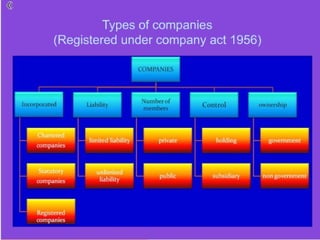
Types of company
Introduction
WHAT IS COMPANY

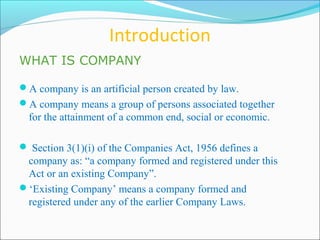
A company is an artificial person created by law.
A company means a group of persons associated together
  for the attainment of a common end, social or economic.

 Section 3(1)(i) of the Companies Act, 1956 defines a
 company as: “a company formed and registered under this
 Act or an existing Company”.
‘Existing Company’ means a company formed and
 registered under any of the earlier Company Laws.
Characteristics of a company


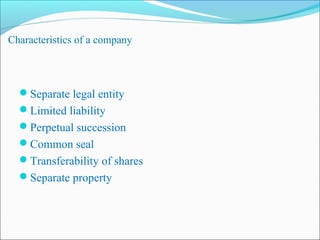
  Separate legal entity
  Limited liability
  Perpetual succession
  Common seal
  Transferability of shares
  Separate property
SEPARATE LEGAL ENTITY-
 A company is in law regarded as an entity separate
  from its members. It has an independent corporate
  existence.
 Any of its member can enter into contracts with it
  in the same manner as any other individual can and
  he cannot be held liable for the acts of the company
  even if he holds virtually the entire share capital.
 The company’s money and property belongs to it
  and not to the shareholders (although the
  shareholders own the company)
LIMITED LIABILITY-
A company may be a company limited by shares or a
  company limited by guarantee. In a company limited
  by shares, the liability of members is limited to the
  unpaid value of the shares.
PERPETUAL SUCCESSION-
Being an artificial person a company never dies, nor
  does its life depend on the life of its members.
  Members may come and go but the company can go on
  forever. It continues to exist even if all its members are
  dead. The existence of company can be terminated only
  by law.
It means that a company’s existence persists
  irrespective of the change in the composition of its
  membership.
COMMON SEAL-
 Since a company has no physical existence, it must
 act through its agents and all such contracts entered
 into by its agents must be under a seal of the
 company. The common seal acts as the official
 signature of the company.

TRANSFERABILITY OF SHARES-
 The capital of a company is divided into parts
 called shares. These shares are, subject to certain
 conditions, freely transferable, so that no shareholder
 is permanently wedded to the company. When the
 join stock companies were established the great
 object was that the shares should be capable of being
 easily transferred.
SEPARATE PROPERTY:
 As a company is a legal person distinct from its
 members, it is capable of owning, enjoying and
 disposing of property in its own name. Although its
 capital and assets are contributed by its shareholders,
 they are not the private and joint owners of its
 property. The company is the real person in which all
 its property is vested and by which it is controlled,
 managed and disposed of.
ON THE BASIS OF INCORPORATION

Statutory companies-
    These are the companies which are created by a
  special Act of the legislature e.g. RBI, SBI, LIC, etc.
  These are mostly concerned with public utilities as
  railways,tramways,gas and electricity companies and
  enterprises of national level importance.

Registered companies-
   These are the companies which are formed and
 registered under the Companies Act,1956 .
ON THE BASIS OF LIABILITY
1) Companies with limited liability:

    LIMITED BY SHARES:
          Where the liability of the members of a
   company is limited to the amount unpaid on the
   shares ,it is known as company limited by shares. If
   the shares are fully paid, the liability of the members
   holding such shares is nil. It may be a public or a
   private company.
LIMITED BY GUARANTEE:
 Where the liability of the members of a company
  is limited to a fixed amount which the members
  undertake to contribute to the assets of a company
  in the event of its being wound up, the company is
  called a company limited by guarantee.

 These companies are not formed for the purpose of
   profit but for the promotion of art, science, charity,
   sports or for some similar purposes. They may or
   may not have a share capital.
2) Companies with unlimited liability

 Sec 12 specifically provides that any 7 or more
  persons may form an incorporated company with or
  without limited liability. In such case every member
  is liable for the debts of the company.

An unlimited company may or may not have a share
  capital. If it has a share capital, it may be a public
  company or a private company. It must have its own
  Articles of Association.
ON THE BASIS OF NUMBER OF MEMBERS

PRIVATE COMPANY-
     A company which has a minimum paid-up capital of
   Rs 1,00,000 or such higher paid up capital as may be
   prescribed, and by its articles
a. Restricts the right to transfer its shares, if any
b. Limits the number of its members to 50.
c. Prohibits any invitation to the public to subscribe for
   any shares in, or debentures of, the company,
d. Prohibits any invitation or acceptance of deposits
   from persons other than its members, directors or their
   relatives.
PUBLIC COMPANY:
A public company means a company which-
(a)has a minimum paid-up capital of Rs. 5 lakh or such
  higher paid-up capital, as may be prescribed;
(b)is a private company which is a subsidiary of a
  company which is not a private company;
  Every public company, existing on the commencement
  of the Companies Act, 2000, with a paid-up capital of
  less than Rs. 5 lakh, within a period of two years from
  such commencement, enhance its paid-up capital to
  Rs. 5 lakh.
ON THE BASIS OF CONTROL

 Holding companies-
     A company is known as the holding company of
 another company if it has the control over that other
 company. A company is deemed to be the holding
 company of another if, but only if, that other is its
 subsidiary.
 Subsidiary company-
      A company is known as a subsidiary of another
 company when control is exercised by the holding
 company over the former called a subsidiary company.
ON THE BASIS OF OWNERSHIP

Government company -
   A government company means any company in which not less
   than 51% of the paid-up share capital is held by-
a) The central government, or
b) Any state government, or governments, or
c) Partly by central government and partly by one or more state
   government.

Foreign company-
    It means any company incorporated outside India which has
    an established place of business in India.Where a minimum of
    50% of the paid up share capital of a foreign company is held
    by one or more citizens of India or/and by one or more bodies
    corporate incorporated in India, whether singly or jointly,
    such company shall comply with such provisions as may be
    prescribed as if it were an Indian company.
Companies act 1956-ppt

Companies act 1956-ppt

  • 2.
  • 3.
    Introduction WHAT IS COMPANY Acompany is an artificial person created by law. A company means a group of persons associated together for the attainment of a common end, social or economic.  Section 3(1)(i) of the Companies Act, 1956 defines a company as: “a company formed and registered under this Act or an existing Company”. ‘Existing Company’ means a company formed and registered under any of the earlier Company Laws.
  • 4.
    Characteristics of acompany Separate legal entity Limited liability Perpetual succession Common seal Transferability of shares Separate property
  • 5.
    SEPARATE LEGAL ENTITY- A company is in law regarded as an entity separate from its members. It has an independent corporate existence.  Any of its member can enter into contracts with it in the same manner as any other individual can and he cannot be held liable for the acts of the company even if he holds virtually the entire share capital.  The company’s money and property belongs to it and not to the shareholders (although the shareholders own the company)
  • 6.
    LIMITED LIABILITY- A companymay be a company limited by shares or a company limited by guarantee. In a company limited by shares, the liability of members is limited to the unpaid value of the shares. PERPETUAL SUCCESSION- Being an artificial person a company never dies, nor does its life depend on the life of its members. Members may come and go but the company can go on forever. It continues to exist even if all its members are dead. The existence of company can be terminated only by law. It means that a company’s existence persists irrespective of the change in the composition of its membership.
  • 7.
    COMMON SEAL-  Sincea company has no physical existence, it must act through its agents and all such contracts entered into by its agents must be under a seal of the company. The common seal acts as the official signature of the company. TRANSFERABILITY OF SHARES-  The capital of a company is divided into parts called shares. These shares are, subject to certain conditions, freely transferable, so that no shareholder is permanently wedded to the company. When the join stock companies were established the great object was that the shares should be capable of being easily transferred.
  • 8.
    SEPARATE PROPERTY:  Asa company is a legal person distinct from its members, it is capable of owning, enjoying and disposing of property in its own name. Although its capital and assets are contributed by its shareholders, they are not the private and joint owners of its property. The company is the real person in which all its property is vested and by which it is controlled, managed and disposed of.
  • 10.
    ON THE BASISOF INCORPORATION Statutory companies- These are the companies which are created by a special Act of the legislature e.g. RBI, SBI, LIC, etc. These are mostly concerned with public utilities as railways,tramways,gas and electricity companies and enterprises of national level importance. Registered companies- These are the companies which are formed and registered under the Companies Act,1956 .
  • 11.
    ON THE BASISOF LIABILITY 1) Companies with limited liability: LIMITED BY SHARES: Where the liability of the members of a company is limited to the amount unpaid on the shares ,it is known as company limited by shares. If the shares are fully paid, the liability of the members holding such shares is nil. It may be a public or a private company.
  • 12.
    LIMITED BY GUARANTEE: Where the liability of the members of a company is limited to a fixed amount which the members undertake to contribute to the assets of a company in the event of its being wound up, the company is called a company limited by guarantee.  These companies are not formed for the purpose of profit but for the promotion of art, science, charity, sports or for some similar purposes. They may or may not have a share capital.
  • 13.
    2) Companies withunlimited liability  Sec 12 specifically provides that any 7 or more persons may form an incorporated company with or without limited liability. In such case every member is liable for the debts of the company. An unlimited company may or may not have a share capital. If it has a share capital, it may be a public company or a private company. It must have its own Articles of Association.
  • 14.
    ON THE BASISOF NUMBER OF MEMBERS PRIVATE COMPANY- A company which has a minimum paid-up capital of Rs 1,00,000 or such higher paid up capital as may be prescribed, and by its articles a. Restricts the right to transfer its shares, if any b. Limits the number of its members to 50. c. Prohibits any invitation to the public to subscribe for any shares in, or debentures of, the company, d. Prohibits any invitation or acceptance of deposits from persons other than its members, directors or their relatives.
  • 15.
    PUBLIC COMPANY: A publiccompany means a company which- (a)has a minimum paid-up capital of Rs. 5 lakh or such higher paid-up capital, as may be prescribed; (b)is a private company which is a subsidiary of a company which is not a private company; Every public company, existing on the commencement of the Companies Act, 2000, with a paid-up capital of less than Rs. 5 lakh, within a period of two years from such commencement, enhance its paid-up capital to Rs. 5 lakh.
  • 16.
    ON THE BASISOF CONTROL Holding companies- A company is known as the holding company of another company if it has the control over that other company. A company is deemed to be the holding company of another if, but only if, that other is its subsidiary. Subsidiary company- A company is known as a subsidiary of another company when control is exercised by the holding company over the former called a subsidiary company.
  • 17.
    ON THE BASISOF OWNERSHIP Government company - A government company means any company in which not less than 51% of the paid-up share capital is held by- a) The central government, or b) Any state government, or governments, or c) Partly by central government and partly by one or more state government. Foreign company- It means any company incorporated outside India which has an established place of business in India.Where a minimum of 50% of the paid up share capital of a foreign company is held by one or more citizens of India or/and by one or more bodies corporate incorporated in India, whether singly or jointly, such company shall comply with such provisions as may be prescribed as if it were an Indian company.