Part II
The Information Economy
Century ago
• The world become smaller.
• Rapid communication technology
• Unprecedented scale of economics.
• Built vast empires.
• Great fortunes, Monopoly.
• Government interruption.
Now
• Technology changes but economic law does
not.
• Focused on trees of technological change,
fail to see forest.
• Success and failure
• E.g. Netscape, software and hardware.
• System
Information
• Anything that can be digitized: encoded as a
stream of bits.
– Text, images, videos, music, etc.
– a.k.a. content, digital goods
• Unique cost characteristics
• Unique demand characteristics
• Value: entertainment, business
Cost structure
• Expensive to produce, cheap to reproduce
• High fixed cost, low marginal cost
– Not only fixed, but sunk
– No significant capacity constraints
– Customer value, not production cost.
– Particular market structures
• Monopoly
• Cost leadership
• Product differentiation (versioning)
Rights Management
• Low reproduction cost is two-edged sword
– Cheap for owners (high profit margin)
– But also cheap for copiers
• Maximize value of IP, not protection
• Examples
– Library industry
– Video industry
Consumption Characteristics
• Experience good
– Browsing
– Always new
– Reputation and brand identity
• E.g. Kantipur
Economics of attention
• Overload
– Economics of attention
– Herbert Simon: “a wealth of information
creates a poverty of attention”
– Locating, filtering and communicating
– Hotmail example
– Broadcast, point-to-point, hybrid
– Web servers-behavior of customers
Technology
• Infrastructure to store, retrieve, filter,
manipulate, view, transmit, and receive
information
• As BOTTLE is to WINE.
• Adds value to information by making it
more accessible.
– Web = 1 terabyte of text = 1 million books
– If 10% useful = 1 Borders Bookstore
– Value of Web is in ease of access
• Front end to databases, etc.
• Currency
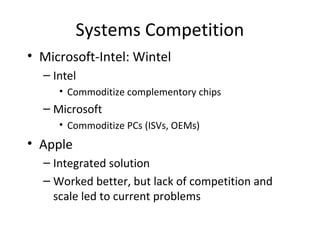
Systems Competition
• Microsoft-Intel: Wintel
– Intel
• Commoditize complementory chips
– Microsoft
• Commoditize PCs (ISVs, OEMs)
• Apple
– Integrated solution
– Worked better, but lack of competition and
scale led to current problems
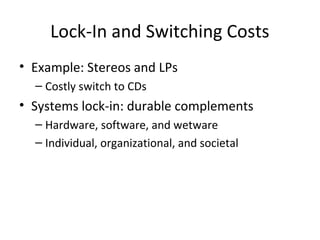
Lock-In and Switching Costs
• Example: Stereos and LPs
– Costly switch to CDs
• Systems lock-in: durable complements
– Hardware, software, and wetware
– Individual, organizational, and societal
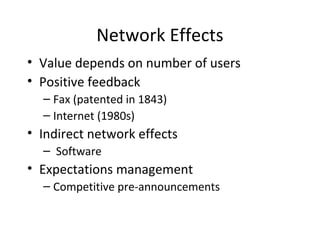
Network Effects
• Value depends on number of users
• Positive feedback
– Fax (patented in 1843)
– Internet (1980s)
• Indirect network effects
– Software
• Expectations management
– Competitive pre-announcements
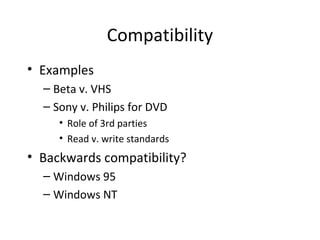
Compatibility
• Examples
– Beta v. VHS
– Sony v. Philips for DVD
• Role of 3rd parties
• Read v. write standards
• Backwards compatibility?
– Windows 95
– Windows NT
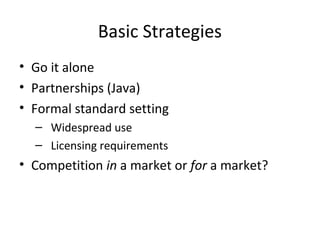
Basic Strategies
• Go it alone
• Partnerships (Java)
• Formal standard setting
– Widespread use
– Licensing requirements
• Competition in a market or for a market?
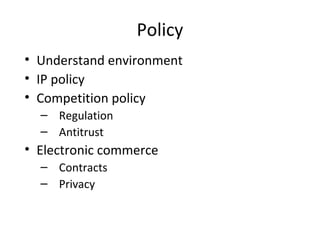
Policy
• Understand environment
• IP policy
• Competition policy
– Regulation
– Antitrust
• Electronic commerce
– Contracts
– Privacy
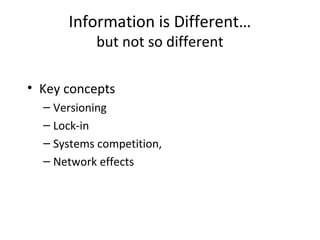
Information is Different…
but not so different
• Key concepts
– Versioning
– Lock-in
– Systems competition,
– Network effects

The Information Economy

  • 1.
  • 2.
    Century ago • Theworld become smaller. • Rapid communication technology • Unprecedented scale of economics. • Built vast empires. • Great fortunes, Monopoly. • Government interruption.
  • 3.
    Now • Technology changesbut economic law does not. • Focused on trees of technological change, fail to see forest. • Success and failure • E.g. Netscape, software and hardware. • System
  • 4.
    Information • Anything thatcan be digitized: encoded as a stream of bits. – Text, images, videos, music, etc. – a.k.a. content, digital goods • Unique cost characteristics • Unique demand characteristics • Value: entertainment, business
  • 5.
    Cost structure • Expensiveto produce, cheap to reproduce • High fixed cost, low marginal cost – Not only fixed, but sunk – No significant capacity constraints – Customer value, not production cost. – Particular market structures • Monopoly • Cost leadership • Product differentiation (versioning)
  • 6.
    Rights Management • Lowreproduction cost is two-edged sword – Cheap for owners (high profit margin) – But also cheap for copiers • Maximize value of IP, not protection • Examples – Library industry – Video industry
  • 7.
    Consumption Characteristics • Experiencegood – Browsing – Always new – Reputation and brand identity • E.g. Kantipur
  • 8.
    Economics of attention •Overload – Economics of attention – Herbert Simon: “a wealth of information creates a poverty of attention” – Locating, filtering and communicating – Hotmail example – Broadcast, point-to-point, hybrid – Web servers-behavior of customers
  • 9.
    Technology • Infrastructure tostore, retrieve, filter, manipulate, view, transmit, and receive information • As BOTTLE is to WINE. • Adds value to information by making it more accessible. – Web = 1 terabyte of text = 1 million books – If 10% useful = 1 Borders Bookstore – Value of Web is in ease of access • Front end to databases, etc. • Currency
  • 10.
    Systems Competition • Microsoft-Intel:Wintel – Intel • Commoditize complementory chips – Microsoft • Commoditize PCs (ISVs, OEMs) • Apple – Integrated solution – Worked better, but lack of competition and scale led to current problems
  • 11.
    Lock-In and SwitchingCosts • Example: Stereos and LPs – Costly switch to CDs • Systems lock-in: durable complements – Hardware, software, and wetware – Individual, organizational, and societal
  • 12.
    Network Effects • Valuedepends on number of users • Positive feedback – Fax (patented in 1843) – Internet (1980s) • Indirect network effects – Software • Expectations management – Competitive pre-announcements
  • 13.
    Compatibility • Examples – Betav. VHS – Sony v. Philips for DVD • Role of 3rd parties • Read v. write standards • Backwards compatibility? – Windows 95 – Windows NT
  • 14.
    Basic Strategies • Goit alone • Partnerships (Java) • Formal standard setting – Widespread use – Licensing requirements • Competition in a market or for a market?
  • 15.
    Policy • Understand environment •IP policy • Competition policy – Regulation – Antitrust • Electronic commerce – Contracts – Privacy
  • 16.
    Information is Different… butnot so different • Key concepts – Versioning – Lock-in – Systems competition, – Network effects