Introduction
MIS MODEL
Components OF MIS
Conclusion
2
Define: An integrated user-machine system for providing
information to support operations, management and
decision making functions in an organization.
The system utilizes computerized and manual procedures;
models for analysis, planning, control and decision making;
and a database.”
3
INTRODUCTION of MIS
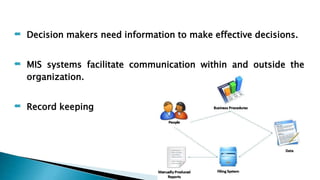
 Decision makers need information to make effective decisions.
 MIS systems facilitate communication within and outside the
organization.
 Record keeping
4
5
6
Define the problem and the factor that influence it.
Select criteria to guide the decision and establish objectives.
Formulate a model that helps management to understand the relationships between
the influence factors and the objectives the firm is trying to achieve.
Collect the relevant data while trying to avoid the incorporation of superfluous
information into the model.
Identify and evaluate the alternatives.
Select the best alternative.
Implement the alternative.
Steps of Model Construction
7
8
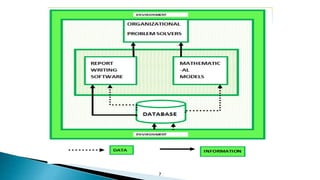
Components of MIS Model
Organizational Problem Solvers:
Outputs are used by persons who are responsible for solving the firm’s.
Database:
It’s contents are used by software that produces report as well as mathematical model.
Mathematical Model:
It produces information as a simulation of firm’s operation.
Report Writing Software:
It produces both periodic and special report.
Environment:
The environment is of great importance to the firm. It is the very reason of the firm’s existence.
9
Advantages:
Can be a learning experience.
Provides predictive power.
Less expensive than trial and error method.
Speed allows consideration of more options.
Disadvantages:
Difficult to model a business system.
High degree of mathematical skills required.
10
MIS flexible enough to deal with changing information needs of the
organization.
The designing of such a system is a complex task. It can be achieved
only if the MIS is planned.
We understand this planning and implementation in management
development process.
CONCLUSION
11
Any questions?
You can find me at:
@username
user@mail.me

Mis model

  • 2.
  • 3.
    Define: An integrateduser-machine system for providing information to support operations, management and decision making functions in an organization. The system utilizes computerized and manual procedures; models for analysis, planning, control and decision making; and a database.” 3 INTRODUCTION of MIS
  • 4.
     Decision makersneed information to make effective decisions.  MIS systems facilitate communication within and outside the organization.  Record keeping 4
  • 5.
  • 6.
    6 Define the problemand the factor that influence it. Select criteria to guide the decision and establish objectives. Formulate a model that helps management to understand the relationships between the influence factors and the objectives the firm is trying to achieve. Collect the relevant data while trying to avoid the incorporation of superfluous information into the model. Identify and evaluate the alternatives. Select the best alternative. Implement the alternative. Steps of Model Construction
  • 7.
  • 8.
    8 Components of MISModel Organizational Problem Solvers: Outputs are used by persons who are responsible for solving the firm’s. Database: It’s contents are used by software that produces report as well as mathematical model. Mathematical Model: It produces information as a simulation of firm’s operation. Report Writing Software: It produces both periodic and special report. Environment: The environment is of great importance to the firm. It is the very reason of the firm’s existence.
  • 9.
    9 Advantages: Can be alearning experience. Provides predictive power. Less expensive than trial and error method. Speed allows consideration of more options. Disadvantages: Difficult to model a business system. High degree of mathematical skills required.
  • 10.
    10 MIS flexible enoughto deal with changing information needs of the organization. The designing of such a system is a complex task. It can be achieved only if the MIS is planned. We understand this planning and implementation in management development process. CONCLUSION
  • 11.
    11 Any questions? You canfind me at: @username user@mail.me