MIS - UNIT 4
DEVELOPMENT OF MIS
Development of Long Rate Plans of the MIS
Any kind of business activity calls for long range plans for success, the same
being true for MIS. The plan for development and its implementation is a basic
necessity for MIS. In MIS the information is recognized as a major resource like
capital, time and capacity. And if this resource is to be managed well, it calls upon
the management to plan for it and controlit for the appropriate use in the
organization. Most of the organizations do not recognize `Information' as a
resource. They have looked at information as one of the many necessities for
conducting the business activity. Hence, due regard is often not given for its
planned development and use. Many organizations have spent financial resources
on computers purely to expedite the activity of data collection and processing.
Many organizations have purchased computers for data processing and for
meeting the statutory requirements of filing the returns and reports to the
Government. Computers are used mainly for computing and accounting the
business transactions and have not been considered as a toolfor information
processing.
The organizations have invested in computers and expanded its use by adding
more or bigger computers to take care of the numerous transactions in the business.
In this approachthe information processing function of the computers in the
organization never got it s due regard as an important asset to the organization. In
fact, this function is misinterpreted as data processingfor expeditious generation of
reports and returns, and not as information processingfor management action and
decisions.
However, the scheme has been changing since late eighties when the computers
became more versatile, in the function of Storage, Communication, Intelligence
and Language. The computer technology is so advanced that the barriers of
storage, distance, understanding of language and speed are broken.
With the advancement of computer technology, it is now possible to recognize
information as valuable resources like money and capacity.
In short, we need a Management Information System flexible enough to deal with
the changing information needs of the organization. It should be conceived as an
open system continuously interacting with the business environment with a built-in
mechanism to provide the desired information as per the new requirements of the
management. The designing of such as open system is a complex task. It can be
achieved only if the MIS is planned, keeping in view, the plan of the business
management of the organization.
The plan of MIS is concurrent to the business plan of the organization. The
information needs for the implementation of the business plan should find place in
the MIS. To ensure such an alignment possibility, it is necessary that the business
plan – strategic or otherwise, states the information needs. The information needs
are the traced to the sourcedata and the systems in the organization which generate
such a data. The plan of development of the MIS is linked with the steps of the
implementation in a business development plan. The system of information
generation is so planned that strategic information is provided for the strategic
planning, controlinformation is provided for a short term planning and execution.
Contents of the MIS Plan
A long range MIS plan provides direction for the development of the systems, and
provides a basis for achieving the specific targets or tasks against a time frame.
The plan would have the following contents which will be dealt by the designer
under a supportfrom the top management.
Different Approaches to Development of MIS
There are two basic approaches for development of MIS :
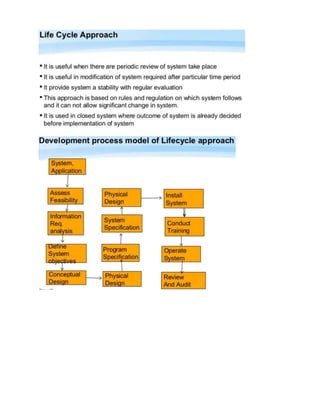
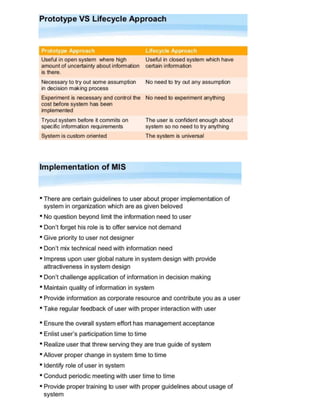
a) System development life cycle : In order to develop a system successfully, it is
managed by breaking the total development process into smaller basic activities or
phases. Any system development process, in general, is understood to have the
following phases
i) Systems Planning
ii) Systems Analysis
iii) Systems Design
iv) Systems Implementation
v) Systems Operation and Support (System Maintenance)
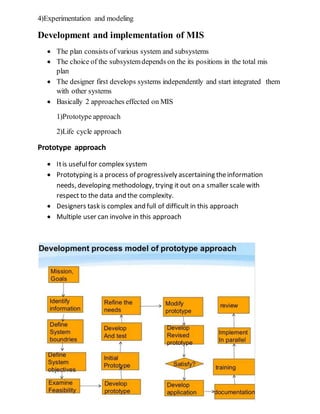
b) Prototyping : Prototyping is the process ofcreating an incomplete model of the
future full-featured system, which can be used to let the users have a first idea of
the completed program or allow the clients to evaluate the program.
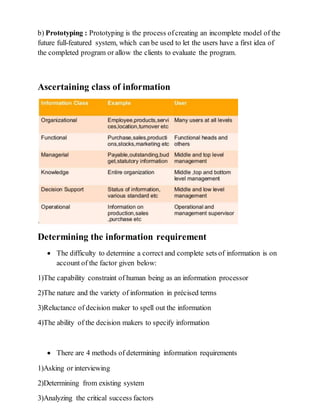
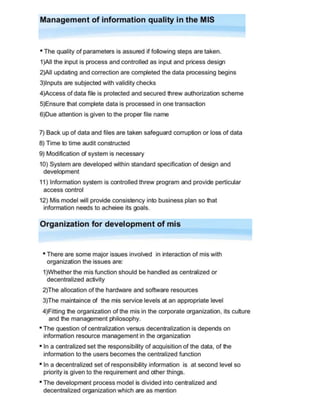
Ascertaining class of information
Determining the information requirement
 The difficulty to determine a correct and complete sets of information is on
account of the factor given below:
1)The capability constraint of human being as an information processor
2)The nature and the variety of information in précised terms
3)Reluctance of decision maker to spell out the information
4)The ability of the decision makers to specify information
 There are 4 methods of determining information requirements
1)Asking or interviewing
2)Determining from existing system
3)Analyzing the critical success factors
4)Experimentation and modeling
Development and implementation of MIS
 The plan consists of various system and subsystems
 The choice of the subsystemdepends on the its positions in the total mis
plan
 The designer first develops systems independently and start integrated them
with other systems
 Basically 2 approaches effected on MIS
1)Prototype approach
2)Life cycle approach
Prototype approach
 Itis usefulfor complex system
 Prototyping is a process of progressively ascertaining theinformation
needs, developing methodology, trying it out on a smaller scale with
respect to the data and the complexity.
 Designers task is complex and full of difficult in this approach
 Multiple user can involve in this approach
Mis notes unit 4
Mis notes unit 4
Mis notes unit 4
Mis notes unit 4
Mis notes unit 4

Mis notes unit 4

  • 1.
    MIS - UNIT4 DEVELOPMENT OF MIS Development of Long Rate Plans of the MIS Any kind of business activity calls for long range plans for success, the same being true for MIS. The plan for development and its implementation is a basic necessity for MIS. In MIS the information is recognized as a major resource like capital, time and capacity. And if this resource is to be managed well, it calls upon the management to plan for it and controlit for the appropriate use in the organization. Most of the organizations do not recognize `Information' as a resource. They have looked at information as one of the many necessities for conducting the business activity. Hence, due regard is often not given for its planned development and use. Many organizations have spent financial resources on computers purely to expedite the activity of data collection and processing. Many organizations have purchased computers for data processing and for meeting the statutory requirements of filing the returns and reports to the Government. Computers are used mainly for computing and accounting the business transactions and have not been considered as a toolfor information processing. The organizations have invested in computers and expanded its use by adding more or bigger computers to take care of the numerous transactions in the business. In this approachthe information processing function of the computers in the organization never got it s due regard as an important asset to the organization. In fact, this function is misinterpreted as data processingfor expeditious generation of reports and returns, and not as information processingfor management action and decisions. However, the scheme has been changing since late eighties when the computers became more versatile, in the function of Storage, Communication, Intelligence and Language. The computer technology is so advanced that the barriers of storage, distance, understanding of language and speed are broken. With the advancement of computer technology, it is now possible to recognize information as valuable resources like money and capacity.
  • 2.
    In short, weneed a Management Information System flexible enough to deal with the changing information needs of the organization. It should be conceived as an open system continuously interacting with the business environment with a built-in mechanism to provide the desired information as per the new requirements of the management. The designing of such as open system is a complex task. It can be achieved only if the MIS is planned, keeping in view, the plan of the business management of the organization. The plan of MIS is concurrent to the business plan of the organization. The information needs for the implementation of the business plan should find place in the MIS. To ensure such an alignment possibility, it is necessary that the business plan – strategic or otherwise, states the information needs. The information needs are the traced to the sourcedata and the systems in the organization which generate such a data. The plan of development of the MIS is linked with the steps of the implementation in a business development plan. The system of information generation is so planned that strategic information is provided for the strategic planning, controlinformation is provided for a short term planning and execution. Contents of the MIS Plan A long range MIS plan provides direction for the development of the systems, and provides a basis for achieving the specific targets or tasks against a time frame. The plan would have the following contents which will be dealt by the designer under a supportfrom the top management. Different Approaches to Development of MIS There are two basic approaches for development of MIS : a) System development life cycle : In order to develop a system successfully, it is managed by breaking the total development process into smaller basic activities or phases. Any system development process, in general, is understood to have the following phases i) Systems Planning ii) Systems Analysis iii) Systems Design iv) Systems Implementation v) Systems Operation and Support (System Maintenance)
  • 3.
    b) Prototyping :Prototyping is the process ofcreating an incomplete model of the future full-featured system, which can be used to let the users have a first idea of the completed program or allow the clients to evaluate the program. Ascertaining class of information Determining the information requirement  The difficulty to determine a correct and complete sets of information is on account of the factor given below: 1)The capability constraint of human being as an information processor 2)The nature and the variety of information in précised terms 3)Reluctance of decision maker to spell out the information 4)The ability of the decision makers to specify information  There are 4 methods of determining information requirements 1)Asking or interviewing 2)Determining from existing system 3)Analyzing the critical success factors
  • 4.
    4)Experimentation and modeling Developmentand implementation of MIS  The plan consists of various system and subsystems  The choice of the subsystemdepends on the its positions in the total mis plan  The designer first develops systems independently and start integrated them with other systems  Basically 2 approaches effected on MIS 1)Prototype approach 2)Life cycle approach Prototype approach  Itis usefulfor complex system  Prototyping is a process of progressively ascertaining theinformation needs, developing methodology, trying it out on a smaller scale with respect to the data and the complexity.  Designers task is complex and full of difficult in this approach  Multiple user can involve in this approach