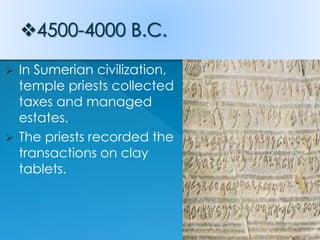

 In Sumerian civilization,
temple priests collected
taxes and managed
estates.
 The priests recorded the
transactions on clay
tablets.
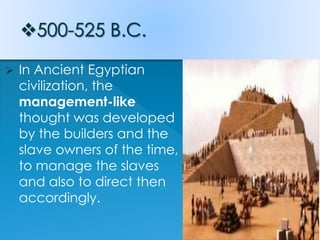
 In Ancient Egyptian
civilization, the
management-like
thought was developed
by the builders and the
slave owners of the time,
to manage the slaves
and also to direct then
accordingly.
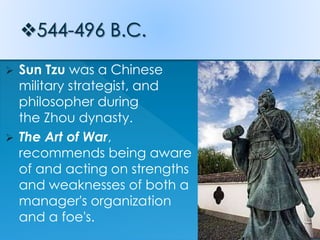
 Sun Tzu was a Chinese
military strategist, and
philosopher during
the Zhou dynasty.
 The Art of War,
recommends being aware
of and acting on strengths
and weaknesses of both a
manager's organization
and a foe's.
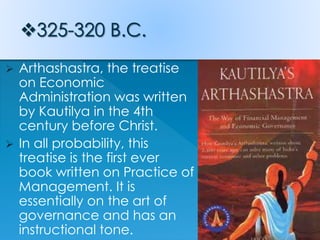
 Arthashastra, the treatise
on Economic
Administration was written
by Kautilya in the 4th
century before Christ.
 In all probability, this
treatise is the first ever
book written on Practice of
Management. It is
essentially on the art of
governance and has an
instructional tone.
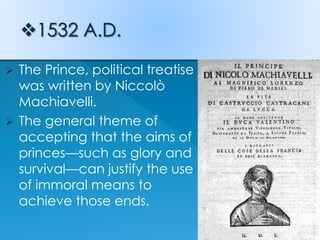
 The Prince, political treatise
was written by Niccolò
Machiavelli.
 The general theme of
accepting that the aims of
princes—such as glory and
survival—can justify the use
of immoral means to
achieve those ends.
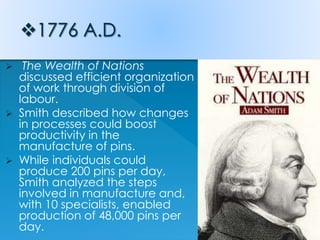
 The Wealth of Nations
discussed efficient organization
of work through division of
labour.
 Smith described how changes
in processes could boost
productivity in the
manufacture of pins.
 While individuals could
produce 200 pins per day,
Smith analyzed the steps
involved in manufacture and,
with 10 specialists, enabled
production of 48,000 pins per
day.
 There are basically six approaches to
management:
a) The Scientific Management
b) General Administrative theories
c) Quantitative Approach to Management
d) Organizational Behavior
e) The Systems Approach
f) The Contingency Approach
 “The science of management is today where
the natural sciences were before the
discovery of circulation of blood.”
History of Management

History of Management

  • 2.
     In Sumeriancivilization, temple priests collected taxes and managed estates.  The priests recorded the transactions on clay tablets.
  • 3.
     In AncientEgyptian civilization, the management-like thought was developed by the builders and the slave owners of the time, to manage the slaves and also to direct then accordingly.
  • 4.
     Sun Tzuwas a Chinese military strategist, and philosopher during the Zhou dynasty.  The Art of War, recommends being aware of and acting on strengths and weaknesses of both a manager's organization and a foe's.
  • 5.
     Arthashastra, thetreatise on Economic Administration was written by Kautilya in the 4th century before Christ.  In all probability, this treatise is the first ever book written on Practice of Management. It is essentially on the art of governance and has an instructional tone.
  • 6.
     The Prince,political treatise was written by Niccolò Machiavelli.  The general theme of accepting that the aims of princes—such as glory and survival—can justify the use of immoral means to achieve those ends.
  • 7.
     The Wealthof Nations discussed efficient organization of work through division of labour.  Smith described how changes in processes could boost productivity in the manufacture of pins.  While individuals could produce 200 pins per day, Smith analyzed the steps involved in manufacture and, with 10 specialists, enabled production of 48,000 pins per day.
  • 8.
     There arebasically six approaches to management: a) The Scientific Management b) General Administrative theories c) Quantitative Approach to Management d) Organizational Behavior e) The Systems Approach f) The Contingency Approach
  • 9.
     “The scienceof management is today where the natural sciences were before the discovery of circulation of blood.”