ORGANIZATIONAL CULTURE
AND ENVIRONMENT
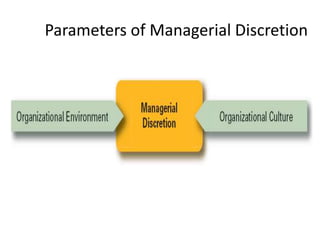
Parameters of Managerial Discretion
ORGANIZATIONAL CULTURE
– A system of shared meanings and common
beliefs held by organizational members that
determines, in a large degree, how they act
towards each other.
– “The way we do things around here.”
• Values, symbols, rituals, myths, and practices
– Implications:
• Culture is a perception.
• Culture is shared.
• Culture is descriptive.
DEFINITION OF ORGANISATIONAL
CULTURE
• According to Ralph Linton, culture refers to
the set of values that help members
understand what the organization stands
for, how it does things, and what it
considers important.
• According to Linda Smircich, organizational
culture is a system of shared values,
assumptions, beliefs, and norms that unite
the members of an organization.
• Ricky W. Griffin states that organizational
culture is the collection of shared (stated or
implied) beliefs, values, rituals ,stories,
myths and specialized language that foster
a feeling of community among organization
members.
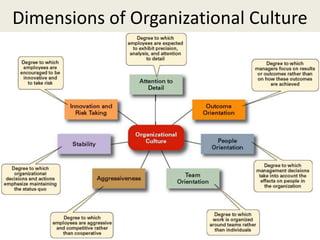
Dimensions of Organizational Culture
Characteristics/ Attributes of
Organizational Culture
• It is distinctive: mission , vision , goal
• It is based on certain norms.
• It promotes dominant and stable values.
• It leads to common behavioral aspects.
• It shapes philosophy rules.
• Its strength varies.
STRONG VERSUS WEAK CULTURES
Strong Culture
– Are cultures in which key values are deeply
held and widely held.
– Have a strong influence on organizational
members.
– Commit members to do things that are in
the best interests of the organization.
– Discourage dysfunctional work behavior.
– Encourage functional work behavior.
• The best organizations have strong
cultures that:
–Are performance-oriented.
–Emphasize teamwork.
–Allow for risk taking.
–Encourage innovation.
–Value the well being of people.
Factors Influencing the Strength of
Culture
1. Size of the organization
2. Age of the organization
3. Rate of employee turnover
4. Strength of the original culture
5. Clarity of cultural values and beliefs
Benefits of a Strong Culture
• Creates a stronger employee commitment
to the organization.
• Aids in the recruitment and socialization of
new employees.
• Fosters higher organizational performance
by instilling and promoting employee
initiative.
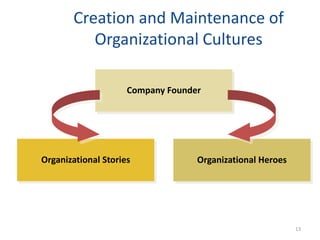
Creation and Maintenance of
Organizational Cultures
13
Organizational HeroesOrganizational Stories
Company Founder
How Employees Learn Culture
• Stories
– Narratives of significant events or actions of
people that convey the spirit of the organization
• Rituals
– Repetitive sequences of activities that express
and reinforce the values of the organization
• Material Symbols
– Physical assets distinguishing the organization
• Language
– Acronyms and jargon of terms, phrases, and
word meanings specific to an organization
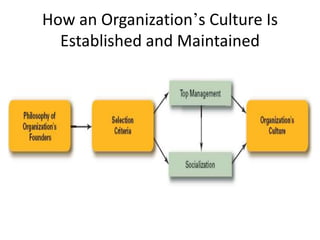
How an Organization’s Culture Is
Established and Maintained
Organizational Socialization Process
It refers to the process that helps new
employee adapt to the organization's culture.
Org uses several resources to the same which
include company newsletter, manual,
handbook, orientation and training , citation of
role models.
Stories can also play vital role as it is powerful
tolls for conveying values.
Another method for conveying values is the
participation of senior officer in training
program designed to help new employees
• Culture is often defined by the system that are
used, the processes that are followed., and
the rituals, symbols, and stories that abound
in the organization.
• It is also reflected in how meetings are held in
the organization
Steps in the Socialization Process
The organization should identify and select
those candidates whose values are compatible
with the organization's culture.
The new employee should be moved closer
emotionally and make them cohesive as a
group.
They will be given practical training, leading to
mastery of the core discipline of the business.
The performance should be measured and
reward the individual performance.
By adopting the company’s values , the
• The last step is acknowledging the good work
of employees by promoting them to higher
position. These people can act as role models
for the new employees.
Managing the organizational Culture
and Change
• There are seven dimensions of an organizational
culture, namely, attention to detail, innovation and
risk taking, outcome orientation, stability, people
orientation, aggressiveness, and team orientation.
• Every single person comes from different background
and lifestyle , so there are various factors which
affect managing organizational culture.:-
Factors Affecting Org Culture
• Organizational Change
• Communication
• Service
• Compensation
• Organizational Culture
• Decision-Making
• Individual
Competencies
• Morale
• Performance Evaluation
• Quality
• Supervision
• Training & Development
• Mission
CHANGE
Change Management is a structured approach
to shifting/transitioning individuals, teams and
organizations from a current state to a desired
future state.
 It is aimed at empowering employee to accept
and embrace change in existing business
environment
It allows for new technology and new ways of
doing the same task more efficient and cost
effective manner.
Change can be un comfortable but surre can
Process of Change Management
Identifying the need for change in
organization.
Designing need specific changes to curb with
the requirement of the organizations.
Making others understand why changes is
necessary for the purpose.
Altering the organizational process like
processes, technology and performance
meters to incorporate the changes
Managing the production and changes to
ensure that customer and the stake holder
How is Change Effective
Successful change management is more likely to
occur if the following are included.:-
• Effective communication that informs various
stakeholder of the reason for the change (why?),the
benefits of the successful implementation (What is in
it for us, and you) as well as the details of the change
(When ? Where ? How much will it cost ?)
• Devise an effective education, training and skill
upgrading schemes for the organization.
• Counter Resistance from the employees of
companies and align them to overall strategies
direction of the organization.
• Provide personal counseling to alleviate any change
related fears.
• Monitoring of the implementation and fine-tuning as
required.
Resistance to Change
• Fear of the unknown
• Fear of Failure
• Disagreement with thee need for change
• Losing something of value
• Leaving a comfort zone
• False beliefs
• Misunderstanding and lack of trust.
• Inertia.
Group
• Two or more people/individuals coming into contact
on a continuing basis, personally & meaningfully
could be referred to as a group.
• Informal Group
– Informal group comprise of a small number of
people who frequently participate in activities and
sharre feelings for the purpose of a meeting their
mutual needs
• Formal Group
– Formal group and institution on the other hand
could be defined as the rules that are readily
observable through written documents or rules
that are determined & executed through formal
position such as authority or ownership.
– They include explicit incentives, contractual terms,
& firm boundaries as defined by equity position,
organizational charts and job description generally
reflect the formal structure or prescribed network
in a given organization
Leadership
• Leadership is a process by which a person
influences others to accomplish an objective
and directs the organization
• Leadership is a process where an individual
influences a group of individual to achieve a
common goal.
• Leadership Style
– Leadership style is the manner and approach of
providing direction, implementing plans, and
motivating people.
Leadership Style
• Authoritarian or Autocratic
• Participative or democratic
• Delegative or Free Reign
Authoritarian or Autocratic
• Here, leader tell their employees what he want done
and hoe he want it to accomplished, without getting
the advice of his followers.
• It used when leaders have all the information to
solve the problem, they are short on time, and their
employees are self motivated.
• This style can be vehicle for yelling, using demeaning
language, and leading by threats and abusing their
power.
• It is about ‘Bossing People Around’
Participative or democratic
• This style involves the leader including one or
more employees in the decision making
process (determining what to do and how to
do it).
• However leader maintain the final decision.
• It is normally used when employees are
knowledgeable and skillful.
• Using this style is of mutual benefit-it allows
them to become part of the team and allows
Delegative or Free Reign
• Here, the leader allows the employees to
make the decisions. However , the leader is
still responsible for outcome of the decision.
• It is useful when employees are able to
analyze the situation and determine what
needs to be done and how to do it.
• A Leader must set the priorities and delegate
certain tasks..
• This style is helpful when leader s have full
trust and confidence in employees.
Managerial Decisions Affected by
Culture
•Planning
•The degree of risk that plans should contain
•Whether plans should be developed by
individuals or teams
•The degree of environmental scanning in which
management will engage
•Organizing
•How much autonomy should be designed into
employees’ jobs
•Whether tasks should be done by individuals or
in teams
•Leading
•The degree to which managers are concerned
with increasing employee job satisfaction
•What leadership styles are appropriate
•Whether all disagreements—even constructive
ones—should be eliminated
•Controlling
•Whether to impose external controls or to allow
employees to control their own actions
•What criteria should be emphasized in employee
performance evaluations
•What repercussions will occur from exceeding
one’s budget
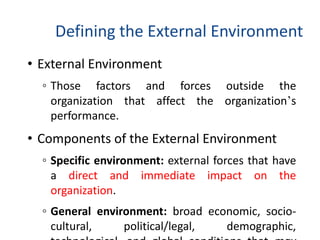
Defining the External Environment
• External Environment
◦ Those factors and forces outside the
organization that affect the organization’s
performance.
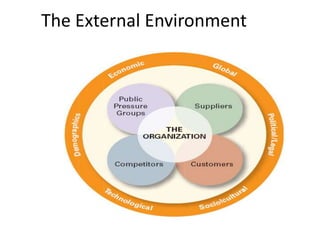
• Components of the External Environment
◦ Specific environment: external forces that have
a direct and immediate impact on the
organization.
◦ General environment: broad economic, socio-
cultural, political/legal, demographic,
The External Environment
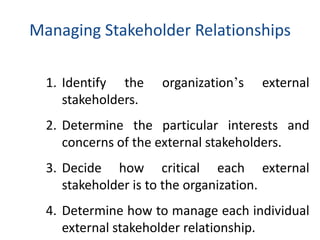
Managing Stakeholder Relationships
1. Identify the organization’s external
stakeholders.
2. Determine the particular interests and
concerns of the external stakeholders.
3. Decide how critical each external
stakeholder is to the organization.
4. Determine how to manage each individual
external stakeholder relationship.
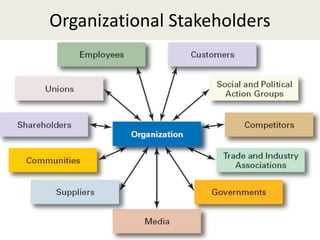
Organizational Stakeholders
Social responsibility and
Managerial ethics
Chapter – 5
MGT/M5/SS
“Business of Business is Business”
-Milton Friedman
CORPORATE SOCIAL RESPONSIBILITY
Corporate Social Responsibility is the
continuing commitment by business to
behave ethically and contribute to
economic development while improving
the quality of life of the workforce and
their families as well as of the local
community and society at large
42
Arguments in Favor of CSR
• It is in best interest of business to promote &
improve the communities where it does
business
• It is an ethical
• Long –run survival of the business concerns
• Profitable for the business concerns
• Moral and social commitment
• Improvement in public image
• Helps in avoiding government regulation
43
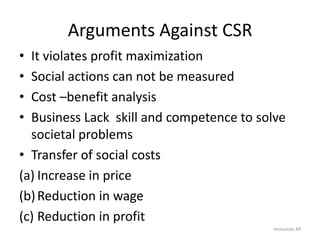
Arguments Against CSR
• It violates profit maximization
• Social actions can not be measured
• Cost –benefit analysis
• Business Lack skill and competence to solve
societal problems
• Transfer of social costs
(a) Increase in price
(b)Reduction in wage
(c) Reduction in profit
resources 44
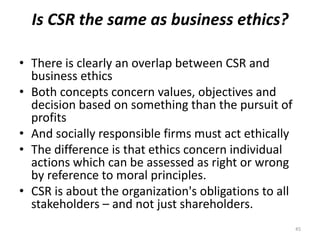
Is CSR the same as business ethics?
• There is clearly an overlap between CSR and
business ethics
• Both concepts concern values, objectives and
decision based on something than the pursuit of
profits
• And socially responsible firms must act ethically
• The difference is that ethics concern individual
actions which can be assessed as right or wrong
by reference to moral principles.
• CSR is about the organization's obligations to all
stakeholders – and not just shareholders.
45
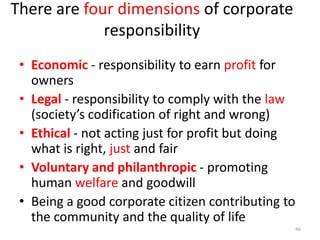
There are four dimensions of corporate
responsibility
• Economic - responsibility to earn profit for
owners
• Legal - responsibility to comply with the law
(society’s codification of right and wrong)
• Ethical - not acting just for profit but doing
what is right, just and fair
• Voluntary and philanthropic - promoting
human welfare and goodwill
• Being a good corporate citizen contributing to
the community and the quality of life
46
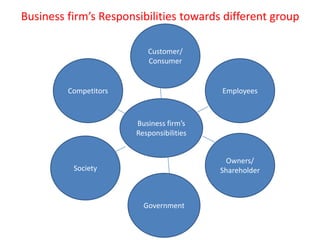
Business firm’s
Responsibilities
Owners/
Shareholder
Government
Society
Employees
Customer/
Consumer
Competitors
Business firm’s Responsibilities towards different group
Responsibilities towards Customer
• Fair Price
• Product must meet the need of the group
• Superior Quality
• Followed by Superior Service
• Superior Product Design
• Quick & Complete Information
Responsibilities Towards Employees
• Meaningful work
• Fair Salaries & Benefits
• Job Satisfaction
• Participation in Key Decisions
• Succession planning & Development
• Best quality of work life
• Member of Trade Union
• Collective Bargaining
• Right to strike
Responsibilities Towards
owners/Shareholder
• Fair & Reasonable Dividend
• Solvent & Efficient Business
• Optimum use of Resources
• Planned Growth
• Effective Communication by report
Responsibilities Towards Competitor
• Fair Competition
• Cooperation for sharing of scare resources and
facilities
• Good Advertisement
• Collaboration for maximization
Responsibilities Towards Government
• Payment of Taxes, Custom Duties etc
• Abide by the Laws
• Observe the politics
• Maintain Law & Security
Responsibilities Towards
Society/community
• Employment without discrimination
• Employment to disadvantaged person
• Community welfare services
• Business Morality of Business Efficiency
• Maintaining Pollution free environment
• Maintaining ecological balance
Ethics
• Derived from ‘ethos’ means character
• It’s science of Morals, being right, just, honest, good.
• A study concerned with human character and
conduct, Principles or ideals of human conduct.
Business Ethics
• Refers to the application of moral values,
accepted character and behavior during
performance of all business activities,
dealings, offers, practices and other corporate
issues.
Tools of Business Ethics
• To protect the interest of the society and to
maximize human welfare
• To convince the business to respect its
competitors role in the economy
• To respect customer’s interest and their role in
the business
• Improves the confidence of customer,
employers, suppliers, bankers etc in the
process of protecting their interest
• Regulate the roles and activities of all the
players in business activities.
• Make the business to discharge its role toward
government more fairly.
• To perform fair role in the social issues,
ecology and environmental protection,
consumerism, energy crisis, technology
development and unemployment, resources
utilization and the like.
Principle of Ethics
by: Mr Woodrow Wilson
• The rule of publicity
• The rule of equivalent price
• The rule of conscience in business
• The rule of spirit of service

Management ch-4 and ch-5

  • 1.
  • 2.
  • 3.
    ORGANIZATIONAL CULTURE – Asystem of shared meanings and common beliefs held by organizational members that determines, in a large degree, how they act towards each other. – “The way we do things around here.” • Values, symbols, rituals, myths, and practices – Implications: • Culture is a perception. • Culture is shared. • Culture is descriptive.
  • 4.
    DEFINITION OF ORGANISATIONAL CULTURE •According to Ralph Linton, culture refers to the set of values that help members understand what the organization stands for, how it does things, and what it considers important. • According to Linda Smircich, organizational culture is a system of shared values, assumptions, beliefs, and norms that unite the members of an organization.
  • 5.
    • Ricky W.Griffin states that organizational culture is the collection of shared (stated or implied) beliefs, values, rituals ,stories, myths and specialized language that foster a feeling of community among organization members.
  • 6.
  • 7.
    Characteristics/ Attributes of OrganizationalCulture • It is distinctive: mission , vision , goal • It is based on certain norms. • It promotes dominant and stable values. • It leads to common behavioral aspects. • It shapes philosophy rules. • Its strength varies.
  • 8.
  • 9.
    Strong Culture – Arecultures in which key values are deeply held and widely held. – Have a strong influence on organizational members. – Commit members to do things that are in the best interests of the organization. – Discourage dysfunctional work behavior. – Encourage functional work behavior.
  • 10.
    • The bestorganizations have strong cultures that: –Are performance-oriented. –Emphasize teamwork. –Allow for risk taking. –Encourage innovation. –Value the well being of people.
  • 11.
    Factors Influencing theStrength of Culture 1. Size of the organization 2. Age of the organization 3. Rate of employee turnover 4. Strength of the original culture 5. Clarity of cultural values and beliefs
  • 12.
    Benefits of aStrong Culture • Creates a stronger employee commitment to the organization. • Aids in the recruitment and socialization of new employees. • Fosters higher organizational performance by instilling and promoting employee initiative.
  • 13.
    Creation and Maintenanceof Organizational Cultures 13 Organizational HeroesOrganizational Stories Company Founder
  • 14.
    How Employees LearnCulture • Stories – Narratives of significant events or actions of people that convey the spirit of the organization • Rituals – Repetitive sequences of activities that express and reinforce the values of the organization • Material Symbols – Physical assets distinguishing the organization • Language – Acronyms and jargon of terms, phrases, and word meanings specific to an organization
  • 15.
    How an Organization’sCulture Is Established and Maintained
  • 16.
    Organizational Socialization Process Itrefers to the process that helps new employee adapt to the organization's culture. Org uses several resources to the same which include company newsletter, manual, handbook, orientation and training , citation of role models. Stories can also play vital role as it is powerful tolls for conveying values. Another method for conveying values is the participation of senior officer in training program designed to help new employees
  • 17.
    • Culture isoften defined by the system that are used, the processes that are followed., and the rituals, symbols, and stories that abound in the organization. • It is also reflected in how meetings are held in the organization
  • 18.
    Steps in theSocialization Process The organization should identify and select those candidates whose values are compatible with the organization's culture. The new employee should be moved closer emotionally and make them cohesive as a group. They will be given practical training, leading to mastery of the core discipline of the business. The performance should be measured and reward the individual performance. By adopting the company’s values , the
  • 19.
    • The laststep is acknowledging the good work of employees by promoting them to higher position. These people can act as role models for the new employees.
  • 20.
    Managing the organizationalCulture and Change • There are seven dimensions of an organizational culture, namely, attention to detail, innovation and risk taking, outcome orientation, stability, people orientation, aggressiveness, and team orientation. • Every single person comes from different background and lifestyle , so there are various factors which affect managing organizational culture.:-
  • 21.
    Factors Affecting OrgCulture • Organizational Change • Communication • Service • Compensation • Organizational Culture • Decision-Making • Individual Competencies • Morale • Performance Evaluation • Quality • Supervision • Training & Development • Mission
  • 22.
    CHANGE Change Management isa structured approach to shifting/transitioning individuals, teams and organizations from a current state to a desired future state.  It is aimed at empowering employee to accept and embrace change in existing business environment It allows for new technology and new ways of doing the same task more efficient and cost effective manner. Change can be un comfortable but surre can
  • 23.
    Process of ChangeManagement Identifying the need for change in organization. Designing need specific changes to curb with the requirement of the organizations. Making others understand why changes is necessary for the purpose. Altering the organizational process like processes, technology and performance meters to incorporate the changes Managing the production and changes to ensure that customer and the stake holder
  • 24.
    How is ChangeEffective Successful change management is more likely to occur if the following are included.:- • Effective communication that informs various stakeholder of the reason for the change (why?),the benefits of the successful implementation (What is in it for us, and you) as well as the details of the change (When ? Where ? How much will it cost ?)
  • 25.
    • Devise aneffective education, training and skill upgrading schemes for the organization. • Counter Resistance from the employees of companies and align them to overall strategies direction of the organization. • Provide personal counseling to alleviate any change related fears. • Monitoring of the implementation and fine-tuning as required.
  • 26.
    Resistance to Change •Fear of the unknown • Fear of Failure • Disagreement with thee need for change • Losing something of value • Leaving a comfort zone • False beliefs • Misunderstanding and lack of trust. • Inertia.
  • 27.
    Group • Two ormore people/individuals coming into contact on a continuing basis, personally & meaningfully could be referred to as a group. • Informal Group – Informal group comprise of a small number of people who frequently participate in activities and sharre feelings for the purpose of a meeting their mutual needs
  • 28.
    • Formal Group –Formal group and institution on the other hand could be defined as the rules that are readily observable through written documents or rules that are determined & executed through formal position such as authority or ownership. – They include explicit incentives, contractual terms, & firm boundaries as defined by equity position, organizational charts and job description generally reflect the formal structure or prescribed network in a given organization
  • 29.
    Leadership • Leadership isa process by which a person influences others to accomplish an objective and directs the organization • Leadership is a process where an individual influences a group of individual to achieve a common goal. • Leadership Style – Leadership style is the manner and approach of providing direction, implementing plans, and motivating people.
  • 30.
    Leadership Style • Authoritarianor Autocratic • Participative or democratic • Delegative or Free Reign
  • 31.
    Authoritarian or Autocratic •Here, leader tell their employees what he want done and hoe he want it to accomplished, without getting the advice of his followers. • It used when leaders have all the information to solve the problem, they are short on time, and their employees are self motivated. • This style can be vehicle for yelling, using demeaning language, and leading by threats and abusing their power. • It is about ‘Bossing People Around’
  • 32.
    Participative or democratic •This style involves the leader including one or more employees in the decision making process (determining what to do and how to do it). • However leader maintain the final decision. • It is normally used when employees are knowledgeable and skillful. • Using this style is of mutual benefit-it allows them to become part of the team and allows
  • 33.
    Delegative or FreeReign • Here, the leader allows the employees to make the decisions. However , the leader is still responsible for outcome of the decision. • It is useful when employees are able to analyze the situation and determine what needs to be done and how to do it. • A Leader must set the priorities and delegate certain tasks.. • This style is helpful when leader s have full trust and confidence in employees.
  • 34.
    Managerial Decisions Affectedby Culture •Planning •The degree of risk that plans should contain •Whether plans should be developed by individuals or teams •The degree of environmental scanning in which management will engage •Organizing •How much autonomy should be designed into employees’ jobs •Whether tasks should be done by individuals or in teams
  • 35.
    •Leading •The degree towhich managers are concerned with increasing employee job satisfaction •What leadership styles are appropriate •Whether all disagreements—even constructive ones—should be eliminated •Controlling •Whether to impose external controls or to allow employees to control their own actions •What criteria should be emphasized in employee performance evaluations •What repercussions will occur from exceeding one’s budget
  • 36.
    Defining the ExternalEnvironment • External Environment ◦ Those factors and forces outside the organization that affect the organization’s performance. • Components of the External Environment ◦ Specific environment: external forces that have a direct and immediate impact on the organization. ◦ General environment: broad economic, socio- cultural, political/legal, demographic,
  • 37.
  • 38.
    Managing Stakeholder Relationships 1.Identify the organization’s external stakeholders. 2. Determine the particular interests and concerns of the external stakeholders. 3. Decide how critical each external stakeholder is to the organization. 4. Determine how to manage each individual external stakeholder relationship.
  • 39.
  • 40.
    Social responsibility and Managerialethics Chapter – 5 MGT/M5/SS
  • 41.
    “Business of Businessis Business” -Milton Friedman
  • 42.
    CORPORATE SOCIAL RESPONSIBILITY CorporateSocial Responsibility is the continuing commitment by business to behave ethically and contribute to economic development while improving the quality of life of the workforce and their families as well as of the local community and society at large 42
  • 43.
    Arguments in Favorof CSR • It is in best interest of business to promote & improve the communities where it does business • It is an ethical • Long –run survival of the business concerns • Profitable for the business concerns • Moral and social commitment • Improvement in public image • Helps in avoiding government regulation 43
  • 44.
    Arguments Against CSR •It violates profit maximization • Social actions can not be measured • Cost –benefit analysis • Business Lack skill and competence to solve societal problems • Transfer of social costs (a) Increase in price (b)Reduction in wage (c) Reduction in profit resources 44
  • 45.
    Is CSR thesame as business ethics? • There is clearly an overlap between CSR and business ethics • Both concepts concern values, objectives and decision based on something than the pursuit of profits • And socially responsible firms must act ethically • The difference is that ethics concern individual actions which can be assessed as right or wrong by reference to moral principles. • CSR is about the organization's obligations to all stakeholders – and not just shareholders. 45
  • 46.
    There are fourdimensions of corporate responsibility • Economic - responsibility to earn profit for owners • Legal - responsibility to comply with the law (society’s codification of right and wrong) • Ethical - not acting just for profit but doing what is right, just and fair • Voluntary and philanthropic - promoting human welfare and goodwill • Being a good corporate citizen contributing to the community and the quality of life 46
  • 47.
  • 48.
    Responsibilities towards Customer •Fair Price • Product must meet the need of the group • Superior Quality • Followed by Superior Service • Superior Product Design • Quick & Complete Information
  • 49.
    Responsibilities Towards Employees •Meaningful work • Fair Salaries & Benefits • Job Satisfaction • Participation in Key Decisions • Succession planning & Development • Best quality of work life • Member of Trade Union • Collective Bargaining • Right to strike
  • 50.
    Responsibilities Towards owners/Shareholder • Fair& Reasonable Dividend • Solvent & Efficient Business • Optimum use of Resources • Planned Growth • Effective Communication by report
  • 51.
    Responsibilities Towards Competitor •Fair Competition • Cooperation for sharing of scare resources and facilities • Good Advertisement • Collaboration for maximization
  • 52.
    Responsibilities Towards Government •Payment of Taxes, Custom Duties etc • Abide by the Laws • Observe the politics • Maintain Law & Security
  • 53.
    Responsibilities Towards Society/community • Employmentwithout discrimination • Employment to disadvantaged person • Community welfare services • Business Morality of Business Efficiency • Maintaining Pollution free environment • Maintaining ecological balance
  • 54.
    Ethics • Derived from‘ethos’ means character • It’s science of Morals, being right, just, honest, good. • A study concerned with human character and conduct, Principles or ideals of human conduct.
  • 55.
    Business Ethics • Refersto the application of moral values, accepted character and behavior during performance of all business activities, dealings, offers, practices and other corporate issues.
  • 56.
    Tools of BusinessEthics • To protect the interest of the society and to maximize human welfare • To convince the business to respect its competitors role in the economy • To respect customer’s interest and their role in the business • Improves the confidence of customer, employers, suppliers, bankers etc in the process of protecting their interest
  • 57.
    • Regulate theroles and activities of all the players in business activities. • Make the business to discharge its role toward government more fairly. • To perform fair role in the social issues, ecology and environmental protection, consumerism, energy crisis, technology development and unemployment, resources utilization and the like.
  • 58.
    Principle of Ethics by:Mr Woodrow Wilson • The rule of publicity • The rule of equivalent price • The rule of conscience in business • The rule of spirit of service