
© Oxford University Press 2008.
All rights reserved. 2
 The software industry in India has made us
proud by demonstrating to the world that
Indians ca be leader in the filed of software
technology.
 India produces 250 thousand software engineer
annually, and this number is growing at the
rate of 20-25%.
© Oxford University Press 2008.
All rights reserved. 3
 Indian companies had to built credibility in the
outsourcing market and focus on the quality
aspect to differentiate themselves from
ordinary suppliers.
 Because the world looks towards the Indian IT
software and service industry for quality and
price performance
© Oxford University Press 2008.
All rights reserved. 4
 For automating & Managing the tasks of the
entire organization
 Managing the payments by payroll system.
 For invoicing & billing Procedure.
 To manage the asset both physical & Intangible
i.e. intellectual property, goodwill.
 To increase the efficiency and effectiveness of
organization activities.
© Oxford University Press 2008.
All rights reserved. 5
The major task in improving software
quality is to minimize the no of faults or defects
or bug or error. Common measurement of
software quality are as follows:-
 Mean time between failures.
 Mean time to repair a defect (MTTR)
 Defect rate by hour, day, week, or month
© Oxford University Press 2008.
All rights reserved.
 Defect rate per unit of software size, such as
function point or thousand lines of code
 Size of the defect backlog
 Number of clean lines of code or system
components that passed quality assurance on
the first attempt
• Cumulative defects per version
• Timeliness of response to defect or time to fix
defect
• Customer level of satisfaction with software
and quality of work done to fix defect
• Rate of defects per unit of software size
discovered in the first year after delivery
© Oxford University Press 2008.
All rights reserved. 7
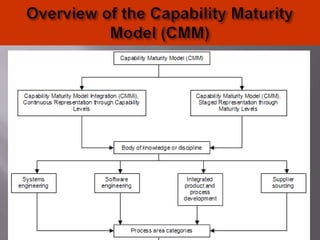
 The Capability maturity model (CMM) was
developed by the Software Engineering
Institute(SEI) of Carnegie Mellon
University, USA.
 The earlier model was s staged representation
through maturity levels, wile the current
model-CMMi (i-integration) is continuous
representation through capability levels.
8
 Out of 117 global companies 80 Indian
Software companies have attained SEI-CMM
level-5 .
 For the application of the model, we need to
choose one of four bodies of knowledge or
discipline-system engineering, software
engineering, integrated product and process
development, and lastly, supplier sourcing.
© Oxford University Press 2008.
All rights reserved. 9
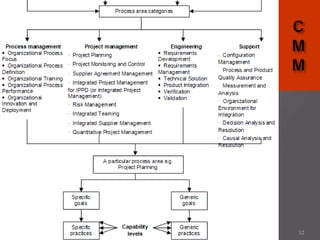
 The model concentrates upon four process area
categories namely, process
management, project management, engineering
and support.
 Each of these process categories contains
various process areas.
 For all the process areas, the model contains
generic goals and generic practice
© Oxford University Press 2008.
All rights reserved. 10
© Oxford University Press 2008.
All rights reserved. 11
© Oxford University Press 2008.
All rights reserved. 12
 The organization must determine its process
performance objective, such as cycle
time, productivity, defects correction rates.
 Key processes have to be prioritized on the basis
of cost involved and level of difficulty in
implementation.
 So proper action plan should be made and
progress of implementing those action plan tracked
continually
13
 The organization must establish standard
process suitable to particular site, offices etc.
 These standard process can be broken down
into small process elements for better
understanding. The key attribute of these
elements , such as input, output, interfaces and
verification points, should be identified.
 The organization must establish process asset
library containing corporate
policies, , procedure manual, development
plan, quality strategies, training material.
14
 An organization training tactical plan containing
the training topic, schedules training
methods, training material quality requirement
and the required resources should be prepared.
 Organization must develop training capabilities by
deciding approach to training, that is, classroom
teaching, computer-aided training, self –
study, mentorship.
 Cost-benefit analysis also need to be done.
 Training effectiveness can be judged by participant
survey, job performance improvement.
15
 Process measure such as effort, cycle
time, defect removal rates etc as well as
product measure such as reliability, are used
in, assessing, the process performance
© Oxford University Press 2008.
All rights reserved. 16
 The whole idea behind the process area is to
introduce incremental improvement through
innovation in organization's process and
technologies.
 The objective addressed here can be increasing
customer satisfaction, improving the product
quality, decreasing the cycle time, increasing
the productivity, and so on…..
© Oxford University Press 2008.
All rights reserved. 17
 It starts with defining the scope of the project
by breaking down the project into work
breakdown structure(WBS).
 The WBS developed by creating small and
manageable components of the project known
as work packages.
 This makes it easier to assign resources and
responsibilities for execution of the project..
 Also to track and control progress in
implementation of it.
18
 Monitoring would be required for data
management and stake holder involvement.
Forma or informal progress review should be
conducted
 These reviews must be documented properly.
 The corrective action required such as adding
more resources, revising plan, changing the
process etc should be implemented.
19
 The supplier should be selected on the basis of
criteria such as the geographical location of the
supplier, supplier’s past performance with
similar requirement, staff and facilities of the
supplier, engineering capabilities of the
supplier, etc.
 The risk should be worked out with legal
agreement in warranty, acceptance criteria,
ongoing maintenance and support of acquired
products.
© Oxford University Press 2008.
All rights reserved. 20
 A project’s defined process constituted by
business and operational
environment, organizational process needs and
objectives, product and component
requirement, should be established , .
 This is subjected to peer reviews and revised if
required.
© Oxford University Press 2008.
All rights reserved. 21
 The various source of possible risk in the
creation of a product or execution of a project
must be determined.
 Example of such sources can be unavailability
of technology, unprecedented effort
requirement(estimates not available) uncertain
vendor capability, and so on. The various
parameter of risks such as
likelihood(Probability of
Occurrence), severity(impact of
occurrence), and threshold to act as triggers for
management action upon occurrence should
 The identified risk should be evaluated and
categorized in classes such as
low, medium, high , critical, catastrophic, etc.
 Plans should be developed for mitigating the
risk, such as risk avoidance(lowering the
requirement, but still satisfying the customer’s
needs) and risk control (taking measures to
minimize the risk) and risk monitoring for
some favorable changes in parameters.
23
 This process area focuses on forming teams of
employees for the execution of project.
 The knowledge and skill required by team for
performing a task should be identified. The
selection of members of the team should be
based on criteria such as ability to work in a
team environment, a learning aptitude, ability
to represent a functional area, etc.
24
 Potential Sources of Product and component
required should be found by proactively
engaging in market research continually, as new
supplier may emerge with better and cheaper
products and components.
 The supplier have to be evaluated on various
criteria such as ability to fulfill critical delivery
and integration dates, on-site support relating to
integration problem etc
25
 The quality and process performance objectives
of the project have to be reviewed.
 The attributes of the quality and process
performance objective can be mean time
between failure, number and severity of the
customer complaints.
 Similarly process performance can be cycle
time, defect escape rate, percentage of rework
time etc.
26
 The need, expectation and constraints of the
stakeholder in the project (customer, supplier,
employee, top management, promoters, etc)
are collected .
 Certain need should be elicited by using
interviews, surveys, brainstorming sessions,
quality function deployment, etc.
27
 The customer requirement should be translated
in product components, whhich in turn should
be expressed in technical terms.
 The operational concepts and scenarios
containing
functionality, performance, maintenance, supp
ort and disposal.
© Oxford University Press 2008.
All rights reserved. 28
 Here the product –components solution are being
selected.
 For example commercial-off –the self(COTS)
components may be considered in order to take
care off the cost, schedule, performance, and risk
issues..
 The operational concepts and scenarios document
the interaction of the product components with the
users, environment and other product components.
29
 These should be documented so as to be used
during product delivery and
installation, operation, maintenance and
disposal.
 Materials to support the use of the
product, such as instruction manual, service
manual, operator’s manual etc should be
developed .
© Oxford University Press 2008.
All rights reserved. 30
 Having designed and created the product
components, now it is time to integrate these
components to form the finished product.
 The environment required for product
integration (e.g. test equipment, simulators,
fabrication equipment, etc.) during each step of
the product integration process should be
created or bought.
 The product integration procedure and criteria,
such as level of testing for build components,
quality/cost trade-off, lead time from order to
delivery should be established. 31
 The verification methods to be used should be
identified, for example, in software
engineering, the testing methods can be load,
test and performance testing, path coverage
testing.
 A verification environment including testing
equipment, personnel should be created .
 Criteria and procedure based on the factors
such as standards (CMM or ISO), quality-cost-
trade-off, test type, organizational policies etc.
32
 Products or product components to be
validated should be selected and the scope of
validation including operational
behavior, maintenance, training, user interface
etc. should be determined.
 Validation environment, methods, criteria and
procedure should be established.
33
 It involves the identification and
documentation of the functional and physical
characteristics of a selected item.
 These can be descriptions, requirements, test
plans, procedure and results, programming
code/modules
 There are three types of configuration
management systems.
 Dynamic(developer’s),Masters controlled),
Static
34
 Dynamic configuration management system
contain items which are currently being created
or being updated by the developer.
 Master configuration management system
contain items with current baselines including
the changes incorporated in them.
 Static configuration management system
contain the achieves of various baseline
released for use.
35
 The process / product should be evaluated
against the process description, procedure and
standard (CMM/ISO).
 The frequency of audits, personnel to be
involved in it, method of evaluation and
items/work products/process to be evaluated
should be decided using appropriate criteria.
 Quality –related trends should be analyzed to
get some clues to solve quality issues.
36
 The measures to be used in the measurement
process should be identified either as a base
measure (Such as labor hours, number of pages
of document, no of defects) or derived measure
(Such as defect density, mean time to
failure, no of defects by severity).
 Issues relating to the analysis of data, for
example, the tool to be used (for example the
types of charts, types of measure of central
tendency-mean, median, mode, statistical
sampling criteria, handling situation of missing
data elements) should be sorted
 The data should be analyzed and discussed. 37
 The criteria to analyze a decision should be the
risk associated with the issue requiring
decisions as medium or high, decision related
to issues which may result in undue delays ,
decision affecting the achievement of the
project objectives and the cost of formal
evaluation compared to the impact of the
decision.
 Suitable evaluation methods should be
selected for example simulations, extrapolation
of current trends, cost studies, etc.
38
 The first step here is the establishment of the
organization's shared vision that included its
mission, objective, expected behavior and
values which communicated to all the
employee and external partners.
 An integrated work environment supported by
facilities , tools, and equipment to aid the
employees perform the task in an integrated
fashion.
© Oxford University Press 2008.
All rights reserved. 39
 For example , to ensure proper communication
within the organization, meeting rooms, e-mail
facility, faxes, etc can be provided.
 Suitable leadership skill /approach need to be
imparted in employee which can be
commanding, consultative, collaborative,
consensus or structured.
© Oxford University Press 2008.
All rights reserved. 40
 This process area focuses on the identification of
defects and problems and finding off the root
cause for their resolution.
 The defect can come from complaints by
customer, end users, peer reviews, testing.
 Which is subjected to be analyzed using Pareto
analysis, histograms.
 The proposed action should be implemented and
changes should be made .
41
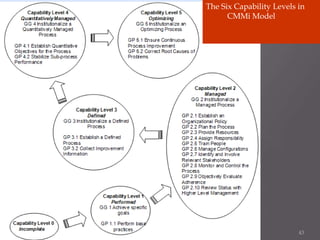
The capability level denote the maturity of the
process area as signified by the terminology-
incomplete(0), performed(1), managed(2),
defined(3), quantitatively managed(4), and
optimizing(5), with respect to level 0,1,2,3,4,5
respectively
© Oxford University Press 2008.
All rights reserved. 43
The Six Capability Levels in
CMMi Model
© Oxford University Press 2008.
All rights reserved. 44
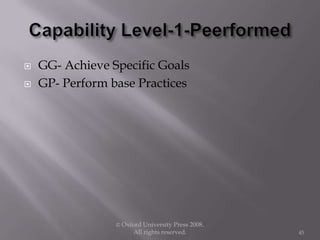
 GG- Achieve Specific Goals
 GP- Perform base Practices
© Oxford University Press 2008.
All rights reserved. 45
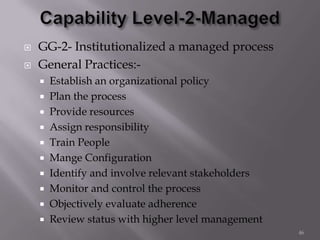
 GG-2- Institutionalized a managed process
 General Practices:-
 Establish an organizational policy
 Plan the process
 Provide resources
 Assign responsibility
 Train People
 Mange Configuration
 Identify and involve relevant stakeholders
 Monitor and control the process
 Objectively evaluate adherence
 Review status with higher level management
46
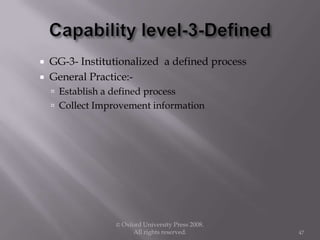
 GG-3- Institutionalized a defined process
 General Practice:-
 Establish a defined process
 Collect Improvement information
© Oxford University Press 2008.
All rights reserved. 47
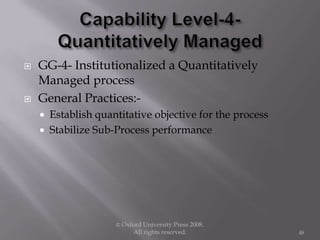
 GG-4- Institutionalized a Quantitatively
Managed process
 General Practices:-
 Establish quantitative objective for the process
 Stabilize Sub-Process performance
© Oxford University Press 2008.
All rights reserved. 48
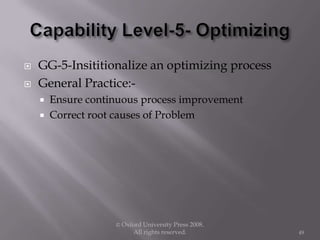
 GG-5-Insititionalize an optimizing process
 General Practice:-
 Ensure continuous process improvement
 Correct root causes of Problem
© Oxford University Press 2008.
All rights reserved. 49
© Oxford University Press 2008.
All rights reserved. 50
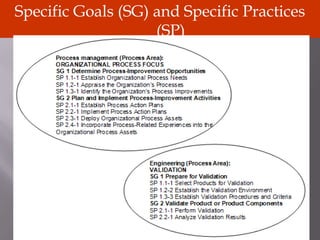
Specific Goals (SG) and Specific Practices
(SP)
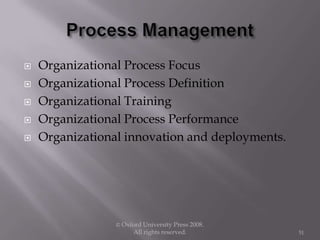
 Organizational Process Focus
 Organizational Process Definition
 Organizational Training
 Organizational Process Performance
 Organizational innovation and deployments.
© Oxford University Press 2008.
All rights reserved. 51
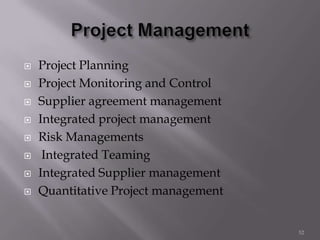
 Project Planning
 Project Monitoring and Control
 Supplier agreement management
 Integrated project management
 Risk Managements
 Integrated Teaming
 Integrated Supplier management
 Quantitative Project management
52
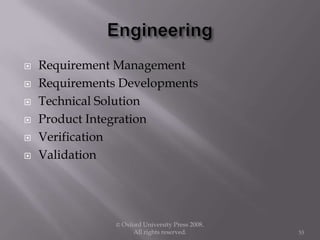
 Requirement Management
 Requirements Developments
 Technical Solution
 Product Integration
 Verification
 Validation
© Oxford University Press 2008.
All rights reserved. 53
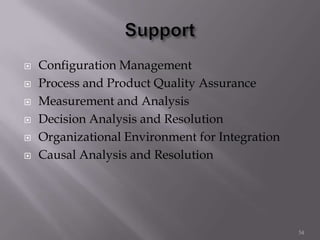
 Configuration Management
 Process and Product Quality Assurance
 Measurement and Analysis
 Decision Analysis and Resolution
 Organizational Environment for Integration
 Causal Analysis and Resolution
54
© Oxford University Press 2008.
All rights reserved. 55
© Oxford University Press 2008.
All rights reserved. 56
© Oxford University Press 2008.
All rights reserved. 57
© Oxford University Press 2008.
All rights reserved. 58
© Oxford University Press 2008.
All rights reserved. 59
© Oxford University Press 2008.
All rights reserved. 60
© Oxford University Press 2008.
All rights reserved. 61

Fandamental quality mgt-Ch-6 and Ch-9

  • 2.
    © Oxford UniversityPress 2008. All rights reserved. 2
  • 3.
     The softwareindustry in India has made us proud by demonstrating to the world that Indians ca be leader in the filed of software technology.  India produces 250 thousand software engineer annually, and this number is growing at the rate of 20-25%. © Oxford University Press 2008. All rights reserved. 3
  • 4.
     Indian companieshad to built credibility in the outsourcing market and focus on the quality aspect to differentiate themselves from ordinary suppliers.  Because the world looks towards the Indian IT software and service industry for quality and price performance © Oxford University Press 2008. All rights reserved. 4
  • 5.
     For automating& Managing the tasks of the entire organization  Managing the payments by payroll system.  For invoicing & billing Procedure.  To manage the asset both physical & Intangible i.e. intellectual property, goodwill.  To increase the efficiency and effectiveness of organization activities. © Oxford University Press 2008. All rights reserved. 5
  • 6.
    The major taskin improving software quality is to minimize the no of faults or defects or bug or error. Common measurement of software quality are as follows:-  Mean time between failures.  Mean time to repair a defect (MTTR)  Defect rate by hour, day, week, or month © Oxford University Press 2008. All rights reserved.
  • 7.
     Defect rateper unit of software size, such as function point or thousand lines of code  Size of the defect backlog  Number of clean lines of code or system components that passed quality assurance on the first attempt • Cumulative defects per version • Timeliness of response to defect or time to fix defect • Customer level of satisfaction with software and quality of work done to fix defect • Rate of defects per unit of software size discovered in the first year after delivery © Oxford University Press 2008. All rights reserved. 7
  • 8.
     The Capabilitymaturity model (CMM) was developed by the Software Engineering Institute(SEI) of Carnegie Mellon University, USA.  The earlier model was s staged representation through maturity levels, wile the current model-CMMi (i-integration) is continuous representation through capability levels. 8
  • 9.
     Out of117 global companies 80 Indian Software companies have attained SEI-CMM level-5 .  For the application of the model, we need to choose one of four bodies of knowledge or discipline-system engineering, software engineering, integrated product and process development, and lastly, supplier sourcing. © Oxford University Press 2008. All rights reserved. 9
  • 10.
     The modelconcentrates upon four process area categories namely, process management, project management, engineering and support.  Each of these process categories contains various process areas.  For all the process areas, the model contains generic goals and generic practice © Oxford University Press 2008. All rights reserved. 10
  • 11.
    © Oxford UniversityPress 2008. All rights reserved. 11
  • 12.
    © Oxford UniversityPress 2008. All rights reserved. 12
  • 13.
     The organizationmust determine its process performance objective, such as cycle time, productivity, defects correction rates.  Key processes have to be prioritized on the basis of cost involved and level of difficulty in implementation.  So proper action plan should be made and progress of implementing those action plan tracked continually 13
  • 14.
     The organizationmust establish standard process suitable to particular site, offices etc.  These standard process can be broken down into small process elements for better understanding. The key attribute of these elements , such as input, output, interfaces and verification points, should be identified.  The organization must establish process asset library containing corporate policies, , procedure manual, development plan, quality strategies, training material. 14
  • 15.
     An organizationtraining tactical plan containing the training topic, schedules training methods, training material quality requirement and the required resources should be prepared.  Organization must develop training capabilities by deciding approach to training, that is, classroom teaching, computer-aided training, self – study, mentorship.  Cost-benefit analysis also need to be done.  Training effectiveness can be judged by participant survey, job performance improvement. 15
  • 16.
     Process measuresuch as effort, cycle time, defect removal rates etc as well as product measure such as reliability, are used in, assessing, the process performance © Oxford University Press 2008. All rights reserved. 16
  • 17.
     The wholeidea behind the process area is to introduce incremental improvement through innovation in organization's process and technologies.  The objective addressed here can be increasing customer satisfaction, improving the product quality, decreasing the cycle time, increasing the productivity, and so on….. © Oxford University Press 2008. All rights reserved. 17
  • 18.
     It startswith defining the scope of the project by breaking down the project into work breakdown structure(WBS).  The WBS developed by creating small and manageable components of the project known as work packages.  This makes it easier to assign resources and responsibilities for execution of the project..  Also to track and control progress in implementation of it. 18
  • 19.
     Monitoring wouldbe required for data management and stake holder involvement. Forma or informal progress review should be conducted  These reviews must be documented properly.  The corrective action required such as adding more resources, revising plan, changing the process etc should be implemented. 19
  • 20.
     The suppliershould be selected on the basis of criteria such as the geographical location of the supplier, supplier’s past performance with similar requirement, staff and facilities of the supplier, engineering capabilities of the supplier, etc.  The risk should be worked out with legal agreement in warranty, acceptance criteria, ongoing maintenance and support of acquired products. © Oxford University Press 2008. All rights reserved. 20
  • 21.
     A project’sdefined process constituted by business and operational environment, organizational process needs and objectives, product and component requirement, should be established , .  This is subjected to peer reviews and revised if required. © Oxford University Press 2008. All rights reserved. 21
  • 22.
     The varioussource of possible risk in the creation of a product or execution of a project must be determined.  Example of such sources can be unavailability of technology, unprecedented effort requirement(estimates not available) uncertain vendor capability, and so on. The various parameter of risks such as likelihood(Probability of Occurrence), severity(impact of occurrence), and threshold to act as triggers for management action upon occurrence should
  • 23.
     The identifiedrisk should be evaluated and categorized in classes such as low, medium, high , critical, catastrophic, etc.  Plans should be developed for mitigating the risk, such as risk avoidance(lowering the requirement, but still satisfying the customer’s needs) and risk control (taking measures to minimize the risk) and risk monitoring for some favorable changes in parameters. 23
  • 24.
     This processarea focuses on forming teams of employees for the execution of project.  The knowledge and skill required by team for performing a task should be identified. The selection of members of the team should be based on criteria such as ability to work in a team environment, a learning aptitude, ability to represent a functional area, etc. 24
  • 25.
     Potential Sourcesof Product and component required should be found by proactively engaging in market research continually, as new supplier may emerge with better and cheaper products and components.  The supplier have to be evaluated on various criteria such as ability to fulfill critical delivery and integration dates, on-site support relating to integration problem etc 25
  • 26.
     The qualityand process performance objectives of the project have to be reviewed.  The attributes of the quality and process performance objective can be mean time between failure, number and severity of the customer complaints.  Similarly process performance can be cycle time, defect escape rate, percentage of rework time etc. 26
  • 27.
     The need,expectation and constraints of the stakeholder in the project (customer, supplier, employee, top management, promoters, etc) are collected .  Certain need should be elicited by using interviews, surveys, brainstorming sessions, quality function deployment, etc. 27
  • 28.
     The customerrequirement should be translated in product components, whhich in turn should be expressed in technical terms.  The operational concepts and scenarios containing functionality, performance, maintenance, supp ort and disposal. © Oxford University Press 2008. All rights reserved. 28
  • 29.
     Here theproduct –components solution are being selected.  For example commercial-off –the self(COTS) components may be considered in order to take care off the cost, schedule, performance, and risk issues..  The operational concepts and scenarios document the interaction of the product components with the users, environment and other product components. 29
  • 30.
     These shouldbe documented so as to be used during product delivery and installation, operation, maintenance and disposal.  Materials to support the use of the product, such as instruction manual, service manual, operator’s manual etc should be developed . © Oxford University Press 2008. All rights reserved. 30
  • 31.
     Having designedand created the product components, now it is time to integrate these components to form the finished product.  The environment required for product integration (e.g. test equipment, simulators, fabrication equipment, etc.) during each step of the product integration process should be created or bought.  The product integration procedure and criteria, such as level of testing for build components, quality/cost trade-off, lead time from order to delivery should be established. 31
  • 32.
     The verificationmethods to be used should be identified, for example, in software engineering, the testing methods can be load, test and performance testing, path coverage testing.  A verification environment including testing equipment, personnel should be created .  Criteria and procedure based on the factors such as standards (CMM or ISO), quality-cost- trade-off, test type, organizational policies etc. 32
  • 33.
     Products orproduct components to be validated should be selected and the scope of validation including operational behavior, maintenance, training, user interface etc. should be determined.  Validation environment, methods, criteria and procedure should be established. 33
  • 34.
     It involvesthe identification and documentation of the functional and physical characteristics of a selected item.  These can be descriptions, requirements, test plans, procedure and results, programming code/modules  There are three types of configuration management systems.  Dynamic(developer’s),Masters controlled), Static 34
  • 35.
     Dynamic configurationmanagement system contain items which are currently being created or being updated by the developer.  Master configuration management system contain items with current baselines including the changes incorporated in them.  Static configuration management system contain the achieves of various baseline released for use. 35
  • 36.
     The process/ product should be evaluated against the process description, procedure and standard (CMM/ISO).  The frequency of audits, personnel to be involved in it, method of evaluation and items/work products/process to be evaluated should be decided using appropriate criteria.  Quality –related trends should be analyzed to get some clues to solve quality issues. 36
  • 37.
     The measuresto be used in the measurement process should be identified either as a base measure (Such as labor hours, number of pages of document, no of defects) or derived measure (Such as defect density, mean time to failure, no of defects by severity).  Issues relating to the analysis of data, for example, the tool to be used (for example the types of charts, types of measure of central tendency-mean, median, mode, statistical sampling criteria, handling situation of missing data elements) should be sorted  The data should be analyzed and discussed. 37
  • 38.
     The criteriato analyze a decision should be the risk associated with the issue requiring decisions as medium or high, decision related to issues which may result in undue delays , decision affecting the achievement of the project objectives and the cost of formal evaluation compared to the impact of the decision.  Suitable evaluation methods should be selected for example simulations, extrapolation of current trends, cost studies, etc. 38
  • 39.
     The firststep here is the establishment of the organization's shared vision that included its mission, objective, expected behavior and values which communicated to all the employee and external partners.  An integrated work environment supported by facilities , tools, and equipment to aid the employees perform the task in an integrated fashion. © Oxford University Press 2008. All rights reserved. 39
  • 40.
     For example, to ensure proper communication within the organization, meeting rooms, e-mail facility, faxes, etc can be provided.  Suitable leadership skill /approach need to be imparted in employee which can be commanding, consultative, collaborative, consensus or structured. © Oxford University Press 2008. All rights reserved. 40
  • 41.
     This processarea focuses on the identification of defects and problems and finding off the root cause for their resolution.  The defect can come from complaints by customer, end users, peer reviews, testing.  Which is subjected to be analyzed using Pareto analysis, histograms.  The proposed action should be implemented and changes should be made . 41
  • 42.
    The capability leveldenote the maturity of the process area as signified by the terminology- incomplete(0), performed(1), managed(2), defined(3), quantitatively managed(4), and optimizing(5), with respect to level 0,1,2,3,4,5 respectively
  • 43.
    © Oxford UniversityPress 2008. All rights reserved. 43 The Six Capability Levels in CMMi Model
  • 44.
    © Oxford UniversityPress 2008. All rights reserved. 44
  • 45.
     GG- AchieveSpecific Goals  GP- Perform base Practices © Oxford University Press 2008. All rights reserved. 45
  • 46.
     GG-2- Institutionalizeda managed process  General Practices:-  Establish an organizational policy  Plan the process  Provide resources  Assign responsibility  Train People  Mange Configuration  Identify and involve relevant stakeholders  Monitor and control the process  Objectively evaluate adherence  Review status with higher level management 46
  • 47.
     GG-3- Institutionalizeda defined process  General Practice:-  Establish a defined process  Collect Improvement information © Oxford University Press 2008. All rights reserved. 47
  • 48.
     GG-4- Institutionalizeda Quantitatively Managed process  General Practices:-  Establish quantitative objective for the process  Stabilize Sub-Process performance © Oxford University Press 2008. All rights reserved. 48
  • 49.
     GG-5-Insititionalize anoptimizing process  General Practice:-  Ensure continuous process improvement  Correct root causes of Problem © Oxford University Press 2008. All rights reserved. 49
  • 50.
    © Oxford UniversityPress 2008. All rights reserved. 50 Specific Goals (SG) and Specific Practices (SP)
  • 51.
     Organizational ProcessFocus  Organizational Process Definition  Organizational Training  Organizational Process Performance  Organizational innovation and deployments. © Oxford University Press 2008. All rights reserved. 51
  • 52.
     Project Planning Project Monitoring and Control  Supplier agreement management  Integrated project management  Risk Managements  Integrated Teaming  Integrated Supplier management  Quantitative Project management 52
  • 53.
     Requirement Management Requirements Developments  Technical Solution  Product Integration  Verification  Validation © Oxford University Press 2008. All rights reserved. 53
  • 54.
     Configuration Management Process and Product Quality Assurance  Measurement and Analysis  Decision Analysis and Resolution  Organizational Environment for Integration  Causal Analysis and Resolution 54
  • 55.
    © Oxford UniversityPress 2008. All rights reserved. 55
  • 56.
    © Oxford UniversityPress 2008. All rights reserved. 56
  • 57.
    © Oxford UniversityPress 2008. All rights reserved. 57
  • 58.
    © Oxford UniversityPress 2008. All rights reserved. 58
  • 59.
    © Oxford UniversityPress 2008. All rights reserved. 59
  • 60.
    © Oxford UniversityPress 2008. All rights reserved. 60
  • 61.
    © Oxford UniversityPress 2008. All rights reserved. 61