MANAGEMENT
BY OBJECTIVES
Bavijesh Thaliyil
M.Ed, Dept. of Education
University of Kerala
”
The best way to
predict your
future is to
create it
_Peter F Drucker
“
MBO- A preludeMBO- A prelude
The term "management by objectives" was first popularized by Peter
Drucker in his 1954 book 'The Practice of Management'
“Management by Objectives (MBO) is a process of
agreeing upon objectives within an organization so
that management and employees agree to the objectives
and understand what they are in the organization”
Management By Objectives (MBO) can be defined as a process
whereby the employees and the superiors come together to identify
common goals, the employees set their goals to be achieved, the
standards to be taken as the criteria for measurement of their
performance and contribution and deciding the course of action to be
followed.
MBO- Main conceptMBO- Main concept
To make sure that everybody within the organization has a clear
understanding of the aims, or objectives, of that organization, as well as
awareness of theirown roles and responsibilities in achieving those aims.
The core concept of MBO is planning, which means that an organization
and its members are not merely reacting to events and problems but are
instead being proactive.
MBO requires that employees set measurable personal goals based
upon the organizational Goals. Goals are set down in writing annually and
are continually monitored by managers to check progress. Rewards are
based upon goal achievement.
MBO is a supervised and managed activity so that all of the individual
goals can be coordinated to work towards the overall organizational goal
MBO- Main conceptMBO- Main concept
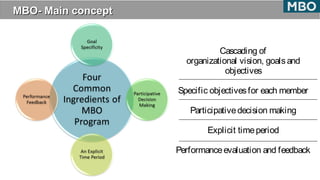
Cascading of
organizational vision, goalsand
objectives
Specific objectivesfor each member
Participativedecision making
Explicit timeperiod
Performanceevaluation and feedback
MBO- ProcessMBO- Process
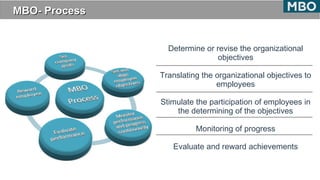
Determine or revise the organizational
objectives
Translating the organizational objectives to
employees
Stimulate the participation of employees in
the determining of the objectives
Monitoring of progress
Evaluate and reward achievements
MBO- SMART MethodMBO- SMART Method
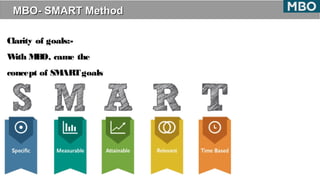
Clarity of goals:-
With MBO, came the
concept of SMART goals 
MBO- Advantage Vs DisadvantageMBO- Advantage Vs Disadvantage
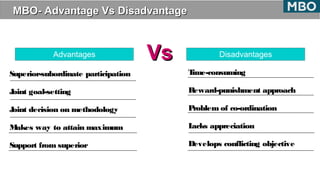
Advantages DisadvantagesVsVs
Superior-subordinate participation
Joint goal-setting
Joint decision on methodology
Makes way to attain maximum
Support from superior
Time-consuming
Reward-punishment approach
Problem of co-ordination
Lacks appreciation
Develops conflicting objective
MBO- ReferencesMBO- References
Drucker, P. F. (2007). Management challenges for the 21st century.
Routledge.
Drucker, P. F. (1995). People and performance: The best of Peter
Drucker on
management. Routledge.
Rodgers, R., & Hunter, J. E. (1991). Impact of management by
objectives on
organizational productivity. Journal of Applied Psychology, 76(2),
322.
Decision MakingDecision Making
Never make permanent
decisions on temporary feelings
”
“
Decision Making- DefinitionDecision Making- Definition
“Decision-making involves the selection of a course of action from
among two or more possible alternatives in order to arrive at a
solution for a given problem”
“The process of deciding about something important, especially in a
group of people or in an organization ” Oxford Advanced Learner’s Dictionary
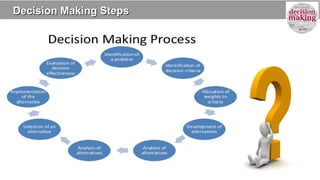
Decision Making StepsDecision Making Steps
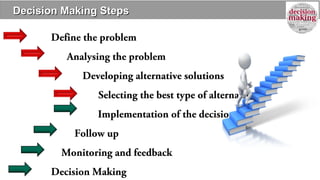
Define the problem
Analysing the problem
Developing alternative solutions
Selecting the best type of alternative
Implementation of the decision
Follow up
Monitoring and feedback
Decision Making
Decision Making StepsDecision Making Steps
Management By Objectives and Decision Making

Management By Objectives and Decision Making

  • 1.
    MANAGEMENT BY OBJECTIVES Bavijesh Thaliyil M.Ed,Dept. of Education University of Kerala
  • 2.
    ” The best wayto predict your future is to create it _Peter F Drucker “
  • 3.
    MBO- A preludeMBO-A prelude The term "management by objectives" was first popularized by Peter Drucker in his 1954 book 'The Practice of Management' “Management by Objectives (MBO) is a process of agreeing upon objectives within an organization so that management and employees agree to the objectives and understand what they are in the organization” Management By Objectives (MBO) can be defined as a process whereby the employees and the superiors come together to identify common goals, the employees set their goals to be achieved, the standards to be taken as the criteria for measurement of their performance and contribution and deciding the course of action to be followed.
  • 4.
    MBO- Main conceptMBO-Main concept To make sure that everybody within the organization has a clear understanding of the aims, or objectives, of that organization, as well as awareness of theirown roles and responsibilities in achieving those aims. The core concept of MBO is planning, which means that an organization and its members are not merely reacting to events and problems but are instead being proactive. MBO requires that employees set measurable personal goals based upon the organizational Goals. Goals are set down in writing annually and are continually monitored by managers to check progress. Rewards are based upon goal achievement. MBO is a supervised and managed activity so that all of the individual goals can be coordinated to work towards the overall organizational goal
  • 5.
    MBO- Main conceptMBO-Main concept Cascading of organizational vision, goalsand objectives Specific objectivesfor each member Participativedecision making Explicit timeperiod Performanceevaluation and feedback
  • 6.
    MBO- ProcessMBO- Process Determineor revise the organizational objectives Translating the organizational objectives to employees Stimulate the participation of employees in the determining of the objectives Monitoring of progress Evaluate and reward achievements
  • 7.
    MBO- SMART MethodMBO-SMART Method Clarity of goals:- With MBO, came the concept of SMART goals 
  • 8.
    MBO- Advantage VsDisadvantageMBO- Advantage Vs Disadvantage Advantages DisadvantagesVsVs Superior-subordinate participation Joint goal-setting Joint decision on methodology Makes way to attain maximum Support from superior Time-consuming Reward-punishment approach Problem of co-ordination Lacks appreciation Develops conflicting objective
  • 9.
    MBO- ReferencesMBO- References Drucker,P. F. (2007). Management challenges for the 21st century. Routledge. Drucker, P. F. (1995). People and performance: The best of Peter Drucker on management. Routledge. Rodgers, R., & Hunter, J. E. (1991). Impact of management by objectives on organizational productivity. Journal of Applied Psychology, 76(2), 322.
  • 10.
    Decision MakingDecision Making Nevermake permanent decisions on temporary feelings ” “
  • 11.
    Decision Making- DefinitionDecisionMaking- Definition “Decision-making involves the selection of a course of action from among two or more possible alternatives in order to arrive at a solution for a given problem” “The process of deciding about something important, especially in a group of people or in an organization ” Oxford Advanced Learner’s Dictionary
  • 12.
    Decision Making StepsDecisionMaking Steps Define the problem Analysing the problem Developing alternative solutions Selecting the best type of alternative Implementation of the decision Follow up Monitoring and feedback Decision Making
  • 13.