Presented By
Apoorva Gupta
Megha Tomar
Management by Objectives
Management by Objectives (MBO) is a
personnel management technique where
managers and employees work together to set,
record and monitor goals for a specific period
of time. Organizational goals and planning flow
top-down through the organization and are
translated into personal goals for organizational
members. The technique was first championed
by management expert Peter Drucker and
became commonly used in the 1960s.
Need for Management by Objectives
(MBO)
• Helps to understand their duties at the workplace.
• KRAs are designed for each employee
• The employees are clear as to what is expected out of them.
• Avoids job mismatch and unnecessary confusions
• Employees enjoy at the workplace and do not treat work as a burden.
• Effective communication
• The MBOProcess leads to highlymotivated and committed employees.
• The MBOProcess sets a benchmark for every employee.
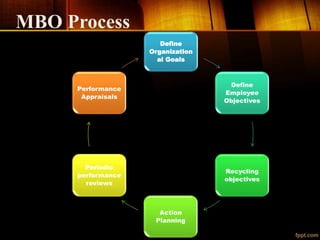
Define
Organization
al Goals
Define
Employee
Objectives
Recycling
objectives
Action
Planning
Periodic
performance
reviews
Performance
Appraisals
MBO Process
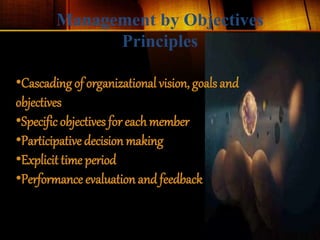
Management by Objectives
Principles
•Cascading of organizational vision, goals and
objectives
•Specific objectives for each member
•Participative decision making
•Explicit time period
•Performance evaluation and feedback
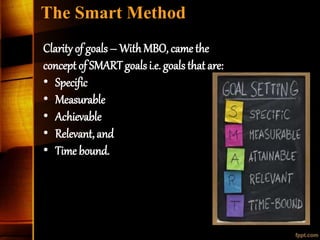
The Smart Method
Clarity of goals – With MBO, came the
concept of SMART goalsi.e. goals that are:
• Specific
• Measurable
• Achievable
• Relevant, and
• Time bound.
Managerial Implications of MBO
• Enterprise Point of View
• Superiors Point of View
• Employees Point of View
Limitations of Management by
objectives Process
•It sometimes ignores the prevailingculture and working
conditions of the organization.
•More emphasis is being laid on targets and objectives. It just
expectsthe employees to achieve their targets and meet the
objectives of the organization without bothering much about the
existing circumstances at the workplace. Employees are just
expectedto performand meet the deadlines. The MBOProcess
sometimes do treat individuals as mere machines.
• The MBO process increases comparisons between individuals at
the workplace. Employees tend to depend on nastypolitics and
other unproductive tasks to outshine their fellowworkers.
Employees do only what their superiors ask themto do. Their work
lacks innovation, creativity and sometimes also becomes
monotonous.
ANY QUESTION
???

Megha Tomar

  • 1.
    Presented By Apoorva Gupta MeghaTomar Management by Objectives
  • 3.
    Management by Objectives(MBO) is a personnel management technique where managers and employees work together to set, record and monitor goals for a specific period of time. Organizational goals and planning flow top-down through the organization and are translated into personal goals for organizational members. The technique was first championed by management expert Peter Drucker and became commonly used in the 1960s.
  • 4.
    Need for Managementby Objectives (MBO) • Helps to understand their duties at the workplace. • KRAs are designed for each employee • The employees are clear as to what is expected out of them. • Avoids job mismatch and unnecessary confusions • Employees enjoy at the workplace and do not treat work as a burden. • Effective communication • The MBOProcess leads to highlymotivated and committed employees. • The MBOProcess sets a benchmark for every employee.
  • 5.
  • 6.
    Management by Objectives Principles •Cascadingof organizational vision, goals and objectives •Specific objectives for each member •Participative decision making •Explicit time period •Performance evaluation and feedback
  • 7.
    The Smart Method Clarityof goals – With MBO, came the concept of SMART goalsi.e. goals that are: • Specific • Measurable • Achievable • Relevant, and • Time bound.
  • 8.
    Managerial Implications ofMBO • Enterprise Point of View • Superiors Point of View • Employees Point of View
  • 9.
    Limitations of Managementby objectives Process •It sometimes ignores the prevailingculture and working conditions of the organization. •More emphasis is being laid on targets and objectives. It just expectsthe employees to achieve their targets and meet the objectives of the organization without bothering much about the existing circumstances at the workplace. Employees are just expectedto performand meet the deadlines. The MBOProcess sometimes do treat individuals as mere machines. • The MBO process increases comparisons between individuals at the workplace. Employees tend to depend on nastypolitics and other unproductive tasks to outshine their fellowworkers. Employees do only what their superiors ask themto do. Their work lacks innovation, creativity and sometimes also becomes monotonous.
  • 10.

Editor's Notes

  • #5 KRA- key responsibility areas
  • #8 The goals thus set are clear, motivating and there is a linkage between organizational goals and performance targets of the employees. The focus is on future rather than on past. Goals and standards are set for the performance for the future with periodic reviews and feedback.