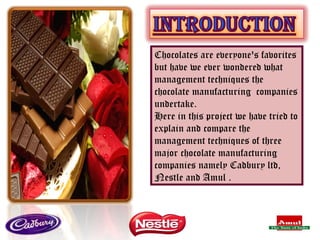
Chocolates are everyone's favorites but have we ever wondered what management techniques the chocolate manufacturing  companies undertake. Here in this project we have tried to explain and compare the management techniques of three major chocolate manufacturing companies namely Cadbury ltd, Nestle and Amul .
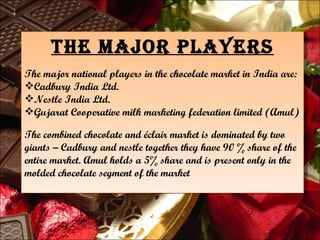
THE MAJOR PLAYERS The major national players in the chocolate market in India are: Cadbury India Ltd.  Nestle India Ltd. Gujarat Cooperative milk marketing federation limited (Amul) The combined chocolate and éclair market is dominated by two giants – Cadbury and nestle together they have 90 % share of the entire market. Amul holds a 5% share and is present only in the molded chocolate segment of the market
 
 
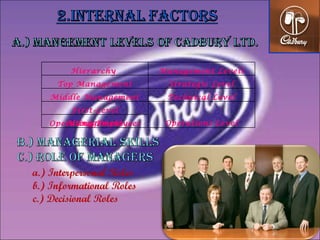
Hierarchy  Management Levels Top Management Strategic Level Middle Management Technical Level First-Level Management Operations Level Operating Employees


Organizational Structure: Cadbury’s follows a downward flow of communication. So, their organizational structure can be said is hierarchical structure. Hierarchical structure is based on distinct chain of commands from Managing director to Clerical Support assistants (according to Cadbury). Decisions are made at the top and pass down. Cadbury’s employee’s roles are usually based on clearly defined procedures and roles. Cadbury organization is based on a Democratic Management style decisions are made as a result of a consultation process involving various members of the organization (Cadbury). Ideas would be discussed and thought through collectively. Within Cadbury organization we can find a Democratic structure, because Cadbury tends to be found in situation where it is felt to be important for all members of the organization to understand what they are doing, were decisions require individual initiative, and where member of staff need to work as a team.  In Cadbury’s organizational structure there is less complexity, less formalization and they are almost decentralized. In that sense we can say that Cadbury’s organizational structure is Neo classically designed.
 
Nestlé is an international corporation that produces a variety of products including food, beverages, and  pharmaceuticals that amount to over 8,000 in all (Tomlinson 2000).Nestlé India is a subsidiary of   Nestlé S.A.  of Switzerland. With seven factories and a large number of co-packers, Nestlé India is a vibrant Company that provides consumers in India with products of global standards and is committed to long-term sustainable growth and shareholder satisfaction. Most innovative and fastest growing food company offering Products enjoyed in “ Every home every day”
 
 
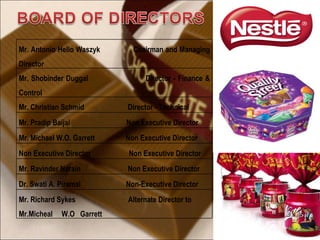
Mr. Antonio Helio Waszyk  Chairman and Managing Director Mr. Shobinder Duggal  Director - Finance & Control Mr. Christian Schmid  Director - Technical Mr. Pradip Baijal  Non Executive Director Mr. Michael W.O. Garrett  Non Executive Director Non Executive Director  Non Executive Director Mr. Ravinder Narain  Non Executive Director Dr. Swati A. Piramal  Non-Executive Director Mr. Richard Sykes  Alternate Director to  Mr.Micheal  W.O  Garrett
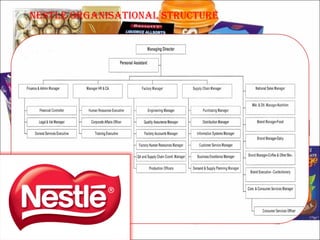
NESTLE ORGANISATIONAL STRUCTURE
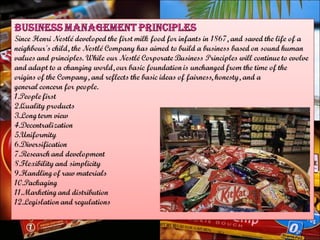
MANAGEMENT PRINCIPLES AND LEADERSHIP Nestle Value Added Leadership Concept   Members of the Nestle management at all levels are more concerned with continuously adding value to the company than exercising formal authority. They can delegate all without abdicating their proper responsibility. Qualities And Characteristics of A Nestle Manager   The higher the levels of the position and the responsibility of a Nestle Manager, the more he/she should be selected on the basis of the following  criteria (in addition to professional education, skills and practical experience) :   Courage, solid nerves and composure; capacity to handle stress. Ability to learn, open-mindedness and perceptiveness . Ability to create a climate of innovation. Thinking in context. Credibility : in other words “practice what you preach”. Willingness to accept change and ability to manage change. International experience and understanding of other cultures.  
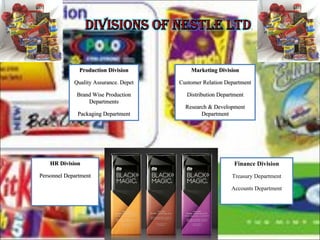
Production Division Quality Assurance. Depet Brand Wise Production Departments Packaging Department Marketing Division Customer Relation Department Distribution Department Research & Development Department HR Division Personnel Department Finance Division Treasury Department Accounts Department
 
AMUL has been able to: Produce an appropriate blend of the policy makers farmers board of management and the professionals: each group appreciating its rotes and Limitations, Bring at the command of the rural milk producers the best of the technology and harness its fruit for betterment. Provide a support system to the milk producers without disturbing their agro economic systems, Plough back the profits, by prudent use of men, material and machines, in the rural sector for the common good and betterment of the member producers and Even though, growing with time and on scale, it has remained with the smallest producer members. In that sense. Amul is an example par excellence, of an intervention for rural change.


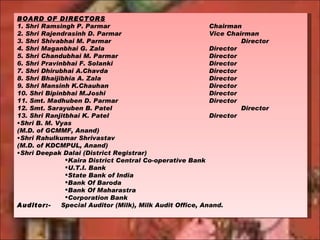
BOARD OF DIRECTORS 1. Shri Ramsingh P. Parmar  Chairman 2. Shri Rajendrasinh D. Parmar  Vice Chairman 3. Shri Shivabhai M. Parmar  Director 4. Shri Maganbhai G. Zala  Director 5. Shri Chandubhai M. Parmar  Director 6. Shri Pravinbhai F. Solanki   Director 7. Shri Dhirubhai A.Chavda  Director 8. Shri Bhaijibhia A. Zala  Director 9. Shri Mansinh K.Chauhan  Director 10. Shri Bipinbhai M.Joshi  Director 11. Smt. Madhuben D. Parmar  Director 12. Smt. Sarayuben B. Patel  Director 13. Shri Ranjitbhai K. Patel  Director  Shri B. M. Vyas (M.D. of GCMMF, Anand) Shri Rahulkumar Shrivastav  (M.D. of KDCMPUL, Anand) Shri Deepak Dalai (District Registrar) Kaira District Central Co-operative Bank U.T.I. Bank State Bank of India Bank Of Baroda Bank Of Maharastra Corporation Bank Auditor:-  Special Auditor (Milk), Milk Audit Office, Anand.


Management

  • 1.
  • 2.
  • 3.
    Chocolates are everyone'sfavorites but have we ever wondered what management techniques the chocolate manufacturing companies undertake. Here in this project we have tried to explain and compare the management techniques of three major chocolate manufacturing companies namely Cadbury ltd, Nestle and Amul .
  • 4.
    THE MAJOR PLAYERSThe major national players in the chocolate market in India are: Cadbury India Ltd. Nestle India Ltd. Gujarat Cooperative milk marketing federation limited (Amul) The combined chocolate and éclair market is dominated by two giants – Cadbury and nestle together they have 90 % share of the entire market. Amul holds a 5% share and is present only in the molded chocolate segment of the market
  • 5.
  • 6.
  • 7.
    Hierarchy ManagementLevels Top Management Strategic Level Middle Management Technical Level First-Level Management Operations Level Operating Employees
  • 8.
  • 9.
  • 10.
  • 11.
  • 12.
  • 13.
    Organizational Structure: Cadbury’sfollows a downward flow of communication. So, their organizational structure can be said is hierarchical structure. Hierarchical structure is based on distinct chain of commands from Managing director to Clerical Support assistants (according to Cadbury). Decisions are made at the top and pass down. Cadbury’s employee’s roles are usually based on clearly defined procedures and roles. Cadbury organization is based on a Democratic Management style decisions are made as a result of a consultation process involving various members of the organization (Cadbury). Ideas would be discussed and thought through collectively. Within Cadbury organization we can find a Democratic structure, because Cadbury tends to be found in situation where it is felt to be important for all members of the organization to understand what they are doing, were decisions require individual initiative, and where member of staff need to work as a team. In Cadbury’s organizational structure there is less complexity, less formalization and they are almost decentralized. In that sense we can say that Cadbury’s organizational structure is Neo classically designed.
  • 14.
  • 15.
    Nestlé is aninternational corporation that produces a variety of products including food, beverages, and pharmaceuticals that amount to over 8,000 in all (Tomlinson 2000).Nestlé India is a subsidiary of   Nestlé S.A.  of Switzerland. With seven factories and a large number of co-packers, Nestlé India is a vibrant Company that provides consumers in India with products of global standards and is committed to long-term sustainable growth and shareholder satisfaction. Most innovative and fastest growing food company offering Products enjoyed in “ Every home every day”
  • 16.
  • 17.
  • 18.
    Mr. Antonio HelioWaszyk Chairman and Managing Director Mr. Shobinder Duggal Director - Finance & Control Mr. Christian Schmid Director - Technical Mr. Pradip Baijal Non Executive Director Mr. Michael W.O. Garrett Non Executive Director Non Executive Director Non Executive Director Mr. Ravinder Narain Non Executive Director Dr. Swati A. Piramal Non-Executive Director Mr. Richard Sykes Alternate Director to Mr.Micheal W.O Garrett
  • 19.
  • 20.
    MANAGEMENT PRINCIPLES ANDLEADERSHIP Nestle Value Added Leadership Concept   Members of the Nestle management at all levels are more concerned with continuously adding value to the company than exercising formal authority. They can delegate all without abdicating their proper responsibility. Qualities And Characteristics of A Nestle Manager   The higher the levels of the position and the responsibility of a Nestle Manager, the more he/she should be selected on the basis of the following criteria (in addition to professional education, skills and practical experience) :   Courage, solid nerves and composure; capacity to handle stress. Ability to learn, open-mindedness and perceptiveness . Ability to create a climate of innovation. Thinking in context. Credibility : in other words “practice what you preach”. Willingness to accept change and ability to manage change. International experience and understanding of other cultures.  
  • 21.
    Production Division QualityAssurance. Depet Brand Wise Production Departments Packaging Department Marketing Division Customer Relation Department Distribution Department Research & Development Department HR Division Personnel Department Finance Division Treasury Department Accounts Department
  • 22.
  • 23.
    AMUL has beenable to: Produce an appropriate blend of the policy makers farmers board of management and the professionals: each group appreciating its rotes and Limitations, Bring at the command of the rural milk producers the best of the technology and harness its fruit for betterment. Provide a support system to the milk producers without disturbing their agro economic systems, Plough back the profits, by prudent use of men, material and machines, in the rural sector for the common good and betterment of the member producers and Even though, growing with time and on scale, it has remained with the smallest producer members. In that sense. Amul is an example par excellence, of an intervention for rural change.
  • 24.
  • 25.
  • 26.
  • 27.
  • 28.
    BOARD OF DIRECTORS1. Shri Ramsingh P. Parmar Chairman 2. Shri Rajendrasinh D. Parmar Vice Chairman 3. Shri Shivabhai M. Parmar Director 4. Shri Maganbhai G. Zala Director 5. Shri Chandubhai M. Parmar Director 6. Shri Pravinbhai F. Solanki Director 7. Shri Dhirubhai A.Chavda Director 8. Shri Bhaijibhia A. Zala Director 9. Shri Mansinh K.Chauhan Director 10. Shri Bipinbhai M.Joshi Director 11. Smt. Madhuben D. Parmar Director 12. Smt. Sarayuben B. Patel Director 13. Shri Ranjitbhai K. Patel Director Shri B. M. Vyas (M.D. of GCMMF, Anand) Shri Rahulkumar Shrivastav (M.D. of KDCMPUL, Anand) Shri Deepak Dalai (District Registrar) Kaira District Central Co-operative Bank U.T.I. Bank State Bank of India Bank Of Baroda Bank Of Maharastra Corporation Bank Auditor:- Special Auditor (Milk), Milk Audit Office, Anand.
  • 29.
  • 30.
  • 31.
  • 32.
  • 33.
  • 34.
  • 35.

Editor's Notes