CORPORATE
COMMUNICATION SKILLS
Taha Khan
MBA (FINANCE)
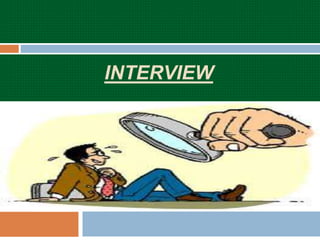
INTERVIEW
What is an interview?
 Basically ,an interview
is a conversation
between two people (the
interviewer and the
interviewee) where
questions are asked by
the interviewer to obtain
information from the
interviewee.
Interview means different things
 The word interview can stand for different things.
For example a reporter interviews a celebrity for
television. This kind of interviews can be one-on-
one but usually when it comes to television there
are many reporters from different channels.
 There are also job interviews where a person has to
go through in order to get a job he wants. Job
interviews are usually face-to-face interviews and it
includes paperwork.
Types of Interviews
 Face-To-Face Interview
 Behavioral Interview
 Phone Interview
 Panel Interview
 Exit interview
 Stress Interview
 Technical Interview
Different Kinds Of Interview
 Face-To-Face Interview
 This is a traditional interview and the most common
type.
 In this interview the candidate and the interviewer
meets face-to-face.
 The main concept of the interview is to build rapport
with the interviewer and show how the qualifications
will benefit their organization.
 The interviewee should maintain eye contact, and
respond to all the questions of the interviewer.
Behavioral Interview
 A common type of job interview in the modern workplace is
the behavioral interview or behavioral event interview, also
called a competency-based interview. This type of interview
is based on the notion that a job candidate's previous
behaviors are the best indicators of future performance. In
behavioral interviews, the interviewer asks candidates to
recall specific instances where they were faced with a set of
circumstances, and how they reacted.
Behavioral Interview Questions
 Tell me about a project you worked on where the requirements
changed midstream. What did you do?"
 "Tell me about a time when you took the lead on a project. What
did you do?"
 "Describe the worst project you worked on."
 "Describe a time you had to work with someone you didn't like."
 "Tell me about a time when you had to stick by a decision you
had made, even though it made you very unpopular."
 "Give us an example of something particularly innovative that
you have done that made a difference in the workplace."
 "What happened the last time you were late with a project?"
 "Have you ever witnessed a person doing something that you
felt was against company policy. What did you do and why?"
Phone Interviews
 Telephone Interviews take
place if a recruiter wishes to
dwindle down the number of
prospective candidates before
deciding on a shortlist for face-
to-face interviews. They also
take place if a job applicant is a
significant distance away from
the premises of the hiring
company such as abroad or in
another state.
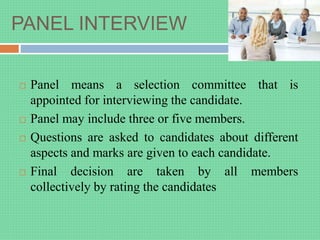
PANEL INTERVIEW
 Panel means a selection committee that is
appointed for interviewing the candidate.
 Panel may include three or five members.
 Questions are asked to candidates about different
aspects and marks are given to each candidate.
 Final decision are taken by all members
collectively by rating the candidates
EXIT INTERVIEW
 When an employee leaves the company, he is
interviewed either by his immediate superior or by
the HRD manager. This interview is called an exit
interview.
 Exit interview is taken to find out why the
employee is leaving the company.
 Exit interviews are taken to create a good image of
the company in the minds of the employees who
are leaving the company.
STRESS INTERVIEW
 The interview, attempts to find how applicants
would respond to aggressive, embarrassing, rude
and insulting questions.
 A stress interview allows interviewers to see how
well you work under pressure
Stress interview means-
 Being asked more than one questions at a time;
 Being asked further questions without being
allowed adequate time to respond;
 Being questioned in an interrogatory tone and
voice;
 Being asked an unrelated bunch of questions;
 Having his feelings provoked.
Technical Interview
 This kind of interview focuses on problem solving
and creativity. The questions aim at your problem-
solving skills and likely show your ability and
creativity. Sometimes these interviews will be on a
computer module with multiple-choice questions.
Need for interview
 To judge the overall personality of the candidate
 To know whether you are able to perform the
required job or not
 To judge the skills and attributes which are not
mentioned in c.v.
 Apart from your knowledge
your ability and capacity to do the job
 To find out what motivates you, how well you
communicate
 Your actual strengths and weaknesses.
Need for interview
Common Interview Questions
 Tell me about yourself
 Why did you leave your last job?
 What experience do you have in this field?
 Do you consider yourself successful?
 What do co-workers say about you?
 What do you know about this organization?
 What have you done to improve your knowledge in the last
year?
 Are you applying for other jobs?
 Why do you want to work for this organization?
 Do you know anyone who works for us?
Do’s and Don'ts of Interviewing
 Do not assume anything
 Do not form pre-judgments
 Do ask both open and closed questions
 Do verify understanding through probing and confirming
questions
 Do avoid confrontation
 Do act in a friendly but professional manner
 Do not interrupt
 Do listen actively
 Do take notes but do not be obtrusive about it
Do’s and Don'ts of Interviewing
 Do let the interviewee do most of the talking
 Do establish rapport early and maintain it
 Do maintain control over the subject matter
 Do establish a time frame for the interview and stick to it
 Do conclude positively
 Do be polite and courteous.
Conclusion - Final Tips
 Know the company: You should be pretty well acquainted with the
company and the type of work they do. You will need to do your
homework and know something of their corporate culture, internal
systems, business history, annual reports, mission statement etc.
You can do this using several resources including company
brochures, pamphlets, annual reports, newsletters and the company
Web site.
 Confirm important details: Confirm times and arrive at least
fifteen minutes early to create a good first impression, travel to the
interview location a day before using the same method of transport
to ensure you will be on time and memorize the name of the
interviewer.
Conclusion – Final Tips
 Switch off your mobile: make sure it is switched off during the
interview to avoid distractions.
 No wet fish handshakes: Shake hands warmly with a firm grip.
Handshakes have a far deeper significance than most people give
credit for.
 Ask questions: At the end of the interview, ask questions. This is your
chance to really impress the interviewer with your research skills
about the company and list of planned questions about the role.
 Body language: Don’t smoke, relax, smile, look at people as you
speak to them, avoid one word answers, ask questions if something
seems unclear and keep your answers simple and honest.
 Job Offer: Finally: If you accept the job, you have given your word, it
is a "Verbal Contract". If you have any doubts, ask for time to think
but give a time within 24 hours by which you will respond, and stick
to it.
Corporate communication skill

Corporate communication skill

  • 1.
  • 2.
  • 3.
    What is aninterview?  Basically ,an interview is a conversation between two people (the interviewer and the interviewee) where questions are asked by the interviewer to obtain information from the interviewee.
  • 4.
    Interview means differentthings  The word interview can stand for different things. For example a reporter interviews a celebrity for television. This kind of interviews can be one-on- one but usually when it comes to television there are many reporters from different channels.  There are also job interviews where a person has to go through in order to get a job he wants. Job interviews are usually face-to-face interviews and it includes paperwork.
  • 5.
    Types of Interviews Face-To-Face Interview  Behavioral Interview  Phone Interview  Panel Interview  Exit interview  Stress Interview  Technical Interview
  • 6.
    Different Kinds OfInterview  Face-To-Face Interview  This is a traditional interview and the most common type.  In this interview the candidate and the interviewer meets face-to-face.  The main concept of the interview is to build rapport with the interviewer and show how the qualifications will benefit their organization.  The interviewee should maintain eye contact, and respond to all the questions of the interviewer.
  • 7.
    Behavioral Interview  Acommon type of job interview in the modern workplace is the behavioral interview or behavioral event interview, also called a competency-based interview. This type of interview is based on the notion that a job candidate's previous behaviors are the best indicators of future performance. In behavioral interviews, the interviewer asks candidates to recall specific instances where they were faced with a set of circumstances, and how they reacted.
  • 8.
    Behavioral Interview Questions Tell me about a project you worked on where the requirements changed midstream. What did you do?"  "Tell me about a time when you took the lead on a project. What did you do?"  "Describe the worst project you worked on."  "Describe a time you had to work with someone you didn't like."  "Tell me about a time when you had to stick by a decision you had made, even though it made you very unpopular."  "Give us an example of something particularly innovative that you have done that made a difference in the workplace."  "What happened the last time you were late with a project?"  "Have you ever witnessed a person doing something that you felt was against company policy. What did you do and why?"
  • 9.
    Phone Interviews  TelephoneInterviews take place if a recruiter wishes to dwindle down the number of prospective candidates before deciding on a shortlist for face- to-face interviews. They also take place if a job applicant is a significant distance away from the premises of the hiring company such as abroad or in another state.
  • 10.
    PANEL INTERVIEW  Panelmeans a selection committee that is appointed for interviewing the candidate.  Panel may include three or five members.  Questions are asked to candidates about different aspects and marks are given to each candidate.  Final decision are taken by all members collectively by rating the candidates
  • 11.
    EXIT INTERVIEW  Whenan employee leaves the company, he is interviewed either by his immediate superior or by the HRD manager. This interview is called an exit interview.  Exit interview is taken to find out why the employee is leaving the company.  Exit interviews are taken to create a good image of the company in the minds of the employees who are leaving the company.
  • 12.
    STRESS INTERVIEW  Theinterview, attempts to find how applicants would respond to aggressive, embarrassing, rude and insulting questions.  A stress interview allows interviewers to see how well you work under pressure
  • 13.
    Stress interview means- Being asked more than one questions at a time;  Being asked further questions without being allowed adequate time to respond;  Being questioned in an interrogatory tone and voice;  Being asked an unrelated bunch of questions;  Having his feelings provoked.
  • 14.
    Technical Interview  Thiskind of interview focuses on problem solving and creativity. The questions aim at your problem- solving skills and likely show your ability and creativity. Sometimes these interviews will be on a computer module with multiple-choice questions.
  • 15.
    Need for interview To judge the overall personality of the candidate  To know whether you are able to perform the required job or not  To judge the skills and attributes which are not mentioned in c.v.  Apart from your knowledge your ability and capacity to do the job
  • 16.
     To findout what motivates you, how well you communicate  Your actual strengths and weaknesses. Need for interview
  • 17.
    Common Interview Questions Tell me about yourself  Why did you leave your last job?  What experience do you have in this field?  Do you consider yourself successful?  What do co-workers say about you?  What do you know about this organization?  What have you done to improve your knowledge in the last year?  Are you applying for other jobs?  Why do you want to work for this organization?  Do you know anyone who works for us?
  • 18.
    Do’s and Don'tsof Interviewing  Do not assume anything  Do not form pre-judgments  Do ask both open and closed questions  Do verify understanding through probing and confirming questions  Do avoid confrontation  Do act in a friendly but professional manner  Do not interrupt  Do listen actively  Do take notes but do not be obtrusive about it
  • 19.
    Do’s and Don'tsof Interviewing  Do let the interviewee do most of the talking  Do establish rapport early and maintain it  Do maintain control over the subject matter  Do establish a time frame for the interview and stick to it  Do conclude positively  Do be polite and courteous.
  • 20.
    Conclusion - FinalTips  Know the company: You should be pretty well acquainted with the company and the type of work they do. You will need to do your homework and know something of their corporate culture, internal systems, business history, annual reports, mission statement etc. You can do this using several resources including company brochures, pamphlets, annual reports, newsletters and the company Web site.  Confirm important details: Confirm times and arrive at least fifteen minutes early to create a good first impression, travel to the interview location a day before using the same method of transport to ensure you will be on time and memorize the name of the interviewer.
  • 21.
    Conclusion – FinalTips  Switch off your mobile: make sure it is switched off during the interview to avoid distractions.  No wet fish handshakes: Shake hands warmly with a firm grip. Handshakes have a far deeper significance than most people give credit for.  Ask questions: At the end of the interview, ask questions. This is your chance to really impress the interviewer with your research skills about the company and list of planned questions about the role.  Body language: Don’t smoke, relax, smile, look at people as you speak to them, avoid one word answers, ask questions if something seems unclear and keep your answers simple and honest.  Job Offer: Finally: If you accept the job, you have given your word, it is a "Verbal Contract". If you have any doubts, ask for time to think but give a time within 24 hours by which you will respond, and stick to it.