NATURE AND SIGNIFICANCE OF
MANAGEMENT.
ANYTHING-MANAGEMENT=0
MANAGEMENT: Management is a process of conducting a set of functions
(planning,organising,staffing,directing and controlling)to get the work
done in effective and efficient manner.
-ACTIVITY:Activity is a single stroke action.
PROCESS:Process is a combination of many actions.
# Management is a set of actions/functions/steps.
*That’s why management is a process not a activity.
--EFFECTIVE:Doing right things,achieving goals.
EFFICIENT:Doing things right,avoid wastage of resources,in
cost effective manner.
---MANAGER:Person who manages others(Workers are not managers
because they no subordinates.# They are non –managerial workers.)
CASE1:
Shiv Nadar Chief Executive Officer of HCL.
Two listed companies-1.HCL Technologies
2.HCL Infosystems
Actions/Functions of management:-
These should be in given order.
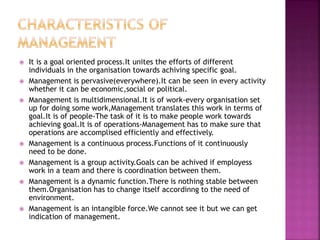
 It is a goal oriented process.It unites the efforts of different
individuals in the organisation towards achiving specific goal.
 Management is pervasive(everywhere).It can be seen in every activity
whether it can be economic,social or political.
 Management is multidimensional.It is of work-every organisation set
up for doing some work,Management translates this work in terms of
goal.It is of people-The task of it is to make people work towards
achieving goal.It is of operations-Management has to make sure that
operations are accomplised efficiently and effectively.
 Management is a continuous process.Functions of it continuously
need to be done.
 Management is a group activity.Goals can be achived if employess
work in a team and there is coordination between them.
 Management is a dynamic function.There is nothing stable between
them.Organisation has to change itself accordinng to the need of
environment.
 Management is an intangible force.We cannot see it but we can get
indication of management.
 It refers to utilisation of human and physical
resources available in the organisation.
 Survival:Every business wants to survive for
long.
 Profit:It must be ensured that adequate
profit is ensured.
 Growth:Every business wants to grow.It must
ensure growth of Business.It can be
measured in terms of sale,number of
employees.They should show increasing
trend.
 Social objectives:It involves creation of
benefit for society.
 Main social objectives-a) To create
employment opportunities.
 b)To save environment.
 c)To contribute in increase in living standard.
 Personal Objectives:objectives to be
determind with respect to the employees of
the organisation.
 Management as science:-
 Systematised body of knowledge(own theory
of principles)
 Principles based on experiment
 Universal Validity(applied everywhere)
 Management as art:-
 Existence of theoretical knowledge
 Personalised Application(vary from person to
person)
 Based on Practice and Creativity(improve by
practice)
• Well defined body of
knowledge
• Service motive
Management
as Profession
• Restricted entry
• Professional
Association
• Ethical code of
conduct
Management
as not
profession
Level of
management
Level of
organisation
Organisation
Organisation
Managerial
Members
Top level
management
Middle level
management
Bottom level
management
Non
Managerial
Members
Platform
Area/Workers

Management(chapter 1)

  • 1.
    NATURE AND SIGNIFICANCEOF MANAGEMENT. ANYTHING-MANAGEMENT=0
  • 2.
    MANAGEMENT: Management isa process of conducting a set of functions (planning,organising,staffing,directing and controlling)to get the work done in effective and efficient manner. -ACTIVITY:Activity is a single stroke action. PROCESS:Process is a combination of many actions. # Management is a set of actions/functions/steps. *That’s why management is a process not a activity. --EFFECTIVE:Doing right things,achieving goals. EFFICIENT:Doing things right,avoid wastage of resources,in cost effective manner. ---MANAGER:Person who manages others(Workers are not managers because they no subordinates.# They are non –managerial workers.) CASE1: Shiv Nadar Chief Executive Officer of HCL. Two listed companies-1.HCL Technologies 2.HCL Infosystems
  • 3.
    Actions/Functions of management:- Theseshould be in given order.
  • 4.
     It isa goal oriented process.It unites the efforts of different individuals in the organisation towards achiving specific goal.  Management is pervasive(everywhere).It can be seen in every activity whether it can be economic,social or political.  Management is multidimensional.It is of work-every organisation set up for doing some work,Management translates this work in terms of goal.It is of people-The task of it is to make people work towards achieving goal.It is of operations-Management has to make sure that operations are accomplised efficiently and effectively.  Management is a continuous process.Functions of it continuously need to be done.  Management is a group activity.Goals can be achived if employess work in a team and there is coordination between them.  Management is a dynamic function.There is nothing stable between them.Organisation has to change itself accordinng to the need of environment.  Management is an intangible force.We cannot see it but we can get indication of management.
  • 5.
     It refersto utilisation of human and physical resources available in the organisation.  Survival:Every business wants to survive for long.  Profit:It must be ensured that adequate profit is ensured.  Growth:Every business wants to grow.It must ensure growth of Business.It can be measured in terms of sale,number of employees.They should show increasing trend.
  • 6.
     Social objectives:Itinvolves creation of benefit for society.  Main social objectives-a) To create employment opportunities.  b)To save environment.  c)To contribute in increase in living standard.  Personal Objectives:objectives to be determind with respect to the employees of the organisation.
  • 7.
     Management asscience:-  Systematised body of knowledge(own theory of principles)  Principles based on experiment  Universal Validity(applied everywhere)  Management as art:-  Existence of theoretical knowledge  Personalised Application(vary from person to person)  Based on Practice and Creativity(improve by practice)
  • 8.
    • Well definedbody of knowledge • Service motive Management as Profession • Restricted entry • Professional Association • Ethical code of conduct Management as not profession
  • 10.
    Level of management Level of organisation Organisation Organisation Managerial Members Toplevel management Middle level management Bottom level management Non Managerial Members Platform Area/Workers

Editor's Notes

  • #2 Management been defined as a process of getting things done with the aim of achieving goals effectively and efficiently.
  • #3 Management is a process and functions of management is an activity in related to it.But in business activities ,management is an activity.
  • #4 Comment:A satisfied employee creates a satisfied customer , who in turn creates profit that lead to satisfied shareholders.-HCL Management.
  • #5 Management of people-It deal with people of different need and taking them as one group.
  • #6 Economic objectives of organisation-Survival,Growth,Profit.
  • #7 Objectives:economic,social,personal
  • #9 Management is not profession . It is an art and science.