Principles of
Management
Dr.J.JEYA SUNITHA
MBA.,M.PHIL.,PH.D
INTRODUCTION
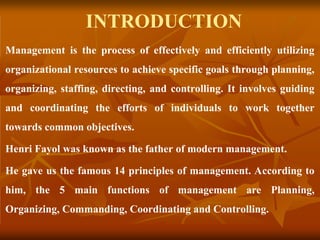
Management is the process of effectively and efficiently utilizing
organizational resources to achieve specific goals through planning,
organizing, staffing, directing, and controlling. It involves guiding
and coordinating the efforts of individuals to work together
towards common objectives.
Henri Fayol was known as the father of modern management.
He gave us the famous 14 principles of management. According to
him, the 5 main functions of management are Planning,
Organizing, Commanding, Coordinating and Controlling.
Define Management
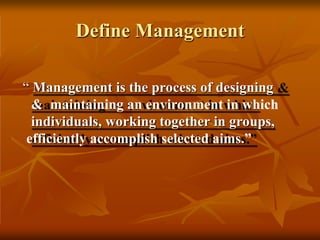
“ Management is the process of designing
& maintaining an environment in which
individuals, working together in groups,
efficiently accomplish selected aims.”
Contd>>>>>>>
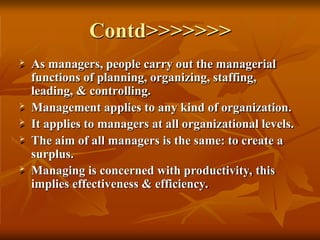
 As managers, people carry out the managerial
functions of planning, organizing, staffing,
leading, & controlling.
 Management applies to any kind of organization.
 It applies to managers at all organizational levels.
 The aim of all managers is the same: to create a
surplus.
 Managing is concerned with productivity, this
implies effectiveness & efficiency.
Define Organizations :
“Organizations which can be defined as group of
people working together to create a surplus.”
 In business organizations, this surplus is profit.
 In nonprofit organizations, such as charitable
organizations, it may be the satisfaction of needs.
Features of Management :
 Organized activities
 Existence of objectives
 Relationship among resources
 Working with & Through people
 Decision- Making
Management & Administration :
 Administration is above management
 Administration is part of management
 Management & administration are
same
Administration is above management :
 “Administration is that phase of business
enterprise that concerns itself with the overall
determination of institutional objectives & the
policies necessary to be followed in achieving those
objectives.”
 “Management on the other hand, is an executive
function which is primarily concerned with
carrying out broad policies laid down by the
administration.”
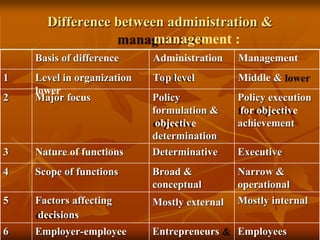
Difference between administration &
management :
1
Basis of difference Administration Management
Level in organization Top level Middle &
lower
2 Major focus Policy
formulation &
objective
determination
Policy execution
for objective
achievement
3 Nature of functions Determinative Executive
4 Scope of functions Broad &
conceptual
Narrow &
operational
5 Factors affecting
decisions
Mostly external Mostly internal
6 Employer-employee Entrepreneurs Employees
Administration is a part of
management :
 Management is a generic name for the total process of
executive control in industry or commerce.
 It is a social process entailing responsibility for the
executive & economic planning & regulation of the
operation of an enterprise, in the fulfillment of a given
purpose or task.
 Administration is that part of management which is
concerned with the installation & carrying out the
procedures by which it is laid down & communicated, &
the process of activities regulated & checked against
plans.
Management & Administration are same
 Management & administration are synonymous; the
difference between the two terms lies mostly in their
usage in different countries or different fields of human
organizations.
 The distinction between the two terms may be drawn by
analyzing the origin of the word “administration”.
 The government often uses the word administrator,
instead of manager, to handle & manage its affairs
The functions of management :
 Management can be break down into 5
managerial functions : planning,
organizing, staffing, leading & controlling
 Management as an essential for any
organization
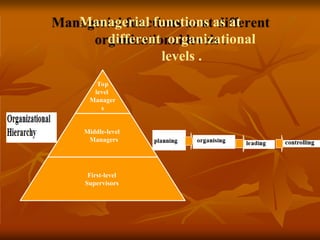
Managerial functions as at
different organizational
levels .
Top
level
Manager
s
Middle-level
Managers
First-level
Supervisors
Functions of Top Management :
 To analyze, evaluate & deal with the external
environmental forces
 To establish overall long-term goals strategy & policies
of the company including the master budget to allocate
resources.
 To create an organizational framework consisting of
authority responsibility relationships.
 To appoint departmental & other key executives.
 To provide overall leadership to the company.
Contd >>>>>>>
 To represent the company to the outside world, e.g. ; trade
associations, government, trade unions, etc.
 To exercise overall review & control on the company’s
operations &
 To coordinate the activities & efforts of different
departments.
Functions of Middle Management :
 To interpret & explain the policies framed by top
management .
 To compile & issue detailed instructions regarding
operations.
 To maintain close contacts with operating results so as to
evaluate performance.
 To participate in operating decisions
 To cooperate among themselves so as to integrate or
coordinate various parts of a division or a department
Functions of Supervisory Management :
 To plan day-to-day production within the goals laid down
by higher authorities.
 To assign jobs to workers to make arrangements for their
training & development.
 To supervise & control workers & maintain personal
contact with charge hands.
 To arrange materials & tools & to maintain machinery.
 To advise & assist workers by explaining work procedures,
solving their problems, etc
Importance of Management :
 Effective Utilization of Resources
 Development of Resources
 To Incorporate Innovations
 Integrating Various Interest
Groups
 Stability in the Society
Skills of Management :

Technical skills
 Human skills
 Conceptual
skills
 Design skills
Nature of Management :
I.
II.
III.
IV.
V.
 Management as an activity (or a process )
Planning Organizing Staffing Directing &
Controlling
Contd >>>>>>>
I.
II.
III.
IV.
 Management as a discipline
Management education is gaining popularity in the present
–day-times.
Scholars are interested in study of management discipline,
for purposes of conducting research studies &
making new & valuable contributions to this
discipline
Practitioners of management are much interested in a
study of management discipline
Management discipline is growing into specialized branches
of management like
production, marketing, personnel, finance & several others
Contd >>>>>..
I.
II.
 Management as a group ( class or team or society)
Micro-level : the economic results, in terms of the
attainment of common objectives, of the group- endeavor
Macro-level : the survival, growth & prosperity of the
economy would be determined by the integrity,
competence & efforts of the total management class
 Management as an economic resource (or a factor of
production) . The economist has been all the time been
speaking of 4 factors viz , land, labour, capital &
enterprise.
Management science or Art :
Management science or art differ in the following ways :
Commonsense is vague as compared to scientific
knowledge
Flagrant inconsistency often appears in commonsense
whereas logical consistency is the basic of science
Science systematically seeks to explain the events with
which it deals, commonsense ignores the need for
explanation
The scientific method deliberately exposes claims to the
critical evaluation of experimental analysis, commonsense
method fails to test conclusions in any scientific fashion
Management as profession :
“Profession is an occupation for which specialized
knowledge, skills & training are required & the use of
these skills is not meant for self-satisfaction but these are
used for larger interests of the society & the success of
the use of these skills is measured not in terms of money
alone.”
Characteristics of profession :
 Existence of knowledge
 Acquisition of knowledge
 Professional association
 Ethical codes
 Service motive
Objectives/ Advantages OR Significance
of Management :
 Micro level
 Macro level
Micro level
Enterprise level
I.
II.
 Maximum results with minimum inputs
Securing results in terms of production, sales, employee
satisfaction
Maintaining a balance between the internal
environment of the enterprise & the external
environment
Contd >>>>>>>
I.
II.
III.
IV.
V.
 Ensuring maximum prosperity for both employers &
employees
Stability of employement Satisfactory working conditions
Fair remuneration
Job-satisfaction
Justice & human treatment
 Ensuring survival, growth & prestige of the enterprise
Macro level
 To further the process of economic growth
 To ensure social welfare
 Generation of employment opportunities
 Helping maintain healthy industrial relations
 Conversion of challenges into opportunities
Role of Management Principles :
 To increase efficiency
 To crystallize the nature of
Management
 To carry on Researches
 To attain social objectives
Evolution of Management Thought :
 Many different contributors of writers &
practitioners have resulted in different
approaches to management, & these
make up a “management theory jungle”
Taylor & scientific management :
 The concept of scientific management was introduced by
Frederick Taylor in USA in the beginning of 20th century.
 Scientific management was concerned essentially with
improving the operational efficiency at the shop floor
level
Contd >>>>>>>>
 “scientific management is concerned with
knowing exactly what you want men to
do & then see in that they do in the best
&
cheapest way”
Elements & Tools of scientific Management :
 Separation of planning & doing
 Functional Foremanship
 Job analysis
1. Time study involves the determination of time a
movement takes to complete
2. Motion study involves the study of movements in parts
which are involved in doing a job & thereby eliminating
the wasteful movements & performing only necessary
movements
Contd >>>>>>>
3. Fatigue study shows the amount & frequency of rest
required in completing the work.
Standardization
Scientific selection & training of workers
Financial Incentives
Economy
Mental Revolution
Principles of scientific management :
 Replacing rule of Thumb with science
 Harmony in Group Action
 Co-operation
 Maximum output
 Development of workers
 A more equal division of responsibility between
management & workers
Contd >>>>>>>>>>>.
 Mental revolution on the part of management & workers
Merits of scientific Management :
 More production & higher profits
 Job-satisfaction
 Personality development
 Higher standard of living
Fayol’s Administrative management :
 Henry Fayol was a french mining engineer who
turned a leading industrialist & a successful manager
 Perhaps the real father of modern operational
management theory is the French industrialist Henry
Fayol.
Contd >>>>>>>
5.
6.
Fayol found that activities of an industrial
organization could be divided into 6 groups such
as :
1. Technical (relating to production)
2. Commercial (buying, selling & exchange)
3. Financial (search for capital & its optimum use )
4. Security (protection of property & person)
Accounting (including statistics ) & Managerial
(planning, organization, command,
coordination, & control )
Managerial qualities & training :
 Physical (health, vigour , & address )
 Mental (ability to understand & learn, judgment, mental
vigour, & capability)
 Moral (energy, firmness, initiative, loyalty, tact, &
dignity)
 Educational (general acquaintance with matters not
belonging exclusively to the function performed)
 Technical (peculiar to the function being performed) &
 Experience (arising from the work )
General Principles of Management :
 Division of work
 Authority & Responsibility
 Discipline
 Unity of Command
 Unity of Direction
 Subordination of Individual to General Interest
 Remuneration of Personnel
Contd >>>>>.
 Centralization
 Scalar chain
 Order
 Equity
 Stability of Tenure
 Initiative
 Esprit de corps
Role & Functions of a
manager & activities
of management
Functions of Manager :
 Planning
 Organizing
 Staffing
 Directing
 Controlling
Nature Management Functions :
 Management functions are universal
 Management functions have interactive quality
 Although management process suggests a sequential
arrangement of functions its not always possible in the
performance of managerial functions strictly in a
sequence

Since there are many managerial functions often a
question arises which management function is more
important so that managers devote more time to that
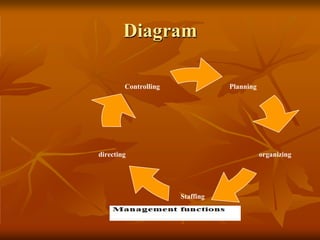
Diagram
Planning
Staffing
directing organizing
Controlling
Roles Of Manager :
 Interpersonal Role
 Informational Role
 Decisional Role
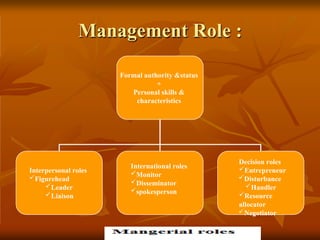
Management Role :
Formal authority &status
+
Personal skills &
characteristics
Interpersonal roles
Figurehead
Leader
Liaison
International roles
Monitor
Disseminator
spokesperson
Decision roles
Entrepreneur
Disturbance
Handler
Resource
allocator
Negotiator
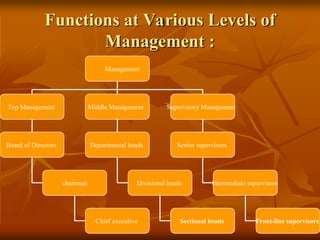
Functions at Various Levels of
Management :
Management
Top Management Supervisory Management
Middle Management
Board of Directors Departmental heads Senior supervisors
chairman Divisional heads Intermediate supervisors
Chief executive Sectional heads Front-line supervisors
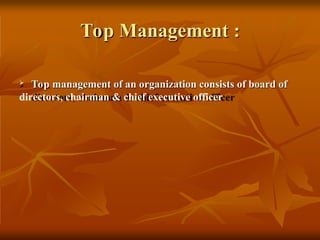
Top Management :
 Top management of an organization consists of board of
directors, chairman & chief executive officer
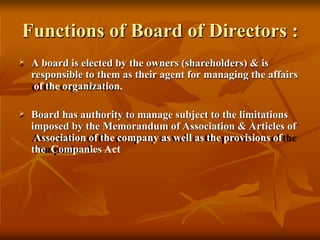
Functions of Board of Directors :
 A board is elected by the owners (shareholders) & is
responsible to them as their agent for managing the affairs
of the organization.
 Board has authority to manage subject to the limitations
imposed by the Memorandum of Association & Articles of
Association of the company as well as the provisions of
the Companies Act
Board of Directors
Divided into 6 categories :

trusteeship, function implying that
board must use the property of the
company
Determination of basic objectives &
policies of the organization
Selection of top executives &
determination of overall organization
structure
Approval of financial matters like
principlesofmanagementsem1slides-131211060335-phpapp01 (1).ppt

  • 1.
  • 2.
    INTRODUCTION Management is theprocess of effectively and efficiently utilizing organizational resources to achieve specific goals through planning, organizing, staffing, directing, and controlling. It involves guiding and coordinating the efforts of individuals to work together towards common objectives. Henri Fayol was known as the father of modern management. He gave us the famous 14 principles of management. According to him, the 5 main functions of management are Planning, Organizing, Commanding, Coordinating and Controlling.
  • 3.
    Define Management “ Managementis the process of designing & maintaining an environment in which individuals, working together in groups, efficiently accomplish selected aims.”
  • 4.
    Contd>>>>>>>  As managers,people carry out the managerial functions of planning, organizing, staffing, leading, & controlling.  Management applies to any kind of organization.  It applies to managers at all organizational levels.  The aim of all managers is the same: to create a surplus.  Managing is concerned with productivity, this implies effectiveness & efficiency.
  • 5.
    Define Organizations : “Organizationswhich can be defined as group of people working together to create a surplus.”  In business organizations, this surplus is profit.  In nonprofit organizations, such as charitable organizations, it may be the satisfaction of needs.
  • 6.
    Features of Management:  Organized activities  Existence of objectives  Relationship among resources  Working with & Through people  Decision- Making
  • 7.
    Management & Administration:  Administration is above management  Administration is part of management  Management & administration are same
  • 8.
    Administration is abovemanagement :  “Administration is that phase of business enterprise that concerns itself with the overall determination of institutional objectives & the policies necessary to be followed in achieving those objectives.”  “Management on the other hand, is an executive function which is primarily concerned with carrying out broad policies laid down by the administration.”
  • 9.
    Difference between administration& management : 1 Basis of difference Administration Management Level in organization Top level Middle & lower 2 Major focus Policy formulation & objective determination Policy execution for objective achievement 3 Nature of functions Determinative Executive 4 Scope of functions Broad & conceptual Narrow & operational 5 Factors affecting decisions Mostly external Mostly internal 6 Employer-employee Entrepreneurs Employees
  • 10.
    Administration is apart of management :  Management is a generic name for the total process of executive control in industry or commerce.  It is a social process entailing responsibility for the executive & economic planning & regulation of the operation of an enterprise, in the fulfillment of a given purpose or task.  Administration is that part of management which is concerned with the installation & carrying out the procedures by which it is laid down & communicated, & the process of activities regulated & checked against plans.
  • 11.
    Management & Administrationare same  Management & administration are synonymous; the difference between the two terms lies mostly in their usage in different countries or different fields of human organizations.  The distinction between the two terms may be drawn by analyzing the origin of the word “administration”.  The government often uses the word administrator, instead of manager, to handle & manage its affairs
  • 12.
    The functions ofmanagement :  Management can be break down into 5 managerial functions : planning, organizing, staffing, leading & controlling  Management as an essential for any organization
  • 13.
    Managerial functions asat different organizational levels . Top level Manager s Middle-level Managers First-level Supervisors
  • 14.
    Functions of TopManagement :  To analyze, evaluate & deal with the external environmental forces  To establish overall long-term goals strategy & policies of the company including the master budget to allocate resources.  To create an organizational framework consisting of authority responsibility relationships.  To appoint departmental & other key executives.  To provide overall leadership to the company.
  • 15.
    Contd >>>>>>>  Torepresent the company to the outside world, e.g. ; trade associations, government, trade unions, etc.  To exercise overall review & control on the company’s operations &  To coordinate the activities & efforts of different departments.
  • 16.
    Functions of MiddleManagement :  To interpret & explain the policies framed by top management .  To compile & issue detailed instructions regarding operations.  To maintain close contacts with operating results so as to evaluate performance.  To participate in operating decisions  To cooperate among themselves so as to integrate or coordinate various parts of a division or a department
  • 17.
    Functions of SupervisoryManagement :  To plan day-to-day production within the goals laid down by higher authorities.  To assign jobs to workers to make arrangements for their training & development.  To supervise & control workers & maintain personal contact with charge hands.  To arrange materials & tools & to maintain machinery.  To advise & assist workers by explaining work procedures, solving their problems, etc
  • 18.
    Importance of Management:  Effective Utilization of Resources  Development of Resources  To Incorporate Innovations  Integrating Various Interest Groups  Stability in the Society
  • 19.
    Skills of Management:  Technical skills  Human skills  Conceptual skills  Design skills
  • 20.
    Nature of Management: I. II. III. IV. V.  Management as an activity (or a process ) Planning Organizing Staffing Directing & Controlling
  • 21.
    Contd >>>>>>> I. II. III. IV.  Managementas a discipline Management education is gaining popularity in the present –day-times. Scholars are interested in study of management discipline, for purposes of conducting research studies & making new & valuable contributions to this discipline Practitioners of management are much interested in a study of management discipline Management discipline is growing into specialized branches of management like production, marketing, personnel, finance & several others
  • 22.
    Contd >>>>>.. I. II.  Managementas a group ( class or team or society) Micro-level : the economic results, in terms of the attainment of common objectives, of the group- endeavor Macro-level : the survival, growth & prosperity of the economy would be determined by the integrity, competence & efforts of the total management class  Management as an economic resource (or a factor of production) . The economist has been all the time been speaking of 4 factors viz , land, labour, capital & enterprise.
  • 23.
    Management science orArt : Management science or art differ in the following ways : Commonsense is vague as compared to scientific knowledge Flagrant inconsistency often appears in commonsense whereas logical consistency is the basic of science Science systematically seeks to explain the events with which it deals, commonsense ignores the need for explanation The scientific method deliberately exposes claims to the critical evaluation of experimental analysis, commonsense method fails to test conclusions in any scientific fashion
  • 24.
    Management as profession: “Profession is an occupation for which specialized knowledge, skills & training are required & the use of these skills is not meant for self-satisfaction but these are used for larger interests of the society & the success of the use of these skills is measured not in terms of money alone.”
  • 25.
    Characteristics of profession:  Existence of knowledge  Acquisition of knowledge  Professional association  Ethical codes  Service motive
  • 26.
    Objectives/ Advantages ORSignificance of Management :  Micro level  Macro level
  • 27.
    Micro level Enterprise level I. II. Maximum results with minimum inputs Securing results in terms of production, sales, employee satisfaction Maintaining a balance between the internal environment of the enterprise & the external environment
  • 28.
    Contd >>>>>>> I. II. III. IV. V.  Ensuringmaximum prosperity for both employers & employees Stability of employement Satisfactory working conditions Fair remuneration Job-satisfaction Justice & human treatment  Ensuring survival, growth & prestige of the enterprise
  • 29.
    Macro level  Tofurther the process of economic growth  To ensure social welfare  Generation of employment opportunities  Helping maintain healthy industrial relations  Conversion of challenges into opportunities
  • 30.
    Role of ManagementPrinciples :  To increase efficiency  To crystallize the nature of Management  To carry on Researches  To attain social objectives
  • 31.
    Evolution of ManagementThought :  Many different contributors of writers & practitioners have resulted in different approaches to management, & these make up a “management theory jungle”
  • 32.
    Taylor & scientificmanagement :  The concept of scientific management was introduced by Frederick Taylor in USA in the beginning of 20th century.  Scientific management was concerned essentially with improving the operational efficiency at the shop floor level
  • 33.
    Contd >>>>>>>>  “scientificmanagement is concerned with knowing exactly what you want men to do & then see in that they do in the best & cheapest way”
  • 34.
    Elements & Toolsof scientific Management :  Separation of planning & doing  Functional Foremanship  Job analysis 1. Time study involves the determination of time a movement takes to complete 2. Motion study involves the study of movements in parts which are involved in doing a job & thereby eliminating the wasteful movements & performing only necessary movements
  • 35.
    Contd >>>>>>> 3. Fatiguestudy shows the amount & frequency of rest required in completing the work. Standardization Scientific selection & training of workers Financial Incentives Economy Mental Revolution
  • 36.
    Principles of scientificmanagement :  Replacing rule of Thumb with science  Harmony in Group Action  Co-operation  Maximum output  Development of workers  A more equal division of responsibility between management & workers
  • 37.
    Contd >>>>>>>>>>>.  Mentalrevolution on the part of management & workers
  • 38.
    Merits of scientificManagement :  More production & higher profits  Job-satisfaction  Personality development  Higher standard of living
  • 39.
    Fayol’s Administrative management:  Henry Fayol was a french mining engineer who turned a leading industrialist & a successful manager  Perhaps the real father of modern operational management theory is the French industrialist Henry Fayol.
  • 40.
    Contd >>>>>>> 5. 6. Fayol foundthat activities of an industrial organization could be divided into 6 groups such as : 1. Technical (relating to production) 2. Commercial (buying, selling & exchange) 3. Financial (search for capital & its optimum use ) 4. Security (protection of property & person) Accounting (including statistics ) & Managerial (planning, organization, command, coordination, & control )
  • 41.
    Managerial qualities &training :  Physical (health, vigour , & address )  Mental (ability to understand & learn, judgment, mental vigour, & capability)  Moral (energy, firmness, initiative, loyalty, tact, & dignity)  Educational (general acquaintance with matters not belonging exclusively to the function performed)  Technical (peculiar to the function being performed) &  Experience (arising from the work )
  • 42.
    General Principles ofManagement :  Division of work  Authority & Responsibility  Discipline  Unity of Command  Unity of Direction  Subordination of Individual to General Interest  Remuneration of Personnel
  • 43.
    Contd >>>>>.  Centralization Scalar chain  Order  Equity  Stability of Tenure  Initiative  Esprit de corps
  • 44.
    Role & Functionsof a manager & activities of management
  • 45.
    Functions of Manager:  Planning  Organizing  Staffing  Directing  Controlling
  • 46.
    Nature Management Functions:  Management functions are universal  Management functions have interactive quality  Although management process suggests a sequential arrangement of functions its not always possible in the performance of managerial functions strictly in a sequence  Since there are many managerial functions often a question arises which management function is more important so that managers devote more time to that
  • 47.
  • 48.
    Roles Of Manager:  Interpersonal Role  Informational Role  Decisional Role
  • 49.
    Management Role : Formalauthority &status + Personal skills & characteristics Interpersonal roles Figurehead Leader Liaison International roles Monitor Disseminator spokesperson Decision roles Entrepreneur Disturbance Handler Resource allocator Negotiator
  • 50.
    Functions at VariousLevels of Management : Management Top Management Supervisory Management Middle Management Board of Directors Departmental heads Senior supervisors chairman Divisional heads Intermediate supervisors Chief executive Sectional heads Front-line supervisors
  • 51.
    Top Management : Top management of an organization consists of board of directors, chairman & chief executive officer
  • 52.
    Functions of Boardof Directors :  A board is elected by the owners (shareholders) & is responsible to them as their agent for managing the affairs of the organization.  Board has authority to manage subject to the limitations imposed by the Memorandum of Association & Articles of Association of the company as well as the provisions of the Companies Act
  • 53.
    Board of Directors Dividedinto 6 categories :  trusteeship, function implying that board must use the property of the company Determination of basic objectives & policies of the organization Selection of top executives & determination of overall organization structure Approval of financial matters like