

Principles of
Management:
Introduction
Management: Definition
• Process of reaching organizational goals efficiently and
effectively by working with and through people and
other organizational resources.
• Process of coordinating and integrating work activities
so that they are completed efficiently and effectively
with and through other people.
Why study Management?
• Important for society, industry,
and government organizations.
• Students will be able to
recognize good and poor
management.
• Provides insights into the way
the boss or peer behave
• To be familiar with the internal
working of organizations.
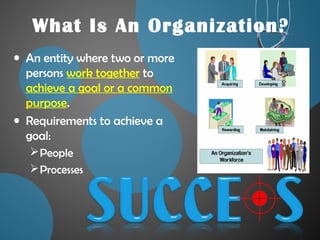
What Is An Organization?
• An entity where two or more
persons work together to
achieve a goal or a common
purpose.
• Requirements to achieve a
goal:
People
Processes
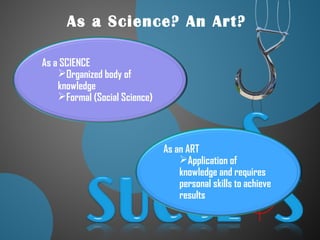
As a Science? An Art?
As a SCIENCE
Organized body of
knowledge
Formal (Social Science)
As an ART
Application of
knowledge and requires
personal skills to achieve
results
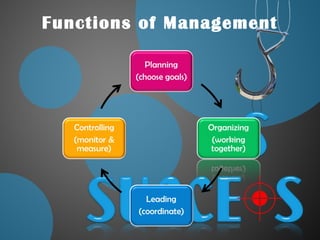
Functions of Management
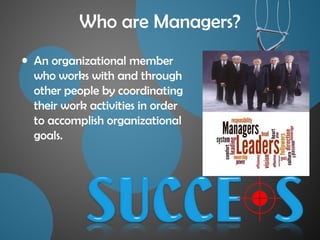
Who are Managers?
• An organizational member
who works with and through
other people by coordinating
their work activities in order
to accomplish organizational
goals.
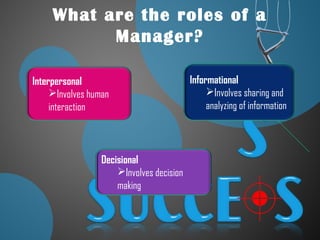
What are the roles of a
Manager?
Interpersonal
Involves human
interaction
Informational
Involves sharing and
analyzing of information
Decisional
Involves decision
making
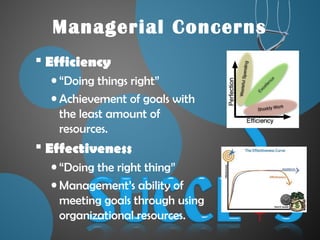
Managerial Concerns
 Efficiency
• “Doing things right”
• Achievement of goals with
the least amount of
resources.
 Effectiveness
• “Doing the right thing”
• Management’s ability of
meeting goals through using
organizational resources.
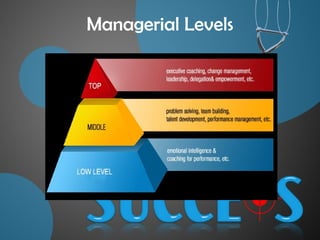
Managerial Levels
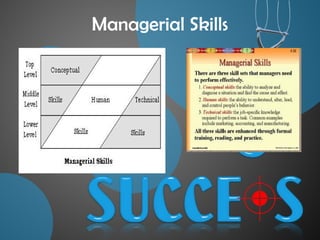
Managerial Skills
Class Activity
• Each group will given a specific undertaking or
activity in which the student participants will apply
the 4 functions of management.
• Each group will be given one hour to do the activity
after which discussions/presentations will be
conducted.
• The undertakings will be as follows:
– Seminar for Business Studies students
– Exhibit
– Job Fair for Business Studies students
Evolution of
Management Thought
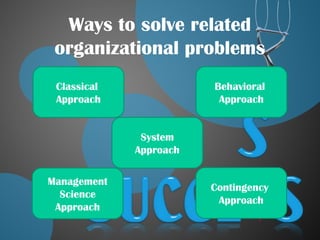
Ways to solve related
organizational problems
Classical
Approach
Behavioral
Approach
Management
Science
Approach
Contingency
Approach
System
Approach
1. Classical Approach
“Emphasizes organizational efficiency to
increase organizational success.”
1.1 Lower Level Management
Analysis
• Concentrates on one best way to
perform a task.
• Simply called as “Scientific
Management.”
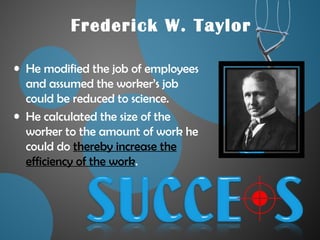
Frederick W. Taylor
• He modified the job of employees
and assumed the worker’s job
could be reduced to science.
• He calculated the size of the
worker to the amount of work he
could do thereby increase the
efficiency of the work.
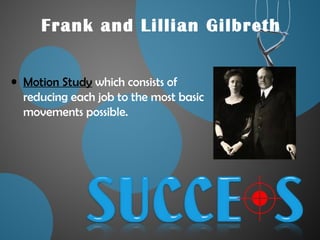
Frank and Lillian Gilbreth
• Motion Study which consists of
reducing each job to the most basic
movements possible.
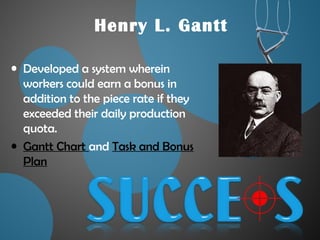
Henry L. Gantt
• Developed a system wherein
workers could earn a bonus in
addition to the piece rate if they
exceeded their daily production
quota.
• Gantt Chart and Task and Bonus
Plan
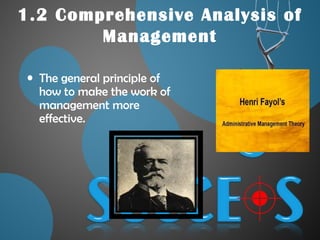
1.2 Comprehensive Analysis of
Management
• The general principle of
how to make the work of
management more
effective.
14 Principles of Henry Fayol
• Division of Work – one employee with one type of
work.
• Authority and Responsibility – right, power, and
duty to perform a task.
• Discipline – obedience and willingness to follow rules
and regulations.
• Unity of Command – employee receives orders from
one superior only.
• Unity of Direction – people with similar work should
be in one group and under the control of one
manager.
14 Principles of Henry Fayol
• Subordination of individual interests to general
interests – give more importance to the goal of the
company.
• Remuneration – salary paid to the employees should
be fair and reasonable.
• Centralization – concentration of power or authority
at the top management.
• Scalar Chain – all employees should follow the line of
authority from TOP to BOTTOM.
• Order – material and social.
• Equity – equal treatment in dealing with employees.
14 Principles of Henry Fayol
• Stability of Tenure – job security for employees.
• Initiative – employees should be creative and
allowed to suggest improvements.
• Esprit-De-Corps – unity and cooperation must be
encouraged.
2. Behavioral Approach
• Management approach that emphasizes
on increasing organizational success by
focusing on human variables in the
organization.
3. Management Science
Approach
• Emphasizes the use of the scientific method
and quantitative techniques to increase
organizational success.
4. Contingency Approach
• Emphasizing that what managers do in
practice depends on a given situation.
5. System Approach
• The organization must be viewed as a system
(as a whole).
• System – number of interdependent parts
functioning as a whole for some purpose.
Closed System – one that is not influenced by, and
does not interact with its environment.
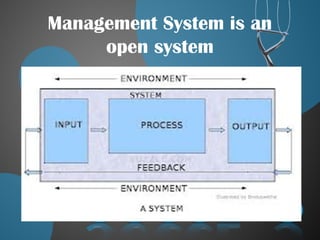
Open System – one that is influenced by, and is
continually interacting with its environment.
Management System is an
open system

Unit 1.pom

  • 1.
  • 2.
    Management: Definition • Processof reaching organizational goals efficiently and effectively by working with and through people and other organizational resources. • Process of coordinating and integrating work activities so that they are completed efficiently and effectively with and through other people.
  • 3.
    Why study Management? •Important for society, industry, and government organizations. • Students will be able to recognize good and poor management. • Provides insights into the way the boss or peer behave • To be familiar with the internal working of organizations.
  • 4.
    What Is AnOrganization? • An entity where two or more persons work together to achieve a goal or a common purpose. • Requirements to achieve a goal: People Processes
  • 5.
    As a Science?An Art? As a SCIENCE Organized body of knowledge Formal (Social Science) As an ART Application of knowledge and requires personal skills to achieve results
  • 6.
  • 7.
    Who are Managers? •An organizational member who works with and through other people by coordinating their work activities in order to accomplish organizational goals.
  • 8.
    What are theroles of a Manager? Interpersonal Involves human interaction Informational Involves sharing and analyzing of information Decisional Involves decision making
  • 9.
    Managerial Concerns  Efficiency •“Doing things right” • Achievement of goals with the least amount of resources.  Effectiveness • “Doing the right thing” • Management’s ability of meeting goals through using organizational resources.
  • 10.
  • 11.
  • 12.
    Class Activity • Eachgroup will given a specific undertaking or activity in which the student participants will apply the 4 functions of management. • Each group will be given one hour to do the activity after which discussions/presentations will be conducted. • The undertakings will be as follows: – Seminar for Business Studies students – Exhibit – Job Fair for Business Studies students
  • 13.
  • 14.
    Ways to solverelated organizational problems Classical Approach Behavioral Approach Management Science Approach Contingency Approach System Approach
  • 15.
    1. Classical Approach “Emphasizesorganizational efficiency to increase organizational success.”
  • 16.
    1.1 Lower LevelManagement Analysis • Concentrates on one best way to perform a task. • Simply called as “Scientific Management.”
  • 17.
    Frederick W. Taylor •He modified the job of employees and assumed the worker’s job could be reduced to science. • He calculated the size of the worker to the amount of work he could do thereby increase the efficiency of the work.
  • 18.
    Frank and LillianGilbreth • Motion Study which consists of reducing each job to the most basic movements possible.
  • 19.
    Henry L. Gantt •Developed a system wherein workers could earn a bonus in addition to the piece rate if they exceeded their daily production quota. • Gantt Chart and Task and Bonus Plan
  • 20.
    1.2 Comprehensive Analysisof Management • The general principle of how to make the work of management more effective.
  • 21.
    14 Principles ofHenry Fayol • Division of Work – one employee with one type of work. • Authority and Responsibility – right, power, and duty to perform a task. • Discipline – obedience and willingness to follow rules and regulations. • Unity of Command – employee receives orders from one superior only. • Unity of Direction – people with similar work should be in one group and under the control of one manager.
  • 22.
    14 Principles ofHenry Fayol • Subordination of individual interests to general interests – give more importance to the goal of the company. • Remuneration – salary paid to the employees should be fair and reasonable. • Centralization – concentration of power or authority at the top management. • Scalar Chain – all employees should follow the line of authority from TOP to BOTTOM. • Order – material and social. • Equity – equal treatment in dealing with employees.
  • 23.
    14 Principles ofHenry Fayol • Stability of Tenure – job security for employees. • Initiative – employees should be creative and allowed to suggest improvements. • Esprit-De-Corps – unity and cooperation must be encouraged.
  • 24.
    2. Behavioral Approach •Management approach that emphasizes on increasing organizational success by focusing on human variables in the organization.
  • 25.
    3. Management Science Approach •Emphasizes the use of the scientific method and quantitative techniques to increase organizational success.
  • 26.
    4. Contingency Approach •Emphasizing that what managers do in practice depends on a given situation.
  • 27.
    5. System Approach •The organization must be viewed as a system (as a whole). • System – number of interdependent parts functioning as a whole for some purpose. Closed System – one that is not influenced by, and does not interact with its environment. Open System – one that is influenced by, and is continually interacting with its environment.
  • 28.
    Management System isan open system