Traditional fermented
cereal products
KULUBYA ALVIN PAVIN
1900723182
Cereals
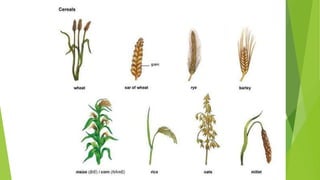
A cereal is a grain used for food, for example wheat, maize, or rye. They are staple foods and are
important sources of nutrients.
Examples include;
 Wheat
 Rice
 Maize
 Oat
 Barley
 Rye
 Millet
 Sorghum
NB: Sorghum, Millets, Wheat, Maize and Rice are major staple foods of the most population.
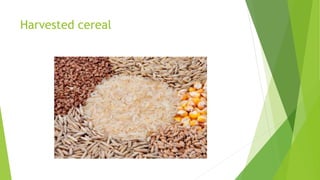
Harvested cereal
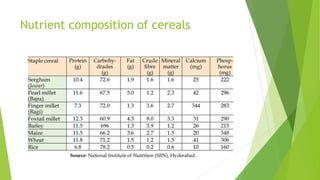
Nutrient composition of cereals
Cereals are staple foods and are important sources of nutrients in both
developed and developing countries. Cereals and cereal products are an
important source of energy, carbohydrates, protein and fiber and also contain a
number of micronutrients such as vitamin E, some B vitamins, magnesium and
zinc.
Nutrient composition of cereals
Compositionally, cereals consist of 12-14 percent water, 65-75 percent
carbohydrates, 2-6 percent lipids and 7-12 percent protein.
Cereals are quite similar in gross composition being low in protein and high in
carbohydrates . Oats and maize however contain relatively large amounts of
lipids.
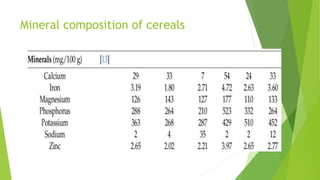
Mineral composition of cereals
production statistics of cereals
In 2018, 2.7 billion tonnes of cereals were produced worldwide, an increase
of 18% compared to 2008. Production grew faster than the global population,
reaching 354 kilograms per person in 2018. World cereal stocks amounted to 853
million tonnes in the same year, up from 510 million tonnes in 2008.
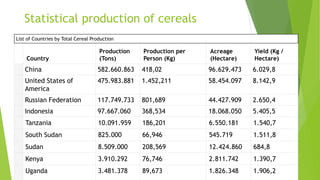
Statistical production of cereals
List of Countries by Total Cereal Production
Country
Production
(Tons)
Production per
Person (Kg)
Acreage
(Hectare)
Yield (Kg /
Hectare)
China 582.660.863 418,02 96.629.473 6.029,8
United States of
America
475.983.881 1.452,211 58.454.097 8.142,9
Russian Federation 117.749.733 801,689 44.427.909 2.650,4
Indonesia 97.667.060 368,534 18.068.050 5.405,5
Tanzania 10.091.959 186,201 6.550.181 1.540,7
South Sudan 825.000 66,946 545.719 1.511,8
Sudan 8.509.000 208,569 12.424.860 684,8
Kenya 3.910.292 76,746 2.811.742 1.390,7
Uganda 3.481.378 89,673 1.826.348 1.906,2
Some uses of cereals
 As animal feed, they are consumed mainly by livestock and poultry
 Many cereals are used industrially in the production of a wide range of substances,
such as glucose, adhesives, oils, and alcohols.
 The maize grain is processed into a growing number of food products, including
corn flour, corn oil, corn syrup, and many other by-products.
 It is a very important animal feed and is heavily used in the production of
cellulosic ethanol, a biofuel.
 Like wheat, rye is widely used for bread making.

 Oats are are used in animal feed, although they may also be processed for human
consumption.
 Barley is a source of the malt used in both the brewing of beer and the distillation
of alcoholic beverages. Barley malt is also a constituent of vinegar
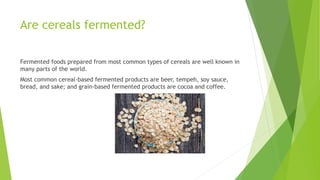
Are cereals fermented?
Fermented foods prepared from most common types of cereals are well known in
many parts of the world.
Most common cereal-based fermented products are beer, tempeh, soy sauce,
bread, and sake; and grain-based fermented products are cocoa and coffee.
Some fermented cereals
Name Cereal Used Fermentation
Microorganism (s)
Boza
Millet, Wheat, Maize,
Rice, Barley, Oat, Rye
LAB
Bushera Sorghum, Millet LAB
Cheka Sorghum, Maize Unknown
Chicha Maize LAB, Acetobacter
The how of cereal fermentation
 The basic fermentation process involves the enzymatic activities of
lactobacilli, leuconostoc, pediococci, yeasts and moulds. Their metabolic
activities result in the production of short chain fatty acids such
 The pH of these foods is reduced to values of 4 or less . Acids formed during
fermentation process, lower the pH thus inhibiting the growth of spoilage
organisms.
Locally produced cereal fermented
products
There quite a number of fermented cereal products all over the world and these
range from juices to alcohols. In Uganda, these may include;
1. Amalwa
2. Bushera
3. Mageu
4. umcombotsi
Production of bushera
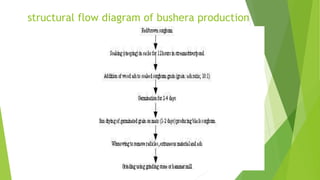
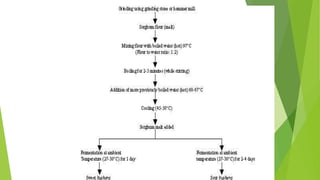
 the sorghum or millet flour is mixed with cooled boiled water to form a paste or slurry in a pot.
 Thereafter, more boiled water is added and the mixture is stirred and then boiled for about 2-5
minutes.
 After boiling, the mixture is then cooled, and germinated sorghum or millet flour or a mixture
of both flours is added to initiate fermentation.
 The mixture is left to ferment at ambient temperature (27- 30°C).
NB: Hot water can directly be added to the flour instead of cooled boiled water in a pot, while
stirring continuously to form a paste, then more hot water is added to obtain the required viscosity.
 when a mixture of millet and sorghum flour is to be used to make Bushera, one or one and half
parts of germinated sorghum is mixed with four parts of non-germinated or germinated millet
flour. However, if only non-germinated millet flour is used for Bushera production, malt of millet
and sorghum (0.5-1.0 Kg) is added which is claimed to act as a sweetener and flavour enhancer.
structural flow diagram of bushera production
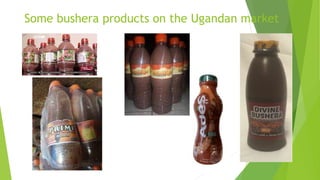
Some bushera products on the Ugandan market
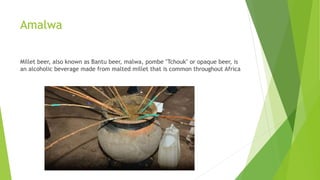
Amalwa
Millet beer, also known as Bantu beer, malwa, pombe "Tchouk" or opaque beer, is
an alcoholic beverage made from malted millet that is common throughout Africa
amalwa
 Prepare millet and take it for grinding. After grinding, ferment the millet for seven days.
 And roast it until it is hard enough then dry it in the sun.
 Keep it for later use.
 Then get millet clean it and pour in water then cover with either a banana leaf or clean sack
depending on what is available for two days.
 After two days it would have turned into yeast, dry it and grind it.
 Get a clean container mix the roasted millet with the ground yeast and add water.
 Make sure you smash the roasted millet so that the mixture looks like thick porridge.
 On the second day, the mixture will be sweet. You can draw some with a cup for drinking.
 Keep checking on it while adding yeast to it.
 You can add water depending on how thick you want your malwa to be.
 After three or four days the drink will be ready.
Mageu
Mageu is a traditional South African drink that is made by fermenting mealie pap.
It is non-alcoholic and is extremely popular especially among traditional groups,
who also call it maxau, maHewu, amaRhewu, or amaHewu.
Production of mageu
Wheat flour is added to the thin milled white maize, which creates the lactate-
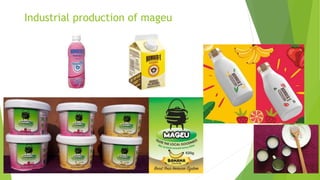
producing bacteria essential for the fermentation process. Commercial mageu
made in factories is pasteurized to extend its shelf life, which is quite short in
home-made mageu that isn’t refrigerated.
Industrial production of mageu
Health benefits of traditional mageu
 mageu is considered the most nutritious breakfast supplement for the optimal
growth of children.
 It also contains plenty of dietary fibres, including crude, soluble, and insoluble
fibres.
 In addition, it is very low in sodium (which increases blood pressure) and
saturated fats (which increase “bad” cholesterol).
 Mageu is very high in energy and is therefore preferred by athletes for a quick
energy boost.
 It is also a very good source of protein, which is an essential building block of
bones, muscles, cartilage, blood, and skin.
 Protein also builds and repairs tissues and helps to produce hormones, enzymes,
and other bodily chemicals essential for optimal health.
 According to the National Center for Biotechnology Information (NCBI), fermented
foods like mageu (called “functional foods” because their health benefits exceed
basic nutrition) normalise intestinal flora, prevent gut infestation by bacteria and
colon cancer, and treat diarrhoea in both adults and children.
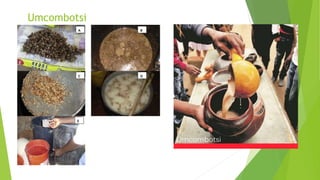
Umcombotsi
Umcombotsi is a brew made from maize (corn), maize malt, sorghum malt, yeast
and water. The brew has a heavy and distinctly sour aroma.
It does not have a very high alcohol content, usually less than three per cent. In
appearance, it is opaque and light tan in colour.
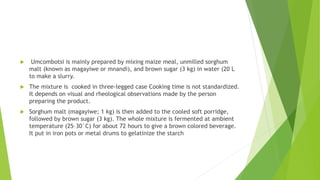
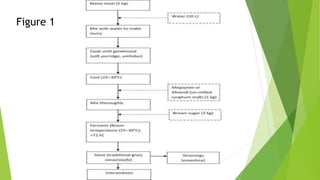
 Umcombotsi is mainly prepared by mixing maize meal, unmilled sorghum
malt (known as magayiwe or mnandi), and brown sugar (3 kg) in water (20 L
to make a slurry.
 The mixture is cooked in three-legged case Cooking time is not standardized.
It depends on visual and rheological observations made by the person
preparing the product.
 Sorghum malt (magayiwe; 1 kg) is then added to the cooled soft porridge,
followed by brown sugar (3 kg). The whole mixture is fermented at ambient
temperature (25–30°C) for about 72 hours to give a brown colored beverage.
It put in iron pots or metal drums to gelatinize the starch
Figure 1
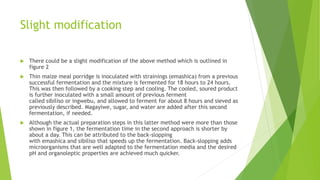
Slight modification
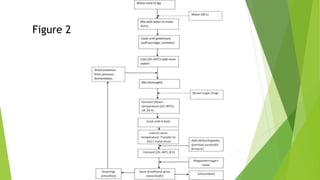
 There could be a slight modification of the above method which is outlined in
figure 2
 Thin maize meal porridge is inoculated with strainings (emashica) from a previous
successful fermentation and the mixture is fermented for 18 hours to 24 hours.
This was then followed by a cooking step and cooling. The cooled, soured product
is further inoculated with a small amount of previous ferment
called sibiliso or ingwebu, and allowed to ferment for about 8 hours and sieved as
previously described. Magayiwe, sugar, and water are added after this second
fermentation, if needed.
 Although the actual preparation steps in this latter method were more than those
shown in figure 1, the fermentation time in the second approach is shorter by
about a day. This can be attributed to the back-slopping
with emashica and sibiliso that speeds up the fermentation. Back-slopping adds
microorganisms that are well adapted to the fermentation media and the desired
pH and organoleptic properties are achieved much quicker.
Figure 2
Umcombotsi
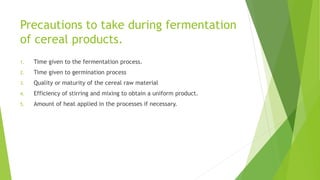
Precautions to take during fermentation
of cereal products.
1. Time given to the fermentation process.
2. Time given to germination process
3. Quality or maturity of the cereal raw material
4. Efficiency of stirring and mixing to obtain a uniform product.
5. Amount of heat applied in the processes if necessary.
refferecnces
Nutrient composition of cereals; https://www.researchgate.net/figure/Nutritional-
composition-of-staple-cereals-per-100-g_tbl1_325443441
production statistics of cereals
https://www.globalagriculture.org/transformation-of-our-food-
systems/book/infographics/cereal-
production.html#:~:text=In%202018%2C%202.7%20billion%20tonnes,510%20million%20t
onnes%20in%202008
Bushera production
PRODUCTION METHODS AND COMPOSITION OF BUSHERA pdf( prof Muyanja Charles)
Mageu
http://www.power-supply.co.za/health-benefits-eating-instant-mageu/
Traditional fermented cereal products.pptx

Traditional fermented cereal products.pptx

  • 1.
  • 2.
    Cereals A cereal isa grain used for food, for example wheat, maize, or rye. They are staple foods and are important sources of nutrients. Examples include;  Wheat  Rice  Maize  Oat  Barley  Rye  Millet  Sorghum NB: Sorghum, Millets, Wheat, Maize and Rice are major staple foods of the most population.
  • 3.
  • 5.
    Nutrient composition ofcereals Cereals are staple foods and are important sources of nutrients in both developed and developing countries. Cereals and cereal products are an important source of energy, carbohydrates, protein and fiber and also contain a number of micronutrients such as vitamin E, some B vitamins, magnesium and zinc.
  • 6.
  • 7.
    Nutrient composition ofcereals Compositionally, cereals consist of 12-14 percent water, 65-75 percent carbohydrates, 2-6 percent lipids and 7-12 percent protein. Cereals are quite similar in gross composition being low in protein and high in carbohydrates . Oats and maize however contain relatively large amounts of lipids.
  • 8.
  • 9.
    production statistics ofcereals In 2018, 2.7 billion tonnes of cereals were produced worldwide, an increase of 18% compared to 2008. Production grew faster than the global population, reaching 354 kilograms per person in 2018. World cereal stocks amounted to 853 million tonnes in the same year, up from 510 million tonnes in 2008.
  • 10.
    Statistical production ofcereals List of Countries by Total Cereal Production Country Production (Tons) Production per Person (Kg) Acreage (Hectare) Yield (Kg / Hectare) China 582.660.863 418,02 96.629.473 6.029,8 United States of America 475.983.881 1.452,211 58.454.097 8.142,9 Russian Federation 117.749.733 801,689 44.427.909 2.650,4 Indonesia 97.667.060 368,534 18.068.050 5.405,5 Tanzania 10.091.959 186,201 6.550.181 1.540,7 South Sudan 825.000 66,946 545.719 1.511,8 Sudan 8.509.000 208,569 12.424.860 684,8 Kenya 3.910.292 76,746 2.811.742 1.390,7 Uganda 3.481.378 89,673 1.826.348 1.906,2
  • 11.
    Some uses ofcereals  As animal feed, they are consumed mainly by livestock and poultry  Many cereals are used industrially in the production of a wide range of substances, such as glucose, adhesives, oils, and alcohols.  The maize grain is processed into a growing number of food products, including corn flour, corn oil, corn syrup, and many other by-products.  It is a very important animal feed and is heavily used in the production of cellulosic ethanol, a biofuel.  Like wheat, rye is widely used for bread making.  Oats are are used in animal feed, although they may also be processed for human consumption.  Barley is a source of the malt used in both the brewing of beer and the distillation of alcoholic beverages. Barley malt is also a constituent of vinegar
  • 13.
    Are cereals fermented? Fermentedfoods prepared from most common types of cereals are well known in many parts of the world. Most common cereal-based fermented products are beer, tempeh, soy sauce, bread, and sake; and grain-based fermented products are cocoa and coffee.
  • 14.
    Some fermented cereals NameCereal Used Fermentation Microorganism (s) Boza Millet, Wheat, Maize, Rice, Barley, Oat, Rye LAB Bushera Sorghum, Millet LAB Cheka Sorghum, Maize Unknown Chicha Maize LAB, Acetobacter
  • 15.
    The how ofcereal fermentation  The basic fermentation process involves the enzymatic activities of lactobacilli, leuconostoc, pediococci, yeasts and moulds. Their metabolic activities result in the production of short chain fatty acids such  The pH of these foods is reduced to values of 4 or less . Acids formed during fermentation process, lower the pH thus inhibiting the growth of spoilage organisms.
  • 16.
    Locally produced cerealfermented products There quite a number of fermented cereal products all over the world and these range from juices to alcohols. In Uganda, these may include; 1. Amalwa 2. Bushera 3. Mageu 4. umcombotsi
  • 17.
    Production of bushera the sorghum or millet flour is mixed with cooled boiled water to form a paste or slurry in a pot.  Thereafter, more boiled water is added and the mixture is stirred and then boiled for about 2-5 minutes.  After boiling, the mixture is then cooled, and germinated sorghum or millet flour or a mixture of both flours is added to initiate fermentation.  The mixture is left to ferment at ambient temperature (27- 30°C). NB: Hot water can directly be added to the flour instead of cooled boiled water in a pot, while stirring continuously to form a paste, then more hot water is added to obtain the required viscosity.  when a mixture of millet and sorghum flour is to be used to make Bushera, one or one and half parts of germinated sorghum is mixed with four parts of non-germinated or germinated millet flour. However, if only non-germinated millet flour is used for Bushera production, malt of millet and sorghum (0.5-1.0 Kg) is added which is claimed to act as a sweetener and flavour enhancer.
  • 18.
    structural flow diagramof bushera production
  • 20.
    Some bushera productson the Ugandan market
  • 21.
    Amalwa Millet beer, alsoknown as Bantu beer, malwa, pombe "Tchouk" or opaque beer, is an alcoholic beverage made from malted millet that is common throughout Africa
  • 22.
    amalwa  Prepare milletand take it for grinding. After grinding, ferment the millet for seven days.  And roast it until it is hard enough then dry it in the sun.  Keep it for later use.  Then get millet clean it and pour in water then cover with either a banana leaf or clean sack depending on what is available for two days.  After two days it would have turned into yeast, dry it and grind it.  Get a clean container mix the roasted millet with the ground yeast and add water.  Make sure you smash the roasted millet so that the mixture looks like thick porridge.  On the second day, the mixture will be sweet. You can draw some with a cup for drinking.  Keep checking on it while adding yeast to it.  You can add water depending on how thick you want your malwa to be.  After three or four days the drink will be ready.
  • 23.
    Mageu Mageu is atraditional South African drink that is made by fermenting mealie pap. It is non-alcoholic and is extremely popular especially among traditional groups, who also call it maxau, maHewu, amaRhewu, or amaHewu.
  • 24.
    Production of mageu Wheatflour is added to the thin milled white maize, which creates the lactate- producing bacteria essential for the fermentation process. Commercial mageu made in factories is pasteurized to extend its shelf life, which is quite short in home-made mageu that isn’t refrigerated.
  • 25.
  • 26.
    Health benefits oftraditional mageu  mageu is considered the most nutritious breakfast supplement for the optimal growth of children.  It also contains plenty of dietary fibres, including crude, soluble, and insoluble fibres.  In addition, it is very low in sodium (which increases blood pressure) and saturated fats (which increase “bad” cholesterol).  Mageu is very high in energy and is therefore preferred by athletes for a quick energy boost.  It is also a very good source of protein, which is an essential building block of bones, muscles, cartilage, blood, and skin.  Protein also builds and repairs tissues and helps to produce hormones, enzymes, and other bodily chemicals essential for optimal health.  According to the National Center for Biotechnology Information (NCBI), fermented foods like mageu (called “functional foods” because their health benefits exceed basic nutrition) normalise intestinal flora, prevent gut infestation by bacteria and colon cancer, and treat diarrhoea in both adults and children.
  • 27.
    Umcombotsi Umcombotsi is abrew made from maize (corn), maize malt, sorghum malt, yeast and water. The brew has a heavy and distinctly sour aroma. It does not have a very high alcohol content, usually less than three per cent. In appearance, it is opaque and light tan in colour.
  • 28.
     Umcombotsi ismainly prepared by mixing maize meal, unmilled sorghum malt (known as magayiwe or mnandi), and brown sugar (3 kg) in water (20 L to make a slurry.  The mixture is cooked in three-legged case Cooking time is not standardized. It depends on visual and rheological observations made by the person preparing the product.  Sorghum malt (magayiwe; 1 kg) is then added to the cooled soft porridge, followed by brown sugar (3 kg). The whole mixture is fermented at ambient temperature (25–30°C) for about 72 hours to give a brown colored beverage. It put in iron pots or metal drums to gelatinize the starch
  • 29.
  • 30.
    Slight modification  Therecould be a slight modification of the above method which is outlined in figure 2  Thin maize meal porridge is inoculated with strainings (emashica) from a previous successful fermentation and the mixture is fermented for 18 hours to 24 hours. This was then followed by a cooking step and cooling. The cooled, soured product is further inoculated with a small amount of previous ferment called sibiliso or ingwebu, and allowed to ferment for about 8 hours and sieved as previously described. Magayiwe, sugar, and water are added after this second fermentation, if needed.  Although the actual preparation steps in this latter method were more than those shown in figure 1, the fermentation time in the second approach is shorter by about a day. This can be attributed to the back-slopping with emashica and sibiliso that speeds up the fermentation. Back-slopping adds microorganisms that are well adapted to the fermentation media and the desired pH and organoleptic properties are achieved much quicker.
  • 31.
  • 32.
  • 33.
    Precautions to takeduring fermentation of cereal products. 1. Time given to the fermentation process. 2. Time given to germination process 3. Quality or maturity of the cereal raw material 4. Efficiency of stirring and mixing to obtain a uniform product. 5. Amount of heat applied in the processes if necessary.
  • 34.
    refferecnces Nutrient composition ofcereals; https://www.researchgate.net/figure/Nutritional- composition-of-staple-cereals-per-100-g_tbl1_325443441 production statistics of cereals https://www.globalagriculture.org/transformation-of-our-food- systems/book/infographics/cereal- production.html#:~:text=In%202018%2C%202.7%20billion%20tonnes,510%20million%20t onnes%20in%202008 Bushera production PRODUCTION METHODS AND COMPOSITION OF BUSHERA pdf( prof Muyanja Charles) Mageu http://www.power-supply.co.za/health-benefits-eating-instant-mageu/