MALIGNANT OTITIS
EXTERNA
(NECROTIZING OTITIS EXTERNA)
BY
DR. SRIHARIHARAN
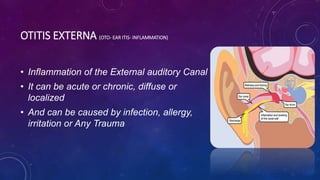
OTITIS EXTERNA (OTO- EAR ITIS- INFLAMMATION)
• Inflammation of the External auditory Canal
• It can be acute or chronic, diffuse or
localized
• And can be caused by infection, allergy,
irritation or Any Trauma
MALIGNANT OTITIS EXTERNA
• It is an aggressive, inflammatory
condition involving the outer ear canal
progressively spreading to Involve skull
base and the adjacent structures.
• Is it malignancy – NO
• Misnomer
• It is so called malignancy because of aggressive & life-
threatening clinical progressive behavior, Poor treatment
outcome (in later stages) & high mortality rate
MALIGNANT OTITIS EXTERNA
PREDISPOSING FACTORS- MOE
• Elderly People with uncontrolled Diabetes
mellitus
• Immunocompromised (HIV) Patients
• Patients on chemotherapy/ Immunosuppressive
drugs
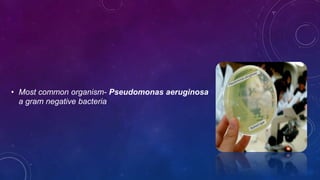
• Most common organism- Pseudomonas aeruginosa
a gram negative bacteria
SIGNS AND SYMPTOMS
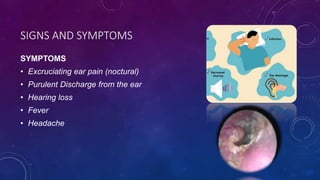
SYMPTOMS
• Excruciating ear pain (noctural)
• Purulent Discharge from the ear
• Hearing loss
• Fever
• Headache
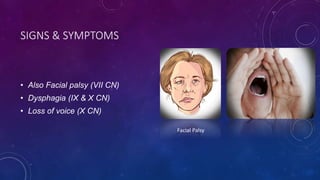
SIGNS & SYMPTOMS
• Also Facial palsy (VII CN)
• Dysphagia (IX & X CN)
• Loss of voice (X CN)
Facial Palsy
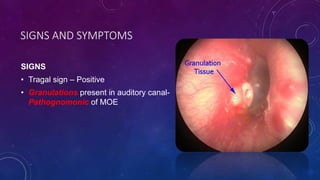
SIGNS
• Tragal sign – Positive
• Granulations present in auditory canal-
Pathognomonic of MOE
SIGNS AND SYMPTOMS
MALIGNANT OTITIS EXTERNA
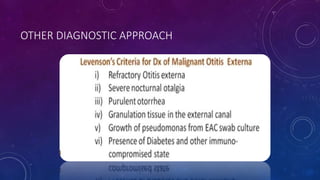
OTHER DIAGNOSTIC APPROACH
INVESTIGATIONS
The initial investigation for OME is
• CT scan – Reveals the bony destruction but is
often not helpful
INVESTIGATIONS
• Technetium 99 bone scan- reveals bone
infection
• But test remains positive for a year or so and
cannot be used to monitor the disease.
INVESTIGATIONS
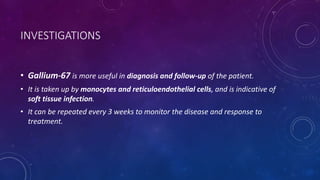
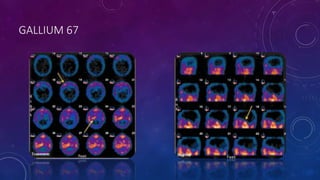
• Gallium-67 is more useful in diagnosis and follow-up of the patient.
• It is taken up by monocytes and reticuloendothelial cells, and is indicative of
soft tissue infection.
• It can be repeated every 3 weeks to monitor the disease and response to
treatment.
INVESTIGATIONS
Further Hematological investigations Helpful in further management and
Treatment
• Complete blood count
• ESR ,CRP, Procalcitonin
• FBS, PPBS,
• HbAIC
• Hearing test
• Culture and sensitivity
GALLIUM 67
TREATMENT.
• Toilet of ear canal
Remove discharge, debris and
granulations or any dead tissue or bone.
IV ANTIBIOTICS
• Antibiotic treatment is continued for 6–8 weeks,
sometimes more.
• Third-generation cephalosporins
e.g. ceftriaxone 1–2 g/day i.v. or ceftazidime 1–2
g/day i.v. are usually combined with an aminogly
ORAL ANTIBIOTICS
• Quinolones (ciprofloxacin, ofloxacin and levofloxacin) are also effective and
can be given orally. They can be combined with rifampin.
• Ciprofloxacin 750 mg OD orally can be used.
HYPERBARIC OXYGEN THERAPY
• HBO increases the partial pressure of oxygen
improving hypoxia and allowing greater oxidative
killing of bacteria.
• Used only as an adjunct to antimicrobial therapy
• Since the exact mechanism and success rate is very
low, it is not widely used.
TREATMENT
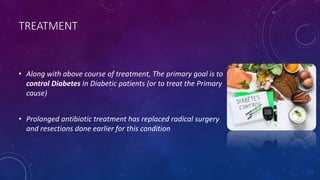
• Along with above course of treatment, The primary goal is to
control Diabetes In Diabetic patients (or to treat the Primary
cause)
• Prolonged antibiotic treatment has replaced radical surgery
and resections done earlier for this condition
FOLLOW UP
Response to treatment
• Earliest sign of response to therapy is decrease in nocturnal ear pain
• Drop in ESR,CRP & procalcitonin
• Gallium -67/ PET scan after treatment (usually after 6-8 weeks), useful in
follow-up course of Treatment
PREVENTION
• Avoid manipulation of the ear canal in immunocompromised patients
• Don't use cotton buds to clean ears
• Avoid aural irrigation
• Early diagnosis and treatmentnecessary
• Strict control of primary condition
• Regular follow up
Thank you

Malignant Otitis Externa by Dr.S .pptx

  • 1.
  • 2.
    OTITIS EXTERNA (OTO-EAR ITIS- INFLAMMATION) • Inflammation of the External auditory Canal • It can be acute or chronic, diffuse or localized • And can be caused by infection, allergy, irritation or Any Trauma
  • 3.
    MALIGNANT OTITIS EXTERNA •It is an aggressive, inflammatory condition involving the outer ear canal progressively spreading to Involve skull base and the adjacent structures.
  • 4.
    • Is itmalignancy – NO • Misnomer • It is so called malignancy because of aggressive & life- threatening clinical progressive behavior, Poor treatment outcome (in later stages) & high mortality rate MALIGNANT OTITIS EXTERNA
  • 6.
    PREDISPOSING FACTORS- MOE •Elderly People with uncontrolled Diabetes mellitus • Immunocompromised (HIV) Patients • Patients on chemotherapy/ Immunosuppressive drugs
  • 7.
    • Most commonorganism- Pseudomonas aeruginosa a gram negative bacteria
  • 8.
    SIGNS AND SYMPTOMS SYMPTOMS •Excruciating ear pain (noctural) • Purulent Discharge from the ear • Hearing loss • Fever • Headache
  • 9.
    SIGNS & SYMPTOMS •Also Facial palsy (VII CN) • Dysphagia (IX & X CN) • Loss of voice (X CN) Facial Palsy
  • 10.
    SIGNS • Tragal sign– Positive • Granulations present in auditory canal- Pathognomonic of MOE SIGNS AND SYMPTOMS
  • 11.
  • 13.
  • 14.
    INVESTIGATIONS The initial investigationfor OME is • CT scan – Reveals the bony destruction but is often not helpful
  • 15.
    INVESTIGATIONS • Technetium 99bone scan- reveals bone infection • But test remains positive for a year or so and cannot be used to monitor the disease.
  • 16.
    INVESTIGATIONS • Gallium-67 ismore useful in diagnosis and follow-up of the patient. • It is taken up by monocytes and reticuloendothelial cells, and is indicative of soft tissue infection. • It can be repeated every 3 weeks to monitor the disease and response to treatment.
  • 17.
    INVESTIGATIONS Further Hematological investigationsHelpful in further management and Treatment • Complete blood count • ESR ,CRP, Procalcitonin • FBS, PPBS, • HbAIC • Hearing test • Culture and sensitivity
  • 18.
  • 19.
    TREATMENT. • Toilet ofear canal Remove discharge, debris and granulations or any dead tissue or bone.
  • 20.
    IV ANTIBIOTICS • Antibiotictreatment is continued for 6–8 weeks, sometimes more. • Third-generation cephalosporins e.g. ceftriaxone 1–2 g/day i.v. or ceftazidime 1–2 g/day i.v. are usually combined with an aminogly
  • 21.
    ORAL ANTIBIOTICS • Quinolones(ciprofloxacin, ofloxacin and levofloxacin) are also effective and can be given orally. They can be combined with rifampin. • Ciprofloxacin 750 mg OD orally can be used.
  • 22.
    HYPERBARIC OXYGEN THERAPY •HBO increases the partial pressure of oxygen improving hypoxia and allowing greater oxidative killing of bacteria. • Used only as an adjunct to antimicrobial therapy • Since the exact mechanism and success rate is very low, it is not widely used.
  • 23.
    TREATMENT • Along withabove course of treatment, The primary goal is to control Diabetes In Diabetic patients (or to treat the Primary cause) • Prolonged antibiotic treatment has replaced radical surgery and resections done earlier for this condition
  • 24.
    FOLLOW UP Response totreatment • Earliest sign of response to therapy is decrease in nocturnal ear pain • Drop in ESR,CRP & procalcitonin • Gallium -67/ PET scan after treatment (usually after 6-8 weeks), useful in follow-up course of Treatment
  • 25.
    PREVENTION • Avoid manipulationof the ear canal in immunocompromised patients • Don't use cotton buds to clean ears • Avoid aural irrigation • Early diagnosis and treatmentnecessary • Strict control of primary condition • Regular follow up
  • 26.