
Malignant Otitis Externa
• Nishchal Gupta
Introduction
• Malignant otitis externa is an aggressive and
potentially life-threatening infection of the
softtissues of the external ear and surrounding
structures, quickly spreading to involve the
periosteum and bone of the skull base.
• Synonyms :
▫ Necrotizing Otitis Externa
▫ Skull Base osteomyelitis
• Malignant otitis externa is a misnomer as it is
not a neoplastic process.
• In 1968, Chandler described this otitis externa as
malignant because he observed an aggressive
clinical behavior, poor treatment outcome, and a
high mortality rate for the patients affected by
this disease.
Microbiology:
• Bacterial :
▫ Pseudomonas aeruginosa (95%)
▫ Staphylococcus aureus , S epidermidis
• Fungus
▫ Aspergillus Fumigatus, A. Flavus, A. Niger
Predisposing Factors
• Uncontrolled diabetes above 55 years of age.
• Immunocompromised - Acquired Immune
Deficiency Syndrome (AIDS) or malignancy and
are on immunosuppressive drugs like
azathioprine, methotrexate, cyclophosphamide
and cyclosporine.
• Malnutrition
• Anemia(Children)
• Organ Transplant Recipent
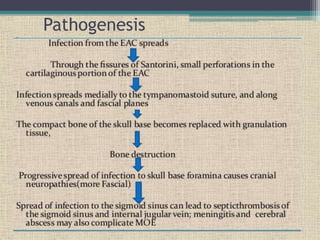
Pathogenesis
CLINICAL FEATURES
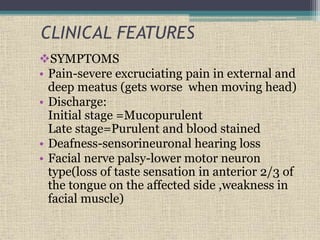
SYMPTOMS
• Pain-severe excruciating pain in external and
deep meatus (gets worse when moving head)
• Discharge:
Initial stage =Mucopurulent
Late stage=Purulent and blood stained
• Deafness-sensorineuronal hearing loss
• Facial nerve palsy-lower motor neuron
type(loss of taste sensation in anterior 2/3 of
the tongue on the affected side ,weakness in
facial muscle)
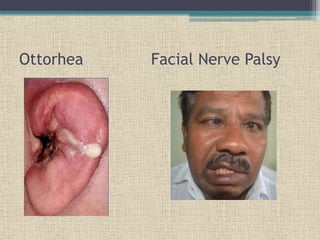
Ottorhea Facial Nerve Palsy
• Difficulty swallowing
• Persistent itching in the ear canal
• Swollen and red skin around the ear
• Fever and headache sometimes
• Neck stiffness
SIGNS
• Pinna will be doughy on palpation
• Tenderness on pulling the pinna
• Mastoid tenderness in late cases
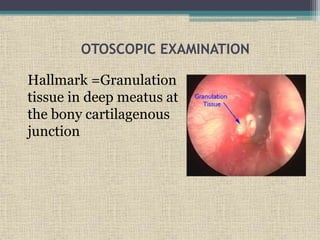
OTOSCOPIC EXAMINATION
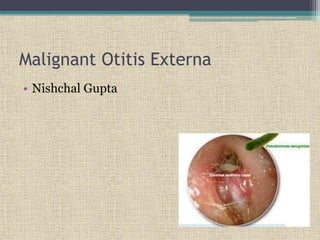
Hallmark =Granulation
tissue in deep meatus at
the bony cartilagenous
junction
• External Auditory Canal(EAC) is narrow and
discharge present
• Sagging of the posterior meatal wall
• Tympanic membrane is normal in early cases
• May show bulge,congestion and granulation if
middle ear is involved
• Signs of multiple cranial nerve palsies in late
cases
STAGING AND CLASSIFICATION
• Stage 1:Clinical evidence of malignant otitis
externa with infection of soft tissue beyond the
external auditory canal,but negative Tc-99 bone
scan
• Stage 2:soft tissue infection beyond EAC with
positive Tc-99 bone scan
• Stage 3:As above,but with cranial nerve paralysis
3a -single
3b-multiple
• Stage 4:Meningitis,empyema,sinus thrombosis or
brain abscess
Diagnosis of malignant Otitis Externa
• There is no single pathognomonic criterion that
defines malignant otitis externa
• History: Age, Diabetic, may also give history of
trauma to ear by irrigation or cleaning
• Complete head and neck examination: Signs of
otitis externa with or without cranial nerve palsy
Investigations
• Ear swab for Culture & Sensitivity
▫ Positive for Pseudomonas
• Blood examination: Complete blood count
• ESR, CRP are raised
• Fasting Blood Sugar & HbA1C for the status of
the blood glucose level.
• RFT & LFT are not for diagnosis but are
important because the patient has to be treated
with antibiotics for longer period.
• Tissue biopsy to rule out malignancy.
Radiological Invstigations
▫ CT Scan/MRI with galium contrast will show
evidence of temporal bone involvement and extent
of the ear.
▫ TC 99 isotope bone scan – demonstrate increased
uptake in the region of skull base in active case.
Management
• Medical management:
▫ Glucose control
▫ Aural toilet
▫ Systemic anti-Pseudomonas antibiotics (treatment
of choice )
▫ Hyperbaric Oxygen Therapy
Medical Management
• Fluoroquinolones are active against P.
aeruginosa.
• For at least 6 to 8 weeks- oral and
intravenous ciprofloxacin
• Ceftazidime provide an alternative to
ciprofloxacin with or without Aminoglycoside
• Amphotericin B is the most commonly used
antifungal agent for fungal
Hyperbaric Oxygen (HBO):
• HBO increases the partial pressure of oxygen,
improving hypoxia and allowing greater
oxidative killing of bacteria.
• Used only as an adjunct to antimicrobial therapy
Surgical Management
• Local debridement of necrotic tissues and bone.
• Wide surgical excision of infected tissue and
bone may be required sometime.
Cranial Nerve Complications
• Cranial nerves can be affected by inflammation
along the skull base or by a neurotoxin produced
by Pseudomonas species.
• The facial nerve (VII) is affected most commonly,
usually at the stylomastoid foramen.
• As the disease progresses, cranial nerves IX, X,
and XI can be affected at the jugular foramen,
followed by XII at the hypoglossal canal.
• Cranial nerves V and VI can be affected if the
disease extends to the petrous apex.
Intracranial Complications
• Meningitis, brain abscess, and dural sinus
thrombosis.
• Sigmoid Sinus Thrombosis- if cranial
neuropathies related to jugular foramen is
present.
• Cavernous Sinus Thrombosis- if Cranial nerve V
& VI are involved.
•THANK YOU!!

Malignant otitis externa

  • 1.
  • 2.
    Introduction • Malignant otitisexterna is an aggressive and potentially life-threatening infection of the softtissues of the external ear and surrounding structures, quickly spreading to involve the periosteum and bone of the skull base. • Synonyms : ▫ Necrotizing Otitis Externa ▫ Skull Base osteomyelitis
  • 3.
    • Malignant otitisexterna is a misnomer as it is not a neoplastic process. • In 1968, Chandler described this otitis externa as malignant because he observed an aggressive clinical behavior, poor treatment outcome, and a high mortality rate for the patients affected by this disease.
  • 4.
    Microbiology: • Bacterial : ▫Pseudomonas aeruginosa (95%) ▫ Staphylococcus aureus , S epidermidis • Fungus ▫ Aspergillus Fumigatus, A. Flavus, A. Niger
  • 5.
    Predisposing Factors • Uncontrolleddiabetes above 55 years of age. • Immunocompromised - Acquired Immune Deficiency Syndrome (AIDS) or malignancy and are on immunosuppressive drugs like azathioprine, methotrexate, cyclophosphamide and cyclosporine. • Malnutrition • Anemia(Children) • Organ Transplant Recipent
  • 6.
  • 7.
    CLINICAL FEATURES SYMPTOMS • Pain-severeexcruciating pain in external and deep meatus (gets worse when moving head) • Discharge: Initial stage =Mucopurulent Late stage=Purulent and blood stained • Deafness-sensorineuronal hearing loss • Facial nerve palsy-lower motor neuron type(loss of taste sensation in anterior 2/3 of the tongue on the affected side ,weakness in facial muscle)
  • 8.
  • 9.
    • Difficulty swallowing •Persistent itching in the ear canal • Swollen and red skin around the ear • Fever and headache sometimes • Neck stiffness
  • 10.
    SIGNS • Pinna willbe doughy on palpation • Tenderness on pulling the pinna • Mastoid tenderness in late cases
  • 11.
    OTOSCOPIC EXAMINATION Hallmark =Granulation tissuein deep meatus at the bony cartilagenous junction
  • 12.
    • External AuditoryCanal(EAC) is narrow and discharge present • Sagging of the posterior meatal wall • Tympanic membrane is normal in early cases • May show bulge,congestion and granulation if middle ear is involved • Signs of multiple cranial nerve palsies in late cases
  • 13.
    STAGING AND CLASSIFICATION •Stage 1:Clinical evidence of malignant otitis externa with infection of soft tissue beyond the external auditory canal,but negative Tc-99 bone scan • Stage 2:soft tissue infection beyond EAC with positive Tc-99 bone scan • Stage 3:As above,but with cranial nerve paralysis 3a -single 3b-multiple • Stage 4:Meningitis,empyema,sinus thrombosis or brain abscess
  • 14.
    Diagnosis of malignantOtitis Externa • There is no single pathognomonic criterion that defines malignant otitis externa • History: Age, Diabetic, may also give history of trauma to ear by irrigation or cleaning • Complete head and neck examination: Signs of otitis externa with or without cranial nerve palsy
  • 15.
    Investigations • Ear swabfor Culture & Sensitivity ▫ Positive for Pseudomonas • Blood examination: Complete blood count • ESR, CRP are raised • Fasting Blood Sugar & HbA1C for the status of the blood glucose level. • RFT & LFT are not for diagnosis but are important because the patient has to be treated with antibiotics for longer period. • Tissue biopsy to rule out malignancy.
  • 16.
    Radiological Invstigations ▫ CTScan/MRI with galium contrast will show evidence of temporal bone involvement and extent of the ear. ▫ TC 99 isotope bone scan – demonstrate increased uptake in the region of skull base in active case.
  • 17.
    Management • Medical management: ▫Glucose control ▫ Aural toilet ▫ Systemic anti-Pseudomonas antibiotics (treatment of choice ) ▫ Hyperbaric Oxygen Therapy
  • 18.
    Medical Management • Fluoroquinolonesare active against P. aeruginosa. • For at least 6 to 8 weeks- oral and intravenous ciprofloxacin • Ceftazidime provide an alternative to ciprofloxacin with or without Aminoglycoside • Amphotericin B is the most commonly used antifungal agent for fungal
  • 19.
    Hyperbaric Oxygen (HBO): •HBO increases the partial pressure of oxygen, improving hypoxia and allowing greater oxidative killing of bacteria. • Used only as an adjunct to antimicrobial therapy
  • 20.
    Surgical Management • Localdebridement of necrotic tissues and bone. • Wide surgical excision of infected tissue and bone may be required sometime.
  • 21.
    Cranial Nerve Complications •Cranial nerves can be affected by inflammation along the skull base or by a neurotoxin produced by Pseudomonas species. • The facial nerve (VII) is affected most commonly, usually at the stylomastoid foramen. • As the disease progresses, cranial nerves IX, X, and XI can be affected at the jugular foramen, followed by XII at the hypoglossal canal. • Cranial nerves V and VI can be affected if the disease extends to the petrous apex.
  • 22.
    Intracranial Complications • Meningitis,brain abscess, and dural sinus thrombosis. • Sigmoid Sinus Thrombosis- if cranial neuropathies related to jugular foramen is present. • Cavernous Sinus Thrombosis- if Cranial nerve V & VI are involved.
  • 23.

Editor's Notes

  • #7 Santorini's fissures: Vertical fissures in the anterior part of the cartilage of the external acoustic meatus (ear canal).
  • #17 Tc 99= accumulates at sites of osteoblastic activity making it highly sensitivity for bony infection. Gallium Scal 67ga= more specific than bone scanning since radioisotope is incorporated into granulocytes and bacteria. used to follow response to treatment since uptake value return to normal with resolution of infection.
  • #22  MOE contin. Deep boring extrosis pain. Other ma throbing pain Not limited to soft tissue > periosteum > bone so pain is deep boring pain as in osteomyelitis Tregal tenderness +/- Tympanic membrane normal Granulation tissue +nt at junction of