MALARIA
PRESENTED BY :
MUSTAK AHAMAD
NAINSI KUMARI
PHARM D 3RD YEAR
ISF COLLEGE OF
PHARMACY
PRESENTED TO:
DR. ROJIN G RAJ
ASSISTANT PROFFESOR
DEPT. OF PHARMACY
PRACTICE
ISF COLLEGE OF
INTRODUCTION
 Malaria is a potentially life threateningillness that is caused by the
plasmodium protozoa.
 Malaria is one of the most well known tropical diseasesworldwide. Malaria
is caused by the plasmodium protozoa, which are transmittedto human by
Female Anopheles mosquitoes. These insect transmit the parasite following
the bite of an infected mosquito.
 There are five different types of plasmodium protozoa that can cause
Malaria in humans.
1. P. vivax
2. P. falciparum
3. P. ovale
4. P. malariae
5. P. knowlesi
Life cycle of malaria
EPIDEMIOLOGY
•Malaria is endemic throughout most of the tropics. Ongoing
transmission occurs in 85 countries and territories.
•The World Health Organization (WHO) estimates that India
has 15 million cases of malaria with 19,500–20,000 deaths
annually.
•The WHO has set global targets to reduce malaria case
incidence by at least 90% by 2030.
ETIOLOGY
There are five known species of Plasmodium that cause malaria in
humans.
Malaria is caused by the Plasmodium protozoa, which are
single-celled eukaryotes. Humans acquire the parasite through an
infected Anopheles mosquitobite, which are contained within its
salvia. There are five types of Plasmodium that can cause infection
in humans.
 Plasmodium falciparum: most common cause. Most prevalent
species in Africa. Incubation period 7-30 days (mean 12-14 days).
Rarely causes initial infection up to a year later. No dormant phase
so does not 'relapse'following treatment..
Plasmodiumvivax: second most common cause. Found in
Southeast Asia, Latin America and Africa. Incubation period
usually 2 weeks. Has a dormant liver stage, which means the
disease can 'relapse' months or years later (usually <2-3 years
Plasmodium ovale: predominantly identified in West Africa.
Incubation period 2 weeks. Similar to P. vivax, has a dormant
liver stage, which means disease can relapse with 2-3 years
of onset.
Plasmodium malariae: found throughout Africa, Asia and
the Americans. Has an incubation period around 18 days. Can
cause a chronic low-grade infection if not treated. No dormant
phase so does not 'relapse' following treatment..
Plasmodium knowlesi: a nonhuman primate malaria that
has infected humans throughout Southeast Asia. The natural
host are macaques. Incubation period is 3-27 days (median 8-
12 days). Fatal infections can occur.
CLINICAL PRESENTATION
Initial presentation
Nonspecific fever, chills, rigors, diaphoresis, malaise, vomiting
Orthostatic hypotension
Electrolyte abnormalities
Erythrocytic phase
Prodrome: headache, anorexia,malaise, fatigue, myalgia
Nonspecific complaints such as abdominalpain, diarrhea,chest pain,
and arthralgia
Paroxysm: high fever, chills, and rigor
Cold phase: severe pallor and cyanosis of the lips
Hot phase: fever between 40.5°C (104.9°F) and 41°C (105.8°F)
Sweating phase: Follows hot phase by 2–6 hours
Fever resolves
Marked fatigue and drowsiness,warm, dry skin, tachycardia, cough, severe
headache,nausea, vomiting, abdominal pain, diarrhea, and delirium
Lactic acidosis and hypoglycemia(with falciparum malaria)
Anemia
Splenomegaly
P. falciparum infections
Hypoglycemia,acute renal failure, pulmonary edema, severe anemia,
thrombocytopenia,high-output heart failure, cerebral congestion,seizures
and coma, and adult respiratorysyndrome.
diagnosis
1.MICROSCOPIC DIAGNOSIS
THICK AND THIN FILMS:
Microscopic examinationof a blood film remains the 'gold-standard'
diagnostictool for malaria.A blood specimen is taken from a patient
and preparedon a slide using a Giemsa stain.
Thick film: up to 20 times more sensitive than thin film for detection of
parasites but less sensitive for identificationof species.
Thin film: considereda qualitative test. Less sensitive at detection of
parasites,but better for identificationfor species.
QBC (Quantitative Buffy Coat) :
It is a diagnostic technique for malaria. It concentrates a blood
sample's buffy coat, containing malaria parasites, using centrifugation.
A fluorescent stain makes parasites visible under a microscope.
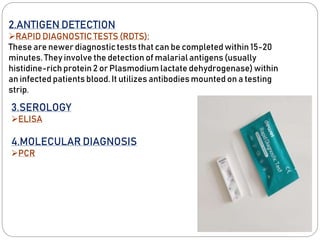
2.ANTIGEN DETECTION
RAPID DIAGNOSTIC TESTS (RDTS):
These are newer diagnostictests that can be completed within 15-20
minutes. They involve the detection of malarial antigens (usually
histidine-richprotein 2 or Plasmodiumlactate dehydrogenase)within
an infected patients blood. It utilizes antibodies mounted on a testing
strip.
3.SEROLOGY
ELISA
4.MOLECULAR DIAGNOSIS
PCR
TREATMENT
DESIRED OUTCOME:
The primarygoal in the managementof malaria is the rapid diagnosisof
the Plasmodiasp. by bloodsmears(repeatedevery12 hours for 3 days) so
as to initiate timely anti malarial therapy to eradicate the infection within
48 to 72 hours.
 To avoid complicationssuch as hypoglycemia,pulmonary edema, and
renal failure that are responsiblefor increasedmortality in malaria.
PHARMACOLOGICAL TREATMENT
NON FALCIPARUM MALARIA :
oA patient infected with one of the other species of Plasmodium
(P. vivax,P. ovale,or P. malariae)shouldreceive oralchloroquine
Phosphate.
oFor patients who cannot tolerate the oral doses of chloroquine, parenteral
doses of quinidine can be administered.
oPatients with P. ovaleand P. vivax alsoshouldbe given Primaquineto
prevent relapses from the latent exoerythrocytic stages in the liver.
DRUG OF CHOICE DOSAGE
Chloroquine phosphate Adults: 1 g (600 mg base), then 500
mg 6 hours later,
then 500 mg at 24 and 48 hours
later
Children: 10 mg base (max. 600 mg
base) then 5 mg
base/kg 6 hours later, then 5
mg/base at 24 and
48 hours.
Prevention of Relapses (P. vivax and P. ovale)
Primaquine phosphate Adults: 52.6 mg/d (30 mg base) × 14
DRUG OF CHOICE DOSAGE
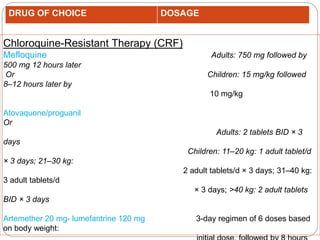
Chloroquine-Resistant Therapy (CRF)
Mefloquine Adults: 750 mg followed by
500 mg 12 hours later
Or Children: 15 mg/kg followed
8–12 hours later by
10 mg/kg
Atovaquone/proguanil
Or
Adults: 2 tablets BID × 3
days
Children: 11–20 kg: 1 adult tablet/d
× 3 days; 21–30 kg:
2 adult tablets/d × 3 days; 31–40 kg:
3 adult tablets/d
× 3 days; >40 kg: 2 adult tablets
BID × 3 days
Artemether 20 mg- lumefantrine 120 mg 3-day regimen of 6 doses based
on body weight:
UNCOMPLICATED FALCIPARUM MALARIA
COMPLICATED FALCIPARUM MALARIA
Monitoring :
 BLOOD GLUCOSE[ 4 HOURLY]
HAEMOGLOBIN
CREATININE
CLOTTINGPROFILE
ELECTROLYTES
DAILYPARASITECOUNT
PROPHYLAXIS OF MALARIA
Chemoprophylaxis for malaria involves taking medications to prevent
the contraction of malaria in individualstravelingto or residingin
malaria-endemicareas.
The specific choice of medication and regimen depends on factors like
the destination'smalaria risk and individualhealth considerations.
DRUG OF CHOICE DOSAGE
Chemoprophylaxis
Chloroquine phosphate Adults: 500 mg (base) once weekly
(beginning
1–2 weeks before departure
and continuing through
stay and up to 4 weeks
after returning)
,
Children: 5 mg/kg base once
Chemoprophylaxis-CRF
Mefloquine
Or Adults: 250 mg once weekly
beginning 1–2 weeks
before departure, continuing
through stay and for
1–4 weeks after return
Children: <15 kg: 5 mg/kg once
weekly; 15–19 kg:
1/4 tablet once weekly; 20–30 kg:
1/2 tablet once
weekly; 31–45 kg: 3/4 tablet once
weekly; >45 kg:
1 tablet once weekly
Doxycycline Adults: 100 mg daily beginning 1–2
days before
departure continuing during stay and 1
week after return.
DRUG OF CHOICE DOSING
Quinine sulfate (Qualaquin) Adults: 650 PO TID × 3 days
+ Children: 25 mg/kg/d PO TID
× 3 days
Pyrimethamine-sulfadoxine Adults: 3 tablets at once (withhold
until febrile episode)
Children: 1/2–2 tablets (depends
on age)
Or
Mefloquine Adults: 1,250 mg once
Children: 25 mg/kg once (>45 kg)
MALARIA
MALARIA

MALARIA

  • 1.
    MALARIA PRESENTED BY : MUSTAKAHAMAD NAINSI KUMARI PHARM D 3RD YEAR ISF COLLEGE OF PHARMACY PRESENTED TO: DR. ROJIN G RAJ ASSISTANT PROFFESOR DEPT. OF PHARMACY PRACTICE ISF COLLEGE OF
  • 2.
    INTRODUCTION  Malaria isa potentially life threateningillness that is caused by the plasmodium protozoa.  Malaria is one of the most well known tropical diseasesworldwide. Malaria is caused by the plasmodium protozoa, which are transmittedto human by Female Anopheles mosquitoes. These insect transmit the parasite following the bite of an infected mosquito.  There are five different types of plasmodium protozoa that can cause Malaria in humans. 1. P. vivax 2. P. falciparum 3. P. ovale 4. P. malariae 5. P. knowlesi
  • 3.
  • 4.
    EPIDEMIOLOGY •Malaria is endemicthroughout most of the tropics. Ongoing transmission occurs in 85 countries and territories. •The World Health Organization (WHO) estimates that India has 15 million cases of malaria with 19,500–20,000 deaths annually. •The WHO has set global targets to reduce malaria case incidence by at least 90% by 2030.
  • 5.
    ETIOLOGY There are fiveknown species of Plasmodium that cause malaria in humans. Malaria is caused by the Plasmodium protozoa, which are single-celled eukaryotes. Humans acquire the parasite through an infected Anopheles mosquitobite, which are contained within its salvia. There are five types of Plasmodium that can cause infection in humans.  Plasmodium falciparum: most common cause. Most prevalent species in Africa. Incubation period 7-30 days (mean 12-14 days). Rarely causes initial infection up to a year later. No dormant phase so does not 'relapse'following treatment.. Plasmodiumvivax: second most common cause. Found in Southeast Asia, Latin America and Africa. Incubation period usually 2 weeks. Has a dormant liver stage, which means the disease can 'relapse' months or years later (usually <2-3 years
  • 6.
    Plasmodium ovale: predominantlyidentified in West Africa. Incubation period 2 weeks. Similar to P. vivax, has a dormant liver stage, which means disease can relapse with 2-3 years of onset. Plasmodium malariae: found throughout Africa, Asia and the Americans. Has an incubation period around 18 days. Can cause a chronic low-grade infection if not treated. No dormant phase so does not 'relapse' following treatment.. Plasmodium knowlesi: a nonhuman primate malaria that has infected humans throughout Southeast Asia. The natural host are macaques. Incubation period is 3-27 days (median 8- 12 days). Fatal infections can occur.
  • 7.
    CLINICAL PRESENTATION Initial presentation Nonspecificfever, chills, rigors, diaphoresis, malaise, vomiting Orthostatic hypotension Electrolyte abnormalities Erythrocytic phase Prodrome: headache, anorexia,malaise, fatigue, myalgia Nonspecific complaints such as abdominalpain, diarrhea,chest pain, and arthralgia Paroxysm: high fever, chills, and rigor Cold phase: severe pallor and cyanosis of the lips Hot phase: fever between 40.5°C (104.9°F) and 41°C (105.8°F) Sweating phase: Follows hot phase by 2–6 hours Fever resolves Marked fatigue and drowsiness,warm, dry skin, tachycardia, cough, severe headache,nausea, vomiting, abdominal pain, diarrhea, and delirium Lactic acidosis and hypoglycemia(with falciparum malaria) Anemia Splenomegaly
  • 8.
    P. falciparum infections Hypoglycemia,acuterenal failure, pulmonary edema, severe anemia, thrombocytopenia,high-output heart failure, cerebral congestion,seizures and coma, and adult respiratorysyndrome.
  • 9.
    diagnosis 1.MICROSCOPIC DIAGNOSIS THICK ANDTHIN FILMS: Microscopic examinationof a blood film remains the 'gold-standard' diagnostictool for malaria.A blood specimen is taken from a patient and preparedon a slide using a Giemsa stain. Thick film: up to 20 times more sensitive than thin film for detection of parasites but less sensitive for identificationof species. Thin film: considereda qualitative test. Less sensitive at detection of parasites,but better for identificationfor species. QBC (Quantitative Buffy Coat) : It is a diagnostic technique for malaria. It concentrates a blood sample's buffy coat, containing malaria parasites, using centrifugation. A fluorescent stain makes parasites visible under a microscope.
  • 10.
    2.ANTIGEN DETECTION RAPID DIAGNOSTICTESTS (RDTS): These are newer diagnostictests that can be completed within 15-20 minutes. They involve the detection of malarial antigens (usually histidine-richprotein 2 or Plasmodiumlactate dehydrogenase)within an infected patients blood. It utilizes antibodies mounted on a testing strip. 3.SEROLOGY ELISA 4.MOLECULAR DIAGNOSIS PCR
  • 11.
    TREATMENT DESIRED OUTCOME: The primarygoalin the managementof malaria is the rapid diagnosisof the Plasmodiasp. by bloodsmears(repeatedevery12 hours for 3 days) so as to initiate timely anti malarial therapy to eradicate the infection within 48 to 72 hours.  To avoid complicationssuch as hypoglycemia,pulmonary edema, and renal failure that are responsiblefor increasedmortality in malaria. PHARMACOLOGICAL TREATMENT NON FALCIPARUM MALARIA : oA patient infected with one of the other species of Plasmodium (P. vivax,P. ovale,or P. malariae)shouldreceive oralchloroquine Phosphate.
  • 12.
    oFor patients whocannot tolerate the oral doses of chloroquine, parenteral doses of quinidine can be administered. oPatients with P. ovaleand P. vivax alsoshouldbe given Primaquineto prevent relapses from the latent exoerythrocytic stages in the liver. DRUG OF CHOICE DOSAGE Chloroquine phosphate Adults: 1 g (600 mg base), then 500 mg 6 hours later, then 500 mg at 24 and 48 hours later Children: 10 mg base (max. 600 mg base) then 5 mg base/kg 6 hours later, then 5 mg/base at 24 and 48 hours. Prevention of Relapses (P. vivax and P. ovale) Primaquine phosphate Adults: 52.6 mg/d (30 mg base) × 14
  • 13.
    DRUG OF CHOICEDOSAGE Chloroquine-Resistant Therapy (CRF) Mefloquine Adults: 750 mg followed by 500 mg 12 hours later Or Children: 15 mg/kg followed 8–12 hours later by 10 mg/kg Atovaquone/proguanil Or Adults: 2 tablets BID × 3 days Children: 11–20 kg: 1 adult tablet/d × 3 days; 21–30 kg: 2 adult tablets/d × 3 days; 31–40 kg: 3 adult tablets/d × 3 days; >40 kg: 2 adult tablets BID × 3 days Artemether 20 mg- lumefantrine 120 mg 3-day regimen of 6 doses based on body weight:
  • 14.
  • 15.
  • 16.
    Monitoring :  BLOODGLUCOSE[ 4 HOURLY] HAEMOGLOBIN CREATININE CLOTTINGPROFILE ELECTROLYTES DAILYPARASITECOUNT
  • 17.
    PROPHYLAXIS OF MALARIA Chemoprophylaxisfor malaria involves taking medications to prevent the contraction of malaria in individualstravelingto or residingin malaria-endemicareas. The specific choice of medication and regimen depends on factors like the destination'smalaria risk and individualhealth considerations. DRUG OF CHOICE DOSAGE Chemoprophylaxis Chloroquine phosphate Adults: 500 mg (base) once weekly (beginning 1–2 weeks before departure and continuing through stay and up to 4 weeks after returning) , Children: 5 mg/kg base once
  • 18.
    Chemoprophylaxis-CRF Mefloquine Or Adults: 250mg once weekly beginning 1–2 weeks before departure, continuing through stay and for 1–4 weeks after return Children: <15 kg: 5 mg/kg once weekly; 15–19 kg: 1/4 tablet once weekly; 20–30 kg: 1/2 tablet once weekly; 31–45 kg: 3/4 tablet once weekly; >45 kg: 1 tablet once weekly Doxycycline Adults: 100 mg daily beginning 1–2 days before departure continuing during stay and 1 week after return. DRUG OF CHOICE DOSING Quinine sulfate (Qualaquin) Adults: 650 PO TID × 3 days + Children: 25 mg/kg/d PO TID × 3 days Pyrimethamine-sulfadoxine Adults: 3 tablets at once (withhold until febrile episode) Children: 1/2–2 tablets (depends on age) Or Mefloquine Adults: 1,250 mg once Children: 25 mg/kg once (>45 kg)