Malaria and it’s Treatment
presented to : Mam Sana
presented by : Rimsha
CONTENTS
01 Introduction 02 Types of Malaria
03 Causes of Malaria 04
Symptoms and life cycle of
malaria
05 Treatment 06 Prevention
01 Introduction
Introduction
• Malaria is a life-threatening disease. It’s typically transmitted through the bite of an infected
Anopheles mosquito. Infected mosquitoes carry the Plasmodium parasite. When this mosquito
bites you, the parasite is released into your bloodstream.
• Once the parasites are inside your body, they travel to the liver, where they mature. After
several days, the mature parasites enter the bloodstream and begin to infect red blood
cells.Within 48 to 72 hours, the parasites inside the red blood cells multiply, causing the infected
cells to burst open.
• The parasites continue to infect red blood cells, resulting in symptoms that occur in cycles that
last two to three days at a time.
• Malaria is typically found in tropical and subtropical climates where the parasites can live. The
World Health Organization (WHO)Trusted Source states that, in 2016, there were an estimated
216 million cases of malaria in 91 countries.
CONTENTS
02 Types
Asymptomatic malaria can be caused by all Plasmodium species; the patient has circulating parasites but
no symptoms.
Asymptomatic malaria
Uncomplicated malaria
Uncomplicated malaria can be caused by all Plasmodium species. Symptoms generally occur 7-10 days
after the initial mosquito bite. Symptoms are non-specific and can include fever, moderate to severe
shaking chills, profuse sweating, headache, nausea, vomiting, diarrhoea and anaemia, with no clinical or
laboratory findings of severe organ dysfunction.
Severe malaria
Severe malaria is usually caused by infection with Plasmodium falciparum, though less frequently can also
be caused by Plasmodium vivax or Plasmodium knowlesi. Complications include severe anaemia and end-
organ damage, including coma (cerebral malaria), pulmonary complications (for example, oedema and
hyperpnoeic syndrome) and hypoglycaemia or acute kidney injury.
CONTENTS
03 Causes of Malaria
Causes
• Malaria can occur if a mosquito infected with the Plasmodium parasite bites you. There are four
kinds of malaria parasites that can infect humans: Plasmodium vivax, P. ovale, P. malariae, and
P. falciparum.
• P. falciparum causes a more severe form of the disease and those who contract this form of
malaria have a higher risk of death. An infected mother can also pass the disease to her baby
at birth. This is known as congenital malaria.
Malaria is transmitted by blood, so it can also be transmitted through:
 an organ transplant
 a transfusion
 use of shared needles or syringes
04
Symptoms and life cycle of
malaria
Symptoms:
The symptoms of malaria typically develop within 10 days to 4
weeks following the infection. In some cases, symptoms may not
develop for several months. Some malarial parasites can enter the
body but will be dormant for long periods of time.
Common symptoms of malaria include:
• shaking chills that can range from moderate to severe
high fever
• profuse sweating
• headache
• nausea
• vomiting
• abdominal pain
Symptoms
• diarrhea
• anemia
• muscle pain
• convulsions
• coma
• bloody stools
Life cycle of malaria:
• Malaria parasites spread by successively infecting two types of
hosts: female Anopheles mosquitoes and humans.
• the female Anopheles mosquito injects sporozoites into the blood
stream of malaria’s next victim.
• The sporozoites are rapidly taken up by the liver cells.
• In all species of Plasmodium, these parasites develop to form
schizonts (the multinucleate stage of the cell during asexual
reproduction), from which several thousand merozoites develop.
• In Plasmodium vivax and Plasmodium ovale only, a proportion of
the liver-stage parasites (known as hypnozoites) remain dormant
in the hepatocytes. In this stage the parasite can remain dormant
for months or several years. These two species of parasite can
therefore initiate a cycle of asexual reproduction causing clinical
symptoms in the absence of a new mosquito bite, giving P. vivax
infection the name relapsing malaria.
Life cycle of malaria:
• When the liver cells rupture, the merozoites are released into the bloodstream where they rapidly
invade the red blood cells. These blood-stage parasites replicate asexually – rapidly attaining a
high parasite burden and destroying each red blood cell they infect, leading to the clinical
symptoms of malaria.
• The trigger is as yet unknown, but a small percentage of merozoites, differentiate into male and
female gametocytes, which are taken up by the mosquito in her blood meal. It is these
gametocytes that cause the cycle of transmission to continue back to the mosquito.
• Male and female gametocytes fuse within the mosquito forming diploid zygotes, which in turn
become ookinetes.
• These ookinetes migrate to the midgut of the insect, pass through the gut wall and form the
oocysts.
• Meiotic division of the oocysts occur and sporozoites are formed, which then migrate to the
salivary glands of the female Anopheles mosquito ready to continue the cycle of transmission
back to man.
05 Treatment
Treatment
Malaria is treated with prescription drugs to kill the parasite. The types
of drugs and the length of treatment will vary, depending on:
• Which type of malaria parasite you have
• The severity of your symptoms
• Your age
• Whether you're pregnant
Medications
The most common antimalarial drugs include:
Chloroquine phosphate. Chloroquine is the preferred treatment for
any parasite that is sensitive to the drug. But in many parts of the
world, parasites are resistant to chloroquine, and the drug is no longer
an effective treatment.
Treatment
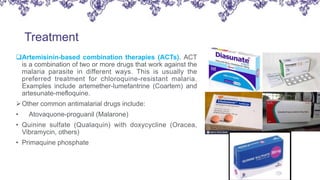
Artemisinin-based combination therapies (ACTs). ACT
is a combination of two or more drugs that work against the
malaria parasite in different ways. This is usually the
preferred treatment for chloroquine-resistant malaria.
Examples include artemether-lumefantrine (Coartem) and
artesunate-mefloquine.
Other common antimalarial drugs include:
• Atovaquone-proguanil (Malarone)
• Quinine sulfate (Qualaquin) with doxycycline (Oracea,
Vibramycin, others)
• Primaquine phosphate
06 Prevention
Prevention
There's a significant risk of getting malaria if you travel to an affected
area. It's very important you take precautions to prevent the disease.
Malaria can often be avoided using the ABCD approach to prevention,
which stands for:
1. Awareness of risk – find out whether you're at risk of getting
malaria.
2. Bite prevention – avoid mosquito bites by using insect repellent,
covering your arms and legs, and using a mosquito net.
3. Check whether you need to take malaria prevention tablets – if
you do, make sure you take the right antimalarial tablets at the right
dose, and finish the course.
4. Diagnosis – seek immediate medical advice if you have malaria
symptoms, including up to a year after you return from travelling.
Malaria

Malaria

  • 1.
    Malaria and it’sTreatment presented to : Mam Sana presented by : Rimsha
  • 2.
    CONTENTS 01 Introduction 02Types of Malaria 03 Causes of Malaria 04 Symptoms and life cycle of malaria 05 Treatment 06 Prevention
  • 3.
  • 4.
    Introduction • Malaria isa life-threatening disease. It’s typically transmitted through the bite of an infected Anopheles mosquito. Infected mosquitoes carry the Plasmodium parasite. When this mosquito bites you, the parasite is released into your bloodstream. • Once the parasites are inside your body, they travel to the liver, where they mature. After several days, the mature parasites enter the bloodstream and begin to infect red blood cells.Within 48 to 72 hours, the parasites inside the red blood cells multiply, causing the infected cells to burst open. • The parasites continue to infect red blood cells, resulting in symptoms that occur in cycles that last two to three days at a time. • Malaria is typically found in tropical and subtropical climates where the parasites can live. The World Health Organization (WHO)Trusted Source states that, in 2016, there were an estimated 216 million cases of malaria in 91 countries.
  • 6.
  • 7.
    Asymptomatic malaria canbe caused by all Plasmodium species; the patient has circulating parasites but no symptoms. Asymptomatic malaria Uncomplicated malaria Uncomplicated malaria can be caused by all Plasmodium species. Symptoms generally occur 7-10 days after the initial mosquito bite. Symptoms are non-specific and can include fever, moderate to severe shaking chills, profuse sweating, headache, nausea, vomiting, diarrhoea and anaemia, with no clinical or laboratory findings of severe organ dysfunction. Severe malaria Severe malaria is usually caused by infection with Plasmodium falciparum, though less frequently can also be caused by Plasmodium vivax or Plasmodium knowlesi. Complications include severe anaemia and end- organ damage, including coma (cerebral malaria), pulmonary complications (for example, oedema and hyperpnoeic syndrome) and hypoglycaemia or acute kidney injury.
  • 8.
  • 9.
    Causes • Malaria canoccur if a mosquito infected with the Plasmodium parasite bites you. There are four kinds of malaria parasites that can infect humans: Plasmodium vivax, P. ovale, P. malariae, and P. falciparum. • P. falciparum causes a more severe form of the disease and those who contract this form of malaria have a higher risk of death. An infected mother can also pass the disease to her baby at birth. This is known as congenital malaria. Malaria is transmitted by blood, so it can also be transmitted through:  an organ transplant  a transfusion  use of shared needles or syringes
  • 10.
    04 Symptoms and lifecycle of malaria
  • 11.
    Symptoms: The symptoms ofmalaria typically develop within 10 days to 4 weeks following the infection. In some cases, symptoms may not develop for several months. Some malarial parasites can enter the body but will be dormant for long periods of time. Common symptoms of malaria include: • shaking chills that can range from moderate to severe high fever • profuse sweating • headache • nausea • vomiting • abdominal pain
  • 12.
    Symptoms • diarrhea • anemia •muscle pain • convulsions • coma • bloody stools
  • 13.
    Life cycle ofmalaria: • Malaria parasites spread by successively infecting two types of hosts: female Anopheles mosquitoes and humans. • the female Anopheles mosquito injects sporozoites into the blood stream of malaria’s next victim. • The sporozoites are rapidly taken up by the liver cells. • In all species of Plasmodium, these parasites develop to form schizonts (the multinucleate stage of the cell during asexual reproduction), from which several thousand merozoites develop. • In Plasmodium vivax and Plasmodium ovale only, a proportion of the liver-stage parasites (known as hypnozoites) remain dormant in the hepatocytes. In this stage the parasite can remain dormant for months or several years. These two species of parasite can therefore initiate a cycle of asexual reproduction causing clinical symptoms in the absence of a new mosquito bite, giving P. vivax infection the name relapsing malaria.
  • 15.
    Life cycle ofmalaria: • When the liver cells rupture, the merozoites are released into the bloodstream where they rapidly invade the red blood cells. These blood-stage parasites replicate asexually – rapidly attaining a high parasite burden and destroying each red blood cell they infect, leading to the clinical symptoms of malaria. • The trigger is as yet unknown, but a small percentage of merozoites, differentiate into male and female gametocytes, which are taken up by the mosquito in her blood meal. It is these gametocytes that cause the cycle of transmission to continue back to the mosquito. • Male and female gametocytes fuse within the mosquito forming diploid zygotes, which in turn become ookinetes. • These ookinetes migrate to the midgut of the insect, pass through the gut wall and form the oocysts. • Meiotic division of the oocysts occur and sporozoites are formed, which then migrate to the salivary glands of the female Anopheles mosquito ready to continue the cycle of transmission back to man.
  • 16.
  • 17.
    Treatment Malaria is treatedwith prescription drugs to kill the parasite. The types of drugs and the length of treatment will vary, depending on: • Which type of malaria parasite you have • The severity of your symptoms • Your age • Whether you're pregnant Medications The most common antimalarial drugs include: Chloroquine phosphate. Chloroquine is the preferred treatment for any parasite that is sensitive to the drug. But in many parts of the world, parasites are resistant to chloroquine, and the drug is no longer an effective treatment.
  • 18.
    Treatment Artemisinin-based combination therapies(ACTs). ACT is a combination of two or more drugs that work against the malaria parasite in different ways. This is usually the preferred treatment for chloroquine-resistant malaria. Examples include artemether-lumefantrine (Coartem) and artesunate-mefloquine. Other common antimalarial drugs include: • Atovaquone-proguanil (Malarone) • Quinine sulfate (Qualaquin) with doxycycline (Oracea, Vibramycin, others) • Primaquine phosphate
  • 19.
  • 20.
    Prevention There's a significantrisk of getting malaria if you travel to an affected area. It's very important you take precautions to prevent the disease. Malaria can often be avoided using the ABCD approach to prevention, which stands for: 1. Awareness of risk – find out whether you're at risk of getting malaria. 2. Bite prevention – avoid mosquito bites by using insect repellent, covering your arms and legs, and using a mosquito net. 3. Check whether you need to take malaria prevention tablets – if you do, make sure you take the right antimalarial tablets at the right dose, and finish the course. 4. Diagnosis – seek immediate medical advice if you have malaria symptoms, including up to a year after you return from travelling.