Introduction
• Malaria is a life threatening tropic disease caused by members of the protozoan genus
Plasmodium, a group of sporozoans that parasitize the human liver and red blood cells.
• Humans are infected with Plasmodium protozoa when bitten by an infected female Anopheles
mosquito vector.
• Mentions of malaria symptoms can be found in the ancient Roman, Chinese, Indian and
Egyptian manuscripts going back several thousand years.
• The malaria parasite was first noticed under a microscope in 1880 by Charles Louis Laveran
and in 1897 Ronald Ross demonstrated that the malaria parasite can be transmitted by
mosquitos. For his discovery Ross was awarded the Nobel Prize in 1902.
2
3
Introduction
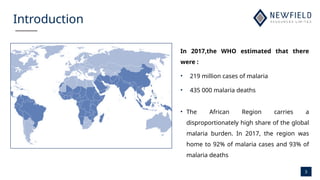
In 2017,the WHO estimated that there
were :
• 219 million cases of malaria
• 435 000 malaria deaths
• The African Region carries a
disproportionately high share of the global
malaria burden. In 2017, the region was
home to 92% of malaria cases and 93% of
malaria deaths
4
Life Cycle of the Malaria Parasite
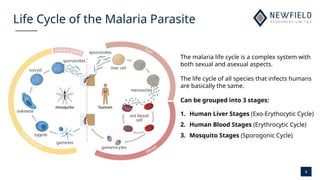
The malaria life cycle is a complex system with
both sexual and asexual aspects.
The life cycle of all species that infects humans
are basically the same.
Can be grouped into 3 stages:
1. Human Liver Stages (Exo-Erythocytic Cycle)
2. Human Blood Stages (Erythrocytic Cycle)
3. Mosquito Stages (Sporogonic Cycle)
5
Life Cycle of the Malaria Parasite
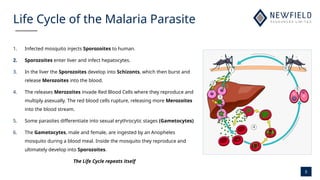
1. Infected mosquito injects Sporozoites to human.
2. Sporozoites enter liver and infect hepatocytes.
3. In the liver the Sporozoites develop into Schizonts, which then burst and
release Merozoites into the blood.
4. The releases Merozoites invade Red Blood Cells where they reproduce and
multiply asexually. The red blood cells rupture, releasing more Merozoites
into the blood stream.
5. Some parasites differentiate into sexual erythrocytic stages (Gametocytes)
6. The Gametocytes, male and female, are ingested by an Anopheles
mosquito during a blood meal. Inside the mosquito they reproduce and
ultimately develop into Sporozoites.
The Life Cycle repeats itself
6
Etiology of Malaria
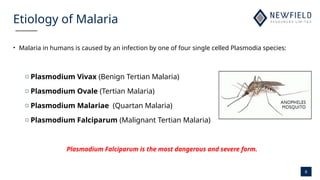
• Malaria in humans is caused by an infection by one of four single celled Plasmodia species:
o Plasmodium Vivax (Benign Tertian Malaria)
o Plasmodium Ovale (Tertian Malaria)
o Plasmodium Malariae (Quartan Malaria)
o Plasmodium Falciparum (Malignant Tertian Malaria)
Plasmodium Falciparum is the most dangerous and severe form.
7
P. Falciparum
• Plasmodium Falciparum is the most dangerous form of malaria
o Risk of cerebral malaria, renal failure, Black water fever, acute respiratory distress
syndrome and severe anemia.
o Infected RBC forms clusters called Rosettes.
• Accounted for an estimated 99.7% of malaria cases in the African Region.
• Prompt treatment is essential.
• An untreated infection in a non-immune person will be fatal.
• No dormant liver stage – Once successfully treated, there is no risk of relapse.
8
P. Vivax and P. Ovale
• Plasmodium Vivax is the most widespread type of malaria as it can survive in both
temperate and tropical climates Plasmodium Ovale is the least common of all
infections.
• Both P. Vivax and P. Ovale are less likely to be life threatening than P. Falciparum.
• Symptoms (especially fever) can still be dramatic.
• Parasite can remain dormant in liver stages by forming Hypnozoites.
9
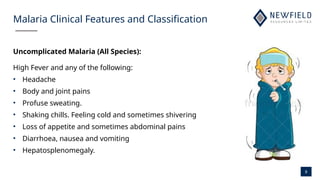
Malaria Clinical Features and Classification
Uncomplicated Malaria (All Species):
High Fever and any of the following:
• Headache
• Body and joint pains
• Profuse sweating.
• Shaking chills. Feeling cold and sometimes shivering
• Loss of appetite and sometimes abdominal pains
• Diarrhoea, nausea and vomiting
• Hepatosplenomegaly.
10
Malaria Clinical Features and Classification
Severe / Complicated Malaria:
• Confusion or drowsiness with extreme weakness
• Decreased level of consciousness
• Cerebral malaria (unrousable coma not contributed to any other cause)
• Respiratory distress (Acidotic breathing)
• Multiple generalized convulsions (2+ within 24 hours)
• Circulatory collapse, septicaemia (Shock)
• Pulmonary oedema
11
Malaria Clinical Features and Classification
Severe / Complicated Malaria Cont.:
• Disseminated intravascular coagulapthy (Abnormal bleeding)
• Jaundice
• Haemogloinuria (Black Water Fever)
• Acute Renal Failure – Presenting as oliguria or anuria.
• Severe anemia (Hb <5g/dl or Haemocrit <15%)
• Persistent high fever
• Hypoglycemia (<2.2 mmol/dl)
12
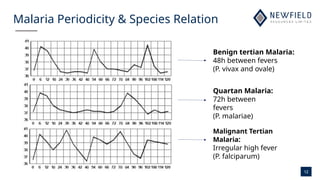
Malaria Periodicity & Species Relation
Benign tertian Malaria:
48h between fevers
(P. vivax and ovale)
Quartan Malaria:
72h between
fevers
(P. malariae)
Malignant Tertian
Malaria:
Irregular high fever
(P. falciparum)
13
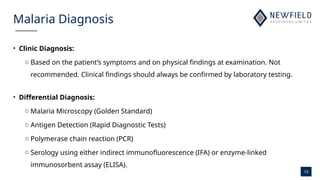
Malaria Diagnosis
• Clinic Diagnosis:
o Based on the patient’s symptoms and on physical findings at examination. Not
recommended. Clinical findings should always be confirmed by laboratory testing.
• Differential Diagnosis:
o Malaria Microscopy (Golden Standard)
o Antigen Detection (Rapid Diagnostic Tests)
o Polymerase chain reaction (PCR)
o Serology using either indirect immunofluorescence (IFA) or enzyme-linked
immunosorbent assay (ELISA).
14
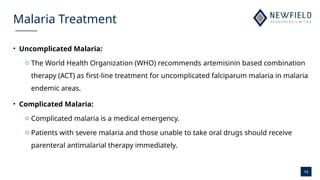
Malaria Treatment
• Uncomplicated Malaria:
o The World Health Organization (WHO) recommends artemisinin based combination
therapy (ACT) as first-line treatment for uncomplicated falciparum malaria in malaria
endemic areas.
• Complicated Malaria:
o Complicated malaria is a medical emergency.
o Patients with severe malaria and those unable to take oral drugs should receive
parenteral antimalarial therapy immediately.
15
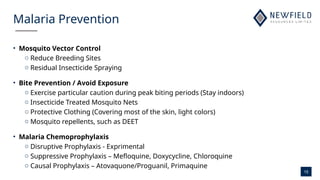
Malaria Prevention
• Mosquito Vector Control
o Reduce Breeding Sites
o Residual Insecticide Spraying
• Bite Prevention / Avoid Exposure
o Exercise particular caution during peak biting periods (Stay indoors)
o Insecticide Treated Mosquito Nets
o Protective Clothing (Covering most of the skin, light colors)
o Mosquito repellents, such as DEET
• Malaria Chemoprophylaxis
o Disruptive Prophylaxis - Exprimental
o Suppressive Prophylaxis – Mefloquine, Doxycycline, Chloroquine
o Causal Prophylaxis – Atovaquone/Proguanil, Primaquine
16
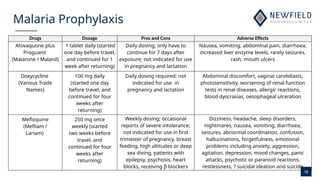
Malaria Prophylaxis
Drugs Dosage Pros and Cons Adverse Effects
Atovaquone plus
Proguanil
(Malarone / Malanil)
1 tablet daily (started
one day before travel,
and continued for 1
week after returning)
Daily dosing; only have to
continue for 7 days after
exposure; not indicated for use
in pregnancy and lactation
Nausea, vomiting, abdominal pain, diarrhoea,
increased liver enzyme levels; rarely seizures,
rash, mouth ulcers
Doxycycline
(Various Trade
Names)
100 mg daily
(started one day
before travel, and
continued for four
weeks after
returning)
Daily dosing required; not
indicated for use in
pregnancy and lactation
Abdominal discomfort, vaginal candidiasis,
photosensitivity, worsening of renal function
tests in renal diseases, allergic reactions,
blood dyscrasias, oesophageal ulceration
Mefloquine
(Mefliam /
Lariam)
250 mg once
weekly (started
two weeks before
travel, and
continued for four
weeks after
returning)
Weekly dosing; occasional
reports of severe intolerance;
not indicated for use in first
trimester of pregnancy, breast
feeding, high altitudes or deep
sea diving, patients with
epilepsy, psychosis, heart
blocks, receiving β blockers
Dizziness, headache, sleep disorders,
nightmares, nausea, vomiting, diarrhoea,
seizures, abnormal coordination, confusion,
hallucinations, forgetfulness, emotional
problems including anxiety, aggression,
agitation, depression, mood changes, panic
attacks, psychotic or paranoid reactions,
restlessness, ? suicidal ideation and suicide
17
Malaria FYI
1. Type O blood group are less likely to get complications from malaria.
o The outcome by a 2016 study by the Cape Coast university in Ghana showed that the
type O blood group is less prone to complications from P. Falciparum malaria due to
decreased rosetting and lower parasitemia when compared to type A & B.
2. Carriers for the sickle cell disease have some protective advantage against malaria.
o Individuals with one sickle gene and one normal hemoglobin gene, also known as
sickle cell trait have a natural protection against malaria. Mostly during their early
years.
3. Partially protective immunity can be acquired after repeated exposure.
o After repeated attacks of malaria a person may develop a partially protective
immunity. Such “semi-immune” persons often can still be infected by malaria parasites
but may not develop severe disease and frequently lack any typical malaria symptoms.
A partially immune person can also loose their immunity over time.
18
End
• Please feel free to ask any questions you
may have.
• Thank you for your time.

Malaria Awareness Presentation - general.pptx

  • 2.
    Introduction • Malaria isa life threatening tropic disease caused by members of the protozoan genus Plasmodium, a group of sporozoans that parasitize the human liver and red blood cells. • Humans are infected with Plasmodium protozoa when bitten by an infected female Anopheles mosquito vector. • Mentions of malaria symptoms can be found in the ancient Roman, Chinese, Indian and Egyptian manuscripts going back several thousand years. • The malaria parasite was first noticed under a microscope in 1880 by Charles Louis Laveran and in 1897 Ronald Ross demonstrated that the malaria parasite can be transmitted by mosquitos. For his discovery Ross was awarded the Nobel Prize in 1902. 2
  • 3.
    3 Introduction In 2017,the WHOestimated that there were : • 219 million cases of malaria • 435 000 malaria deaths • The African Region carries a disproportionately high share of the global malaria burden. In 2017, the region was home to 92% of malaria cases and 93% of malaria deaths
  • 4.
    4 Life Cycle ofthe Malaria Parasite The malaria life cycle is a complex system with both sexual and asexual aspects. The life cycle of all species that infects humans are basically the same. Can be grouped into 3 stages: 1. Human Liver Stages (Exo-Erythocytic Cycle) 2. Human Blood Stages (Erythrocytic Cycle) 3. Mosquito Stages (Sporogonic Cycle)
  • 5.
    5 Life Cycle ofthe Malaria Parasite 1. Infected mosquito injects Sporozoites to human. 2. Sporozoites enter liver and infect hepatocytes. 3. In the liver the Sporozoites develop into Schizonts, which then burst and release Merozoites into the blood. 4. The releases Merozoites invade Red Blood Cells where they reproduce and multiply asexually. The red blood cells rupture, releasing more Merozoites into the blood stream. 5. Some parasites differentiate into sexual erythrocytic stages (Gametocytes) 6. The Gametocytes, male and female, are ingested by an Anopheles mosquito during a blood meal. Inside the mosquito they reproduce and ultimately develop into Sporozoites. The Life Cycle repeats itself
  • 6.
    6 Etiology of Malaria •Malaria in humans is caused by an infection by one of four single celled Plasmodia species: o Plasmodium Vivax (Benign Tertian Malaria) o Plasmodium Ovale (Tertian Malaria) o Plasmodium Malariae (Quartan Malaria) o Plasmodium Falciparum (Malignant Tertian Malaria) Plasmodium Falciparum is the most dangerous and severe form.
  • 7.
    7 P. Falciparum • PlasmodiumFalciparum is the most dangerous form of malaria o Risk of cerebral malaria, renal failure, Black water fever, acute respiratory distress syndrome and severe anemia. o Infected RBC forms clusters called Rosettes. • Accounted for an estimated 99.7% of malaria cases in the African Region. • Prompt treatment is essential. • An untreated infection in a non-immune person will be fatal. • No dormant liver stage – Once successfully treated, there is no risk of relapse.
  • 8.
    8 P. Vivax andP. Ovale • Plasmodium Vivax is the most widespread type of malaria as it can survive in both temperate and tropical climates Plasmodium Ovale is the least common of all infections. • Both P. Vivax and P. Ovale are less likely to be life threatening than P. Falciparum. • Symptoms (especially fever) can still be dramatic. • Parasite can remain dormant in liver stages by forming Hypnozoites.
  • 9.
    9 Malaria Clinical Featuresand Classification Uncomplicated Malaria (All Species): High Fever and any of the following: • Headache • Body and joint pains • Profuse sweating. • Shaking chills. Feeling cold and sometimes shivering • Loss of appetite and sometimes abdominal pains • Diarrhoea, nausea and vomiting • Hepatosplenomegaly.
  • 10.
    10 Malaria Clinical Featuresand Classification Severe / Complicated Malaria: • Confusion or drowsiness with extreme weakness • Decreased level of consciousness • Cerebral malaria (unrousable coma not contributed to any other cause) • Respiratory distress (Acidotic breathing) • Multiple generalized convulsions (2+ within 24 hours) • Circulatory collapse, septicaemia (Shock) • Pulmonary oedema
  • 11.
    11 Malaria Clinical Featuresand Classification Severe / Complicated Malaria Cont.: • Disseminated intravascular coagulapthy (Abnormal bleeding) • Jaundice • Haemogloinuria (Black Water Fever) • Acute Renal Failure – Presenting as oliguria or anuria. • Severe anemia (Hb <5g/dl or Haemocrit <15%) • Persistent high fever • Hypoglycemia (<2.2 mmol/dl)
  • 12.
    12 Malaria Periodicity &Species Relation Benign tertian Malaria: 48h between fevers (P. vivax and ovale) Quartan Malaria: 72h between fevers (P. malariae) Malignant Tertian Malaria: Irregular high fever (P. falciparum)
  • 13.
    13 Malaria Diagnosis • ClinicDiagnosis: o Based on the patient’s symptoms and on physical findings at examination. Not recommended. Clinical findings should always be confirmed by laboratory testing. • Differential Diagnosis: o Malaria Microscopy (Golden Standard) o Antigen Detection (Rapid Diagnostic Tests) o Polymerase chain reaction (PCR) o Serology using either indirect immunofluorescence (IFA) or enzyme-linked immunosorbent assay (ELISA).
  • 14.
    14 Malaria Treatment • UncomplicatedMalaria: o The World Health Organization (WHO) recommends artemisinin based combination therapy (ACT) as first-line treatment for uncomplicated falciparum malaria in malaria endemic areas. • Complicated Malaria: o Complicated malaria is a medical emergency. o Patients with severe malaria and those unable to take oral drugs should receive parenteral antimalarial therapy immediately.
  • 15.
    15 Malaria Prevention • MosquitoVector Control o Reduce Breeding Sites o Residual Insecticide Spraying • Bite Prevention / Avoid Exposure o Exercise particular caution during peak biting periods (Stay indoors) o Insecticide Treated Mosquito Nets o Protective Clothing (Covering most of the skin, light colors) o Mosquito repellents, such as DEET • Malaria Chemoprophylaxis o Disruptive Prophylaxis - Exprimental o Suppressive Prophylaxis – Mefloquine, Doxycycline, Chloroquine o Causal Prophylaxis – Atovaquone/Proguanil, Primaquine
  • 16.
    16 Malaria Prophylaxis Drugs DosagePros and Cons Adverse Effects Atovaquone plus Proguanil (Malarone / Malanil) 1 tablet daily (started one day before travel, and continued for 1 week after returning) Daily dosing; only have to continue for 7 days after exposure; not indicated for use in pregnancy and lactation Nausea, vomiting, abdominal pain, diarrhoea, increased liver enzyme levels; rarely seizures, rash, mouth ulcers Doxycycline (Various Trade Names) 100 mg daily (started one day before travel, and continued for four weeks after returning) Daily dosing required; not indicated for use in pregnancy and lactation Abdominal discomfort, vaginal candidiasis, photosensitivity, worsening of renal function tests in renal diseases, allergic reactions, blood dyscrasias, oesophageal ulceration Mefloquine (Mefliam / Lariam) 250 mg once weekly (started two weeks before travel, and continued for four weeks after returning) Weekly dosing; occasional reports of severe intolerance; not indicated for use in first trimester of pregnancy, breast feeding, high altitudes or deep sea diving, patients with epilepsy, psychosis, heart blocks, receiving β blockers Dizziness, headache, sleep disorders, nightmares, nausea, vomiting, diarrhoea, seizures, abnormal coordination, confusion, hallucinations, forgetfulness, emotional problems including anxiety, aggression, agitation, depression, mood changes, panic attacks, psychotic or paranoid reactions, restlessness, ? suicidal ideation and suicide
  • 17.
    17 Malaria FYI 1. TypeO blood group are less likely to get complications from malaria. o The outcome by a 2016 study by the Cape Coast university in Ghana showed that the type O blood group is less prone to complications from P. Falciparum malaria due to decreased rosetting and lower parasitemia when compared to type A & B. 2. Carriers for the sickle cell disease have some protective advantage against malaria. o Individuals with one sickle gene and one normal hemoglobin gene, also known as sickle cell trait have a natural protection against malaria. Mostly during their early years. 3. Partially protective immunity can be acquired after repeated exposure. o After repeated attacks of malaria a person may develop a partially protective immunity. Such “semi-immune” persons often can still be infected by malaria parasites but may not develop severe disease and frequently lack any typical malaria symptoms. A partially immune person can also loose their immunity over time.
  • 18.
    18 End • Please feelfree to ask any questions you may have. • Thank you for your time.