






Making your Asterisk System Secure 
Who is out there looking to attack your PBX? 
How do they find it? 
How can you protect your PBX 
PRESENT BY: 
ERIC KLEIN 
SR. CONSUL TANT
/home/ericlklein/.finger 
• NEW GRANDFATHER (PICTURES UPON REQUEST) 
• VOIP FRAUD PREVENTION EVANGELIST 
• STARTUP ADVISOR AND ENTHUSIAST 
• AUTHOR, BLOGGER FOR TECHNOLOGY AND 
TRAVEL 
• AMATEUR PHOTOGRAPHER AND CHEF
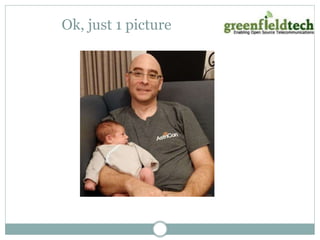
Ok, just 1 picture
2013 
GLOBAL FRAUD SURVEY 
RESULTS
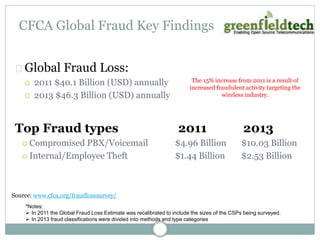
CFCA Global Fraud Key Findings 
Global Fraud Loss: 
 2011 $40.1 Billion (USD) annually 
 2013 $46.3 Billion (USD) annually 
Top Fraud types 2011 
 Compromised PBX/Voicemail $4.96 Billion 
 Internal/Employee Theft $1.44 Billion 
Source: www.cfca.org/fraudlosssurvey/ 
The 15% increase from 2011 is a result of 
increased fraudulent activity targeting the 
wireless industry. 
2013 
$10.03 Billion 
$2.53 Billion 
*Notes: 
 In 2011 the Global Fraud Loss Estimate was recalibrated to include the sizes of the CSPs being surveyed. 
 In 2013 fraud classifications were divided into methods and type categories
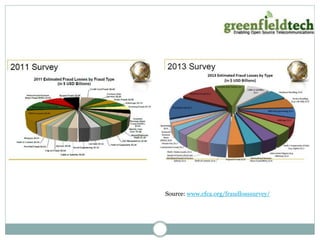
Source: www.cfca.org/fraudlosssurvey/
Why They Attack
How it Works 
Hackers sign up to lease premium-rate phone numbers, often used 
for sexual-chat or psychic lines, from one of dozens of web-based 
services that charge dialers over $1 a minute and give the lessee a 
cut. In the United States, premium-rate numbers are easily 
identified by 1-900 prefixes, and callers are informed they will be 
charged higher rates. But elsewhere, like in Latvia and Estonia, they 
can be trickier to spot. The payout to the lessees can be as high as 24 
cents for every minute spent on the phone. 
Hackers then break into a business’s phone system and make calls 
through it to their premium number, typically over a weekend, 
when nobody is there to notice. With high-speed computers, they 
can make hundreds of calls simultaneously, forwarding as many as 
220 minutes’ worth of phone calls a minute to the pay line. The 
hacker gets a cut of the charges, typically delivered through a 
Western Union, MoneyGram or wire transfer. 
In part because the plan is so profitable, premium rate number 
resellers are multiplying rapidly. There were 17 in 2009; last year 
there were 85 
www.nytimes.com/2014/10/20/technology/dial-and-redial-phone-hackers-stealing-billions-.html
Who Pays?
Who is Responsible for Losses 
from Hacks? 
In almost all cases the customer is contractually 
responsible for losses from a hacked system. 
Major carriers have sophisticated fraud systems in 
place to catch hackers before they run up false six-figure 
charges, and they can afford to credit 
customers for millions of fraudulent charges every 
year. But small businesses often use local carriers, 
which lack such antifraud systems. And some of 
those carriers are leaving customers to foot the bill.
Rare exception: Frip Finishing vs. 
Voiceflex 
Frip Finishing of Leicestershire was hacked over 
Halloween weekend of October 2011 
Internet hackers infiltrated Frip’s PBX and made 
10,366 calls international phone card calls creating a 
bill of £35,000 – most to a premium telephone 
number in Poland 
Judge David Grant rejected arguments the company 
had failed to adequately maintain the security of its. 
On the court’s interpretation of the contract, Frip 
was only obliged to pay for calls that it had actually 
made. 
http://commsbusiness.co.uk/features/halloween-bill-shocker/
Phone Hackers Dial and Redial to Steal 
Billions 
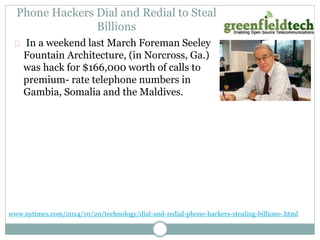
In a weekend last March Foreman Seeley 
Fountain Architecture, (in Norcross, Ga.) 
was hack for $166,000 worth of calls to 
premium- rate telephone numbers in 
Gambia, Somalia and the Maldives. 
www.nytimes.com/2014/10/20/technology/dial-and-redial-phone-hackers-stealing-billions-.html
Need to Change the Laws 
The law is not much help, because no regulations 
require carriers to reimburse customers for fraud the 
way credit card companies must. Lawmakers have 
taken the issue up from time to time, but little 
progress has been made.
What to watch for
Something New Has Started 
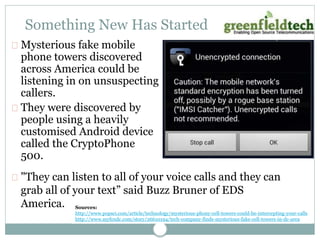
Mysterious fake mobile 
phone towers discovered 
across America could be 
listening in on unsuspecting 
callers. 
They were discovered by 
people using a heavily 
customised Android device 
called the CryptoPhone 
500. 
"They can listen to all of your voice calls and they can 
grab all of your text” said Buzz Bruner of EDS 
America. 
Sources: 
http://www.popsci.com/article/technology/mysterious-phony-cell-towers-could-be-intercepting-your-calls 
http://www.myfoxdc.com/story/26610194/tech-company-finds-mysterious-fake-cell-towers-in-dc-area
Detected in Many Locations 
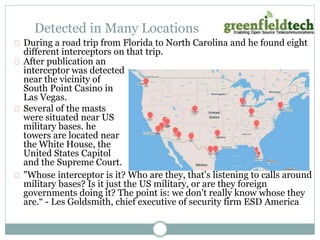
During a road trip from Florida to North Carolina and he found eight 
different interceptors on that trip. 
After publication an 
interceptor was detected 
near the vicinity of 
South Point Casino in 
Las Vegas. 
Several of the masts 
were situated near US 
military bases. he 
towers are located near 
the White House, the 
United States Capitol 
and the Supreme Court. 
"Whose interceptor is it? Who are they, that's listening to calls around 
military bases? Is it just the US military, or are they foreign 
governments doing it? The point is: we don't really know whose they 
are.“ - Les Goldsmith, chief executive of security firm ESD America
Detection is Hard 
“If you've been intercepted, in 
some cases it might show at the 
top that you've been forced 
from 4G down to 2G. But a 
decent interceptor won't show 
that,” says Goldsmith. “It'll be 
set up to show you [falsely] that 
you're still on 4G. You'll think 
that you're on 4G, but you're 
actually being forced back to 
2G.” 
Some devices can not only capture calls and texts, but even 
actively control the phone and send spoof texts.
How they find you
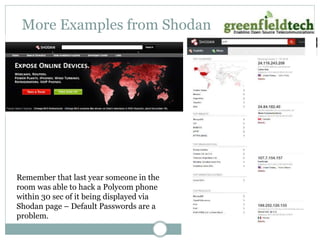
More Examples from Shodan 
Remember that last year someone in the 
room was able to hack a Polycom phone 
within 30 sec of it being displayed via 
Shodan page – Default Passwords are a 
problem.
Security Resources from
Take the updated Asterisk 
Advanced Class for the 
basics. 
Asterisk Security 
Considerations
Copyright © 2014 Digium, The Asterisk Company 22 
Goals 
• Security overview 
• Survey of common threats 
• Layer-by-layer security and best practice 
suggestions 
– physical 
– OS 
– network 
– Asterisk 
– SIP 
– dialplan 
• Resources
Look at the Asterisk Wiki
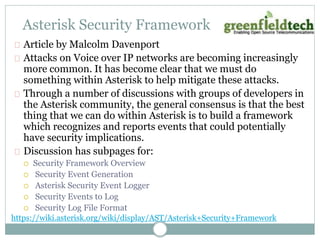
Asterisk Security Framework 
Article by Malcolm Davenport 
Attacks on Voice over IP networks are becoming increasingly 
more common. It has become clear that we must do 
something within Asterisk to help mitigate these attacks. 
Through a number of discussions with groups of developers in 
the Asterisk community, the general consensus is that the best 
thing that we can do within Asterisk is to build a framework 
which recognizes and reports events that could potentially 
have security implications. 
Discussion has subpages for: 
 Security Framework Overview 
 Security Event Generation 
 Asterisk Security Event Logger 
 Security Events to Log 
 Security Log File Format 
https://wiki.asterisk.org/wiki/display/AST/Asterisk+Security+Framework
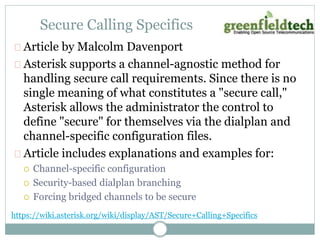
Secure Calling Specifics 
Article by Malcolm Davenport 
Asterisk supports a channel-agnostic method for 
handling secure call requirements. Since there is no 
single meaning of what constitutes a "secure call," 
Asterisk allows the administrator the control to 
define "secure" for themselves via the dialplan and 
channel-specific configuration files. 
Article includes explanations and examples for: 
 Channel-specific configuration 
 Security-based dialplan branching 
 Forcing bridged channels to be secure 
https://wiki.asterisk.org/wiki/display/AST/Secure+Calling+Specifics
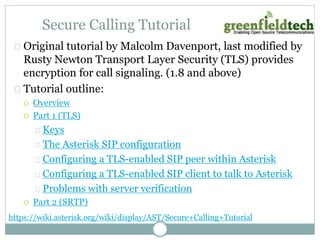
Secure Calling Tutorial 
Original tutorial by Malcolm Davenport, last modified by 
Rusty Newton Transport Layer Security (TLS) provides 
encryption for call signaling. (1.8 and above) 
Tutorial outline: 
 Overview 
 Part 1 (TLS) 
Keys 
The Asterisk SIP configuration 
Configuring a TLS-enabled SIP peer within Asterisk 
Configuring a TLS-enabled SIP client to talk to Asterisk 
Problems with server verification 
 Part 2 (SRTP) 
https://wiki.asterisk.org/wiki/display/AST/Secure+Calling+Tutorial
Pay Attention to Vendor 
Warnings
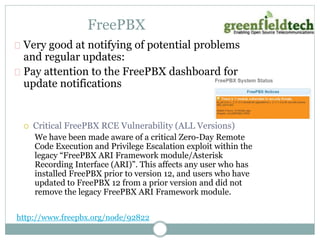
FreePBX 
Very good at notifying of potential problems 
and regular updates: 
Pay attention to the FreePBX dashboard for 
update notifications 
 Critical FreePBX RCE Vulnerability (ALL Versions) 
We have been made aware of a critical Zero-Day Remote 
Code Execution and Privilege Escalation exploit within the 
legacy “FreePBX ARI Framework module/Asterisk 
Recording Interface (ARI)”. This affects any user who has 
installed FreePBX prior to version 12, and users who have 
updated to FreePBX 12 from a prior version and did not 
remove the legacy FreePBX ARI Framework module. 
http://www.freepbx.org/node/92822
Watch out for OS Level Alerts 
Shellshock on 
Shellshock, also known as Bashdoor, is a family of 
security bugs (with 6 CVE's filed at the time of this 
page) in the widely used Unix Bash shell, the first of 
which was disclosed on 24 September 2014. Many 
Internet daemons, such as web servers, use Bash to 
process certain commands, allowing an attacker to 
cause vulnerable versions of Bash to execute 
arbitrary commands. This can allow an attacker to 
gain unauthorized access to a computer system. 
http://wiki.centos.org/Security/Shellshock
Protect Your System 
Watch for and install regular updates 
Do not ignore the OS updates and fixes – Run Yum 
update at least quarterly. 
Always change the default user names and 
passwords 
Keep up on the news and new attacks – Inside fraud 
and Phishing will remain big problems for years to 
come.
VoIP Security Products 
ONES TO LOOK AT AND SEE WHAT BEST FITS 
YOUR NEEDS
Regular Firewall 
Palo Alto firewalls have known problems with SIP 
and SIP ALG, calls can complete but no audio (media 
channel). 
Checkpoint Firewalls work fine with SIP. 
Fail2Ban can still cause additional problems with 
triggering massive whois processes that take a lot of 
CPU resources. (Need to kill PID for the process – 
sometimes you need to kill multiple PIDs).
Single PBX or Phone Level 
New products have come out in the past few years to 
protect SIP at the phone or enterprise PBX level. 
Coordinate the install with your ITSP, as there may 
be configuration issues to be managed (ports to 
open, NAT, etc.).
SIP Threat Manager 
STM is installed in front of any SIP 
based PBX or gateway offering several 
layers of security against numerous 
types of attacks. Block specific IPs or 
countries, protect your PBX against 
hackers trying user names and 
passwords, someone is trying to flood 
your PBX with a DDos attacks? No 
problem! 
Using the SNORT based Real Time 
Deep packet inspection engine, our 
STM analyzes each SIP packet going to 
your phone system, identifies the 
malicious and abnormal ones blocking 
the originating IP.
Firewall Example from Allo 
On Youtube: http://www.youtube.com/watch?v=iEwfH5j9ZfE
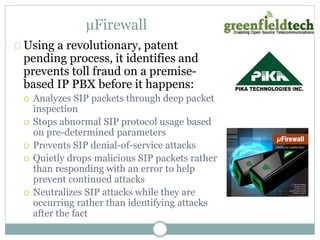
μFirewall 
Using a revolutionary, patent 
pending process, it identifies and 
prevents toll fraud on a premise-based 
IP PBX before it happens: 
 Analyzes SIP packets through deep packet 
inspection 
 Stops abnormal SIP protocol usage based 
on pre-determined parameters 
 Prevents SIP denial-of-service attacks 
 Quietly drops malicious SIP packets rather 
than responding with an error to help 
prevent continued attacks 
 Neutralizes SIP attacks while they are 
occurring rather than identifying attacks 
after the fact
PHPARI 
ARI i s a mind bl owing jump f o r t r adi t i ona l a s t e r i s k int e g r a t o r s . 
Our obj e c t i v e i s t o c r e a t e a s impl e onl ine eng ine , tha t wi l l a l l ow 
f o r p e op l e t o de v e l op sho r t s t a s i s /ARI a p p l i c a t i ons , e i the r on 
the i r own s e r v e r s o r on a ho s t ed ins t anc e - and e xpe r iment wi th 
how ARI wo r k s . 
The s andbo x a l l ows y ou t o e xpe r iment wi th ARI and PHPARI , 
wi thout a ne ed t o a c tua l l y s t a r t c oding the ent i r e s t a s i s 
appl i c a t ion, but a c tua l l y e xpe r iment ins ide s e l f c ont a ined c ode 
snippe t s - v e r y much l i k e tha t J a v a s c r ipt t o o l s on the ne t .
Check out our Hackathon Project 
Check it out (and vote for it) at: 
http://astriconhackathon.challengepost.com/submissions/28 
916-asterisk-ari-sandbox
Thank You 
CONTACT ME AT: 
Eric.Klein@greenfieldtech.net 
www.greenfieldtech.net

Making your Asterisk System Secure

  • 1.
    Making your AsteriskSystem Secure Who is out there looking to attack your PBX? How do they find it? How can you protect your PBX PRESENT BY: ERIC KLEIN SR. CONSUL TANT
  • 2.
    /home/ericlklein/.finger • NEWGRANDFATHER (PICTURES UPON REQUEST) • VOIP FRAUD PREVENTION EVANGELIST • STARTUP ADVISOR AND ENTHUSIAST • AUTHOR, BLOGGER FOR TECHNOLOGY AND TRAVEL • AMATEUR PHOTOGRAPHER AND CHEF
  • 3.
    Ok, just 1picture
  • 4.
    2013 GLOBAL FRAUDSURVEY RESULTS
  • 5.
    CFCA Global FraudKey Findings Global Fraud Loss:  2011 $40.1 Billion (USD) annually  2013 $46.3 Billion (USD) annually Top Fraud types 2011  Compromised PBX/Voicemail $4.96 Billion  Internal/Employee Theft $1.44 Billion Source: www.cfca.org/fraudlosssurvey/ The 15% increase from 2011 is a result of increased fraudulent activity targeting the wireless industry. 2013 $10.03 Billion $2.53 Billion *Notes:  In 2011 the Global Fraud Loss Estimate was recalibrated to include the sizes of the CSPs being surveyed.  In 2013 fraud classifications were divided into methods and type categories
  • 6.
  • 7.
  • 8.
    How it Works Hackers sign up to lease premium-rate phone numbers, often used for sexual-chat or psychic lines, from one of dozens of web-based services that charge dialers over $1 a minute and give the lessee a cut. In the United States, premium-rate numbers are easily identified by 1-900 prefixes, and callers are informed they will be charged higher rates. But elsewhere, like in Latvia and Estonia, they can be trickier to spot. The payout to the lessees can be as high as 24 cents for every minute spent on the phone. Hackers then break into a business’s phone system and make calls through it to their premium number, typically over a weekend, when nobody is there to notice. With high-speed computers, they can make hundreds of calls simultaneously, forwarding as many as 220 minutes’ worth of phone calls a minute to the pay line. The hacker gets a cut of the charges, typically delivered through a Western Union, MoneyGram or wire transfer. In part because the plan is so profitable, premium rate number resellers are multiplying rapidly. There were 17 in 2009; last year there were 85 www.nytimes.com/2014/10/20/technology/dial-and-redial-phone-hackers-stealing-billions-.html
  • 9.
  • 10.
    Who is Responsiblefor Losses from Hacks? In almost all cases the customer is contractually responsible for losses from a hacked system. Major carriers have sophisticated fraud systems in place to catch hackers before they run up false six-figure charges, and they can afford to credit customers for millions of fraudulent charges every year. But small businesses often use local carriers, which lack such antifraud systems. And some of those carriers are leaving customers to foot the bill.
  • 11.
    Rare exception: FripFinishing vs. Voiceflex Frip Finishing of Leicestershire was hacked over Halloween weekend of October 2011 Internet hackers infiltrated Frip’s PBX and made 10,366 calls international phone card calls creating a bill of £35,000 – most to a premium telephone number in Poland Judge David Grant rejected arguments the company had failed to adequately maintain the security of its. On the court’s interpretation of the contract, Frip was only obliged to pay for calls that it had actually made. http://commsbusiness.co.uk/features/halloween-bill-shocker/
  • 12.
    Phone Hackers Dialand Redial to Steal Billions In a weekend last March Foreman Seeley Fountain Architecture, (in Norcross, Ga.) was hack for $166,000 worth of calls to premium- rate telephone numbers in Gambia, Somalia and the Maldives. www.nytimes.com/2014/10/20/technology/dial-and-redial-phone-hackers-stealing-billions-.html
  • 13.
    Need to Changethe Laws The law is not much help, because no regulations require carriers to reimburse customers for fraud the way credit card companies must. Lawmakers have taken the issue up from time to time, but little progress has been made.
  • 14.
  • 15.
    Something New HasStarted Mysterious fake mobile phone towers discovered across America could be listening in on unsuspecting callers. They were discovered by people using a heavily customised Android device called the CryptoPhone 500. "They can listen to all of your voice calls and they can grab all of your text” said Buzz Bruner of EDS America. Sources: http://www.popsci.com/article/technology/mysterious-phony-cell-towers-could-be-intercepting-your-calls http://www.myfoxdc.com/story/26610194/tech-company-finds-mysterious-fake-cell-towers-in-dc-area
  • 16.
    Detected in ManyLocations During a road trip from Florida to North Carolina and he found eight different interceptors on that trip. After publication an interceptor was detected near the vicinity of South Point Casino in Las Vegas. Several of the masts were situated near US military bases. he towers are located near the White House, the United States Capitol and the Supreme Court. "Whose interceptor is it? Who are they, that's listening to calls around military bases? Is it just the US military, or are they foreign governments doing it? The point is: we don't really know whose they are.“ - Les Goldsmith, chief executive of security firm ESD America
  • 17.
    Detection is Hard “If you've been intercepted, in some cases it might show at the top that you've been forced from 4G down to 2G. But a decent interceptor won't show that,” says Goldsmith. “It'll be set up to show you [falsely] that you're still on 4G. You'll think that you're on 4G, but you're actually being forced back to 2G.” Some devices can not only capture calls and texts, but even actively control the phone and send spoof texts.
  • 18.
  • 19.
    More Examples fromShodan Remember that last year someone in the room was able to hack a Polycom phone within 30 sec of it being displayed via Shodan page – Default Passwords are a problem.
  • 20.
  • 21.
    Take the updatedAsterisk Advanced Class for the basics. Asterisk Security Considerations
  • 22.
    Copyright © 2014Digium, The Asterisk Company 22 Goals • Security overview • Survey of common threats • Layer-by-layer security and best practice suggestions – physical – OS – network – Asterisk – SIP – dialplan • Resources
  • 23.
    Look at theAsterisk Wiki
  • 24.
    Asterisk Security Framework Article by Malcolm Davenport Attacks on Voice over IP networks are becoming increasingly more common. It has become clear that we must do something within Asterisk to help mitigate these attacks. Through a number of discussions with groups of developers in the Asterisk community, the general consensus is that the best thing that we can do within Asterisk is to build a framework which recognizes and reports events that could potentially have security implications. Discussion has subpages for:  Security Framework Overview  Security Event Generation  Asterisk Security Event Logger  Security Events to Log  Security Log File Format https://wiki.asterisk.org/wiki/display/AST/Asterisk+Security+Framework
  • 25.
    Secure Calling Specifics Article by Malcolm Davenport Asterisk supports a channel-agnostic method for handling secure call requirements. Since there is no single meaning of what constitutes a "secure call," Asterisk allows the administrator the control to define "secure" for themselves via the dialplan and channel-specific configuration files. Article includes explanations and examples for:  Channel-specific configuration  Security-based dialplan branching  Forcing bridged channels to be secure https://wiki.asterisk.org/wiki/display/AST/Secure+Calling+Specifics
  • 26.
    Secure Calling Tutorial Original tutorial by Malcolm Davenport, last modified by Rusty Newton Transport Layer Security (TLS) provides encryption for call signaling. (1.8 and above) Tutorial outline:  Overview  Part 1 (TLS) Keys The Asterisk SIP configuration Configuring a TLS-enabled SIP peer within Asterisk Configuring a TLS-enabled SIP client to talk to Asterisk Problems with server verification  Part 2 (SRTP) https://wiki.asterisk.org/wiki/display/AST/Secure+Calling+Tutorial
  • 27.
    Pay Attention toVendor Warnings
  • 28.
    FreePBX Very goodat notifying of potential problems and regular updates: Pay attention to the FreePBX dashboard for update notifications  Critical FreePBX RCE Vulnerability (ALL Versions) We have been made aware of a critical Zero-Day Remote Code Execution and Privilege Escalation exploit within the legacy “FreePBX ARI Framework module/Asterisk Recording Interface (ARI)”. This affects any user who has installed FreePBX prior to version 12, and users who have updated to FreePBX 12 from a prior version and did not remove the legacy FreePBX ARI Framework module. http://www.freepbx.org/node/92822
  • 29.
    Watch out forOS Level Alerts Shellshock on Shellshock, also known as Bashdoor, is a family of security bugs (with 6 CVE's filed at the time of this page) in the widely used Unix Bash shell, the first of which was disclosed on 24 September 2014. Many Internet daemons, such as web servers, use Bash to process certain commands, allowing an attacker to cause vulnerable versions of Bash to execute arbitrary commands. This can allow an attacker to gain unauthorized access to a computer system. http://wiki.centos.org/Security/Shellshock
  • 30.
    Protect Your System Watch for and install regular updates Do not ignore the OS updates and fixes – Run Yum update at least quarterly. Always change the default user names and passwords Keep up on the news and new attacks – Inside fraud and Phishing will remain big problems for years to come.
  • 31.
    VoIP Security Products ONES TO LOOK AT AND SEE WHAT BEST FITS YOUR NEEDS
  • 32.
    Regular Firewall PaloAlto firewalls have known problems with SIP and SIP ALG, calls can complete but no audio (media channel). Checkpoint Firewalls work fine with SIP. Fail2Ban can still cause additional problems with triggering massive whois processes that take a lot of CPU resources. (Need to kill PID for the process – sometimes you need to kill multiple PIDs).
  • 33.
    Single PBX orPhone Level New products have come out in the past few years to protect SIP at the phone or enterprise PBX level. Coordinate the install with your ITSP, as there may be configuration issues to be managed (ports to open, NAT, etc.).
  • 34.
    SIP Threat Manager STM is installed in front of any SIP based PBX or gateway offering several layers of security against numerous types of attacks. Block specific IPs or countries, protect your PBX against hackers trying user names and passwords, someone is trying to flood your PBX with a DDos attacks? No problem! Using the SNORT based Real Time Deep packet inspection engine, our STM analyzes each SIP packet going to your phone system, identifies the malicious and abnormal ones blocking the originating IP.
  • 35.
    Firewall Example fromAllo On Youtube: http://www.youtube.com/watch?v=iEwfH5j9ZfE
  • 36.
    μFirewall Using arevolutionary, patent pending process, it identifies and prevents toll fraud on a premise-based IP PBX before it happens:  Analyzes SIP packets through deep packet inspection  Stops abnormal SIP protocol usage based on pre-determined parameters  Prevents SIP denial-of-service attacks  Quietly drops malicious SIP packets rather than responding with an error to help prevent continued attacks  Neutralizes SIP attacks while they are occurring rather than identifying attacks after the fact
  • 37.
    PHPARI ARI is a mind bl owing jump f o r t r adi t i ona l a s t e r i s k int e g r a t o r s . Our obj e c t i v e i s t o c r e a t e a s impl e onl ine eng ine , tha t wi l l a l l ow f o r p e op l e t o de v e l op sho r t s t a s i s /ARI a p p l i c a t i ons , e i the r on the i r own s e r v e r s o r on a ho s t ed ins t anc e - and e xpe r iment wi th how ARI wo r k s . The s andbo x a l l ows y ou t o e xpe r iment wi th ARI and PHPARI , wi thout a ne ed t o a c tua l l y s t a r t c oding the ent i r e s t a s i s appl i c a t ion, but a c tua l l y e xpe r iment ins ide s e l f c ont a ined c ode snippe t s - v e r y much l i k e tha t J a v a s c r ipt t o o l s on the ne t .
  • 38.
    Check out ourHackathon Project Check it out (and vote for it) at: http://astriconhackathon.challengepost.com/submissions/28 916-asterisk-ari-sandbox
  • 39.
    Thank You CONTACTME AT: Eric.Klein@greenfieldtech.net www.greenfieldtech.net

Editor's Notes

  • #2 Over the past few years Eric has shown that telecom fraud is a growing problem, and basic fixes for protecting your (and your customers) PBX. This time he will show the basic configuration considerations that you can take to protect a PBX. Come to this session to find out: Who is out there looking to attack your PBX? How do they find it? How can you protect your PBX
  • #22 21
  • #23 * Layer-by-layer security and best practice suggestions ;; physical, OS, network, Asterisk, SIP, dialplan
  • #33 Palo Alto link https://live.paloaltonetworks.com/docs/DOC-6214